Showing posts with label Cloris Leachman. Show all posts

Saturday, November 10, 2018

Butch Cassidy and the Sundance Kid

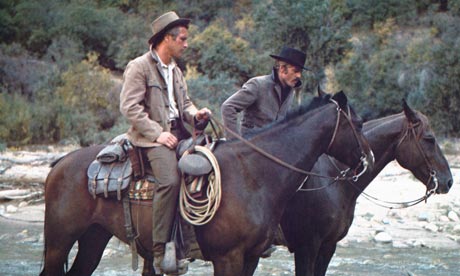
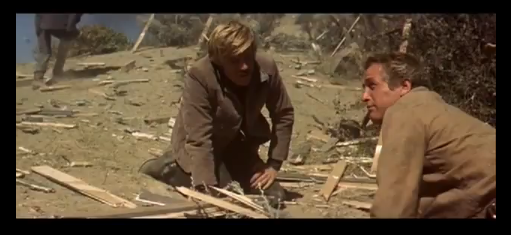
Butch Cassidy and the Sundance Kid (George Roy Hill, 1969)  It is probably for certain that Butch and Sundance were not as entertaining (or as well-scrubbed, with feathered hair) as Newman and Redford, nor that they rode bicycles to Burt Bacharach songs. But then the originals didn't have William Goldman writing for them, either, and though the script starts by saying "Most of what follows is true" you can also bet that much more of it isn't. As it is, it's not a history lesson. It's a grittier, more-influenced-by-European-film version of the previous season's Cat Ballou (which had earned Lee Marvin his Best Actor Oscar).*

And, in point of fact, I have a hard time thinking of it as a Western, despite the desert settings, the horse-chases, the posses, the train robberies, the clapboard houses, the sense of a passing age, all the traditional acoutrements of the classic westerns, but done coyly, cutely, and with an eye towards having a good punch-line (but not much point). It's a Western trying to be modern, but saying it's true to the period. 
Where it does bear the stamp of a traditional western is its through-line of Butch and the Kid being temporary things, caught in the period between the Civil War and the Industrial Age, where the "old ways," with their easily slipped-through dependence on civilization (and the inherent difficulties achieving it in a frontier environment), are replaced by organization, technology, and machine-like precision that are a threat to outliers, dependent on improvisation and fast getaways. The advancements of the 20th Century—bicycles and streets and (gulp!) dynamite—while all well and good, are an impending threat to scraping out an existence on the land, even if the way you do it is scraping other people's existence.  
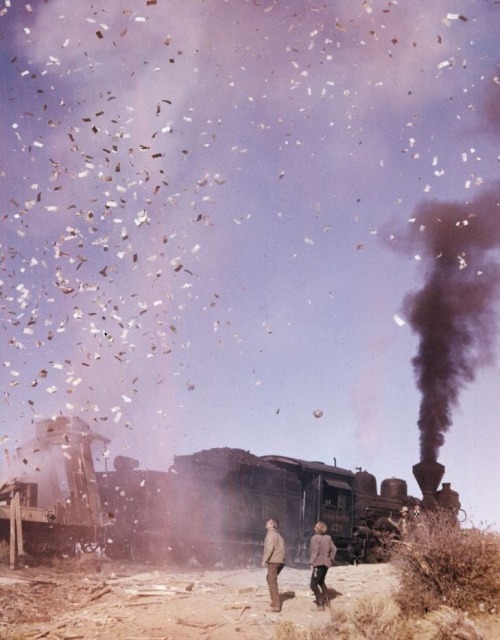
"Think ya used enough dynamite, there, Butch?"
And as much as Butch and Sundance try to adapt ("Think you used enough dynamite there, Butch?"), it ends up blowing up in their faces. It's why Butch's oft-repeated line (that always falls like a lead balloon and a quizzically raised audience eyebrow) "I've got vision and the rest of the world needs bifocals!" only works in that context, and in a cluelessly ironic way, at that.
No wonder they go to Bolivia. It's still the Wild West down South, while the U.S. becomes gentrified and outgrows outlaws. There's a serious thought in there amongst the yuck-lines and the counter-intuitive Bacharach bubba-bubba choruses glossing over the action sequences. As much as Hill, Goldman and Bacharach try to make it larky and fun, it's still doom-laden, without the inherent triumph of civilization over chaos that provides the spine and invigorates—and makes hopeful—most Western films. 
"You crazy? The FALL'll probably KILL you!"
It's never flat-out stated that, though never arrested, the Hole-in-the-Wall gang* are products of arrested development—a better name might be the "Stuck-in-the-Mud" gang—making the whole enterprise an exercise in feeling sorry for the kids who never grew up, or wised up, making the whole show a pitiable "Peter Pan" picture. Maybe it is better to have bifocals. You, at least, see your way clear.
One thing you can't fault is the cinematography of Conrad Hall.
Entertaining? Maybe. And in the short run. But kinda dumb, too.
The Final Shot

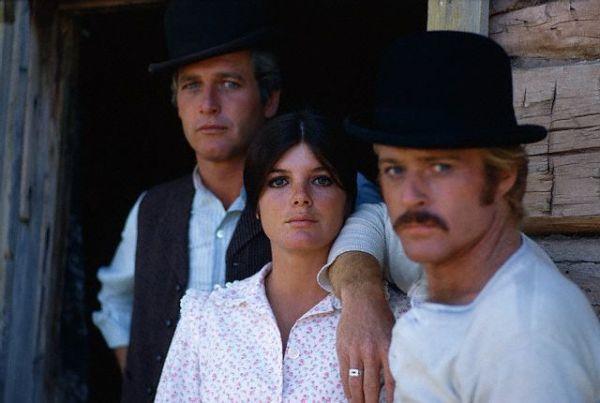
Period photography in the film (above)
and the real Sundance, Etta (Ethel) and Butch at Cholila Ranch (below)
* Just the year before, Sam Peckinpah made another Western about another Hole-in-the-Wall gang with the same arc of old-timers growing too old to see times change and survive. That movie was his masterpiece, The Wild Bunch, which created a revisionist kind of Western, that, along with Sergio Leone's Italian Western series, re-made the Western genre from the form that had become ubiquitous on American television sets in the late 1950's and early 1960's..

Thursday, October 25, 2018

Olde Review: Young Frankenstein

This was part of a series of reviews of the ASUW Film series back in the '70's. Except for some punctuation, I haven't changed anything from the way it was presented, giving the kid I was back in the '70's a break. Any stray thoughts and updates I've included with the inevitable asterisked post-scripts.


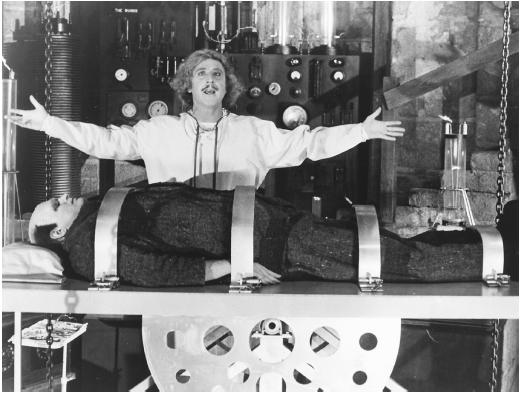
Young Frankenstein (Mel Brooks, 1985) In my review of last quarter's bill of comedies,* I stated that Mel Brooks is just about the only remaining graceful comedy filmmaker**--his films have a flow along with the jokes. After a couple of false starts,*** Brooks achieved his cinematic sense with Young Frankenstein, and achieved it, as most film-makers do today, by following the example of a predecessor in film-making--in this case. the director of the original Frankenstein films, James Whale. His coming of age didn't occur only because of the help of Gene Wilder's script (Wilder's own Sherlock Holmes' Smarter Brother was an abysmal failure), but through the realization by Brooks that the best movie spoofs are those that poke fun at and embrace their cinematic progenitors. And so, in tandem with the humor, good and bad, we are treated to the charms of two-dimensional castles, rain-washed cobblestones, studio-built forests and the glories of black and white photography. And you have to have a special love to go to the trouble to obtain the lab equipment from the original Frankenstein. 
Brooks' love of the original gentles this film. His love makes him understand the charms of the original Frankensteins. Young Frankenstein turns serious when Gene Wilder screams out during the experiment because Brooks understands that he is challenging God's right to be the sole source of life. 
It turns serious when Wilder confronts his creation, and is able to conquer his fear to become the loving father-creator to his very lonely, dependent creation, a moment coupled with the young scientist's first ecstatic re-affirmation of his family name. Brook's understanding goes so far as to present its own version of the weird sexuality that was in the old "Frankenstein" films. Brooks also has the melancholy understanding of the monster's plight--the plight of all those different enough to be rejected by society. However, there is one thing different about Young Frankenstein, as opposed to the originals--this one has a happy ending for all concerned--for Brooks' Young Frankenstein is a sentimental, gentle film--a rare thing these days--a quality that only adds to my enjoyment and appreciation of the films of Mel Brooks.
Broadcast on KCMU-FM on January 6th, 1977

As far as that goes, and it didn't go far. Brooks made a wonderful, financially-risky movie called Silent Movie, (and it was silent, except for one word, spoken by mime Marcel Marceau), then came High Anxiety, a somewhat haggard Hitchcock parody, then The History of the World, Part 1Spaceballs, Life Stinks, and on. And sadly on. Brooks is now a Broadway entrepreneur with his wildly successful Broadway production of "The Producers," and his fine staging of a musical version of "Young Frankenstein." And his company, Brooksfilms, is still in business--except for his own films, Brooks rarely played it safe.


*Those being The Running, Jumping, Standing Still Film, Love and Death and Monty Python and the Holy Grail--I just found those reviews, we'll get to them eventually.

** I hope I changed my mind on this. Blake Edwards was still active at the time, as was Woody Allen.


*** Presumably, The Producers, (clumsy, but funny as Hell) The Twelve Chairs, (better, but not terribly funny), and Blazing Saddles, (which was rude, crude, hilarious, and one of the worst looking movies I've ever seen).


Tuesday, March 17, 2015

Kiss Me Deadly: The Brightest Noir, or The Anti-Life Equation

Kiss Me Deadly (Robert Aldrich, 1955) Kiss Me Deadly might be the greatest film noir film of all time. You know the genre—"When the streets are dark with something more than night"—implying that the lack of light goes far beyond foot-candles and is radiated by a void in the soul...or the permeating Evil in the World. Oh, there'd always been detective movies—but, they were usually played in a cocktail party environment, gussied up and prettified for the ladies...and there always had to be a pet. But, in the late 30's, with Hitler bringing real evil to our headlines and minds, that world changed, became darker, the booze cheaper, and the dames less dependable. After the war, we'd lost our innocence enough that the tarnished golden age of noir happened, its authors became legit, movie deals followed, and the resulting films rougher, because we could take it. Combined with what Hollywood saw coming out of the European neo-realist movement, things got grittier, less polished and the gangsters came out of the dark cracks of the wood-work to walk amongst us and make the lives of decent folk miserable, while in the mind's eye loomed the existence of mushroom clouds that could turn all of us, any of us, into ash and dust. By the time the 50's sneaked up on us, promising a better life (if we followed the rules), paranoia walked the streets, the board-rooms, and halls of government, setting the stage for Robert Aldrich's über-noir. 

Mickey Spillane, author of "Kiss Me Deadly" in all its popular crudeness, didn't like the film version. It slapped his book around for its tough-guy attitude that puffed up its chest in the face of truly nihilistic forces that could wipe the sneer off its mug and dared to question the sexist-macho attitude of its protagonist. The script is by one of the better novelist-scriptwriter vagabonds, A.I. Bezzerides (whose novels were turned into the films They Drive By Night and Thieves' Highway). "I was having fun!" Bezzerides said of his adaptation of Kiss Me Deadly, and, indeed, it is a lot of fun in a savage, even cruel way, that has no truck with the merits of its source-book, and boils it down into a Maltese Falcon-ish quest of thugs for a "great whats-it," that (as is ultimately revealed) is not riches, but power—at the time, the most dangerous form of power extant.

Our savior—the point-man walking down these mean streets—is a private dick in all senses of the term, the not-subtly named Mike Hammer (Ralph Meeker), the bluntest of instruments, and where that other tool of the trade, Sam Spade, beat up bad-guys and gunsels, Hammer makes no character distinctions, he's as indiscriminate as a force of Nature, turning people, places and prized possessions into disaster areas so he can sort through the rubble.
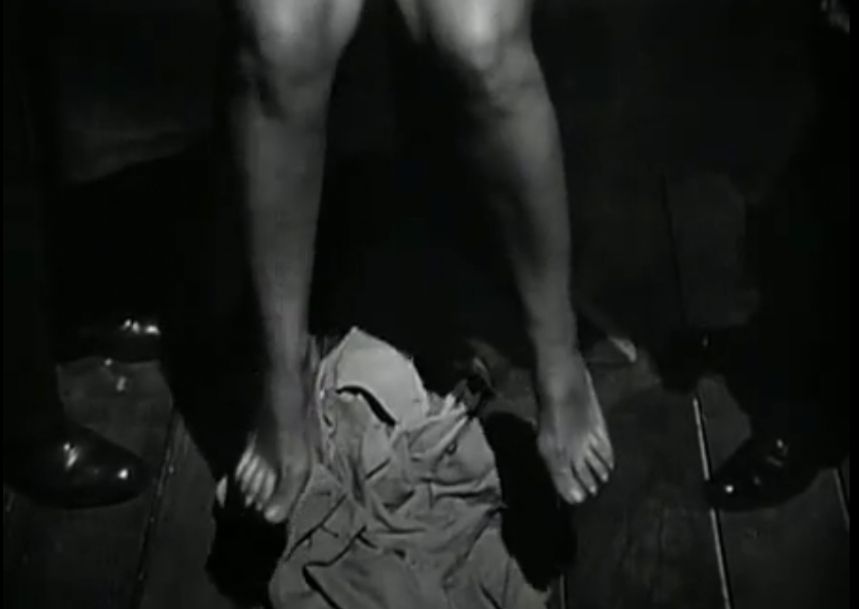
The caper doesn't start very subtley—it doesn't come to him, knocking politely on the door of his offices—he nearly runs it over on the highway. A damsel in distress (Cloris Leachman—yes, her—in her film debut) is running down the street in a panic and only a trench-coat.  She might have escaped from a mental institution, but Hammer, at her request, tries to take her to the nearest bus stop.  

"Get me to that bus stop and forget you ever saw me. If we don't make that bus stop…"  "We will," says Hammer dismissively, confidently.  "If we don’t," she pointedly says, "Remember me."

They never make it. 
Details aside, Hammer wakes up in a hospital bed, remembering—the girl is dead, tortured, and he has two motivations: revenge and to find the people who tried to kill him and succeeded with her. Hammer strikes out, becoming the bull with Los Angeles as his personal china shop, getting closer to the responsible parties but not many answers. A detective without a clue, things usually have to be spelled out for him with a constant litany of "you just don't get it, do you's." His informants and victims dance around the answers, talking circumspectly, while Hammer just scowls, wondering if there's a way to beat the answers out of them.
It's the way things have to be, because almost everyone is corrupt, no matter what their position on the intelligence scale, and that includes the guy behind the whole operation, Dr. G.E. Soberin (Albert Dekker), the type of character Sydney Greenstreet might play in earlier mysteries: brilliant, erudite, but not smart enough not to be brought down by baser instincts than his own. And, once he's gone, any hope of containing the evil about to be unleashed goes with him.
There are two endings to the film: in the first, Hammer and his sexy secretary Velda (Maxine Cooper) manage to escape from the traditionally burning building (burning quite non-traditionally) and seek refuge in the surf. But, somewhere along the way, the film was streamlined, so their fate is undecided and, indeed, the film screams "The End" in the middle of a growing apocalyptic nuclear conflagration. Does it ever end, or does Los Angeles go up with it, the match being struck by the sociopath who sold her soul for power.

It's the ending I first saw when I encountered the film and it's the ending I prefer: Kiss Me Deadly presents a world so far down the jungle path that even a thug like Mike Hammer can be considered a hero. Man has de-evolved so far but still managed to harness the power of God, that the inevitable happens. The film asks nihilistically, given how bad the world is, why not let the whole rotten system crash (sound familiar?). The quest for power has gone nuclear. Let 'em get what they deserve.
The opening of "The Great 'Whats-it:" a "Pandora's Box" that would "inspire"
filmmakers Alex Cox, Steven Spielberg and Quentin Tarantino.
Given the view of the film Kiss Me Deadly, if the world is so corrupt, maybe the justice should be dealt in an uncontained fusion, where the shadows are permanently burned into the landscape. And so the world ends—not with a bang, not with a whimper, but with a high keening shriek, echoing the many screams that have occurred throughout the film.

Even in the glare of a nuclear light, you can't get more dark than that.