Showing posts with label Terri Garr. Show all posts

Tuesday, March 19, 2019

After Hours

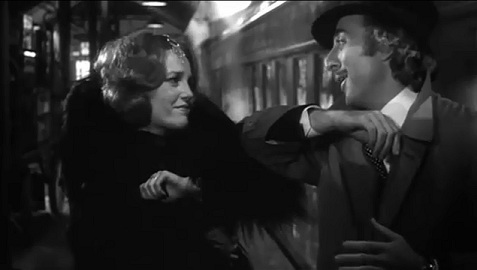
After Hours (Martin Scorsese, 1985) "Different rules apply when it gets this late, ya know what I mean? It's like...'after-hours.'"

Radio monologist Joe Frank died January 15, 2018 and several podcasts who have depended on the spoken word for their medium of choice remarked on his passing. 

But, what seldom came up was the lawsuit. 


Joe Frank sued the producers of After Hours for similarities to his monologue called "Lies." Details of the settlement have never been disclosed, but when you listen to "Lies" and you watch After Hours and it is obvious down to some very specific details that the movie's first portion is a bunch of "Lies." I mean, "bagel and cream-cheese paperweights?" That's the sort of detail that can't be dismissed as the coincidence of two competing "Earth-hit-by-asteroid" movies or "Truman-Capote-writes-"In-Cold-Blood"" movies.* That sort of "coincidence" is right on the proboscis.
Soho
Lawsuit aside, After Hours is one of my favorite Scorsese films** (and I have several of those) as it perfectly captures the bizarre sense of a city's nocturnal side, especially when one is "up" past one's comfort zone due to circumstances beyond one's control with looming consequences once the sun decides to crash the party. I've had nights like that, wandering for miles in the dead of night in the one section of town that doesn't seem to have a gas station at any close proximity—would it be open if there was? But, stuff happens. It just doesn't pile up like this: 
"My God, Marcy finally met Mr. Right"
Paul Hackett (Griffin Dunne) is a corporate drone where he...oh, who cares what he does, it isn't important, but it has something to do with computers or computer training ("I'm just a word processor, for Christ's sake!" he will scream to the heavens at one point). Whatever. It doesn't matter. But, after droning away another day, he goes back to his meticulously arranged apartment, checks out what's on cable—and nothing's on—he goes to eat a lonely dinner at a lonely diner, head down in a book (Henry Miller's "Tropic of Cancer"***) when he looks up and sees Marcy (Roseanna Arquette) watching him. They nod, they smile, and they start to talk...
They talk about "Tropic of Cancer"—she likes it, can quote from it ("'This is not a book, it's a prolonged insult; a gob of spit in the face of art; a kick in the pants to Truth, Beauty, God' something like that...that's all I remember")—and it seems they have a lot in common...enough to continue the conversation. About the cashier "making these strange movements," about how she's going to her friend's loft downtown Soho and she's a sculptress making plaster-of-Paris paperweights of bagels with cream-cheese. She gives him her friend's phone number and later on, he calls her and she's had a fight with a friend and is feeling vulnerable—why doesn't he come over? She's glad he called.

And that's all it takes.
After a "Mr. Toad's wild-cab-ride" that is so violent he loses the $20 bill he was going to use to pay the fare, he goes up to the apartment of Kiki Bridges (Linda Fiorentino), who is working on a sculpture of Edvard Munch's "The Scream." Marcy's not there; she's at the all-night drugstore ("She all right?" "It's under control") although she calls ("Well, of course he's here, you invited him...it's your problem, Marcy, I'm not gonna tell him...) and Kiki asks him to help with the sculpture. His shirt gets messed up and Kiki offers to launder it, giving him a replacement to wear for his "date". They talk about how the plaster is hard work and screws up your shoulders and Paul offers her a massage and after he mentions she has a good body, she agrees, remarking that she doesn't have any scars—"some women are covered with them head to toe...horrible, ugly scars...I'm just telling you now"). He brushes that off, starting a story of how, as a child, he'd spent a night in a burn ward and, before he can get to the meat of the story, she falls asleep. Then, Marcie walks in.
They retire to Marcy's room and her first question is "What'd you do to her?" which makes Paul defensive, and Marcy shrugs it off just as quickly. Saying that she's going to take a quick shower, she asks "I hope you don't have to get up early or anything. Because I think you're somebody I can really talk to. Tonight, I feel like I'm gonna let loose or something. I feel like something really incredible is going to happen here. I feel sooo..excited. I don't know why. I feel it. I'm glad you came." And she laughs semi-hysterically. And then she winks, which Scorsese emphasizes with a forward-travelling shot. 
Marcy's phone rings and Paul hesitantly answers it: "She can't come to the phone now." "Tell her Greg called" and hangs up. Kiki appears in the door-way, stripping off her bra: "She back?" Paul can only lamely answer: "Yeah." She sulks away, and Paul can only shake his head. Weird. He takes advantage of Marcy's shower-time, to look at her bag—the prescription she got was an ointment for second-degree burns, then the shower stops, and Paul hurriedly puts the ointment back in the bag just in time to not be detected. It's then that the conversation takes on what Frank describes as "a slightly pathological cast." "Hey, I thought I told you to stay on the bed..." (she hadn't), then tells him to wait. At that, point Howard Shore's original score kicks in with a back-beat of ticking (Paul is constantly checking the time on his watch) as barely-registered whispers between Marcy and Kiki can be overheard in the next room.
Marcy pokes her head in the doorway, looking troubled. "Did you say something?" (He hadn't) "I thought I heard you say something." (He didn't). Her mood changes and she tells Paul that she'd been raped in that very room. Paul is horrified. "It's alright, it was an ex-boyfriend of mine. I slept through most of it" A change of subject and venue seems called for and they go out for coffee at a diner, run by Peter (the late and sadly-missed Dick Miller), who knows Marcy well. Paul asks about "Franklin" the name on the door-bell of the apartment and she tells him that's her husband. Paul registers another pause, trying not to react—he'll do that a lot. Seems they weren't married very long, that he lives in Turkey and is a film-freak, whose favorite movie is The Wizard of Oz. In fact, on their wedding night, when they were making love, he kept yelling "Surrender, Dorothy!" "Naturally," she says, as he takes his hand "I don't like to talk about it." "Can we get the check?" Paul asks suddenly.
It's then that Peter delivers that signature line at the top of the post. "It's on the house," he says. "After-Hours." Marcy and Paul go back to the Franklin loft, where he tries to make out with Marcy, but she starts to break down, they retire to her room, Marcy has another whispering session with Nikki, and then Paul turns petulant, as if all of the delays, intrigues, and feints have worn thin. He becomes a real jerk and Marcy goes crying to Nikki (ostensibly so Paul can buy one of their bagel and cream-cheese paperweights—"...as we sit here chatting, there are important papers flying rampant around my apartment 'cause I don't have anything to hold them down with!") and Paul goes out into the night where it is pouring down rain, and he becomes soaked. But, he can't get home, even by subway, because he only has ninety-seven cents...and fares go up to $1.50 at midnight.
Paul can't even go the Men's Room without being confronted with dread.
That is just the first half-hour of After Hours, and already it is so filled with a sense of dread, mystery, paranoia, miscommunication and misdirection that if Kafka were in the audience, he might run to the comfort of the lobby to soak his head in hot butter.
Paul will spend the night as it ticks away in an increasingly threatening waking nightmare. During the course of the evening, he will lose $20.00, find another, and lose that and his apartment keys, discover a dead body by suicide and be suspected of murder, as well as being a burglar, a pervert, and nearly having his head shaved, on top of being chased by a vigilante mob who know him because his face has been plastered on ever corner light pole. The very boundaries of Soho are a trap that he can't reach, without being attacked, killed (or worse) being accused of something else, by an increasingly misunderstanding and self-obsessed citizenry.
What makes the screenplay (and resulting film) interesting—and what sets it apart from Joe Frank's original source—is its intricate machinations in setting up this Kafkaesque Soho-scape of incomplete information and missed opportunities. But, it does so in a limited scope where Paul Hackett is only one among the Soho nighthawks who knows the complete story (or as much as he can) and his very knowledge of what's going on in the moving, changing landscape is what makes him suspected of the activities that the people he encounters are sensitive to. He's the stranger in a strange land, walking into an established and tenuously connected environment that he, by his movements—and resulting twists of Fate—disrupts. Soho has a barely functioning cohesion to begin with, but Paul's presence sends it spinning off its axis. He may ultimately be blameless for what happens, but it might not have turned out this way were he not there—making him totally to blame. Consider him the anti-George Bailey from It's a Wonderful Life, whose existence determines the difference between Heaven and Hell (or, specifically, Bedford Falls and Potterville). Maybe they should've called this "It's a Horrible Night." 
The world is an intricate mechanism, but throw your shoes into it and you're a saboteur. Rather than be a boon to the community, Paul is the salt in the sugar-shaker, and, as a result, he gets plastered for it. All he can do is retreat to familiar surroundings and know his place, while the rest of the world moves on around him.
After Hours, despite its opening "lifts," is a wholly derivative but amazingly original film. And it's one of my favorites in the Scorsese output.

* Curiously enough, there's an "L.A. version" of After Hours that came out about the same time: the more plot-driven Into the Night, directed by John Landis and starring Jeff Goldblum and Michelle Pfeiffer.

** The first choice of director was Scorsese, but he was embroiled in pre-production of The Last Temptation of Christ, and so producers Amy Robinson and Griffin Dunne turned to neophyte director Tim Burton, after they'd seen his short "Vincent." Plans to start went into place and then The Last Temptation of Christ fell through, which put Dunne and Robinson in an awkward position: how to tell Burton. When Burton was told that Scorsese was interested, he immediately responded: "I gracefully withdraw from the project. I do not want to stand in the way of anything Martin Scorsese wants to do." Burton would make his feature directing debut with Pee-wee's Big Adventure in 1985, and Scorsese released The Last Temptation of Christ in 1988.

*** A very After Hours section: "One can live in Paris—I discovered that!—on just grief and anguish. A bitter nourishment—perhaps the best there is for certain people. At any rate, I had not yet come to the end of my rope. I was only flirting with disaster. ... I understood then why it is that Paris attracts the tortured, the hallucinated, the great maniacs of love. I understood why it is that here, at the very hub of the wheel, one can embrace the most fantastic, the most impossible theories, without finding them in the least strange; it is here that one reads again the books of his youth and the enigmas take on new meanings, one for every white hair. One walks the streets knowing that he is mad, possessed, because it is only too obvious that these cold, indifferent faces are the visages of one's keepers. Here all boundaries fade away and the world reveals itself for the mad slaughterhouse that it is. The treadmill stretches away to infinitude, the hatches are closed down tight, logic runs rampant, with bloody cleaver flashing."

Thursday, October 25, 2018

Olde Review: Young Frankenstein

This was part of a series of reviews of the ASUW Film series back in the '70's. Except for some punctuation, I haven't changed anything from the way it was presented, giving the kid I was back in the '70's a break. Any stray thoughts and updates I've included with the inevitable asterisked post-scripts.


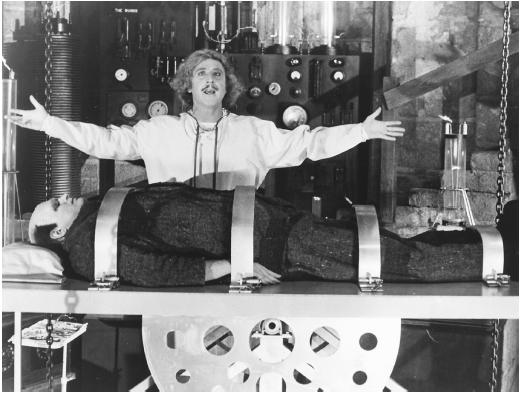
Young Frankenstein (Mel Brooks, 1985) In my review of last quarter's bill of comedies,* I stated that Mel Brooks is just about the only remaining graceful comedy filmmaker**--his films have a flow along with the jokes. After a couple of false starts,*** Brooks achieved his cinematic sense with Young Frankenstein, and achieved it, as most film-makers do today, by following the example of a predecessor in film-making--in this case. the director of the original Frankenstein films, James Whale. His coming of age didn't occur only because of the help of Gene Wilder's script (Wilder's own Sherlock Holmes' Smarter Brother was an abysmal failure), but through the realization by Brooks that the best movie spoofs are those that poke fun at and embrace their cinematic progenitors. And so, in tandem with the humor, good and bad, we are treated to the charms of two-dimensional castles, rain-washed cobblestones, studio-built forests and the glories of black and white photography. And you have to have a special love to go to the trouble to obtain the lab equipment from the original Frankenstein. 
Brooks' love of the original gentles this film. His love makes him understand the charms of the original Frankensteins. Young Frankenstein turns serious when Gene Wilder screams out during the experiment because Brooks understands that he is challenging God's right to be the sole source of life. 
It turns serious when Wilder confronts his creation, and is able to conquer his fear to become the loving father-creator to his very lonely, dependent creation, a moment coupled with the young scientist's first ecstatic re-affirmation of his family name. Brook's understanding goes so far as to present its own version of the weird sexuality that was in the old "Frankenstein" films. Brooks also has the melancholy understanding of the monster's plight--the plight of all those different enough to be rejected by society. However, there is one thing different about Young Frankenstein, as opposed to the originals--this one has a happy ending for all concerned--for Brooks' Young Frankenstein is a sentimental, gentle film--a rare thing these days--a quality that only adds to my enjoyment and appreciation of the films of Mel Brooks.
Broadcast on KCMU-FM on January 6th, 1977

As far as that goes, and it didn't go far. Brooks made a wonderful, financially-risky movie called Silent Movie, (and it was silent, except for one word, spoken by mime Marcel Marceau), then came High Anxiety, a somewhat haggard Hitchcock parody, then The History of the World, Part 1Spaceballs, Life Stinks, and on. And sadly on. Brooks is now a Broadway entrepreneur with his wildly successful Broadway production of "The Producers," and his fine staging of a musical version of "Young Frankenstein." And his company, Brooksfilms, is still in business--except for his own films, Brooks rarely played it safe.


*Those being The Running, Jumping, Standing Still Film, Love and Death and Monty Python and the Holy Grail--I just found those reviews, we'll get to them eventually.

** I hope I changed my mind on this. Blake Edwards was still active at the time, as was Woody Allen.


*** Presumably, The Producers, (clumsy, but funny as Hell) The Twelve Chairs, (better, but not terribly funny), and Blazing Saddles, (which was rude, crude, hilarious, and one of the worst looking movies I've ever seen).


Tuesday, December 2, 2014

The Black Stallion (1979)

The Black Stallion (Carroll Ballard, 1979) Francis Ford Coppola began his desire to film literary classics in the 1990's, not with Bram Stoker's 'Dracula' but with this children's classic, never before filmed. For the director was hired one of Coppola's USC Mafia, Carroll Ballard, a documentary-maker whose eye for construction, framing, and telling a story with images and music and attention to sound would all be used to their full effect in this tall tale of a boy and his horse. 

What is so exciting about The Black Stallion is that so much of it is done not with dialog (the taut, sparse script is by E.T. scribe Melissa Mathison as well as The Journey of Natty Gann writer Jeanne Rosenberg and "Lonesome Dove" scripter Bill Wittliff), but with sumptuous images (cinematography achieved by the very brilliant Caleb Deschanel) that are long on atmosphere and detail and conceived from interesting angles that provide a curious view of the world, that evoke the sense of being a child's point-of-view, where everything is a chance at discovery*
The talent in front of the camera is great, too. The burden of the piece falls on young Kelly Reno, probably chosen for his ability as an equestrian, rather than his acting skills. But even there, he communicates such a fresh "kid-ness" that seems unstudied and unreserved. Terri Garr plays another of the "thankless" Mom-roles she was typecast in during the '80's. But two performances stand out--one from a newcomer, and the other from a movie-"lifer."
Hoyt Axton had done a few television appearances and made a good living as a singer-songwriter when he came to The Black Stallion. He also had a voice so full of bass that it seemed like it was merely an echo of the rumble emanating from his barrel-chest. His role as young Alec's father has one scene that is all-Axton, literally--where he tells his son a bed-time story about the horse he won in a poker game and the horse of myth that was allegedly its forebear. Axton performs the scene staring straight into the camera lens, but the effect it has on audiences is electrifying--he's telling the story to us. It was probably unnerving for the performer to have the camera right under his nose, but Axton powers through it, filling the frame, and putting us in the position of that boy. For those few minutes, his father is his entire world.
The other amazing work is by, of all people, Mickey Rooney, as a down-on-his-luck horse trainer to whom "The Black" seems to be drawn. Of course, Rooney's background includes playing the trainer of National Velvet at an early age, he could have played this role in his sleep if he wanted to. But Rooney takes his M-G-M schooling and leavens it with an almost "method" interiorization to create an enduring, memorable portrait of a trainer gone to pasture who has a miracle land in his lap. His work melds seamlessly with Ballard's "observer" style, and the role made people take notice of him ("Oh yeah, he was good, wasn't he?") and rescued him from a life of dinner theater and "Love Boat" appearances. Rooney is amazing in it.
But it's Ballard's show, as invisible as he is in it. The backbone of the movie, which buys all sorts of cinematic good will is the 30 minute long idyll of the boy and the mysterious horse that becomes his quest and his companion in his castaway existence. Wordless and buoyed by Carmine Coppola's themes (imaginatively and meticulously arranged by an uncredited Shirley Walker), it is at points charming, terrifying and poetic. Once off the island Ballard makes the most of a more conventional narrative style, and though he comes close--particularly in one of the best, and most pilfered horse-racing sequences in movies--he has a hard time trying to match the beauty of that island sequence.
But here's how good The Black Stallion is. I went to see it on its opening night, sitting in the back of the theater to avoid the vocal anarchy of an audience filled with children. After a little bit of rumble as the movie got going, the kids didn't make a peep, didn't get bored, didn't make endless trips to the bathroom, and stayed glued to their seats, their eyes glued to the screen. And they stayed that way through the entire End Credits that played over unused footage from that island sequence, only making a disappointed "Awww.." when the house-lights came up. That truly is, as the movie says, a "miracle horse."
Looking at it again, of course the kids responded to it. This world is full of new sights taken from an angle a kid might want to explore, the boy--Alec--doesn't say much, making him a character that doesn't betray what he knows, so you have to watch him. He is thrown into a scary situation where he learns to fend for himself, and he becomes a devoted friend and care-taker to a powerful animal. He is what every kid wants to be--an adult who has passed childhood behind and can do what he pleases. What kid wouldn't love a movie like this?

And what adult, either?

The Black Stallion is one of the best movies I've ever seen.

* And I'd be remiss not to point out the contributions of sound editor Alan Splet, who became best known for his work with David Lynch. His comprehensive recordings of horses let you know the emotions of "The Black" at every point in the film. Incredible work.
Bob Peak preliminary idea for The Black Stallion poster.