Showing posts with label Griffin Dunne. Show all posts

Tuesday, March 19, 2019

After Hours

After Hours (Martin Scorsese, 1985) "Different rules apply when it gets this late, ya know what I mean? It's like...'after-hours.'"

Radio monologist Joe Frank died January 15, 2018 and several podcasts who have depended on the spoken word for their medium of choice remarked on his passing. 

But, what seldom came up was the lawsuit. 


Joe Frank sued the producers of After Hours for similarities to his monologue called "Lies." Details of the settlement have never been disclosed, but when you listen to "Lies" and you watch After Hours and it is obvious down to some very specific details that the movie's first portion is a bunch of "Lies." I mean, "bagel and cream-cheese paperweights?" That's the sort of detail that can't be dismissed as the coincidence of two competing "Earth-hit-by-asteroid" movies or "Truman-Capote-writes-"In-Cold-Blood"" movies.* That sort of "coincidence" is right on the proboscis.
Soho
Lawsuit aside, After Hours is one of my favorite Scorsese films** (and I have several of those) as it perfectly captures the bizarre sense of a city's nocturnal side, especially when one is "up" past one's comfort zone due to circumstances beyond one's control with looming consequences once the sun decides to crash the party. I've had nights like that, wandering for miles in the dead of night in the one section of town that doesn't seem to have a gas station at any close proximity—would it be open if there was? But, stuff happens. It just doesn't pile up like this: 
"My God, Marcy finally met Mr. Right"
Paul Hackett (Griffin Dunne) is a corporate drone where he...oh, who cares what he does, it isn't important, but it has something to do with computers or computer training ("I'm just a word processor, for Christ's sake!" he will scream to the heavens at one point). Whatever. It doesn't matter. But, after droning away another day, he goes back to his meticulously arranged apartment, checks out what's on cable—and nothing's on—he goes to eat a lonely dinner at a lonely diner, head down in a book (Henry Miller's "Tropic of Cancer"***) when he looks up and sees Marcy (Roseanna Arquette) watching him. They nod, they smile, and they start to talk...
They talk about "Tropic of Cancer"—she likes it, can quote from it ("'This is not a book, it's a prolonged insult; a gob of spit in the face of art; a kick in the pants to Truth, Beauty, God' something like that...that's all I remember")—and it seems they have a lot in common...enough to continue the conversation. About the cashier "making these strange movements," about how she's going to her friend's loft downtown Soho and she's a sculptress making plaster-of-Paris paperweights of bagels with cream-cheese. She gives him her friend's phone number and later on, he calls her and she's had a fight with a friend and is feeling vulnerable—why doesn't he come over? She's glad he called.

And that's all it takes.
After a "Mr. Toad's wild-cab-ride" that is so violent he loses the $20 bill he was going to use to pay the fare, he goes up to the apartment of Kiki Bridges (Linda Fiorentino), who is working on a sculpture of Edvard Munch's "The Scream." Marcy's not there; she's at the all-night drugstore ("She all right?" "It's under control") although she calls ("Well, of course he's here, you invited him...it's your problem, Marcy, I'm not gonna tell him...) and Kiki asks him to help with the sculpture. His shirt gets messed up and Kiki offers to launder it, giving him a replacement to wear for his "date". They talk about how the plaster is hard work and screws up your shoulders and Paul offers her a massage and after he mentions she has a good body, she agrees, remarking that she doesn't have any scars—"some women are covered with them head to toe...horrible, ugly scars...I'm just telling you now"). He brushes that off, starting a story of how, as a child, he'd spent a night in a burn ward and, before he can get to the meat of the story, she falls asleep. Then, Marcie walks in.
They retire to Marcy's room and her first question is "What'd you do to her?" which makes Paul defensive, and Marcy shrugs it off just as quickly. Saying that she's going to take a quick shower, she asks "I hope you don't have to get up early or anything. Because I think you're somebody I can really talk to. Tonight, I feel like I'm gonna let loose or something. I feel like something really incredible is going to happen here. I feel sooo..excited. I don't know why. I feel it. I'm glad you came." And she laughs semi-hysterically. And then she winks, which Scorsese emphasizes with a forward-travelling shot. 
Marcy's phone rings and Paul hesitantly answers it: "She can't come to the phone now." "Tell her Greg called" and hangs up. Kiki appears in the door-way, stripping off her bra: "She back?" Paul can only lamely answer: "Yeah." She sulks away, and Paul can only shake his head. Weird. He takes advantage of Marcy's shower-time, to look at her bag—the prescription she got was an ointment for second-degree burns, then the shower stops, and Paul hurriedly puts the ointment back in the bag just in time to not be detected. It's then that the conversation takes on what Frank describes as "a slightly pathological cast." "Hey, I thought I told you to stay on the bed..." (she hadn't), then tells him to wait. At that, point Howard Shore's original score kicks in with a back-beat of ticking (Paul is constantly checking the time on his watch) as barely-registered whispers between Marcy and Kiki can be overheard in the next room.
Marcy pokes her head in the doorway, looking troubled. "Did you say something?" (He hadn't) "I thought I heard you say something." (He didn't). Her mood changes and she tells Paul that she'd been raped in that very room. Paul is horrified. "It's alright, it was an ex-boyfriend of mine. I slept through most of it" A change of subject and venue seems called for and they go out for coffee at a diner, run by Peter (the late and sadly-missed Dick Miller), who knows Marcy well. Paul asks about "Franklin" the name on the door-bell of the apartment and she tells him that's her husband. Paul registers another pause, trying not to react—he'll do that a lot. Seems they weren't married very long, that he lives in Turkey and is a film-freak, whose favorite movie is The Wizard of Oz. In fact, on their wedding night, when they were making love, he kept yelling "Surrender, Dorothy!" "Naturally," she says, as he takes his hand "I don't like to talk about it." "Can we get the check?" Paul asks suddenly.
It's then that Peter delivers that signature line at the top of the post. "It's on the house," he says. "After-Hours." Marcy and Paul go back to the Franklin loft, where he tries to make out with Marcy, but she starts to break down, they retire to her room, Marcy has another whispering session with Nikki, and then Paul turns petulant, as if all of the delays, intrigues, and feints have worn thin. He becomes a real jerk and Marcy goes crying to Nikki (ostensibly so Paul can buy one of their bagel and cream-cheese paperweights—"...as we sit here chatting, there are important papers flying rampant around my apartment 'cause I don't have anything to hold them down with!") and Paul goes out into the night where it is pouring down rain, and he becomes soaked. But, he can't get home, even by subway, because he only has ninety-seven cents...and fares go up to $1.50 at midnight.
Paul can't even go the Men's Room without being confronted with dread.
That is just the first half-hour of After Hours, and already it is so filled with a sense of dread, mystery, paranoia, miscommunication and misdirection that if Kafka were in the audience, he might run to the comfort of the lobby to soak his head in hot butter.
Paul will spend the night as it ticks away in an increasingly threatening waking nightmare. During the course of the evening, he will lose $20.00, find another, and lose that and his apartment keys, discover a dead body by suicide and be suspected of murder, as well as being a burglar, a pervert, and nearly having his head shaved, on top of being chased by a vigilante mob who know him because his face has been plastered on ever corner light pole. The very boundaries of Soho are a trap that he can't reach, without being attacked, killed (or worse) being accused of something else, by an increasingly misunderstanding and self-obsessed citizenry.
What makes the screenplay (and resulting film) interesting—and what sets it apart from Joe Frank's original source—is its intricate machinations in setting up this Kafkaesque Soho-scape of incomplete information and missed opportunities. But, it does so in a limited scope where Paul Hackett is only one among the Soho nighthawks who knows the complete story (or as much as he can) and his very knowledge of what's going on in the moving, changing landscape is what makes him suspected of the activities that the people he encounters are sensitive to. He's the stranger in a strange land, walking into an established and tenuously connected environment that he, by his movements—and resulting twists of Fate—disrupts. Soho has a barely functioning cohesion to begin with, but Paul's presence sends it spinning off its axis. He may ultimately be blameless for what happens, but it might not have turned out this way were he not there—making him totally to blame. Consider him the anti-George Bailey from It's a Wonderful Life, whose existence determines the difference between Heaven and Hell (or, specifically, Bedford Falls and Potterville). Maybe they should've called this "It's a Horrible Night." 
The world is an intricate mechanism, but throw your shoes into it and you're a saboteur. Rather than be a boon to the community, Paul is the salt in the sugar-shaker, and, as a result, he gets plastered for it. All he can do is retreat to familiar surroundings and know his place, while the rest of the world moves on around him.
After Hours, despite its opening "lifts," is a wholly derivative but amazingly original film. And it's one of my favorites in the Scorsese output.

* Curiously enough, there's an "L.A. version" of After Hours that came out about the same time: the more plot-driven Into the Night, directed by John Landis and starring Jeff Goldblum and Michelle Pfeiffer.

** The first choice of director was Scorsese, but he was embroiled in pre-production of The Last Temptation of Christ, and so producers Amy Robinson and Griffin Dunne turned to neophyte director Tim Burton, after they'd seen his short "Vincent." Plans to start went into place and then The Last Temptation of Christ fell through, which put Dunne and Robinson in an awkward position: how to tell Burton. When Burton was told that Scorsese was interested, he immediately responded: "I gracefully withdraw from the project. I do not want to stand in the way of anything Martin Scorsese wants to do." Burton would make his feature directing debut with Pee-wee's Big Adventure in 1985, and Scorsese released The Last Temptation of Christ in 1988.

*** A very After Hours section: "One can live in Paris—I discovered that!—on just grief and anguish. A bitter nourishment—perhaps the best there is for certain people. At any rate, I had not yet come to the end of my rope. I was only flirting with disaster. ... I understood then why it is that Paris attracts the tortured, the hallucinated, the great maniacs of love. I understood why it is that here, at the very hub of the wheel, one can embrace the most fantastic, the most impossible theories, without finding them in the least strange; it is here that one reads again the books of his youth and the enigmas take on new meanings, one for every white hair. One walks the streets knowing that he is mad, possessed, because it is only too obvious that these cold, indifferent faces are the visages of one's keepers. Here all boundaries fade away and the world reveals itself for the mad slaughterhouse that it is. The treadmill stretches away to infinitude, the hatches are closed down tight, logic runs rampant, with bloody cleaver flashing."

Friday, February 28, 2014

Dallas Buyers Club

The Adventures of Lone Star and Tinkerbell
or
"Worst Case Scenario Being What?"

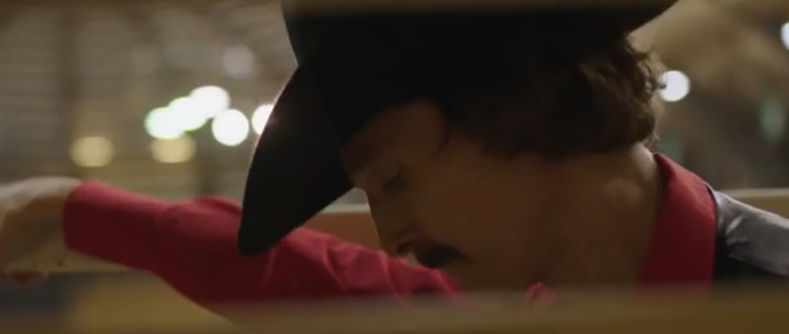
Ron Woodroof (Matthew McConaughey), electrician and bad ol' Texas boy, does not look well. Maybe it's the drinking and drugs. Maybe it's the whoring around and the bad betting he does at the rodeo that gets him beat up a lot. Hey, that's Texas and that's Woodroof. But when an accident at his work-site finally knocks him out so that he can't crawl home and self-medicate, he gets a medical analysis. Somewhere along the way he's acquired the HIV virus and the prognosis is not good: he has 30 days to live and is advised "to get your affairs in order."

What order?

After storming out of the hospital, he starts his thirty days by bingeing himself blind, but he can't escape a glance at a calendar. Not being the sharpest tool in the woodshed, he doesn't know anything about Elisabeth Kubler-Ross and the five stages of grief, he goes from denial to anger and stops at bargaining—he starts to investigate what's happening to him. Libraries, medical journals, he pores over them to find out why a straight man could contract HIV, and finds that doctors and Big Pharma are starting to run tests on an experimental drug, AZT. With cash in hand, he goes about his business like he would looking for cocaine—go to the place that has it and offer money. But, the hospital is only running trials for the FDA, and only some of the subjects will be getting the real drug. The doctor (Jennifer Garner) offers him a support group.  "I'm dying, and you're telling me to get a hug from a bunch of faggots?" But, that's all she can offer. The support group offers some literature, but that's it.
Meanwhile, word of his disease gets around to his cronies, who have as much tolerance for the LGBT community as he does, but, by now being a quick study, he spits at them, scaring them off, and becomes determined to find a cure for his disease. That involves a trip to Mexico and a discredited doctor (played by an unrecognizable Griffin Dunne) who has a lot of information on AZT—not good—and has been getting good results with vitamins, minerals, and an experimental drug called Peptide T. They work for Woodroof—at least preventing debilitating seizures (foreshadowed in the film by the whine of tinnitus) and so, he smuggles years worth of the stuff over the Mexican border, attracting the attention of the FDA.

Jared Leto as Rayon and Matthew McCounaghey as Woodroof
But, Woodroof is nothing if not an entrepreneur, seeing an opportunity and a need in the HIV patients in his community.  He cannot sell the drugs he's brought over—that would be illegal—but taking a page from other parts of the country, he sells membership in a club, providing the recommended dosages of the meds at no additional cost. Being a straight redneck, it's a little difficult to form a trusting relationship in the gay community. For that, he forms a partnership with another HIV transgender patient, Rayon (Jared Leto), who provides him street-cred and an unlikely ally.
The character of Rayon did not actually exist, but is emblematic of many people Woodroof worked with in his efforts that started as a money-making venture and turned into a cause and a quest for better (and less toxic) medical solutions.
There's a lot of "sugar-pill" scenario-writing going on between the actual events and the way they're depicted. lt "plays" better for Woodroof to be the rebel fighting the evil system of Big Pharma and the snail's-pace approval process of the FDA. There's also a lot of drama on the early AZT testing, which was done at levels that were too high and too toxic for the human body to take, but this was done, not to harm, but because there was no previous testing of the much in-demand drug—and the experts did not know the effects ahead of the tests, hence the reason for tests in the first place. It is also consistent with the constant battling Woodroof had to endure to save his own life, his own system, and finally, the people who depended on his efforts.  If Woodroof is an unlikely hero, the filmmakers want to make it unambiguous—yeah, he's a jerk, but, ultimately he's doing the right thing.

Those issues of authenticity aside, the filmmakers, in front of and behind the camera, do a nimble job of keeping the detailed, jargoned and acronym-filled story clear and concise and human—they probably had to cut many, many detailed corners throughout the film's ten year development to get there. McConaughey, as he's been proving for a while now, gives a great performance, pulling no punches with his portrayal of Woodroof, while also losing a scary amount of weight, and contnuing to lose it as the movie, and the disease, progresses. He's only topped in the film by Leto, who runs far afield of caricature and makes Rayon an endearing, if fatally flawed, recognizable human being (even if the actor is not recognizable in it, at all), and their scenes together, starting with a prickly-bitchy card game in a hospital room, keep the film yin-yanging with a tension that starts out at odds, and ends up feeling more like family.


Ron Woodroof