Showing posts with label Melvyn Douglas. Show all posts

Thursday, April 4, 2024

I Never Sang For My Father

I Never Sang for My Father (Gilbert Cates, 1970) Family drama about older kids (Gene Hackman, Estelle Parsons) struggling with what to do with their elderly parents (Melvyn Douglas, Dorothy Stickney) and the way emotional buttresses are formed between generations to prevent "in-home care" for the elderly. 

It's a simple equation: kids want their lives, and parents want their lives back.


Gene Garrison (Hackman) is an author/college professor who's the chief care-taker/"baby-sitter" for his elderly parents, who have just returned to upstate New York from their winter home in Florida. Mom's frail, as is dad (Douglas), but he won't admit it.

Gilbert Cates produced the play on Broadway (where it starred Hal Holbrook, Alan Webb, Teresa Wright and Lillian Gish), and directed it (such as he did) for film. It's not great work, hand-held, close-up stuff that basically gets out of the way of the actors, with a bit too much transitory busy-ness—there's a lot of walking out of rooms as if that's going to stop a conversation, but it doesn't. Cates went on to a career of directing mostly TV movies, but became most famous for producing the annual Oscar telecasts.
One hesitates to come down too hard on I Never Sang... because the issues are familiar if limited to the personalities involved and the selfish motivations of such, but the acting, especially by Douglas, Hackman and Parsons is note-perfect and feels real.

It's just that the film is dully presented, and looks like an after-school special for those going through a mid-life crisis, and it ends, never resolving the issues or presenting any ideas or insights. To do that would involve compromise and none of the characters are willing to, while the movie itself does so at every stage.

Gene Hackman has retired from films and acting (he just turned 94, so the following suggestion is a bit impertinent, as he should enjoy his retirement, leaving us grateful for all he's given us), but it would be nice if he would grace audiences with his take on the Douglas role, just to see what he would do with it.

It is interesting to note that the "Death ends a life"* monologue from the play/film is considered one of the most "overdone audition monologues" in theater.

* Death ends a life, but it does not end a relationship, which struggles on in the survivor's mind towards some final resolution, some clear meaning, which it perhaps never finds.

Tuesday, February 22, 2022

The Sea of Grass

The Sea of Grass (Elia Kazan, 1943) It's Kazan's third feature as a director, playing in Louis B. Mayer's sandbox (literally—the film is shot in-studio at M-G-M, making use of stock-footage of rolling fields already in the can, with some location back-projection), and the founding member of The Actor's Studio has a cast of anybody but—Spencer Tracy and Katherine Hepburn (in their third film together), Melvyn Douglas, Harry Carey Sr. and Edgar Buchanan, all pro movie actors who'd already figured out the best way to project on film, without having to rely on sense-memory for it.
 
Kazan hated this film and discouraged anybody who'd listen from seeing it. But, despite its soap-ish tendencies as a romance, it has an underlying ecological message. Colonel Jim Brewton (Tracy) is a very well-landed cattle baron and resists any efforts by the "guv'mint" towards granting homesteading rights or development on the open range. For him, its a matter of keeping it unspoiled. "God's work," as he calls it. That's his purpose, but he's a might surly, mulish and uncommunicative. Along comes city-girl Lutie (Hepburn) into his life, and he bends slightly, like the trees she insists be planted at the entrance to their estate, as they sway in the harsh prairie winds. He'll bend with a "wait-and-see" attitude, as in "Wait—you'll see." He yields to Lutie on her friends's homesteading near his property. But, a clash is inevitable. "Fences are a curse word in these parts, he informs her.
There are other complications. She's a city girl on the prairie and distances between people are daunting. Then, there's the town lawyer, Chamberlain (Douglas) who has two strikes against him in Brewton's suspicious eyes—he wants the land open to homesteading, and he has his own eyes for Lutie, waiting to pounce whenever there's a crack in the Brewton marriage, which is inevitable.  What his motivations are in both areas are suspect—Brewton Chamberlain are bitter enemies, politically and socially. Chamberlain just might be making the fight personal and can't help himself. With both the open fields and Lutie, he can't leave well enough alone.
The rise in Chamberlain's political career (becoming a judge in the district) dooms Brewton's ecological dreams, and soon the prairie becomes home to sod-busters, dependent on weather for their success, and when the rains stop, the crops fail and the farmers leave, the countryside becoming a barren dust-bowl.  It's a hollow, dry victory for Brewton—he's proven right (which no one will admit) and the land goes to waste.  And, in the meantime, Lutie has left, leaving Brewton and cook Jeff (Buchanan) to raise the kids: loyal but neglected Sara Beth (Phyllis Thaxter), and black sheep son Brock (Robert Walker), who it is more than suggested may be Chambelain's child.

One can see why Kazan, Tracy and Hepburn were attracted to the material. The ecology theme (even if espoused by a bull-headed "protect-what's-mine" cattle rancher) should have been close to the sod of anybody who'd come out of the depression, and the "unbranded scarlet letter" theme must have been attractive to Hepburn who enjoyed tilting at societal windmills. At this point, Tracy and Hepburn knew each other's tricks on-set. And it's interesting to see that their personal back-and-forth's in this film are much the same as they are in Guess Who's Coming to Dinner decades later. She's adoringly passive with a steel spine, and he's remote until his face collapses with emotion. Kazan would come out of this film feeling compromised—and, indeed, this film about the vastness of open land and the prairie feels like it was filmed inside a glass ball—and would explore other ways to make movies, as opposed to being stuck on the sound-stage. He'd start insisting on location work and even filming with a documentarian's eye. His search for authenticity in artifice could not be held behind stage-doors and artificial light.
 

Wednesday, June 5, 2019

The Americanization of Emily

The Americanization of Emily (Arthur Hiller, 1964) Talk about making a silk purse out of a sow's ear.

On this day before the anniversary of D-Day, let's take a look at one of the movies that featured that turning-point in the second World War. But, where most movies or books treat that fateful attack with respect and even reverence, this movie is satirical...and smart....while still being a member of that branch of cinema known as "the service comedy."


The original novel of "The Americanization of Emily" was written by William Bradford Huie (he also wrote "The Execution of Private Slovik", "Mud on the Stars"—which was adapted by Elia Kazan as Wild River—and "The Revolt of Mamie Stover") and although there are some similarities in characters and incidents, characterizations are slightly different as refracted through the typewriter of Paddy Chayevsky. 
The other difference is in attitude. In the novel, "Americanization" is a synonym for prostitution, as British women are assumed to be more loose sexually in the face of having access to wartime contraband normally rationed during the conflict. Chayevsky tones it down a bit by implying that "Americanization" is merely being influenced by American bootlegging. "Influence" might be a polite term.
It's the anticipatory days of the D-Day Invasion of Normandy and Britain is flush with military of every ally and stripe. None are more prevalent than the Americans. Cutting a considerable swath through the vulnerable island-country is Lt. Commander Charles "Charlie" Madison (James Garner), assistant to Navy Admiral William Jessup (Melvyn Douglas), who has assigned him a cushy job—in the parlance, he's a "dog robber," a fixer, although the less colloquial term might be procurer. It is Charlie's heady task to bring comfort to the allies—the entitled officers and the higher-up the better. For the buying of favors and political influence is its own kind of war, strategic and cut-throat. Charlie's had enough of the other kind. Having survived at Guadalcanal, Charlie had a change of heart about his role in the effort; having seen so many brave men die, he has figured out that the best way to survive it is to be a coward. He became as he says "a self-preservationist." Hence, his job change.
It is Charlie's heady task to make the lives of the higher rank-and-file officers more comfortable and, thus, more malleable in their negotiations by providing them whatever they want—women (mostly "although individual tastes may vary")—local girls who can be persuaded by giving them dresses, fine food, things they're not used to in their severely rationed country to be escorts and discretely silent—as well as liquor—top-shelf—cigars, fine foods, and the services and linens to display them on, clothes for the women (because the men are in their uniform finery), perfumes...and the ever-present Hershey's chocolate bars. The women are seen as a commodity, like the others, bargaining chips merely. They are supplies as surely as the guns, the ammunition, they shoot and the transports that ferry them to and fro...even to Normandy.
This may be upsetting in the era of "MeToo" but one can also make a case that the soldiers are mere commodities, as well, counting more as strength in numbers, than as individuals. One can fall as long as there are replacements who can take their position and, hopefully, last a foot farther in the advance.
Into this capitalist quagmire steers Emily Barham (Julie Andrews) of the motor-pool and self-described prig, whose job is to chauffeur the uniforms around—men-drivers being in short supply at the moment—and doing their part to help "the war effort" in any capacity they can. She is, at first, repulsed by Charlie and his proffered hedonism in a time of sacrifice, but he's a charming rogue—"a rascal" as she calls him—but, his cynicism and forthrightness about it makes him stand out, as does his philosophy of staying out of the action, which is attractive to a recent war-widow, whose family has its share of empty chairs at the dinner table and pictures on a shrine of a wall. Charlie, given his stance, may be around a bit longer for anyone sentimental enough to be thinking about the future, especially a future without loss.
If it wasn't for the bloody war. World wars have a way of getting in everybody's business. And this one conspires to separate Emily from Charlie and Charlie from his life. The Admiral, suffering from grief over the death of his wife, and seeing the Navy's role in the invasion as merely support, wakes up from a drunken stupor with an overarching idea that just may improve the position of the Navy—"The first dead man on Omaha Beach must be a sailor!" ("Was there a contest?" Emily will ask, aghast, later). And so Charlie is volunteered to storm Omaha Beach while his until-recently roguish friend-turned PR enthusiast "Bus" (James Coburn) commands a film crew documenting his efforts and probable death.
It is Charlie's worst nightmare. Not only is he back in a fire-zone, but he's doing it for the reason he knows and understands best—exploitation. But, if a man has to die for something, shouldn't it be as something more than a mere symbol and a ploy to get attention for a better share of budget appropriations? Sure, a man can get killed for doing the right thing and for being noble—as per Charlie's earlier arguments regarding his belief in cowardice*—but, not as a bargaining chip. Maybe there are distinctions and higher purposes. Maybe Charlie has to be fed some of his own medicine to concede such things exist and are worth the fight.
A lot of people don't get past that first caustic hour of Madison monologing his new religion, and it's too bad because the second half turns it on its ear through the blackest of comedy and the absurdity of herd-instinct, military protocol and "Mad Men" thinking. Chayevsky does not temper his language and uses it with scalpel-like precision. You'll find that in this screenplay, he does some deft "three-peating" to get laughs and make points, and it's not enough for one character to see the error of his ways (as would be a typical, safe goal for a movie resolution), but it's much more tougher for two lovers to switch roles as they grow together and are separated by crossing both intellectual and emotional paths coming through the wry. It's a twist that would challenge O. Henry, while keeping its satiric edge while providing a nice, neat (and slightly provocative) comfort zone.
Both stars, Julie Andrews (this was only her second film) and James Garner, have said that, of all of the films they made, The Americanization of Emily was their favorite.

They would appear together again in Victor, Victoria (directed by Blake Edwards) in 1982.

Tuesday, July 10, 2018

Ninotchka

Ninotchka (Ernst Lubitsch, 1937) You don't often get to see a perfect movie—a movie of fine material: a great script, perfectly cast and executed, yet isn't calcified in pre-calculation, that lives and breathes and takes advantage of accidents. Something that feels like life, only written better. A movie that beguiles, while still acknowledging the real world, and that any interruption will just have to wait until "The End"...which comes far too soon. A movie that widens the eyes, expands the mind and tickles the funny bone. That's Ninotchka.

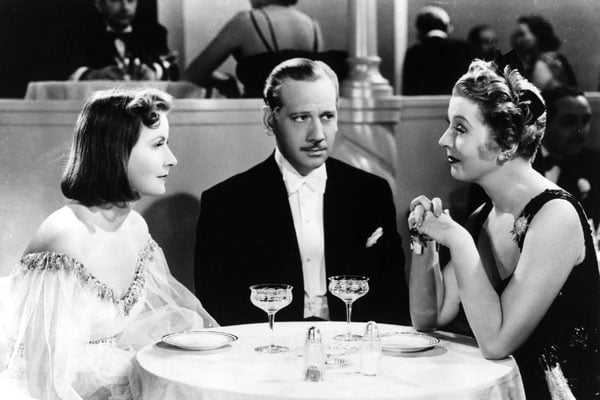
Three Russian emissaries (Sig Ruman, Felix Bressart, Alexander Granach) are in Paris on official business, hoping to get top dollar for some diamonds confiscated during the Russian Revolution. Out of the discriminating eye of the commissar, they decide to stay at Paris' most opulent hotel--the better to attract the interest of capitalist speculators, comrade. Of course. As luck would have it, it's also the domicile of the Russian Grand Duchess Swana (Ina Claire), in exile, and shy a few diamonds due to the Revolution. When her "kept man," the Count Leon D'Algout (Melvyn Douglas) encounters them, he plies them with the finest life Paris has to offer, stringing them along while the gears of the authorities grind slowly to take back the diamonds before they can be sold.

The delays in retrieving money for the Soviet State puts the Reds on high alert, and a by-the-book-politburo-crat,
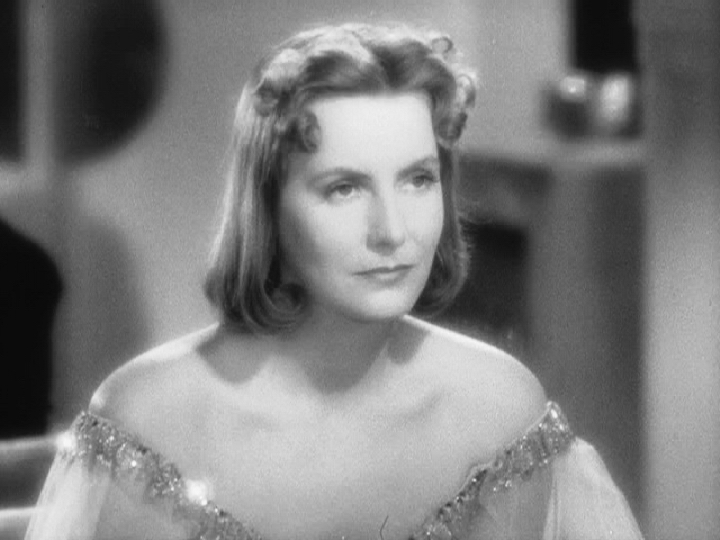
Nina Ivanova Yakushova (Greta Garbo) is dispatched to investigate.

She does not like what she sees.

Her humorless buttinski attitude might put things on the right track, and that's the last thing Count D'Algout wants, but
he finds his and Paris' charms are lost on "Ninotchka." She is so gray and humorless, with a suspicious look in her eye and expressionless of face, she is more than ideologically committed to the Socialist state, she is practically Vulcan (emphasis on "practical"). The Count must work overtime to beguile her, and overtime is something this representative of the Worker cannot abide. Like it matters. The Count becomes intrigued with her, and decides to make time on his own time.
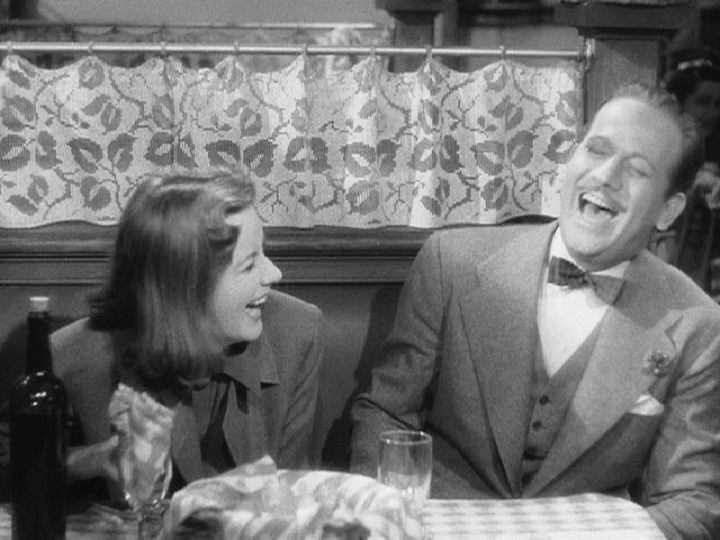
Ninotchka is political satire as fairy-tale, complete with the converted princess and the pixieish subservients (all thing being equal, comrade, but some are more equal than others—or is that "fairest of them all?"). The conceit is charming, and add the star-power of Greta Garbo as "Ninotchka" and the thing practically fizzes. Garbo has always been a legendary presence, somewhat unapproachable. But her work in this film, with Billy Wilder and Charles Brackett's words and buoyed in its interpretation by "The Lubitsch Touch," is the effervescence that pops the film's cork. Again, the structure of the story helps. Garbo's no-bolshevik attitude at the beginning sets up a magical transformation from mugly ducklink to beautiful swana-be. That she is funny in both aspects and possessed of a comic timing with the accuracy of a Swiss watch, while still radiating the sex appeal that made her a box-office queen, is a bit of a miracle. It's my prejudice to think that such a lionized star couldn't possibly be such a fine actress. You learn something new every day.
Which is exactly the point. You might as well enjoy it. One can't help it when the lesson is so delightful.