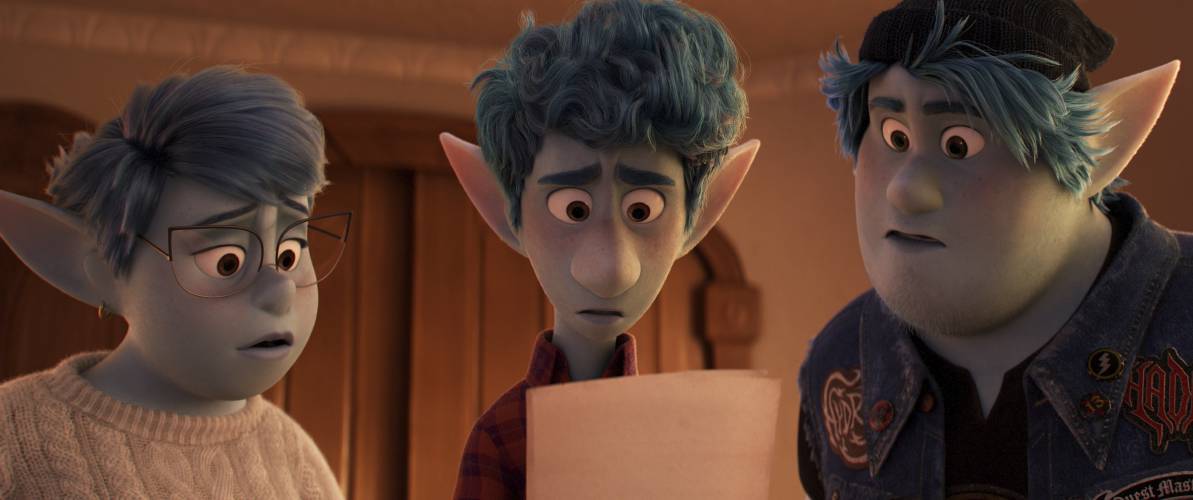
The Real Hero's Quest
or "Only Once Is All We Get..."
"Long ago, the world was full of Wonder. It was adventurous, it was exciting, and best of all, there was magic. And that magic helped all those in need. But, it wasn't easy to master. So, the world found an easier way to get by. Over time, magic faded away."
Ian Lightfoot (voiced by Tom Holland) is an elf, with a lot changing in his life: he's turning 16, about to enter high school, and he's scared of everything. His Mom (voiced by Julia Louis-Dreyfuss) has a new boyfriend (who's a policeman...and a centaur, but let's not be specist), his older brother Barley (voiced by Chris Pratt) is a lout, obsessed with with RPG's, especially quest-themed games based on the past, and there's a lot he doesn't like about his life right now, wondering if he had the guidance of his father—who died before he was born—that he wouldn't be so unsure of himself. But, with a change in schooling comes an opportunity for change of self. Ian makes himself a list of things he wants to do: speak up more; learn to drive; invite people to his birthday party; "be more like Dad." Each item has an empty box next to it that he'll check off when accomplished...at the end of his first day, all of those boxes are empty.
Life in New Mushroomtown
So, it's not the best of birthdays, until after he survives the ignomy of brother Barley picking him up from school in front of potential friends (who invites—and then dis-invites to his birthday party). Mom reveals that Barley and Ian's Dad has bequeathed a boon to the boys when both of them have reached the age of 16. It is a wizard's staff ("I KNEW it! Dad was a wizard!" "No, he was an accountant...") with a parchment written with the very words that start the movie (and this post).
InOnward*, the world was one of wizards and magic. But science and technology took over. You know longer needed an enchanting mage to provide light, once electricity was channeled and utilized, infrastructures built, grids connected, roads built, cars invented and mass-merchandised. As it was said, the world found easier ways and magic in the every-day faded, replaced by industrial wonders and suburbs and highways and gas stations and fast-food restaurants. The world became democratized and needs fulfilled. Oh, there are still elves and centaurs and manticores and sprites and unicorns (knocking over garbage cans and eating the best bits), but society is more about convenience and getting through the 9 to 5. Oh. And dragons. Pet dragons. If they're troublesome, squirt 'em with a water bottle (especially the fire-breathing ones!).
So, for these suburban elflings to get a magic staff, well, that's amazing! Especially for Barley, who's into that sort of thing. And there's another thing in the parcel—a Phoenix Gem. Dad's gift is a means to conjuring himself up for 24 hours (and 24 hours only) to spend it with his sons—handy to spend as little time in the troublesome teen years and to completely avoid diaper-duty. Not handy to be dead, though.
Ian and Barley attempt to magick up Dad, but fail. But, when Ian—who has the greater need (never having seen his father)—tries, he has more success to a certain degree. It being his first spell-attempt, there's some wasted energy (teens!) and the Phoenix Gem empties and dissipates, with only half-a-Dad showing up from the waist down ("I definitely remember Dad had a top part!")—the rest just being an expectant shimmer-layer of pixie-pixels. This is an issue, especially if you're expecting any meaningful conversation beyond foot-taps.
So, that's the set-up of the story; the rest of the movie is a hero's quest for another Phoenix Gem to complete the spell...and Dad...before the 24 hours is up in order to have quality time with a Dad who's more than only part-way there. Simple goal: check. Limited amount of time to do it in: check. Complications, of course, ensue, and, of course, important life lessons are learned along the way. But, being this is a Pixar film, there is an emotional heart to the film beyond what we've come to expect from animated films from other digitizers. Goals may be achieved on the surface, but they are not as important as those achieved, unseen, in the heart. Audience tears may drop.
That's where Pixar excels—in the subtext (although, the subtext is a little more obvious in this one than in the absolute best of the studio's films). Onward is an ingenious blending of RPG games and real world in the ingeniously constructed and exquisitely rendered tradition that we've come to expect out of the Uncanny Valley in Emeryville. Sure, it's in a fantasy world, but there are moments where you would swear that something was filmed rather than rendered, and, beyond the RPG setting, director Dan Scanlon—this is a Giant's sized step up from his work in Monsters University—manages to squeeze in other "quest" touch-stones that might be recognized (there is an ingeniously updated reference to the opening of Raiders of the Lost Ark that has a hilarious capper).
Ultimately, what goes unspoken is the trope that it's not the goal rather than the journey itself, but it does it in such a subtle and smart way that one could be excused for not recognizing it as such, and in a way that might (just "might") frustrate those who are looking for connect-the-dots movie-making. Pixar is better than that, and the results are sublime and well-earned. Lesson learned.
It is not Pixar's best—I just had to rank the Pixar features for The Large Association of Movie Blogs and I would say Onward is solidly in the top third of their output (I still think Ratatouille is the best one they've ever done from a depth perspective, but your results may vary), and one awaits breathlessly for their new one—Soul—in June of this year.
* Onward is not accompanied by a Pixar short, but one of the newly-acquired 20th Century Fox properties—The Simpson's—entitled "Play-Date with Destiny," featuring the non-verbal Maggie Simpson. One may be horrified that the anarchic Simpsons play in front of a Pixar movie, but this one is very clever—the more adult jokes are only written out to be read, so there's nothing that might "weird-out" the kindergartners. The makers of The Simpsons are an ingenious lot.
Animal Magnetism
or "Monsters are the Patron Saints of Imperfection"
Guillermo del Toro
The cinema of Guillermo del Toro veers to and fro in the land of fantasy, never too far from the things that haunt, scare, and thrill us. But, as opposed to a director like Tim Burton, monsters are not a fun thing. Del Toro treats them very seriously, be they friend or foe. And his monsters become us, even if his characters don't become monsters. Monsters are a passion of his, but not a hobby. And when he considers a monster—particularly those featured in the films of his youth—there is always the embedded thought: "What are THEY feeling?" Most monster movies consider the feelings of the folks in the film who are like us, the better that we might understand their reactions when they encounter something strange and not like us. There is kinship there. Entertainment value.
And tribalism. But, rather than consider the "us against them" mentality that most monster movies (like his own Pacific Rim) encourage, del Toro will think about what the monster is feeling. He was thinking about his own reactions to The Creature from the Black Lagoon when he went to Universal Studios more than ten years ago to propose creating a remake with more sympathy for the "Creature." Universal, who was planning its own ways of screwing up their classic monsters, turned him down cold. One hopes their their lawyers aren't monsters, and see his new film, The Shape of Water, for what it is—an extraordinarily well-done gene-splicing of Creature and "Beauty and the Beast"—rather than as a fishing expedition for a copyright infringement suit. Frankly, they don't have a case. The Shape of Water is its own magical animal, far removed from, and more highly evolved than, its source.
It starts, appropriately, in a dream-like state underwater with a narrator still trying to absorb his tale of "the princess without a voice, a love lost, and the monster who tried to destroy it all." The narrator is Giles (Richard Jenkins), who is a commercial artist who lives in a garret above a movie theater.*"The princess without a voice" is his across-the-hall neighbor Elisa Esposito (Sally Hawkins), mute since birth, who works as a cleaning woman for an organization that looks suspiciously like Hellboy's BPRD**but is the Occam Aerospace Research Center. She has a quick daily routine at home and usually shows up to work barely on time after a cross-town bus-ride, where she is saved a place to clock-in by her friend Zelda Fuller (Octavia Spencer) where they clean the facility at night.
One night, an elaborate container housing "what may well be the most sensitive asset ever housed in this facility" is brought into OARC, along with its caretaker Col. Richard Strickland (Michael Shannon), who captured the "asset" in a South American river. The "asset" is an amphibian creature, once worshiped as a god by the Amazonian natives, but Strickland is less enamored of it. OARC is interested in it for space research, but Strickland's military masters see no point in keeping it around to study it. They, like Strickland, are more intrigued in vivisection, seeing what makes (or made) the thing tick,,,once it stops ticking. Strickland doesn't see it so much as an asset as an affront.
But, two people have an interest in keeping it alive: Elisa sees it as an exotic beautiful thing, and she visits it regularly, feeding it hard-boiled eggs and playing it music; new OARC scientist Bob Hofstetler (Michael Stuhlbarg...the ubiquitous Michael Stuhlbarg) sees it as a waste of a scientific anomaly. But, he has another reason...Bob's real name is Dimitri, and he's a Soviet agent who has infiltrated OARC to find out what he can about the research going on there. Bob/Dimitri's Soviet contacts are intrigued by the creature and have no idea why the Americans would want it...but, if THEY want it, the Russians want it, too.
On the flip-side, if the Russian CAN't have it, they want Dimitri to kill it. But, he IS conflicted as a scientist. And when Elisa discovers that the military has plans to destroy it, she makes a decision—not on her shift, and she begins an elaborate...and dangerous...plan to creature-nap the asset. But, Giles is hesitant; he has his own issues and is reluctant to do anything that might draw more attention to himself.
It's a fairy tale, but like most of del Toro's work it is not a complacent one. Here it is the task of the princess to save, rather than be saved. And the monster? Well, it's basically "corporate man." If The Shape of Water has a weakness it's that it's a little heavy-handed on the heavy, which is Strickland. Shannon is up to the task of playing it, of course, but Strickland is such a compendium of every perverted instinct he could probably have been portrayed as a studio head. He's insensitive to beyond the point of cruelty, he's prejudiced, elitist, a potential rapist, uses the Bible—or his interpretation of it—as his justification for his view of the creature ("W're created in the Lord's image. You don't think that's what the Lord looks like, do you?") and he has the audacity to be reading "The Power of Positive Thinking." If you want a comparison, look to the Nazi father of Pan's Labyrinth, but, there the ending is cathartic—you want him to suffer and he does. Strickland, not so much, not to my satisfaction, anyway. If you're going to consider how much the monster feels, there's no much feeling there. Someone so insufferable should suffer more, I think.
But, that's my big fish to fry with the film. Del Toro has made something gorgeous, taking some inspiration from Michael Powell for his vision of things. and filling it with the strong visuals needed to communicate the feelings of someone mute. He's aided, immeasurably, by Sally Hawkins here, who does the sort of effervescent acting that one rarely finds outside of silent pictures, one that incorporates body language, rhythm, even dance. Compared to what everybody else is doing, weakened by actually having to express themselves, Hawkins is a shining light throughout the film that draws you in.
And as his creature, del Toro has again tapped Doug Jones, maybe the least recognizable actor in films...even less than Andy Serkis. Jones played all of the creatures—distinctively—in Pan's Labyrinth, as well as Abe Sapien in both Hellboy movies, and his body-acting instincts as the creature, as much as we see of him, are stately and elegant (even during a black and white dance sequence) despite being done in full prosthetics—not even motion capture. One hopes, for his sake, that they kept the water warm.
It is not a movie for little kids (I shouldn't have to say it, but I'm thinking of those parents who dragged their children to Downsizing), ironic given that a viewing of The Creature from the Black Lagoon at 13 inspired it. But, if one is given to romantic fantasy with a harder edge, it's a great movie to see.
When I think of her all that comes to mind is a poem, made of just a few truthful words, whispered by someone in love, hundreds of years ago: 'Unable to perceive the shape of you, I find you all around me. Your presence fills my eyes with your love. It humbles my heart, for you are everywhere.
* Judging by the movie starting its run at the theater—The Story of Ruth—and that John Glenn is seen on television, the year must be 1960.
Bad Will, Hunting or ♪How Do You Solve a Problem Like a Math-Whiz?♫ Marc Webb, did the very enjoyable (500) Days of Summer, a film I very much admire. He parlayed that success into a journey to Big Budget Marvel-land, where he directed the re-booted and re-webbed "Spider-man" franchise, making it "The Amazing" Spider-man (I and II), with Andrew Garfield and Emma Stone. The first one worked like gang-busters, but the second one suffered from "super-villain bloat" and a commitment to the infamous "Gwen Stacy Syndrome" story-line of the comics. Whatever, the reason, the box-office fell off a bit and intended plans for an "Amazing Spider-man III" were "Green-Lit No More!"* One of the things I've read directors say after they've done a taxing blockbuster is "Next, I want to do a simple love story with just two people..." Rarely happens. But, Webb is a sharp talent with good instincts and his first post-spider-film film is, if not terribly inspired, terrifically realized in the directorial sense, showing that, as a director, he hasn't lost his touch with casting, directing, and of the off-beat, all things proven inGifted.
Frank Adler (Chris Evans) has a little problem. Eking out a stable living repairing boat-motors in a seaside Florida town, the former professor is trying to prepare his niece Mary (the almost too-good McKenna Grace) for her first day at school. Not that she needs it. Mary is a math savant, being home-schooled by her genius uncle. But, there's only so much he can do. He's taking care of Mary because her Mom—his sister—committed suicide. An accomplished math-theoretician herself, she succumbed to the pressure of work and home and legacy, leaving Frank as care-taker.
He's been home-schooling Mary in their trailer-park, with the added social skills of neighbor Roberta (Octavia Spencer, who is good in a role that has "Octavia Spencer" written all over it**), but he's decided to to enroll her in school to socialize with kids her own age ("This is going to be fun! You'll meet kids today you'll be able to borrow money from the rest of your life!"). As her previous playmates have been adults and her play-time consisting of stacking algorithms like they were blocks, he thinks that one so endowed is only missing one thing—a childhood.
Her first day does not go well. What takes the other kids 30 minutes to do, she does in two. While they are coping with Dr. Seuss, she's curious about the term "ad nauseum." And where their concerns are about who's "King of the Hill," she asks her Uncle if there's a God (after his initial hedging, she annoyed: "Just tell me..."). She's a kid and a math genius, all things have an answer. It's just a matter of working it out. She is(per my favorite line from "The Simpsons") "a Spalding Gray in a Rick Dees world." And lest she become like Holly Hunter's depressed news producer in Broadcast News ("It must be nice to be the smartest person in the room—to think you're always right and everyone else is wrong." "No, it's not. It's awful!"), Frank wants to put her on another path. When school administrators bring him to protest that she should be put in an institute of higher learning, his answer is simple: "...If we separate our leaders - if we segregate them from people like you and me - you get 'congressmen. So, just dumb her down to a decent human being. Everybody wins."
But, Frank is soon visited by his mother, Evelyn (Lindsay Duncan), Mary's grandmother, who has finally tracked him down after months of searching. She holds Frank in contempt, not only for abandoning his own professorial career-path, but, also for what she sees as his stunting Mary's potential. Mom has issues—she gave up her own sterling academic career to raise Mary's Mom and she was clearly using her daughter to compensate for her arrested goals. But she also has a lawyer, and she threatens a child custody battle to take Mary away from Frank, despite her daughter's wishes.
You'd think a math scholar would come up with a better solution than simple division by court order. But, she's driven. And desperate. And a real shrew. Fortunately, she's played by Duncan who suggests the neurosis and vulnerability in the character, in order to keep audiences from throwing popcorn at the screen. She's matched by Evans, who manages to make Frank less of a super-dad "Captain America-style" as a victim of conflictions and burn-out. But, the laurels go to the kid. Grace is going to eclipse everybody else in this movie in people's memory—which may not be fair as her work was no doubt influenced by everybody.
"He's a dude and he's a guy/And he only has one eye/ Fred, Fred, Fred/Freddy, Fred, Fred" Fred, the Amazing One-Eyed Cat
But, it's a miracle performance in that you believe the kid could be a math genius, while also being charming enough to be a handful. Director Webb never takes things easy, never appeals to the lowest common denominator, but always puts some sand in the sugar to make things seem a bit more real than is expected. And Gifted promises that he hasn't been derailed in that regard by his studies in super-hero myth. And that is a gift in itself.
* Yeah, yeah. It's been re-booted with Tom Holland. ** Probably not fair, but Spencer's so good she could do this role while in a coma. It's not much of a challenge, and doesn't present the kind of opportunities that Spencer is capable of. I would love to see her do something beyond "proudly restrained sass."
The Go/No Go Point or "Let's Have an 'Amen', Dammit!" Hidden Figuresis one of those movies you can't fault, even while you're muttering "BS" under your breath. Its "untold" story (too true, unfortunately) of the "computer with skirts" unit (true) at the Langley Research Center at the behest of NASA, it both makes things too easy to digest for audiences to the point of incredulity and compresses the timeline to an unbelievable degree. Rather than the early 1960's as the film portrays, these women were making their accomplishments starting in the late 1940's: when Dorothy Vaughan—portrayed by Octavia Spencer in the film—actually did become the first black supervisor of the computer team in 1948, back when NASA was still known as NACA; Mary Jackson—portrayed by Janelle Monae—became an engineer in 1958; and, most egregiously, Katherine Johnson—portrayed by Taraji P. Henson—started work at Langley in 1953, was "loaned out" to NASA and they never let her go, and yes, she was the "go-to" woman for calculating trajectories from the first sub-orbital space shots, through all the Moon landings and on to the Space Shuttle program. The film seriously short-changes these amazing women for dramatic purposes.
Not only that, the film over-dramatizes and even invents instances of racial injustice to make its point of "overcoming obstacles." Oh, these women had obstacles, all right. But, they were too smart and just plain too good to deal with such silliness. They didn't make a point of it. They just ignored it and resisted it and let their behavior dictate the status quo. "Excellence is always the best deterrent to racism or sexism" somebody said*and you did not mess with these women in the work-place. But, the film invents characters that are "indicative of the prejudice of the time" (portrayed by Jim Parsons and Kirsten Dunst) as foils to be overcome. Plus, Kevin Costner's "Al Harrison" never existed, being a composite of several directors of the "Space Task Force" who had the privilege of working with these women.
So, I chortled when John Glenn (Glen Powell) gets a call on the launch-pad from Katherine Johnson giving him the coordinates for the "Go/No Go" point to fire the retro-rockets to return to Earth (she's giving him coordinates down to many decimal places after their IBM computer starts giving differing numbers and he doesn't even have anything to write them down!), but it is true that when that issue came up, Glenn said (and I quote) "Get 'the girl' to check the numbers. If she says the numbers are good, I'm ready to go." Wow. "The girl" was more trusted than the NASA computers and all the other technicians at NASA and Glenn was willing to risk his life being hurled into space by what was previously a ballistic missile on Katherine Johnson's say-so.
So, even if the movie does somewhat undercut what they did, making a movie about them was drastically necessary and long overdue.Long held has been the image of white guys in shirts and ties, smoking over metal rheostats and gauges (nobody smokes, although Costner's Harrison is an incessant gum-chewer as a compensation). Performances are first-rate throughout (although Parsons may be a bit type-cast as a 'nerdlinger" at this point—he never goes full-"Sheldon" in this): Spencer is subtly fierce in this and Monae is a delight, and Henson (who I'd watch reading the phone-book, which was something not out of place for the time-period) is tamped down from what she can do—it's a bit like watching Jane Fonda in 9 to 5, deliberately "playing nice" when you know, deep-down, she's fighting the urge to put some "edge" to it. Hidden Figures is a charmer, even if it doesn't quite achieve the heights it should.
* I know it's Oprah and you don't get a car for knowing it.