"Just Because It's Fiction Doesn't Make it a Lie"*
or
"Cavorting, Twinkling, and Prancing to a Happy Ending Like a Kamikaze"
Mary Poppins was a bitch. That's been my joke for a long time, especially given the reputation that Disney's film of Mary Poppins (this year voted to the National Film Registry) has of being just as sugar-gooey as cotton candy in an Orange County heat wave. It isn't. And I've gotten several startled looks from adults who then see the film and, yes, they do see that aspect of it, despite the step-in-timing chimney-sweeps, the dancing penguins, and the moments of larkiness. It's not all a jolly 'oliday with Mary. In the end, it's a little bittersweet, and she ascends into a Peter Ellenshaw matte painting of London that isn't dabbled in sunlight, but is a melancholy smearing of smoke and darkening skies.
That's probably due more to Travers' own stipulations to the Disney crew than to anything. Disney could be dark—dinosaurs died and there was "Night on Bald Mountain" in Fantasia, Pinocchio had its moments' jack-assery and Monstro swallowing, Bambi's mother died, and 101 Dalmations almost got skinned—and provided moments of terror and threat in its films, as long as everything turned out all right as the final song paraded people up the aisles. But, Mary Poppins would have been a slightly different movie if it hadn't been for Travers' nannying the scripters and Disney with her chalk-lines drawn in the sand. For that, we should be grateful.
Maybe less so for Saving Mr. Banks, the Disneyfication of the Disneyfication of "Mary Poppins." It's "based on a true story," which means (as Blake Edwards coined the phrase) it's "true except for a lie or two," and in the western parlance of John Ford, "when the truth becomes legend, print the legend." They couldn't have made this movie without Disney and "the Disney version," so, obviously the filmmakers are going to take a charitable stand on the studio's side of things (for example, Richard Sherman, who's played by Jason Schwartzman in the film, says that, rather than, as in the film, taking a personal approach when Travers came to work with the film-makers, Disney took off for Palm Springs and didn't come back until she left). But, the more you find out about P.L. Travers (her nom de plume), the more you realize that they're taking the edges off her, as well. Travers was a fantasist, and her largest work was the construction of her life, ever-changing, malleable, inconsistent and to her specifications as the mood and the myth suited her. "Mary Poppins" suited her just fine, and her demands for what was and was not acceptable are well documented in the many scripts versions filled with the word "No" in the margins, and the audio tape of the back-and-forth's between her and the scripters and song-writing team (which she insisted on, and which is played as coda over the end-credits). Emma Thompson, who listened to them all in her preparation for the role, called her "vile."**

 |
"Two artists at the height of their powers-like two gorillas fighting:"***
A study in contrasts between Disney (Hanks) and Travers (Thompson) |
Fascinating, complicated, but vile in the instance. And understandable in her concerns for what she considered "family," and that is where the film is at its most charitable and lovely. Where Saving Mr. Banks shines is in the film's presentation of Travers' carefully hidden back-story, of her growing up in Australia to a charming, but erratic alcoholic father (played by Colin Farrell...think about that, Colin Farrell in a Disney movie), a frail mother (Ruth Wilson), and a precariousness to the family that, until her father is demoted from his bank manager-ship, she had not previously known existed.
The movie goes back and forth between the disappointing assaults on her stipulations at Disney and her memories, some of which inspired the work she fights so egregiously to defend. Meanwhile, Disney (Tom Hanks, who pushes "folksy" mighty hard to play a role almost too familiar to play), with theme parks to build and other movies in the pipeline, is left vexed and perplexed that the "Disney magic" isn't working at all well on "Pamela."How could it? I remember one writer describing the movie adaptation business for one of his works as "holding the coat for the man who's assaulting your child." Disdainful of animation and films in general and Disney's work in particular, the movie's Travers reluctantly comes to Hollywood, where she is inundated by welcoming gifts in the form of "all things Mickey" in her hotel room to the point where she feels under siege. Any pleasantries are seen with suspicion for agendas, hidden. And for the Disney dwarves, the task is mining anthracite because they're playing to a vision of Travers from her books, but not from her history and will always come up short until they know the origin story...which she'll never tell.
The process, by which the movie-makers back-and-forth to keep the starched corners of the character, and the tone from being perpetually giddy, would be long and tedious to sit through in a movie, and so compromises have to be made. Let's just say things didn't happen the way they happen in the movie—there was no meeting of the minds and no sharing of histories; Disney was a businessman and entrepreneur who knew a good thing when his daughters saw it and Travers wanted to keep her house. Battles were chosen; compromises were made...in Mary Poppins and Saving Mr. Banks. That same give and take, that same grace under fire, to produce the best work regardless of the truth, permeates both films in their way. The truth is just one more hurdle to a good story.
"And you can stay there until you've learned the art of subtlety..."
So, one can gripe—although Thompson is the very definition of "practically perfect in every way" here and should cause no consternation—but if one does, they're being a little bit intransigent and dealing with their own "issues," reflecting, again, the issues of the film. It's a film that ultimately charms. Anyone immune to it can, as everyone on both sides of the conundrum seemed to agree, "go fly a kite."
 |
| Julie Andrews, Uncle Walt, and Dr. Travers on best behavior |
* P.L. Travers
** In one of those perfect symmetry moments, Thompson, in her satiric acceptance speech winning the Golden Globe for her adaptation of Jane Austen's "Sense and Sensibility" imagined Austen's own disregard for her just-awarded work: "P.S. Managed to avoid the hoiden, Emily Thompkinson, who has purloined my creation and added things of her own. Nefarious creature."
*** Thompson, in an interview, describing why she was drawn to the script and the story.

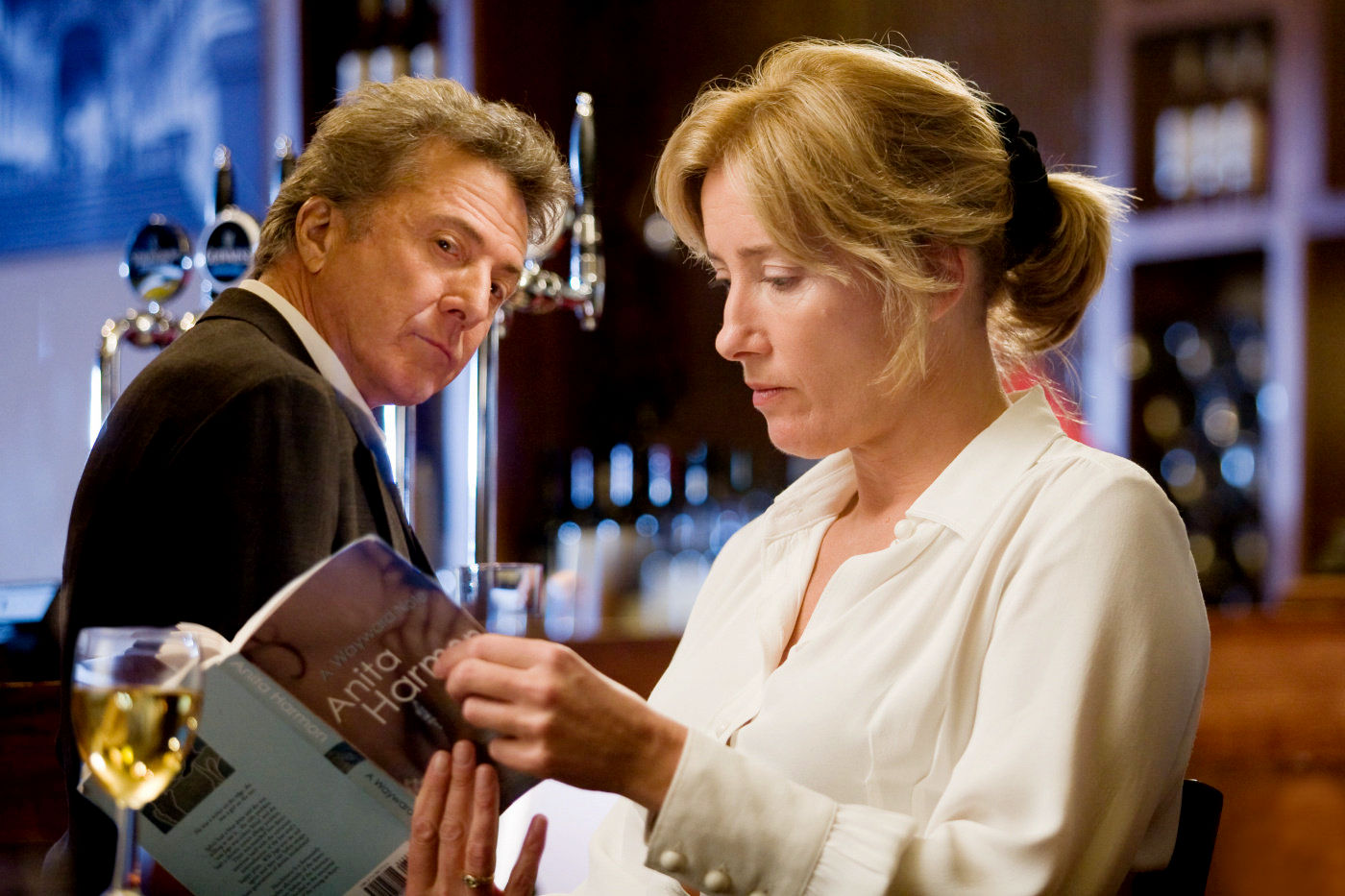
 Add to that, his estrangement from his family (his ex-wife, played by Kathy Baker, is now married to James Brolin's character) his awkwardness with social situations in general, and that dear daughter wants her step-dad to give her away, Shine is having a very bad time of it. He spends the wedding at the back of the church (at least he's there), but he's determined to skip the reception and just slink home, until he finds his flight delayed with a long layover. Only thing to do is hit the bar, and once there, he has a strained conversation with Kate Walker (Emma Thompson, always exactly right), an airline worker he previously had blown off while she was just doing her job.
 She wouldn't be there if a connection didn't happen...not merely back to the U.S., but between the two characters...and as I said it's amiable and genial and you probably already know where it is heading. Hoffman is such an adept spur-of-the-moment actor and Thompson is such a quick wit and sharp writer that it's like seeing your two best friends spark off each other and say what you will about the rest of it, but that is a joy.
 There is a complication or two of the An Affair to Remember variety—don't worry, no one gets hit by a bus—and we get to witness what may be the longest wedding reception in history. The slight story-line is fleshed out with Kate's eccentric mother (the wonderful Eileen Atkins) who thinks that there's a Rear Window-style murderer living next door. Hilarity ensues.