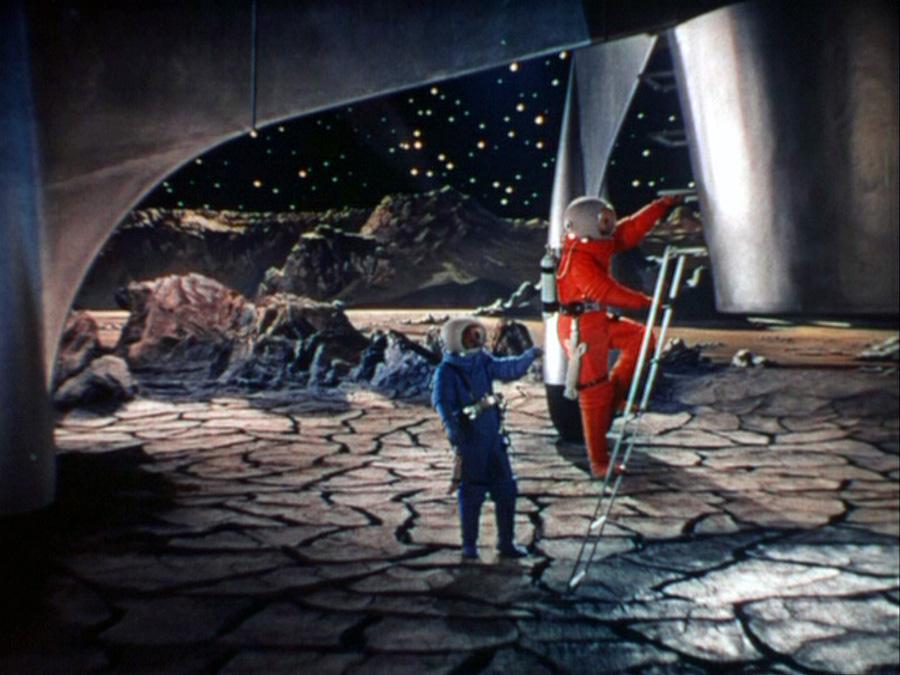
Destination Moon(Irving Pichel, 1950) As it's the 55th Anniversary of the "Yes, It Really Happened" First Moon Landing with a new movie (however fanciful) and all, it's a good time to look at a past movie about a first trip to the moon—we've done reviews of First Man and Fritz Lang's Die Frau in Mond—like this 1950 George Pal production that had considerable input (co-scenarist based on his novel, technical advisor) from "Mr. Grok" himself, science fiction author Robert A. Heinlein.
It's a fascinating little curiosity, by turns both sophisticated and puerile—something you could say about most Pal movies—that can take into account such things as G-forces, orbital mechanics, and weight playing a part in fuel consumption and maintain a strict adherence to science (no sound in space—not even for dramatic purposes—and the advantages and disadvantages of micro-gravity and the ritual of pressurizing air-locks) while having some of the more advanced concepts being explained in a Woody Woodpecker cartoon.*
Bear in mind that Destination Moon was made seven years before Sputnik put the fear of dumbness into Americans**and kicked our fledgling rocket program into "trust" mode. In the movie's opening minutes, researchers and private corporations are on the cusp of launching the first man-made satellite into orbit only to have the rocket launch off the pad and then slam itself into the desert, disastrously. And just a couple of months later, they're talking about sending a manned rocket to the Moon. Baby...steps, guys....
The Woody Woodpecker cartoon attracts investors (it's called "science fiction" for a reason...) and pretty soon construction begins on a Moon rocket using atomic energy to create enough steam thrusters to power it out of Earth's gravity and to the Moon. The entrepreneurial heads of the program are going to be the ones on-board for the flight, not test pilots, and they are Jim Barnes (John Archer) the aerospace magnate whose company built it, famed rocket scientist Dr. Charles Hargraves (Warner Anderson) who designed it, retired General Thayer (Tom Powers) who wants America's presence in space to be used for deterrence and technician Browne (Ted Warde) who supervised the technical aspects of the good ship, Luna.
But, there are complications—political ones. The Atomic Energy Commission (referred to as just "the Commission" here) denies permission to test Hargraves' atomic engine at its launch-site in the desert given protests by local citizens. Barnes suspects foul play by one of our nation's enemies (after all, how could American citizens complain about atomic testing ten miles away from their homes?) and to avoid any legal action...like a pending court order...the crew determines that, instead of further testing and other technical details, they'll launch this brand-new untested space ship in just 17 hours time.
But, that causes another complication: Browne comes down with appendicitis and has to go in for emergency surgery, his place to be taken by Brooklynite technician Joe Sweeney (Dick Wesson, who suggestsnothing so much as Humphrey Bogart's younger, goofier brother) who would rather not, thank you, as not only because he thinks the thing won't get off the ground (he's the technician??) but also he has "a date with a chick" the next day. See what I mean by the movie being a bit puerile?
But, complications aside, the ship launches just moments ahead of a court order, and, for 1950, the sequence isn't bad, suggesting G-forces pressing the astronauts into their couches and distorting their forces from the strain. An unscheduled EVA has to happen to set up radio communications as Sweeney had "greased" the aerial to make sure it deployed, not realizing that the gunk would freeze in the vacuum of space (again...he's the technician?).
About the moon sequences: it's eerie that a movie about Americans reaching the moon should reflect so much of what the actual Moon landing was like with its talk of "for all mankind" and the description of the Moon as "barren and desolate" and a formal phone-call from Earth as the astronauts are standing on the lunar surface—as if they have nothing better to do. Science Fiction illustrator Chesley Bonestell, credited as "technical advisor of astronomical art", provides the vast vistas of the lunar surface as well as shots of earth and the Moon's sphere.
At the time, the gee-wizardry made the film very popular while today it feels like a silly relic with all the risky behavior that goes on in order to get the ship off the ground without so much as a safety check. But, this was made at a time when test-pilots were flying by the seat-of-their-pants and years before the first artificial satellites started educating us about the formalities of near-Earth space travel. It was science fiction for the audiences of 1950.
The ironic thing is that, after the efforts, the chances taken, and the lives lost, and the mission accomplished, a hefty percentage of Americans still think its fiction.
Who could have predicted that in 1950? Probably nobody. Some concepts are just too strange to grasp.
* But then, Steven Spielberg did the somewhat the same thing in Jurassic Park, didn't he?
** I wish we had that NOW!
Dinah Washington's "Destination Moon" which was the End-title song for the recent Fly Me to the Moon
The Most Dangerous Game (Irving Pichel and Ernest B. Shoedsack, 1932) The year before releasing King Kong, the team that made that film (with some slight changes in personnel) made this pre-Code adaptation of Richard Connell's classic "The Most Dangerous Game." Connell's story is spare (you can read it in the hidden link in the title), and it has been expanded in the adaptation by James Ashmore Creelman (he also worked on Kong) to include more characters (demonstrating the dire nature of the situation, but also making it less credible and more susceptible to detection that "something's up" from the "outside" world). But, the basic structure of the story is the same: Rainsford (Joel McCrea)—in the story his name is Sanger, in the film he's just plain "Bob"*—is a big game hunter on a yacht with friends in the midst of a hunting trip. The ship hits a reef, explodes and the crew are eaten by sharks (interesting sequence, that). Only Bob survives and is washed up on the island of Baranka, the home of the Russian Baron Zaroff (Leslie Banks). He is found and brought to the Baron's rather creepy stone "lair" and made welcome.
The Baron has ambitious goals.
The Baron is a genial, if rather forboding host, and is particularly interested when he recognizes Rainsford, as he is one of the most storied big game hunters on the planet, and Zaroff fancies himself of equal or greater stature. The two have much in common, discussing the blood-sport and the difficulties in bringing to ground various prey.
Wait a minute, isn't that?...no, no, that's next year...
But Rainsford is not the only guest. In the biggest departure from the story, there are other castaways from shipwrecks there, as well—Martin (Robert Armstrong) and Eve (Fay Wray). It's still prohibition and Martin is making short work of the Baron's stores of alcohol—he's on a perpetual toot. And Eve is the only woman there, and although she's very cagey about disclosing anything, suspects that something is very, very wrong on the island of Baranka. For instance, there were two sailors with she and Martin, but they have gone missing, never to return. There's also the strange man-servant and the blood-thirsty dogs. And then there's the basement, a tour from which few return. What is going on?
Well, if you haven't figured it out yet, you haven't seen a lot of movies, or are so familiar with what has become something of a trope in films and television, it may hold no surprises or cause a thought that it might be unusual. But it does lead up to a sustained set-piece with man (and woman) versus man in a jungle hunt. And where Connell's story dripped with irony and a macabre wit, there's not much evidence of it in the filmed version, despite efforts to increase the "ick" factor (a lot of which went missing when the Hays Code came into effect...and when preview audiences ran out of the theater). Now the film is a curiosity, not only for its relationship to Kong (which was filmed about the same time with many of the sets used in both films) and for its none-too-subtle forays into the horror field. Still, for what it is, it's nicely acted by McCrea, Wray, and the superbly creepy Banks who has a lazer-like stare that rivaled Lugosi's. Two years later, he would star as Hitchcock's The Man Who Knew Too Much (British version), as the father of a child kidnapped by terrorists to keep him silent about a planned political assassination. But, here he's "the bad guy" and he's as effective as he is in more heroic roles for other directors. He's a revelation and a powerful presence, quite more than the original character in the story's.
For those playing along with "The Game," some ads had a convenient map.
* With a name like "Bob" no wonder he survived the ship-wreck (Ooooh...sorry).

 Bear in mind that Destination Moon was made seven years before Sputnik put the fear of dumbness into Americans** and kicked our fledgling rocket program into "trust" mode. In the movie's opening minutes, researchers and private corporations are on the cusp of launching the first man-made satellite into orbit only to have the rocket launch off the pad and then slam itself into the desert, disastrously. And just a couple of months later, they're talking about sending a manned rocket to the Moon. Baby...steps, guys....
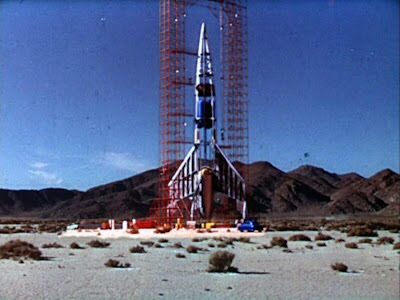 The Woody Woodpecker cartoon attracts investors (it's called "science fiction" for a reason...) and pretty soon construction begins on a Moon rocket using atomic energy to create enough steam thrusters to power it out of Earth's gravity and to the Moon. The entrepreneurial heads of the program are going to be the ones on-board for the flight, not test pilots, and they are Jim Barnes (John Archer) the aerospace magnate whose company built it, famed rocket scientist Dr. Charles Hargraves (Warner Anderson) who designed it, retired General Thayer (Tom Powers) who wants America's presence in space to be used for deterrence and technician Browne (Ted Warde) who supervised the technical aspects of the good ship, Luna.