Showing posts with label Jenny Agutter. Show all posts

Friday, June 22, 2018

Walkabout

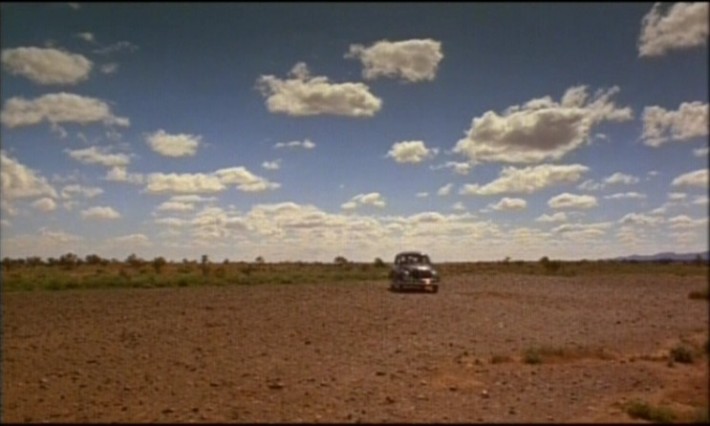
Walkabout (Nicolas Roeg, 1971) The clash of civilizations has long been a staple of film-drama, and many of the most thoughtful films on the subject have come out of the Australian wave of the 1970's and such film-makers as Peter Weir, Philip Noyce and George Miller. But, anticipating the emergence of "Aussinema" to the world-screens was this Australian-set fable of children stranded in the outback, and their rescue and immersion into the aboriginal, directed by radical cinematographer Nicolas Roeg (adapted from the 1959 novel by James Vance Marshall originally entitled "The Children"). Told mostly without a narrative thread, with circumspect dialogue in a frequently non-linear manner, the film is a lushly photographed quilt of styles and methods, flashing forward and back, seemingly made up of fantasy and memory; indeed, one can't be sure after the film is over, that the whole thing isn't a dream...or a wish...a false memory...or an act of contrition.
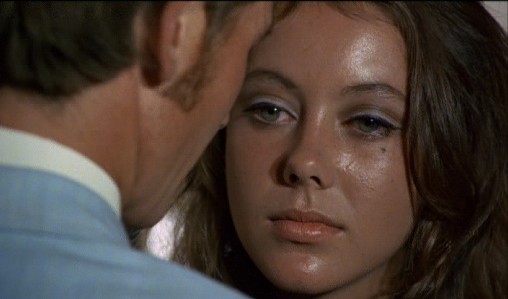
Two children (Jenny Agutter and Lucien John--son of the director), never named, are picked up by their brooding father after school. She is in middle grades, and he in grade school. Father drives them outside of Sydney, far out to the desert interior of Australia, and as the kids sit up a picnic, he pulls out a gun and attempts to kill them. They flee for their lives, and the man, stricken with inexplicable self-destruction, douses his VW bug in gasoline, sets it ablaze and shoots himself. 
The children are stranded in the desert, in their school-clothes, with no shelter, food or water. Worse still, they're city-children in the wild with no survival skills to fall back on. The only thing they can do is walk, and keep walking. Eventually, hopefully, they'll reach civilization.

But Civilization may not be what they need.
Nearly at the end of their ability to survive, they come across an aborigine (David Gulpilil) on a walkabout as a rite of passage, and the three children form an alliance of sorts for survival in the desert. The native provides water, and food and keeps them alive. The stranded kids can merely follow and comply: The younger child is "okay" with everything, the closest to nature and accepting of everything. The girl is a teenager caught between innocence and societal regimentation, sexually curious of the aborigine but already mindful of her place in the strata of society. The aborigine simply is. As provider for the children, his intentions become conflicting as his relationship to the two grows. It may be that he never intends to take the boy and girl back to civilization.
As one can expect with Roeg, there are distractions from the main story: a sequence with a team of desert climatologists plays like a rudely-placed combination of Fellini and Keystone Cops; shots of the native boy killing for meat are inter-cut with scenes from a butcher shop (okay, point made); a group of aborigine's forced to make kitsch art by a brutal overseer; a hunting scene is interspersed with an extended skinny-dipping swim by Agutter. The images transition from majestic nature-scapes to 8 millimeter scratchiness and back again. John Barry's lush score supports it all with over-arching brass and mixed choirs.
Roeg has never been a meek film-maker. His films are charged with adult themes and subject matter, brutality and sexuality, and unblinking presentations of that material. Compared to such diverse films of Roeg's as Performance, The Man Who Fell to Earth, and Eureka, though, Walkabout is pretty tame. But it is, at times, brutal. When I first saw it in its original theater run, soon after its premiere in 1972, I did not know that there had been sections stripped out of it in order to give it a PG rating (or GP, as it was known back then) in America. Those sequences involved the killing and cleaning of animals by aborigines, shot in a grainy, washed out, home-movie-ish style. 
Those sensitive to those images would do well to stay clear...or hide your eyes. But its part of the make-up of the film and the story. Roeg could have left them out, as the original distributing company did, but it would have eliminated an essential element of the brutal circumstances the kids are surviving, and how it contrasts with the plastic-packaged meat departments their parents travel through in the cities far removed from the more severe Australian interior. 
Still, despite the grit, and the parts I never knew were missing when I first saw it, Walkabout still struck me as one of the most beautiful, intriguing, and challenging films I had ever seen. In its expanded, uncensored form, it still does. It could be a children's film, if it wasn't so "adult." It could be a fantasy, if it weren't so unflinchingly harsh. Instead, it's a rather clear-eyed vision of the wonders of the world, both in terms of beauty and ugliness, the two part and parcel of Nature and life. And the ending is properly ambiguous with a culmination both positive and tragic. And it is quite damning in its portrayal of civilization's ability to sin by omission and still feel good about itself. True to its nature, but not to the natural, we are left at the end, presented with an idealized version of events—a romanticized dream, a false memory, and these final words spoken on the soundtrack.

Into my heart an air that kills
From yon far country blows:
What are those blue remembered hills,
What spires, what farms are those?

That is the land of lost content,
I see it shining plain,
The happy highways where I went
And cannot come again.

"A Shropshire Lad" (Part 40) by A.E. Houseman


The film's original British "quad" poster

Saturday, November 21, 2015

Logan's Run (1976)

written September 5, 1976

Logan's Run (Michael Anderson, 1976) Logan is a movie I'd like to have been a part of. There are so many steps where someone should have taken Saul David, Michael Anderson, or David Zelag Goodman by the hand with a warm glass of milk and a cookie and explain to them that what they wanted to do wouldn't work, and that the slip-shod way they were planning to realize it wasn't going to help it, either.

Mind you, there are some things I like. The 
Jerry Goldsmith score (what, I'm going to desert Goldsmith now? Herrmann's dead and Barry's comatose!)* Jenny Agutter is in it, and provides some moments of acting that actually seem natural in this spectacle of the unnatural (unnatural matte shots, etc.) (Why, in God's name has it taken Jenny Agutter five years since her last movie to appear in another one? The insight and wisdom displayed in her performances in The Railway Children, and in (Nicholas) Roeg's Walkabout should have made her much more in demand, since she is undoubtedly the best young actress since Pamela Franklin--and have you seen what's she's been in lately?)** Peter Ustinov comes in and says his lines like he just thought them up, and makes Michael York et al. look like The Reader's Theater.

I was in love with Jenny Agutter and this is an angle from which you should never see Michael York.
The film brightens up a bit once York and Agutter reach outside, not only because we, the audience, are on familiar ground, but also because we're out of those God-awful sets.
Washington D.C. has returned to swamp-land at the time of Logan's Run.
A friend of mine who's read the book says that book and movie have only the title in common. It's too bad that this should be such a turkey. I remember Bruce Dern's plaintive cry in Silent Running--"What happened to the flowers?" Walking out (of Logan's Run), echoed in my mind "What happened to the $8 million?" Sleazy matte shots. Cruddy model shots. And from the company that put 2001 together.***It has been said that we are about to be engulfed by a resurgence of sci-fi movies, their popularity expanding in the fifties, and then dwindling out to be revived when someone came out with a new special effect technique. Now, unfortunately, it looks like Logan predicts a resurgence of '50's technique. What happened to Magicam that was supposed to be so revolutionary? Is everything being used on the Star Trek film?****
The city-scape of Logan's Run looks like it could have been built in somebody's rec-room
But, lest it be mistaken that I am concerned only with special effects, let me say that "Special effects are worthless unless the ideas presented are special, as well!"***** Or else we get things like "Space: 1999" which looks gorgeous, but its scripts have the consistency (and intelligence) of tapioca pudding.******  (I'm writing this in a camper-pickup truck bouncing over Wyoming's dirt roads). We must have intelligent writing! (and I'm not helping!)
Logan (and Jessica) running
Ah, youth. Pretty bad and squirrelly writing here (and I was complaining about intelligent writing—heh), even for the back of a pick-up truck, but my sentiments about Logan's Run haven't changed one jot. The sets are cheesy (although setting the city in a mall was, in retrospect, a particularly good idea--we'll probably all live in hermetically-sealed malls in the future), the effects ARE bad—the city-scape miniatures wouldn't pass Gerry Anderson "Thunderbirds" muster and the matte shots have edges that disappear—and the original story is fairly trashed. Director Michael Anderson's idea of composition is to make an impressive proscenium arch set and put the actors in the middle of it. Not exactly inspired work here.
Reflective of the tawdry set-design of Logan's Run
(and, yes, that's Farrah Fawcett walking in the foreground)
Clearly, he didn't think about improving the screenplay much. The dumbest decision by the movie-makers is to make the central theme of the book, the lottery for "renewal"—that is, the chance for those turning 30, (21 in the book) to be given a few more years of life or "renewed"—a spectator sport. You'd think that after watching weekly events that destroy every participant taking part that one of these young people would come to the conclusion that NOBODY ever got renewed. I don't care how self-absorbed or de-sensitized or drugged-out they are, someone would notice. If they were looking for a war-draft metaphor, it doesn't get past a glancing consideration before it falls apart.
"Renewal" is staged like a sporting event, but nobody's keeping score.
They're working on a remake now, which might be the perfect thing for a youth-dominated movie market of kids barely out of their teens. In the meantime, the film had an unofficial distillation of themes in Michael Bay's The Island.
Some more of the bad set-design...and WHAT are these people wearing?
The latest: I wrote that last bit in 2008—and they are (in 2015) STILL talking about a re-make of Logan's Run—this time with Ryan Reynolds starring (too old, actually) and Simon ("X-Men" series) Kinberg writing and possibly directing (He's a big fan of this movie, so I don't hold out much hope for it). The next time I run this piece it will be probably still be un-made, despite recent press hyping the relatively short novel into a Hunger Games/Divergent/Maze Runner-type movie series. 

And by the way, how's that Fahrenheit 451 remake going?
* I've written about Goldsmith here. Composer Bernard Herrmann had recently died (his last released score--for DePalma's Obsession would be released a scant two weeks later. And John Barry was not comatose--I was being facetious--but he had relaxed his movie composing style to a slow dirge pace orchestrated for a massive number of strings.

** I wrote this when I was 21. All I can say in my defense is I had the "hots" for Jenny Agutter, so I was partial. I think it was because she didn't mind doing nude scenes. And there wasn't five years between movies--I just hadn't seen any of the ones she'd made in that time.  Agutter continues to act occasionally--to show how time passes, she actually played the mother in a remake of The Railway Children, and had a role in the excellent "Mi-5" series (aka "Spooks"). She can currently be seen as a nun on the BBC series "Call the Mid-wife" and she's also one of the shadowy S.H.I.E.L.D. heads in the Marvel Film Universe. 

Pamela Franklin (who I also found attractive) had just appeared in The Legend of Hell House (hence the remark).  I still think both actresses are very talented, now given the objectivity of years (hell, decades), and I see myself whenever I read some inexplicably passionate comment in IMDB that says that (say) "Selena Gomez/Jennifer Lopez/Jena Malone/Rachel Bilson/Nicola Peltz/Emma Watson/NameSomebodyHere is teh best actress ever and should win an Oscar!!!" Mm-hmm.

*** The distribut
or has nothing to do with it, kiddo. It's the producer and the director and the design team. 
On the road-trip where we saw this movie, we stopped by the
Ft. Worth Water Gardens where this was filmed. We didn't visit the Mall
where a lot of the interiors were shot.
**** The plight of the science-fiction film would be resolved (or made worse, depending on your view) the next year with the release of Star Wars and Close Encounters of the Third Kind. The success of these films kick-started the on-again/off-again Star Trek film and its resultant film series. And Magicam is not the hardware or the app, it was a VFX company that was attached to the first still-untitled Star Trek movie that would become Star Trek: The Motion Picture.
***** This was originally bolded in big block letters. The sentiment is still good (if obvious everywhere except Hollywood), but, really, there's no need to shout!
Jenny Agutter O.B.E. today—from Captain America: Winter Soldier
****** In my dotage, I have acquired a taste for tapioca pudding.