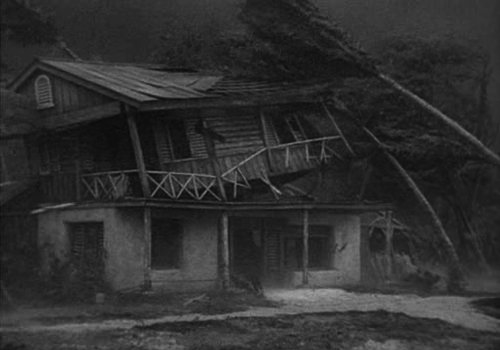
The Greatest Show On Earth (Cecil B. DeMille, 1952)

Insufferable.
In every way, insufferable.
Let's leave out winning the 1952 Best Picture Oscar (over High Noon and The Quiet Man*), as obvious Hollywood Industry pandering during the McCarthy Era anti-communist witch-hunt to the Grand Wizard of that cause, Cecil B. DeMille.
Let's just take that out of the equation and take the film for what it is.
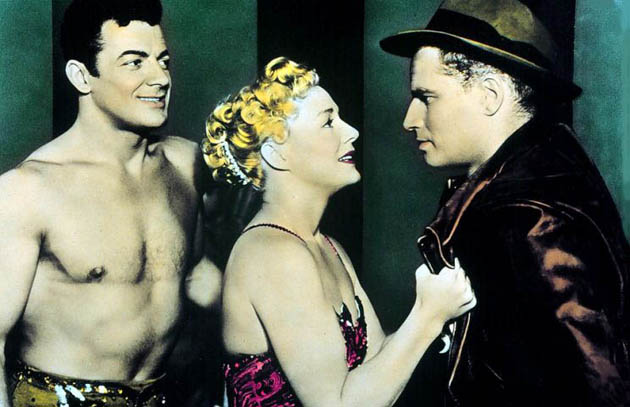
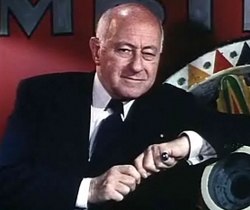
The Greatest Show On Earth is an extended commercial/documentary/drama for The Ringling Brothers and Barnum and Bailey Circus. Filmed in eye-popping Technicolor (which is where the film, showing off the bright colors in many hues, truly is spectacular), that begins with the Director sepulchrally narrating a series of work-a-day location footage of the circus being prepped for its yearly run. The pompous tone that he sets is akin to a war film, the army metaphors stacked up thick and deep like a chain of marching elephants, with all the accompanying lack of grace and subtlety. Leave it to DeMille to take the fun out of a circus and turn it into something resembling boot-camp.
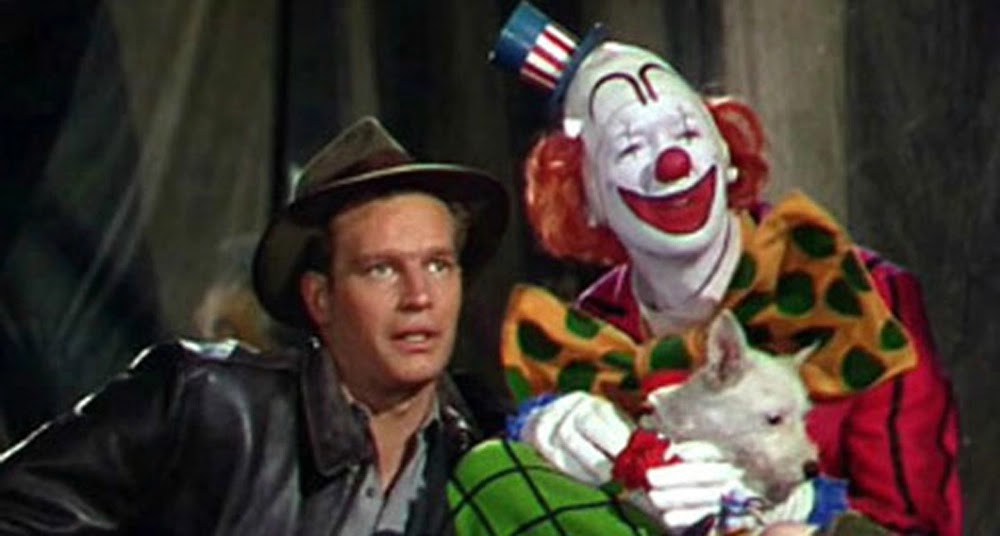
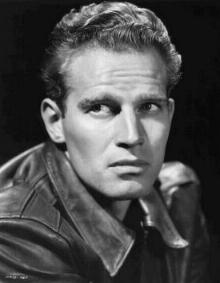
This top-billed character is particularly annoying. Hutton could play dumb well (with a vocal range from A to A-), but here's she's a schizo in need of a pair of padded tongs and a generator, with a change of motivation and character for every change of scene. Buffed up to do her own trapeze stunts (smattering of applause for that), her character is so insecure that she's a harpie spinning like a Tasmanian Devil: "I HATE the Great Sebastian!" "I'm JEALOUS of the Great Sebastian!" "I LOVE the Great Sebastian," "No, now I HATE the Great Sebastian!" "I LOVE you, Sebastian!" "I feel GUILTY about Sebastian" "I'm going to forsake my Ca-REER for Sebastian!")  I pity Sebastian, myself. As well as Heston, the guy you see rubbing his neck from whip-lash. See, she's in love with his character, although she's annoyed with the fact that he spends all his time trying to keep the Circus going, thus letting her keep the only job she's capable of, besides waving on floats. Hutton's Holly not only wears her heart on her sleeve, but also her ankle, around her pretty little neck as a broach, as a hat, anything but a symbol of commitment. She accuses Heston's Brad Braden** of having "sawdust in his veins"—at least he's got something in his. I wanted her capped in the head with her own trapeze twenty minutes in. Probably sawdust in that, too.
  No such luck. Before one can turn their attention to what Holly would look like in the tiger-cage and quicker than one can shout "Sebastian! No! Don't do it without the net!!," tragedy does befall the circus leading to broken bones and souls, angst and recrimination and another case of Holly-pong in desperate need of a net...held by men in white coats.
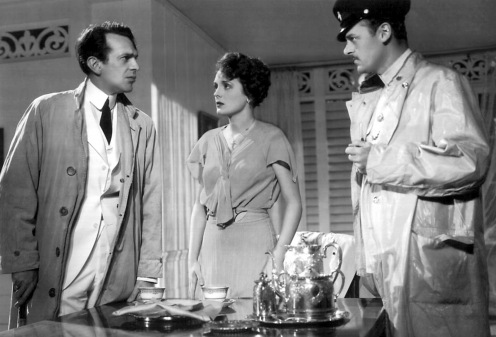
  The movie sets up a dull pattern: stentorian documentary section narrated by DeMille on "Circus as War Machine"/slide wipe to melodrama/slide-wipe to an extended sequence of abbreviated cir-cussedness that manages to make you feel slighted while still feeling interminable each time. Along the way, much of the subjects' opportunities are squandered, if not down-right sabotaged. For a scene of DeMille's heavies planning badness, DeMille stages the two Runyon-esque hoods*** (without the quaint patois) in front of a process shot simulating the outdoors. Halfway, DeMille cuts to a tighter shot of the two, but behind them the projection-screen image doesn't move, making it look like they've quantum-jumped closer to the camera. It's an amateurish give-away of a process shot.
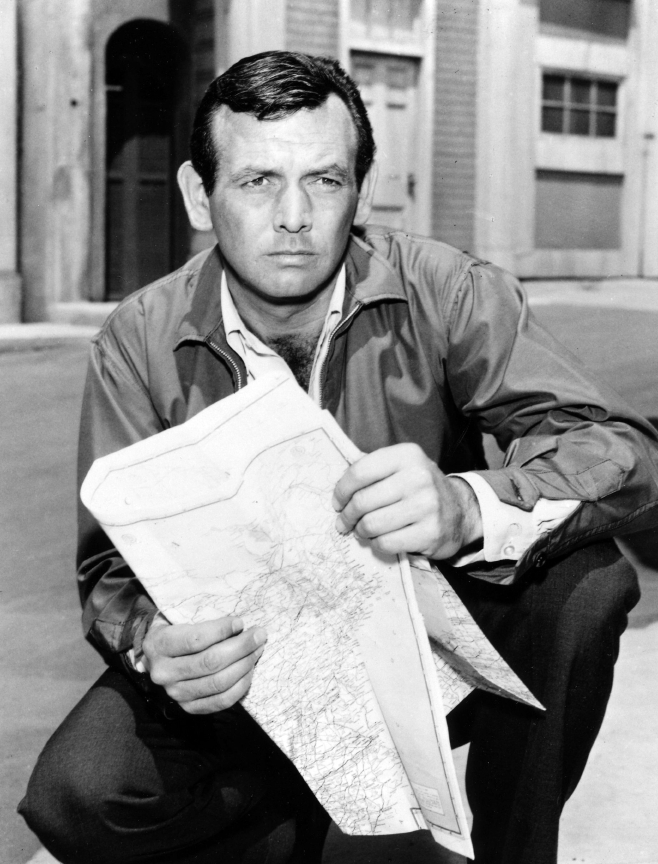
And there's a cynical, rather crude attitude towards the circus audience—pandering to the audience while bashing them at the same time by endlessly showing giddy parents consuming ice-cream cones while their bored children look like they to want to erp up their cotton candy. But as the originator of this particular circus so famously said: "There's a sucker born every minute!" DeMille knew that lesson well.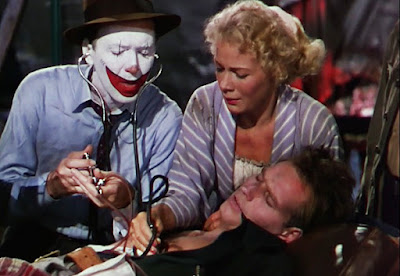 Another lesson is the one of justice, where kindly Dr. Buttons (James Stewart in perpetual clown make-up...Richard Kimble never used that trick!), a surgeon on the lam for murder, unselfishly sacrifices himself by helping injured people on a train-wreck, exposing his true identity and is rewarded by getting cuffed and hauled off to the iron bar hotel. It was the '50's, after all—he could have been lynched. That would have to wait for prison, I guess. Thanks, doc! Take him away, boys.
  Another little game of the movie is a sporadic "Spot the Stars." There's Hopalong Cassidy! There's...somebody? Is that dewey debutante Jeanne Crain or a DeMille "ingenue?" And Bob Hope and Bing Crosby show up during Dorothy Lamour's number because its a Cyclical Universe on the Paramount Lot, with very tight gravitational rules; you could almost make a case for Creationism.


And there's a cynical, rather crude attitude towards the circus audience—pandering to the audience while bashing them at the same time by endlessly showing giddy parents consuming ice-cream cones while their bored children look like they to want to erp up their cotton candy. But as the originator of this particular circus so famously said: "There's a sucker born every minute!" DeMille knew that lesson well.


"Hey, is that Roddy McDowell?"
At some point during this megalith, you begin to realize with butt-numbing certainty, that if DeMille had cut out any of his "Circuses aren't some pink clown-show, they're American Hard Work" lectures, or maybe cut a "Tribute" sequence or parade or two, or one of the forgettable songs (or allowed Holly one less seizure) that the movie wouldn't have had to clock in at 2 1/2 hours in length.
2 1/2 hours is a longish book, with...ya know...subtleties, not a circus movie. But DeMille must have seemed unable to strip whole sequences, however redundant, away. Like Spielberg wanting to over-stuff 1941**** with beloved-by-none-but him-gut-and-budget-busting sequences, DeMille super-saturates the screen until the Technicolor fairly bleeds. And he couldn't bear, or didn't know enough, to cut any of it.  The only thing never mentioned in the many of DeMille's "Bozo Marches On!" narrations, is the requisite shoveling of the tons of manure. Why bother? The evidence is all there on the screen.


In a brilliant "meta" move, DeMille stages a train-wreck in a train-wreck.
* ...and the not-even-nominated Singin' in the Rain.
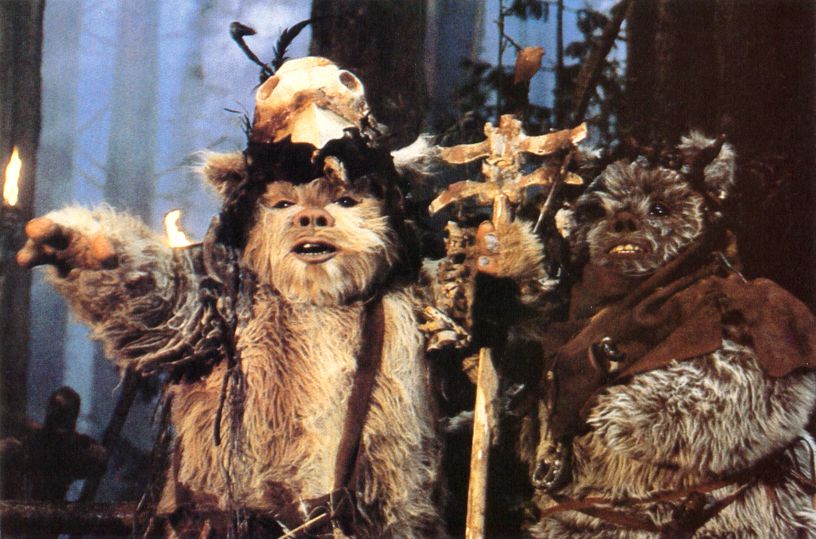
** ?...Brad Braden...of the "we-couldn't-come-up-with-a-better-last-name" Bradens? I think he became an "Ewok" trainer in later life.
*** One of them being Hollywood bad boy/guy Lawrence Tierney. He and Heston have a seething scene of clashing testosterone blasts.
**** It was this very movie that inspired the Spiel-boy-g to pursue a career directing films. Spielberg learned his lessons concerning movie elephantiasis in his 20's. DeMille was in his 60's.