Juggernaut(Richard Lester, 1974) Made in the shock-wave of such star-culling epics as Airport, The Poseidon Adventure, Earthquake, and The Towering Inferno that had the gall to ask: "Who Will Survive?" in its posters, Juggernaut played the same game. See? All the stars are lined up like ducks in a gallery reading to be pinged, just like those other all-star slaughter fests.
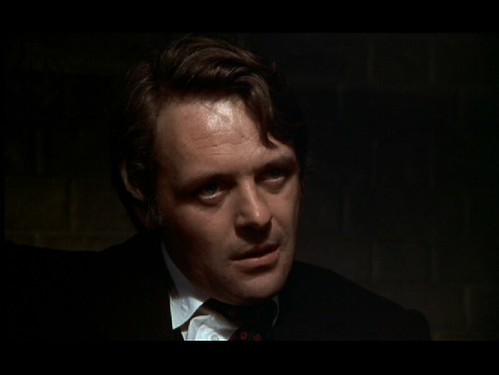
Juggernaut plays the game differently, though, while maintaining the conventions. This film is as soapish as the others in terms of interpersonal relationships. But in other disaster movies, people are collateral damage to the epic depiction of crumbling masonry. Lester's film is all about character—the "disaster" is man-made, the people at-risk are portrayed intimately, if not by stars, by strong character actors (Clifton James, Shirley Knight, Michael Hordern, Cyril Cusack, Julian Glover, Roy Kinnear—Lester's favorite buffoon is given a part to shine in this film—Ian Holm, a pre-fameAnthony Hopkins) you begin to care about.
The cast is filled with faces who would become more familiar in later roles, but the two leads are Omar Sharifat his dyspeptic best as the Captain of the threatened ship and Richard Harris, who was never better than he is in this movie.
The cruise ship SS Britannic is half-way across the Atlantic Ocean when the line's president (Holm) receives a phone call from "Juggernaut" saying there are seven barrels of high explosive rigged to go off the next day at a predetermined time. Unless a ransom is paid, the bombs will go off and the ship will sink. With the ransom, instructions to defuse the bombs will be sent. Any attempt to defuse the bombs will cause them to explode. Holm's president wants to pay the ransom quickly, but the British government threatens to pull his operating subsidy if he negotiates with terrorists. While Hopkins' Scotland Yard detective attempts to find "Juggernaut,"bomb expert Tony Fallon (Harris) and his crew are sent out to the Britannic, dropped in the ocean, and clamber onto the boat.
The focus shifts to Fallon, who sees all defusing jobs as a form of psychology—he's not trying to figure out the bomb, he's trying to figure out the man who made the bomb, and the tense scenes of Fallon examining one bomb to relay instructions to his crew are a whispered monologue of a man on the edge of death attempting to read the mind of the puzzle-maker in a battle of wills.
For director Lester, who is fond of games and puzzle solving, the film is one of his obsessions brought to life with the bomb design being particularly devious. Given its nature, one is put immediately into the Fallon mind-set that he is battling a man and not a bomb. And it is this interplay, where one man must rely on his skills and his knowledge, rather than the tides of Fate, that makes Juggernaut sail past the other films in the sub-genre.
The Three Musketeers: The Queen's Diamonds/ The Four Musketeers: Milady's Revenge(Richard Lester, 1974/1975)These rollicking films were originally planned as a two and a half hour epic (no matter what the Producers now say!) may just be one of the best adventure films (and adaptations of a classic novel) ever adapted, balancing the demands of the story, the tenor of the times in which it was made and the idiosyncrasies of its director.
When approached, Richard Lester (who hadn't made a film since The Bed Sitting Room in 1969) wasn't enthused. Then he read the story, and did some research...and heartily agreed. One can see why. For The Three Musketeers, as Lester and his screen-writer George MacDonald Fraser envisioned it, is a story of intrigue done in high places, but carried out by the lackeys and foot-soldiers who live only to serve. Forget that the palace-dwellers are either snakes or dullards—they provide an opportunity for income and adventure--two qualities lacking amongst the citizens of France and England, who, at the time, are at war. The opportunities for thrills, humor and rapier-pointed satire are rich and mined well by the film-makers.
And Lester's direction is masterful—simple set-ups and multiple cameras are used during the swash-buckling to make sure there's a glimpse of every buckled swash. And those scenes are choreographed as a group participation so that every Musketeer has "business." Lester also worked to make sure that the fights were inelegant affairs--not balletic, as had been the tradition, but more like street-fights, with few rules and the use of landscape and surroundings as equal strategies to the sword technique (and every part of the sword is used, as opponents are sometimes conked with the ornate handles). And, as Lester was renowned as a "one-take" director, opportunities for mis-haps, mess-ups and stumbles only added to the verisimilitude. Sure, the action was rehearsed, but any imperfections made things seem more real.
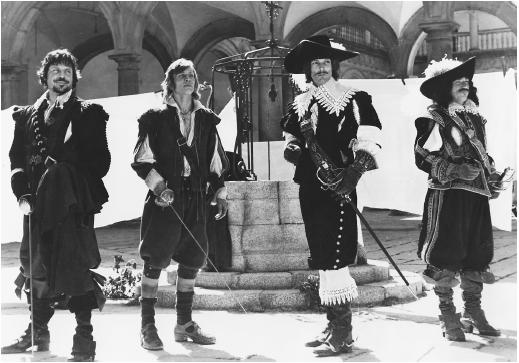
Reed, Finlay, Chamberlain, York and Kinnear enjoying the fruits of their labors.
Lester surrounds the royalty with games and idle amusements that have a slight tint of mindless cruelty to them, and that extends to the villains, whose elaborate machinations involving the Royals are merely extensions of those same games, with regime-toppling consequences.
A royal chess-game with dogs and capuchins
And the cast! As the musketeers, Oliver Reed as the surly Athos, Richard Chamberlain as the effete Aramis, Frank Finlay as the clownish Porthos, and Michael York as the young and naive D'Artagnan. As the Royals, Jean-Pierre Cassel as the foppish King Louis XIII, Geraldine Chaplin as the frail Queen Anna of Austria, and Simon Ward as the rakish Duke of Buckingham. As the villains, Faye Dunaway as Lady De Winter, Christopher Lee as the villainous Rochefort, and Charlton Heston in one of his best performances as the Machiavellian Cardinal Richelieu. Rounding out the cast are Raquel Welch as the Queen's seamstress, the accident-prone Constance de Bonacieux,*Spike Milligan as her randy husband, and Lester regular, the great Roy Kinnear as D'Artagnan's man-servant, Planchet. A superb cast, rarely equalled.
Welch and Dunaway as good girl/bad girl
It's long been contended that the film was supposed to be one movie, but that the Salkind's split it into two to maximize profits. That's the rumor—there is a natural split of the film at the half-way point that features almost all the actors for a sort-of bow, but it could have easily been used as the starting place for an intermission. It's born out by the fact that there is less movie in The Four Musketeers, it being padded with an "up-to-that-point" narrated prologue.
Charlton Heston in one of his best performances as Cardinal Richelieu
The two-film scheme is helped by the fact that there are two very distinct stories of different tones, both of which are resolved, the first being the intrigue-filled, but relatively light-hearted The Queen's Diamondsstory (in which Athos, Aramis and Porthos are wounded, but not killed), and the second, Milady's Revenge where the Palace forces seek to disrupt whatever kept them from succeeding in the first one. That story, with its be-headings, extended back-story and several prominent deaths, is less fun (although certainly as clever) and considerably darker. Where Part 1 is rollicking fun with minimal consequences, the stakes in Part 2 are very high, passions flare, and the sword-play becomes deadly and fraught. The humor is darker than the first, too. Despite the same cast and crew,**the two are very different films. The combination of the two of them would have left audiences winded and less ebullient (and more anticipatory of a continuance).
Two other highlights: David Watkins' exquisite cinematography and the hysterically ornate costumes.
Taken together, they have a moralist's sensibility of the costs of frivolity and duplicity; adventure can be fun, but in a poisonous political atmosphere, one adventures at one's own risk. You can have a good time watching The Three Musketeers, but the story is incomplete without the paid dues in The Four Musketeers. Together, they make one of the finest adaptations of a classic novel ever put to film.
* Welch, not the most versatile of actresses, won the Golden Globe for her hilarious performance in The Three Musketeers and tearfully told the crowd "I've been waiting for this since One Million Years B.C.!"
** ...except for the score composers--Michel Legrand for The Three Musketeers and Lalo Schifrin for The Four Musketeers.
 Juggernaut (Richard Lester, 1974) Made in the shock-wave of such star-culling epics as Airport, The Poseidon Adventure, Earthquake, and The Towering Inferno that had the gall to ask: "Who Will Survive?" in its posters, Juggernaut played the same game. See? All the stars are lined up like ducks in a gallery reading to be pinged, just like those other all-star slaughter fests.