Written at the time of the film's release...(although, here, outdated links have been deleted and more relevant ones have been inserted...and then, I'll post the thing on "Facebook"...which is so "Meta")
"Saving Facebook" ("Every Creation-Myth Needs a Devil")
or
"There's Somethin' Happenin' Here (What It Is Ain't Exactly Clear)"
"O wonder!
How many goodly creatures are there here!
How beautious mankind is!
O brave new world,
That has such people in't!" (The Tempest, Act V, Scene 1)
Maybe it is too early to make a movie about Facebook (out of MySpace and Friendster) and the ramifications of our Brave New World of cyber-relationships. Maybe it is a little too "street-corner sage" to predict The End of the World As We are Sorta Familiar With it (But Not Really...More Acquaintances, Really). But, it is interesting to see a story about the Frankenstein behind the Monster, if only to see how each reflects the other.
And even though we're secretly rooting for The Monster.
And, at this point in time, there isn't a better team to make The Social Network than Aaron Sorkin and David Fincher. Sorkin, the mad savant behind some of the better TV shows of the past decade and a half, has always written about people and their "issues," and how personality impacts policy. Fincher has matured from an ILM tech (who was happy to fly cameras through coffee-maker grips**) to an intricate observer of societal pressures on the psyche. For the two of them to make this particular story is a Friend Invitation made in Hollywood Heaven. "Accept" it. But, you can't "Ignore" it.The movie begins with a date going badly between Mark Zuckerberg (Jesse Eisenberg, late of many movies with "...land" in the title) Harvard wall-flower, and Erica Albright (Rooney Mara—she'll play Lisbeth Salander opposite Daniel Craig in Fincher's big-budget version of The Girl with the Dragon Tattoo), an acquaintance. Anyone familiar with the machine-gun dialogue that writer Sorkin is known for, had better duck for cover—or wait for this on DVD so you can...play...it...slooooowly—for he now has an automatic weapon for a word-processor, and a co-conspirator in Eisenberg who can milk every nuance out of a line, despite hyperventilating it at debate-competition speed. His Zuckerberg is a "no Dolby/no squelch" type of unreadable conscience, and Eisenberg plays it with a deadness behind the eyes that interprets the world as a problem, if not necessarily a challenge. He's a bit too candid for a first date, and she stomps off, which sends him on a mission, simultaneously trashing her on his blog (LiveJournal) and culling the pictures of every woman on campus to create a "Who's Hotter" web-competition that becomes so popular so instantly that it crashes Harvard's web-infrastructure. He becomes both famous and infamous for the stunt, guaranteeing he'll never get a date in college, and attracting the wrath of the college's board, and the interest of two preppies attempting to create an exclusionary social network on the web. He goes them several steps better, making a system open to everyone on campus that trumps their attempts, and as it gains "friends," expands throughout the college system.Hindsight is 20/20, and Sorkin constructs the film as a series of depositions after the fact (of Facebook's success) as everyone who thinks they've been burned by Zuckerberg testifies to his vague promises and dealings under the table.*** Of course, they have every right to sue—but they'd only sue if "The Facebook" was a success—and the underpinnings and double-dealings don't resemble a fight for satisfaction, or a Noble Quest, so much as resembling a snake eating its own tail. ****Which brings us back to Frankenstein and his Monster. The film itself is expertly done—it is a complicated story of hidden motivations and the presentation of masks before public faces—and Sorkin and Fincher manage to navigate us through the maze of the story, even though one feels there is no cheese at the end. The experience is a bit hollow, which may be a part of the point.
Because the Facebook experience is hollow, as well. As hollow as Zuckerberg, as portrayed in this film, is. While it is nice that one has the opportunity to "re-connect" with old friends in a virtual environment and satisfy everyone's need to (as one friend commented on blogging) "talk about what you had for lunch," one wonders why one has to re-connect at all...especially if the relationship wasn't maintained in the first place. Not enough time in the world to meet? Because a "real" relationship takes time, takes effort, "gets messy?" Facebook provides the illusion of "staying in touch," without actually touching. Like Zuckerberg's abortive "date," a lot of time is spent broadcasting, but not interacting. There are, of course, exceptions. But the fact of the matter is Facebook's cyber-community is not a "Brave New World" at all. Just the opposite. It provides a substitute in lieu of commitment. A panacea in a life thought to be full to bursting and without risk. The most precious commodity we can give is time—slices of our lives and our selves. Facebook is a pacifier—a mass-Hallmark card that we can spend a few heart-beats picking out, and send away without a thought and not even sweat the cost of a stamp.
It soon becomes a numbers game—a collection, like the celebration of the 1,000,000th friend portrayed in the film. But who are those million people? Facebook doesn't know or care. It's just a number. A number of casual relationships, that may lead to something else, but probably won't. A collection, nice to look at, but more often, ignored. Trophies, and ones that don't need to be polished or buffed up.
It's a new world of blithely arrested development, in the image of its creator, where love and commitment do not compute, and the only thing close to it is "hope"—translatable as keystroke F5.
* Except for some dodgy freezing breath-work, the biggest special effect will be invisible to you until the closing credits. Nice.
** Personally, I'd like to get back all those hours spent on "ZooWorld."
*** An image that kept coming to mind every time I thought of writing this review, where it would subsequently be published...on B/C-L's's Facebook page.
Showing posts with label Rashida Jones. Show all posts
Wednesday, February 21, 2024
Wednesday, November 14, 2018
Dr. Seuss' The Grinch (2018)
Suess Cheese
or
♫ You're a Not-Altogether Embarrassing One, This Year's Grinch ♫
Dr. Seuss' "How the Grinch Stole Christmas!" is as much a staple of the Holiday season as Dickens' "A Christmas Carol." There have been all sorts of versions of that, so my heart would be three sizes too small if I were to complain there have been too many adaptations of Ted Geisel's slim little classic.
or
♫ You're a Not-Altogether Embarrassing One, This Year's Grinch ♫
Dr. Seuss' "How the Grinch Stole Christmas!" is as much a staple of the Holiday season as Dickens' "A Christmas Carol." There have been all sorts of versions of that, so my heart would be three sizes too small if I were to complain there have been too many adaptations of Ted Geisel's slim little classic.
There is, of course, your grandfather's "Grinch," directed by my hero, Chuck Jones—and which runs on television umpteen times, to this day, every Christmas season. Then, there's Ron Howard's elephantine, rude little live-action version of it (without the exclamation mark in the title, to which I heartily agree!) starring—and dominated by— Jim Carrey. The less said, the better—which should have been the first thing the producers told the writers before they started the script, as it was encumbered with an extended origin story and an awful lot of Who-oey in Whoville, when audiences probably wanted to see more of Carrey in his hairy Grinch costume. My memory of it was that it was interminable, loud, and had way too much padding in just about every aspect of production...including the costuming. The prospect of another "Grinch" movie—even an animated one, as they've been doing lately to more of the Suess-series—and to better effect than the live-action versions—did not exactly make my heart grow a size.
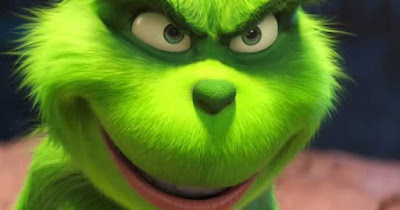
Well, Illumination Studios, which has done the Despicable Me series and the last Seuss adaptation, The Lorax, decided to tackle Seuss' "Big Gun," simplifying the title to simply Dr. Seuss' The Grinch, but retaining the plot, adding more prose (spoken by Pharrell this time), and keeping The Grinch's back-story to a minimum, and adding an interesting little sub-plot (which is rather ingeniously sneaky, although it will hardly be noticed) and adding a couple of amusing side-characters.
As per job-title, the Grinch (voiced this time by Benedict Cumberbatch—yes, he CAN do an American accent, Black Mass notwithstanding) is an un-diagnosed depressive, three bumper-stickers shy of being a postal bomber, living in his multi-level town-house of a mountain, overlooking the metropolis of Whoville, which is not the socialist collective as it's usually depicted, but a city with its share of desperation. We see this is as Mrs. Who (Rashida Jones) nearly has a breakdown trying to catch a bus home from working her night-shift to get home to tend to her kids—Cindy Lou Who (Cameron Seely), who is no longer "no older than two" but is in elementary school, and is far more scrappy than in Geisel's version.
Still, it's not a bad effort, helped immeasurably by Danny Elfman's music, with its combination of cooing innocence and bombastic deviltry—sort of a slam-dunk for Elfman, really, nobody else should have done it—just the right tone of Christmas Nightmare (which he's done before). He also did the music for Charlie and the Chocolate Factory, contributing the best parts to it, and managing to bring something new to the piece without the ghost of the previous version crowding it out. Those Ghosts of Grinch's past (good and bad) can't help but haunt this one and makes it, no matter which of the others you may prefer, at least a middling effort.
Well, Illumination Studios, which has done the Despicable Me series and the last Seuss adaptation, The Lorax, decided to tackle Seuss' "Big Gun," simplifying the title to simply Dr. Seuss' The Grinch, but retaining the plot, adding more prose (spoken by Pharrell this time), and keeping The Grinch's back-story to a minimum, and adding an interesting little sub-plot (which is rather ingeniously sneaky, although it will hardly be noticed) and adding a couple of amusing side-characters.
As per job-title, the Grinch (voiced this time by Benedict Cumberbatch—yes, he CAN do an American accent, Black Mass notwithstanding) is an un-diagnosed depressive, three bumper-stickers shy of being a postal bomber, living in his multi-level town-house of a mountain, overlooking the metropolis of Whoville, which is not the socialist collective as it's usually depicted, but a city with its share of desperation. We see this is as Mrs. Who (Rashida Jones) nearly has a breakdown trying to catch a bus home from working her night-shift to get home to tend to her kids—Cindy Lou Who (Cameron Seely), who is no longer "no older than two" but is in elementary school, and is far more scrappy than in Geisel's version.
It is three weeks before Christmas and all the alarm clock plays to wake up the Grinch is Christmas songs—starting with the Jackson 5 screeching "Santa Claus is Coming to Town" then "Feliz Navidad" by Jose Feliciano (I was ready to throw a book at the screen, myself), going through his wake-up routine—his dog Max does all the work—before finding out that his cupboard is bare "How much emotional eating have I been doing?" he laments. Apparently, a lot. And he and Max decide to go into Whoville to stock up.
It's never a pleasant prospect for the Grinch, but this trip, being so close to Christmas, is particularly galling, especially since the Mayor of Whoville (Angela Lansbury) has decided that this year's decorations and festivities are going to be three times bigger than last year's. The Grinch and Max barely survive a Christmas choir that starts coming after them like the Jets in West Side Story, before they run into Cindy Lou Who, in the midst of sending a letter to Santa Claus with a special request. He dashes any hope that he'll respond to her "list of demands," and then passes the house of the most enthusiastic Christmas decorator, Mr. Bricklebaum (Kenan Thompson), who has such a positive attitude that he even sees the Grinch as a friend.
After some therapy time playing his appropriately, Seussian pipe-organ—the song made me laugh out loud—the Grinch comes up with a plan—a wonderful, awful plan—to steal Christmas from under the noses of the Who's in a terrible midnight run diametrically opposed to Santa Claus'—rather than delivering presents in a single night, he's going to rob Who-ville of any sign of Christmas, right down to the last can of Who-hash.
So, he makes himself a Santa suit, steals a sleigh from Mr. Bricklebaum's elaborate Christmas decorations, then goes off a-hunting for reindeer to drive the sled. Unfortunately, Nature being Nature, he is only able to secure the slowest reindeer of the bunch—Fred, the reindeer—and takes him back to his mountain lair to coordinate how he's going to accomplish such a dastardly, grinchian heist.
You know the story (at least I hope you do). It plays out very much like the book and the previous versions did. And the line "maybe Christmas doesn't come from a store" is replaced in sentiment by the line—"He didn't steal Christmas! He just stole stuff!" It's a subtle distinction, maybe, but my Grinch-like withered heart tells me they didn't want to discourage consumerism and undermine the purveyors of it (after all, they ARE merchandising the heck out of this thing), so much as give the impression that said "stuff" is less important and should be held in less regard than the concept of togetherness and glad tidings (besides, The Lorax got enough backlash over a perceived anti-capitalist spirit). But, there's a couple other differences...
There's a parallel plot running throughout the movie alongside the Grinch's and it comes from a very unlikely source. Yes, ladies and gentlemen, Cindy-Lou Who is an unindicted co-conspirator. Heavens! Geisel is either turning in his grave or cackling over this turn of events. It seems sweet little Cindy-Lou has a special request of Santa and it's very important that he gets the message. It's too late to send a letter, trudging to the North Pole is too far, so she and some school-chums decide that they are going to Claus-nap Santa on Christmas. Oh, the delicious irony of the Grinch being nabbed in a Home Alone type kid-trap.
The other thing is a slight softening of the Grinchiness of the Grinch. There are hints that he's not quite as hard-hearted as, say, Jones' television version, which was ferociouslessly mean and revelled in his dirty work—it helped that he was voiced by Boris Karloff—whereas this version of the Grinch actually displays an act of kindness a bit earlier in the movie than in other versions of the story, that sort of undercuts his ultimate un-Scrooging at the film's climax. It makes the story a bit less heartening in the overall scheme, certainly less of a Christmas Miracle as was the intent. It makes him less of a Grinch than just a Grump.Still, it's not a bad effort, helped immeasurably by Danny Elfman's music, with its combination of cooing innocence and bombastic deviltry—sort of a slam-dunk for Elfman, really, nobody else should have done it—just the right tone of Christmas Nightmare (which he's done before). He also did the music for Charlie and the Chocolate Factory, contributing the best parts to it, and managing to bring something new to the piece without the ghost of the previous version crowding it out. Those Ghosts of Grinch's past (good and bad) can't help but haunt this one and makes it, no matter which of the others you may prefer, at least a middling effort.
*—so much so that there should by an additional day added to "The Twelve Days of Christmas" that includes "Thirteen showings of Chuck Jones' version of "How the Grinch Stole Christmas!...."
Friday, June 8, 2018
Disney's The Muppets
One for the kids...written at the time of the film's release.
"Of Muppets and Meat-Puppets"
or
"Old Feelings Being Felt"
Back in the 1980's Lord Lew Grade made a ton of green with the syndicated "The Muppet Show," which took Jim Henson's cast of characters and had them stage a show in an abandoned theater every week, with practically every bi-ped celebrity host imaginable, ranging anywhere from Bob Hope to Johnny Cash, with the only possible exception being that of Steve Jobs.
Now it's the 2010's and (as the joke goes) not only do we have no Jobs, but no Cash and no Hope. But, at least we have legs. Pity the poor Muppets; they can't stand straight without somebody's arm supporting them! Subsequently falling on hard times, with the prospect of their old theater being acquired and demolished for mineral rights by a greedy oil cowboy named Tex Richman (Chris Cooper, once again channeling his inner Shrub), Kermit the Frog (Steve Whitmire) must get the gang together to try and save the theater and protect the very integrity of the name "Muppet." He has unlikely allies—Gary (SNL's Jason Segel, who co-wrote the hyper-joked, "fourth" wall-exploding screenplay with Nicholas Stoller) and Mary (Amy Adams, who is as goofily inspired in this as she was in Disney's Enchanted), who get mixed up in the plan because of Gary's devotion to his brother Walter (Peter Linz), who was born...a muppet.
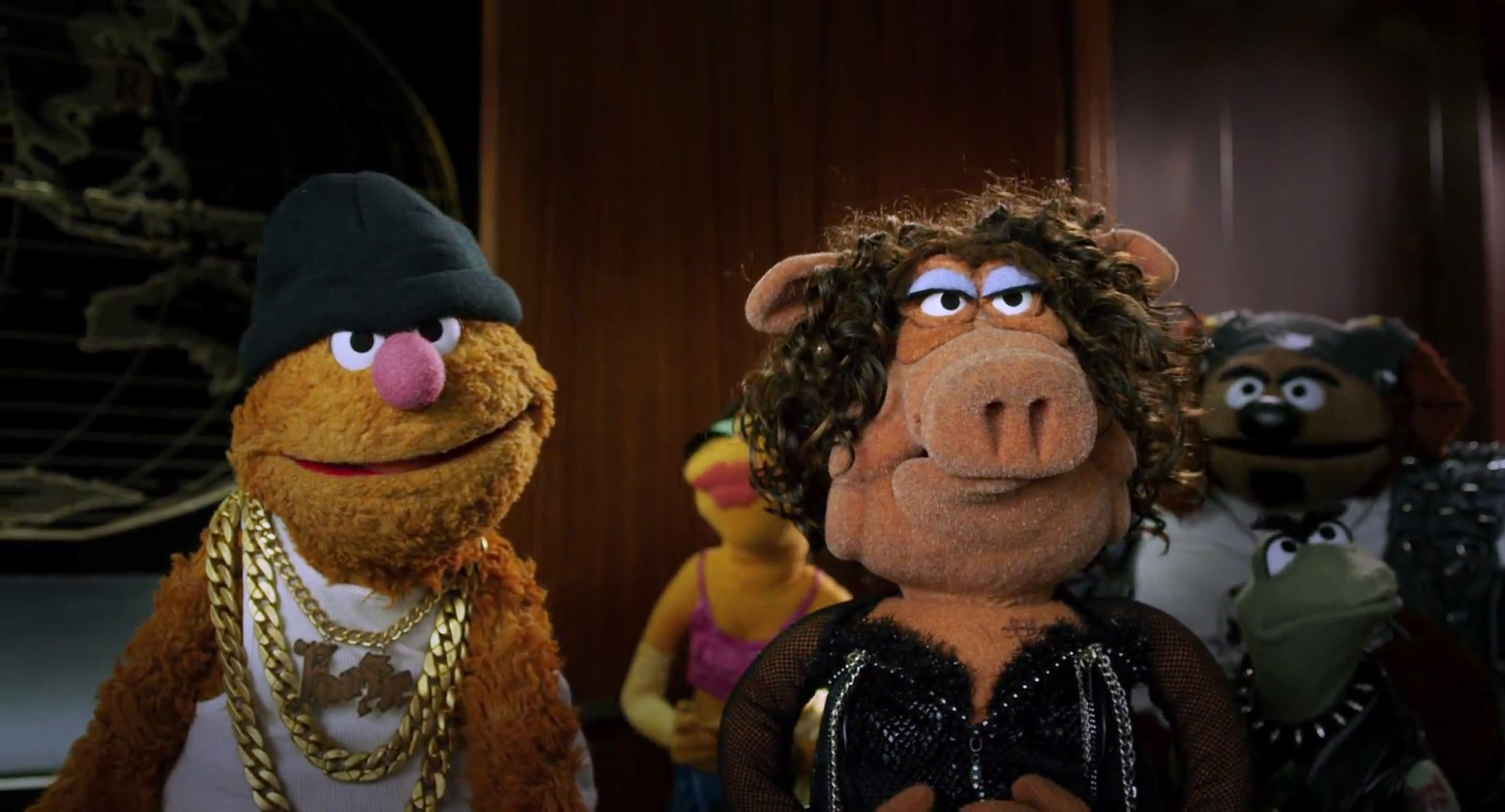
Okay, okay, already the movie is straying into terri-story that has some under-pinnings of life-lessons to them. Plug "muppet" into the "Mad-Libs" space where "developmental challenge" or "specified minority" would go, and you have a nicely anarchic spin to the usual "inspiring" story that...well, a studio like Disney likes to make every now and again. But, Disney always does best when it thinks "outside of the castle" and by re-tooling the Muppets for 21st Century kids* (and their parents who watched them in the 1980's), using Segel and Stoller's less-than-respectful approach to Muppets, mores and movies, a slightly hipper slew of cameos, and the musical supervision of Bret McKenzie (the part of "Flight of the Conchords" that is not Jemaine, and the songs are instantly identifiable as "Conchord" material), it has managed to breath new life into the franchise, while maintaining the integrity of the characters...and Henson's basic art-concepts of marionette-puppetry without resorting to CGI cheating. It's like watching a favorite performer make the artistic jump from vaudeville to a more challenging medium.**
It's easily the best of the Muppet movies, including (uh...) The Muppet Movie which this film makes loving tribute to. I still remember the fascination that first film had for me, being googly-eyed with puppetry at a young age and following Henson's first experimental work in the 1960's and marveling at how he was always pushing the form.*** With Henson's death in 1990 (it's been that long?), and the burgeoning directing career of fellow Muppeteer Frank Oz, the Muppet entity collapsed in on itself somewhat, as those two personalities (and accompanying arms) were the spines that kept the Muppets upright.
But, this film gives one hope (even if Bob is gone) that the Muppets are in—and on—good hands. This film would be hilarious even without the Muppets, with the scripters and director James Bobin having a fine time playing with the concepts and the whole movie-musical world, and doing so very economically. All it takes is one shot for them to skewer or explain away a movie-magic cliché (a particular favorite—the end of a rousing musical number when the principals leave the screen and the dancers and extras hear "Okay, they're gone" and collapse in an exhausted heap), then move on to the next joke.
Everything works, and there's enough material seen in images and bits of trailers that didn't make it into the movie to assure that only the best stuff made it into the movie, with no "down"-time. It's solidly entertaining, fresh and funny, with surprises around every corner. It's not easy being green, but it's extraordinarily hard to re-boot a franchise when the principals can't even wear boots..and don't have a leg to stand on. The Muppets is highly recommended...for everybody.
* It's rated "PG" (so as not to kill a more generalized audience than toddlers, I presume). But, the only things I thought might warrant the rating was Fozzie Bear's invention of "fart-shoes" to generate cheap laughs, and the mere suggestion that Miss Piggy's "replacement" might be a transvestite (in itself a great joke and another instance of the movie "taking chances").
** And, really, are "The Muppets" any different from The Marx Brothers, The Three Stooges, Abbott and Costello and other vaudevillians? It's why stage performers worked so seamlessly with them and why they match the "our heroes against the world" formula of such movies. They also faced the same danger—being pigeon-holed into formula films that ill-suited them. A Muppet Christmas Carol? It was only a matter of time before The Muppets Go West!
*** Parents, don't let your kids read this asterisk! One of the things about The Muppet Movie that I loved was seeing how Henson and crew moved their critters with hidden people attached to them out of the world of medium close-up into full-figured reality without missing a beat, like watching Kermit ride a bicycle (a simple employment of marionette techniques)...or the opening number, which featured Kermit playing a banjo sitting on a log in the middle of a real water-filled lake. Hey, he's a frog, it's only natural (well, except for playing the banjo). But, think of it, the puppeteer (actually two of them, one of whom was undoubtedly Henson himself, who "played" Kermit) had to be submerged in a water-tank to pull off that sequence. It cemented for me the fact that the Muppets and movies were made for each other—both arts depend entirely on what is in the frame and what isn't to pull off the illusion of reality.
"Of Muppets and Meat-Puppets"or
"Old Feelings Being Felt"
Back in the 1980's Lord Lew Grade made a ton of green with the syndicated "The Muppet Show," which took Jim Henson's cast of characters and had them stage a show in an abandoned theater every week, with practically every bi-ped celebrity host imaginable, ranging anywhere from Bob Hope to Johnny Cash, with the only possible exception being that of Steve Jobs.
Now it's the 2010's and (as the joke goes) not only do we have no Jobs, but no Cash and no Hope. But, at least we have legs. Pity the poor Muppets; they can't stand straight without somebody's arm supporting them! Subsequently falling on hard times, with the prospect of their old theater being acquired and demolished for mineral rights by a greedy oil cowboy named Tex Richman (Chris Cooper, once again channeling his inner Shrub), Kermit the Frog (Steve Whitmire) must get the gang together to try and save the theater and protect the very integrity of the name "Muppet." He has unlikely allies—Gary (SNL's Jason Segel, who co-wrote the hyper-joked, "fourth" wall-exploding screenplay with Nicholas Stoller) and Mary (Amy Adams, who is as goofily inspired in this as she was in Disney's Enchanted), who get mixed up in the plan because of Gary's devotion to his brother Walter (Peter Linz), who was born...a muppet.
Okay, okay, already the movie is straying into terri-story that has some under-pinnings of life-lessons to them. Plug "muppet" into the "Mad-Libs" space where "developmental challenge" or "specified minority" would go, and you have a nicely anarchic spin to the usual "inspiring" story that...well, a studio like Disney likes to make every now and again. But, Disney always does best when it thinks "outside of the castle" and by re-tooling the Muppets for 21st Century kids* (and their parents who watched them in the 1980's), using Segel and Stoller's less-than-respectful approach to Muppets, mores and movies, a slightly hipper slew of cameos, and the musical supervision of Bret McKenzie (the part of "Flight of the Conchords" that is not Jemaine, and the songs are instantly identifiable as "Conchord" material), it has managed to breath new life into the franchise, while maintaining the integrity of the characters...and Henson's basic art-concepts of marionette-puppetry without resorting to CGI cheating. It's like watching a favorite performer make the artistic jump from vaudeville to a more challenging medium.**
It's easily the best of the Muppet movies, including (uh...) The Muppet Movie which this film makes loving tribute to. I still remember the fascination that first film had for me, being googly-eyed with puppetry at a young age and following Henson's first experimental work in the 1960's and marveling at how he was always pushing the form.*** With Henson's death in 1990 (it's been that long?), and the burgeoning directing career of fellow Muppeteer Frank Oz, the Muppet entity collapsed in on itself somewhat, as those two personalities (and accompanying arms) were the spines that kept the Muppets upright.
But, this film gives one hope (even if Bob is gone) that the Muppets are in—and on—good hands. This film would be hilarious even without the Muppets, with the scripters and director James Bobin having a fine time playing with the concepts and the whole movie-musical world, and doing so very economically. All it takes is one shot for them to skewer or explain away a movie-magic cliché (a particular favorite—the end of a rousing musical number when the principals leave the screen and the dancers and extras hear "Okay, they're gone" and collapse in an exhausted heap), then move on to the next joke.
Everything works, and there's enough material seen in images and bits of trailers that didn't make it into the movie to assure that only the best stuff made it into the movie, with no "down"-time. It's solidly entertaining, fresh and funny, with surprises around every corner. It's not easy being green, but it's extraordinarily hard to re-boot a franchise when the principals can't even wear boots..and don't have a leg to stand on. The Muppets is highly recommended...for everybody.
You knew something was up, when this rather surprising trailer first appeared.
And only the most churlish could roll their eyes at the way the stars were "revealed."
* It's rated "PG" (so as not to kill a more generalized audience than toddlers, I presume). But, the only things I thought might warrant the rating was Fozzie Bear's invention of "fart-shoes" to generate cheap laughs, and the mere suggestion that Miss Piggy's "replacement" might be a transvestite (in itself a great joke and another instance of the movie "taking chances").
** And, really, are "The Muppets" any different from The Marx Brothers, The Three Stooges, Abbott and Costello and other vaudevillians? It's why stage performers worked so seamlessly with them and why they match the "our heroes against the world" formula of such movies. They also faced the same danger—being pigeon-holed into formula films that ill-suited them. A Muppet Christmas Carol? It was only a matter of time before The Muppets Go West!
*** Parents, don't let your kids read this asterisk! One of the things about The Muppet Movie that I loved was seeing how Henson and crew moved their critters with hidden people attached to them out of the world of medium close-up into full-figured reality without missing a beat, like watching Kermit ride a bicycle (a simple employment of marionette techniques)...or the opening number, which featured Kermit playing a banjo sitting on a log in the middle of a real water-filled lake. Hey, he's a frog, it's only natural (well, except for playing the banjo). But, think of it, the puppeteer (actually two of them, one of whom was undoubtedly Henson himself, who "played" Kermit) had to be submerged in a water-tank to pull off that sequence. It cemented for me the fact that the Muppets and movies were made for each other—both arts depend entirely on what is in the frame and what isn't to pull off the illusion of reality.
Labels:
2011,
Alan Arkin,
Amy Adams,
Bret McKenzie,
Chris Cooper,
Emily Blunt,
Jack Black,
James Bobin,
Jason Segel,
Jim Parsons,
Kiddie Flick,
Kristen Schall,
M,
Rashida Jones,
Sarah Silverman,
Zack Gailifinakis
Subscribe to:
Comments (Atom)