Showing posts with label Kurt Russell. Show all posts

Wednesday, August 7, 2019

Death Proof

Death Proof (Quentin Tarantino, 2007) Part of the "Grindhouse" doube-bill imagined by Robert Rodriguez and Tarantino in 2007. Rodriguez's feature Planet Terror was such an object of loathing on my part that I was in no hurry to see Tarantino's half, not being a fan of Tarantino's body of work, but liking a couple of his films.

Goes to show you. Don't take anything for granted.
Death Proof is such a luxurious exercise in emulating "bad girl" exploitation movies that it manages to rise above the material and actually prove a well-constructed, well-considered and deliriously fine thrill-ride. It's so good, that it fails miserably at its intention of posing as a B-movie.

This is a problem?

Directed and photographed by Tarantino (and very well, as he gets shots that look extremely dangerous to achieve), the flick tells the story of Stuntman Mike (Kurt Russell) who targets girls in cars for murderous collisions. Done in long, long disciplined takes the girl-packs are followed through their paces by the audience and stalking Mike: first, a bevy of Austin, Texas girl-friends of morning DJ Jungle Jill (Sydney Poitier) who proceed to get wasted and meet up Mike on a dark street; then, a clutch of movie-crew women in Tennessee led by hair-stylist Kim (Rosario Dawson), and a couple of stunt women. This scenario is in marked contrast to the first, which ended in an orgiastic car-crash, this second is a white-knuckle chase.
It could be seen as a "Don't Drink and Drive" warning. It could be a "girl-power" statement (it certainly is that). It could be a flipped digit to those all-powerful-stalker movies. But whatever it is, Tarantino pulls out all the action stops, creating some of the most reckless sequences put on film (the stunt Union must love him), with techniques borrowed from a number of acknowledged directors in the credits.
It could also be a love letter to stunt-woman Zoe Bell (the credits say "ZoĆ« Bell as Herself"). Bell, who was the stunt double for "Xena: Warrior Princess" and did the elaborate "Bride" stunt sequences for Kill Bill does some extremely agitating work in Death-Proof, as an Australian stunt-woman who is in the unfortunate position of riding the hood of a car when the women encounter Stuntman Mike on a lonely (and seemingly endless) stretch of dirt road. No, you haven't seen anything like it.
Now, there are some irritating things: a couple of the actresses (Rose McGowan and Tracie Thoms) don't know sub-tle acting techniques—and neither does Tarantino in another of his grand-standing cameos—but Bell, Russell and Dawson compensate mightily doing great work. There's a breaking of the fourth wall that's a little too cute and creepy. Tarantino overdoes the false scratches and imperfections to try and achieve an old movie effect (at one point, an entire reel is in black and white), a bit of dialogue is repeated in a bad edit (anyone who could make a film this good wouldn't make that mistake). But these are minor considerations in great work.
In my laceration of Planet Terror, I wrote about the aspirations of artists trying to recreate the "crap of their youth," which they enjoyed, in an attempt to recreate the experience for a new generation:
I know what they were going for in "Grindhouse." They were trying to go back to the "C"-movie days of double-bill films that tried to eke out a profit by appealing to the lowest common denominator--the kids-and-cretins-circuit—something that Dimension Films,"Grindhouse's" distributor, routinely does, as well. Some of the greatest directors of movies—some of the brightest—honed their craft in the AIP's and worse. But once they got their chops, they stopped making crap. They aspired. They wanted more. Only someone of limited creativity (or a moron...or a deeply cynical artist) would knowingly aspire to garbage, and so reluctantly, I'm bestowing that label to Robert Rodriguez--the "deeply cynical artist" one, as he's very creative, and certainly not a moron. Left to his own devices, Rodriguez can do some entertaining work--the El Mariachi films, the "Spy Kids" films, and they're made with an economy that's something short of miraculous--but team him with his mentor, Quentin Tarantino and it all turns to shit (QT has a mercifully brief role in "Planet Terror," as an over-acting rapist, where he proves, once again, that he's the male equivalent of Pia Zadora). The guy's got the chops, no doubt about it. But he has one thing missing in his many talents--taste. They don't teach that at film school, and you can't get it at the video store. "Taste" is what you get when you aspire, and it can even be with the schlockiest material known to man (Touch of Evil, Psycho, The Godfather...I can go on and on about artists who reached to make a silk purse out of a sow's ear), but to revel in schlock, to aspire to it...and have the results be so ...marginal, so ...bad, and not even in a funny way, but pitiable, well, you start to wonder what it is you saw in these guys before.
Tarantino saw the schlock, loved it, and in his attempt to recreate it, surpassed it, improved it, and passed along his love to the audience, validating it. He got the formula exactly right.
Bravo.

Bravo and "wow." *

Good Will Hunting.
Kurt Russell breaks a lot of things in Death-Proof including the "Fourth Wall.
"

* Yeah, yeah—loved it, sure. But, lest you go rushing out expecting a masterpiece of art, this caveat: It's an exploitation film. That means there's going to be something that offends...well, just about everybody (including folks who get off on exploitation films!) It's just part of the Grand Scheme of "Death Proof."

(Wilhelm alert @ 00:51:23)

Saturday, April 21, 2018

It Happened at the World's Fair

It Happened at the World's Fair (Norman Taurog, 1963) I'm something of a lunkhead about Elvis Presley, even though I grew up in the Elvisian Era.  Fact is, I was born into the Presley presence—he was a fact of life and nothing revolutionary to me, and by the time I was actually cognizant of him, aware, he had moved on from being a rock n' roll revolutionary to being something of a lounge lizard. He'd evolved on to the Hollywood Elvis period, where there was less emphasis on picking good material and taking chances and more on banking on his success and name recognition, while also taking the edge off his persona to be more acceptable to "Mom and Dad America." The films started out somewhat inspired, even special, then settled into a pattern of sticking the King into formula scenarios pulled from the screenwriters' template that had the feel (and factory precision) of romance novels. They did the job, but had all the nutritional and aesthetic value of a TV-dinner, circa 1960.
Culturally, the U.S. had swiveled away from mambo (Castro's overthrow of Cuba being the main reason, as well as the inevitable momentum of faddishness) and gone Polynesian—the American Eagle had sunk its claws into Hawaii permanently, folding it into statehood, and Tiki had started to invade American dens and Trader Vic's was the big restaurant. At the same time, Seattle was looking to the future, Sputnik having launched America's fledgling space program into a panicky orbit, and the plastic revolution bombarding American kitchens. City fathers (one of whom was my father's employer) started a campaign to bring another World's Fair to the home of Boeing (its first being the Alaska-Yukon-Pacific Exhibition in 1910—on the site of what is now the University of Washington). This one would be more forward thinking, embracing science and technology, and the 1962 Seattle World's fair was dubbed "Century 21." It was surprisingly successful, managing to turn the city's "Warren Avenue slum" where the Armory was housed into a central hub of the downtown era...and—a rarity for World's Fairs—turn a profit.
The organizers were particularly good at attracting celebrities and entertainers to the Fair, and only the Cuban Missile Crisis kept President Kennedy from officiating over the closing ceremonies. They even managed to make a movie deal with M-G-M for Elvis to make a movie, no doubt paying the studio a handsome sum for the privilege, while also getting some of the corporate sponsors of the Fair to contribute towards the film (probably the reason why G-M's "car of the future" figures so prominently in the film—for no apparent reason). If it was to promote tourism and the Fair, they might have worked out the timeline a little better—The film opened in April of 1963, six months after it had closed!
It Happened at the World's Fair (It's rather tough to determine what "it" is) is a fairly lousy Presley programmer, short of plot (Elvis is a pilot of a crop-duster, in partnership with Gary Lockwood, and gambling debts force them to try and raise money to buy their plane "Bessie" back) but it's the gristliest of connective tissue between songs that were barely charting and love scenes for the fans. Director Norman Taurog was an efficient, if uninspired, director who moved from silent pictures through studio series—his peak years were directing the Martin and Lewis comedies before Lewis got the directing bug—who could be counted on to bring things in on-time and under-budget. He was good at logistics, and managed to keep the studio accountants happy that his films were managed enough to be able to make a profit at the box-office. And his experience with comedies made him a good candidate for making things light and airy and moving fast.
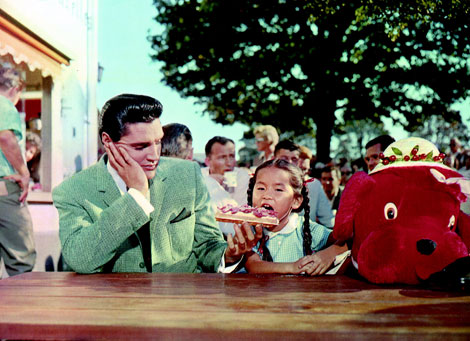
Which is what this one needed. Seeing it as a kid, I thought it was the dullest thing in the world and needed more shots of The Space Needle and, frankly, The Fair. Seeing it as an adult is a grim experience when noting that your tastes haven't changed much. There are faint flashes of wit once in awhile, but it goes without for long stretches of obvious, perfunctory film-making. But, face it, the thing was a commercial enterprise that had outlived its usefulness except to sell records for M-G-M, rather than break them.  It does have one oddity worth noting for trivialists: in the role of a kid who kicks Elvis in the shins (to fake an injury to see a pretty nurse) is Kurt Russell, who would play Presley in John Carpenter's biographical film (produced by the late Dick Clark, by the way).


Thursday, May 18, 2017

Guardians of the Galaxy, Vol. 2

Super-Saturation
or
A Small "s" Sequel

The first Guardians of the Galaxy movie looked like such a lame concept in the trailers (and post-credits set-up of some Marvel film or other—I've lost track*) that it was a pleasant surprise for it to be not only fresh and funny, but an oddly genre-disdainful addition to the Marvel Universe, a story of space-orphans who form a Dirty Half-Dozen and quite against their intentions become a family, a dysfunctional family, to be sure, but a family nonetheless. Indeed, more power to them as they discover they're better as a group than as individuals, no matter how good they think they are, individually.

Given the success of the first film, there had to be the inevitable sequel, called (unimaginatively) Guardians of the Galaxy, Volume 2.  Same cast with a few additions, same writer-director (James Gunn, whose Super was a damning condemnation of heroic vigilantism, comic culture and the ones who are both perpetrators and victims of it) and one would hope, given his past, that any continuation would have the same affectionately anarchic spirit and mess with the formula.
Alas, it doesn't. Alack, someone must have made him read the memo's from Marvel Studios (the animated corporate logo of which is becoming increasingly long and self-important) of the audience metrics from the last one because it starts out catering to the masses with its opening sequence.** 
The self-styled Guardians are on a job protecting a group called "The Sovereigns" (as in the coinage, I'd guess, because they are gilded from head to foot like some Goldfinger fetish-fantasy) whose "something-or-other" batteries are being threatened by a "who-the-hell-cares" squid-ish attacker from outer space that's going to drain them or eat them or replace them with cheap convenience-store-branded batteries and that just ain't right. It feels like a disposable "Men in Black" sequence where they just needed a strong open and this is as good as any to show that the group is still together and functioning as a viable team.
Now, as everyone synchronizes watches and gets ready for the attack, Rocket the Raccoon (he has a lot of good disparaging nicknames in the movie) is busy...setting up a sound system? What the...? It's because one of the delights of the first film was its use of old obscure pop as a soundtrack and the sound system is to play a track...possibly as mood music for the team, distraction for the opponent, or for soundtrack sales for Marvel Studios (my guess would be the latter). Whatever. The Main Titles run along while the Guardians are battling a big-mouthed squid, while in the foreground Baby Groot is boogieing to ELO's "Mr. Blue Sky" to the delight of the audience, while the carnage goes on around him.
Cute. But derivative, one might even say pandering. And a bit of a time-waster, even if the Titles are unwinding in the background. It's a call-back to the previous film's mid-credit sequence where "potted" Groot is grooving to the Jackson's "I Want You Back"—and freezes whenever Drax (David Bautista) notices him. This sort of "memory lane" of audience highlights is lazy writing and dilutes the good will of the original as well as its uniqueness. I keep wondering if someday a movie sequel will ever be a direct copy of its predecessor and I realize that it's been done—Back to the Future II, for most of its length follows a parallel path to its Part 1. It's a weakness of series films that they hearken back to their origins, and there's nothing anyone can say except "I've got a bad feeling about this." It is lazy writing, but at the behest of producers who know it's less risky to do more of the same than tinker with what made the coffers fill the last time.

This is concerning for someone who enjoyed the original Guardians' insouciance in messing with the uber-tone of most movies based on comics, trying desperately to be taken seriously that they take on the mantle of big-m "Myth." It's indicative of less risk-taking (which made its predecessor so enjoyable). A Guardians of the Galaxy entry that took itself seriously would be as dull as Thor...or Iron Man III. Enough on that, there's a whole rest of the movie that improves things.

Ayesha...or "Her"...or "Kismet"...anyway, she's different from the Marvel comics version...i
f she weren't she'd be the Sylvester Stallone character's mother. A-Yeesh.
But, the sequence does get the movie started and introduces us to the Sovereigns, whose Queen Ayesha (Elizabeth Debicki...in an Oscar-worthy performance because, frankly, she LOOKS like an Oscar) pays the Guardians their reward, the sister of Gamora (Zoe Saldana), Nebula (Karen Gillan), the bitter daughter of Thanos (it would be Josh Brolin if he appeared) who disappeared after commandeering a ravager ship in the last movie. Fortunately, it starts to lighten up once the G.o.t.G's move away from Main Title Land. With Nebula in tow, they have to leave in a hurry when it's discovered that Rocket has stolen some of the batteries they've been paid to protect. The Sovereigns send out an impressive number of drone-ships to stop them, but a couple of light-jumps and the battered ship, which is dragging a tethered Drax held by a straining Gamora with her hair on fire (now that's a bit more like it!), crash-lands on a far-away rock.
"Some day, son, this can be all yours..."
They've been followed. The folks in the craft are Ego (Kurt Russell) and his protege Mantis (Pom Klementieff), who make the astounding revelation that Ego is the actual biological father of Peter Quill (Chris Pratt)—his real one, not his human step-father. Quill, Drax and Gamora go to Ego's planet (well...yeah, no, I'm not going to say it...spoiler) while Rocket and Groot keep an eye on Nebula while repairing their ship. The Sovereigns aren't done yet. After Yondu (Michael Rooker) has a falling out with another Ravager, Stakar Ogord (Sylvester Stallone...mm-hmm...we're starting to recycle past super-hero stars***) over child-trafficking (he's the one who plucked Peter Quill from Earth, after all, but...keeps him...because he had tiny, stealing hands), he's approached by the Sovereigns to track down the Guardians wherever in the Universe they might be.
Ego's planet...or maybe...his ego's bigger than you think.
So, there's a lot of conflict and cross-conflict: the Guardians against the Sovereigns AND the Ravagers; factions of the Ravagers against other factions of the Ravagers; Nebula against Gamora; Quill against his team-mates who are suspicious about Ego; Quill with his own suspicions about Ego (despite his finding out the answer to one of his Big Questions). With conflicts come alliances and sometimes in the most unexpected places. Old grudges dissipate with new understandings and different perspectives and the Guardians evolve into a new team, a combination of old and new members.
"We are a pair, aren't we?"
But, the biggest conflict isn't Ravager or Sovereign vs Guardian, it's Nature vs Nurture. It seems odd but wholly appropriate that by the end of Guardians, Vol. 2, there is a perverse contradiction of "there's no place like home." DNA is less important than the strings that tie us together; sure, you may find your biological father or mother, but sometimes, in their absence, you may outgrow them or even replace them with what you need. It is not as complex as Oedipus, especially in the comic-book world filled with orphans who find themselves empowered without biology having anything to do with it. Our courts (in the real, non-fictional world) favor DNA over everything when they have to solemnize the future of a child. Guardians 2 comes down hard on the side of step-parents, mentors, and...well, guardians, who will take in a waif when there's a case of need, even if the arguments against are as a big as a planet.
....ow
It's different and that's good. For all the call-backs and deja-vu moments, it doesn't run in place until it comes up with a good idea for a third movie (which a lot of sequels do). It takes a major hanging plot-point, resolves it, and moves on. That actually builds more good will in a franchise than all the repetitions of key moments can buy.
The Ego begins inflating across the Galaxy (when its Guardians are distracted)

* Thor: The Dark World, as it turns out. I actually did some research.

** And, as if to belie that opening asterisked statement,  I am wrong in this point—there IS a prelude of sorts, set in "EARTH. MISSOURI. 1980" with a CGI'd Kurt Russell (this "de-aging" stuff DOES NOT work on conventionally handsome or beautiful actors, but seemed to work well on the recreation of the skull-like countenance of Peter Cushing in Rogue One.)

*** Next example: Michael Keaton plays The Vulture in Spider-man: Homecoming.

Saturday, February 13, 2016

The Hateful Eight

Just a Liar's Promise
or
Tarantino's Wasteland

The tag line says it all: "The 8th Film by Quentin Tarantino." And in the cackling obviousness that now seems to be part and parcel of what passes for the film output of Quentin Tarantino (except when he's doing in-jokes that are only discernible to the slavish) the title of it is The Hateful Eight. Hateful it is, a movie dominated by good actors playing the worst people in the world in what can only be called a Western torture porn with delusions of drawing-room-detection. Every one in it is the lowest of the low with pretensionss of forthrightness that only serve as fodder for the other characters to stick pins in or blow away with more shots than necessary. Oh, there are good people (and by that I mean non-desperate socio-pathic characters) in it, in but one chapter of the six that the writer-director segments his movie into, but their screen-time is the bare minimum. Like the blacklist in the speech that finalizes Trumbo, The Hateful Eight has no heroes or villains, only victims. 

And an audience member could easily identify with the victimization.


Look, I've always been on the fence about Tarantino. His early films I found flashy, but forced, the dialogue clever in a sophomoric and frequently irrelevant way. He was a kid showing off, usually at the expense of the talents of others as he would "borrow" from the cob-webbed end of the video aisle for his ideas. Nothing wrong with that. There's a lot of "cribbing" going on in the first films of directors. And sometimes, he does something surprising—I'm a big admirer of Jackie Brown and Inglourious Basterds. I thought his half of the double-bill, Grindhouse, Death Car, was a wickedly conceived—if drawn out—feminist tract. Those and pieces of Pulp Fiction, that's all I like. Two and half, maybe three films. The rest of them?

"Got room for one more?"
There's not much to enjoy or admire here, save for a few performances that stand out—Samuel L. Jackson's best acting in years, the return of Jennifer Jason Leigh who has always been a fearless actor, Kurt Russell's bravura performance, and a slippery, inconsistent one by Walter Goggins. The rest is Tarantino writing dialogue that goes on forever, punctuated by gun-fire and blood-spatter by the gallon, often with the intention of comic effect.
 
And to photograph this thing in 70 MM is the highest form of pretense.
The 70 mm format was designed for wide open spaces and vast vistas-(as well as snakes, trains, and funeral corteges). But more importantly, for horizons (and the more majestic the better) to take advantage of the sharpness and clarity of image the larger format provides. It's ideal for nature in the raw, less so for cities that strain and grow on the wrong axis out of frame. It is certainly a waste of format for a set-bound movie that does it's best to invoke cabin fever for 90% of it's nearly 3 hour length. Using 70 MM for this type of film is like using a SCUD to shoot down a duck. It's less a good artistic choice than a case of "Master"-envy on Tarantino's part.
The opening (and it's shot by the eccentric, but extraordinarily talented Robert Richardson, who Tarantino's been using for a while now) tries to cram as much scenic beauty as it can to last, but it is then followed up by such unremitting ugliness in image and spirit, that the effect is like putting a bow on a tarantula.
 
It's all downhill from the first line: "Room for one more?" says Major Marquis Warren (Jackson), the first of many characters to be revealed by the upturning of a hat-brim—wide-screen is good for that, too—as he echoes the line of the hearse-coach in Dead of Night. 
The Major is a bounty-hunter and he's sitting on some work as he's approached by a stagecoach bearing two passengers, John "The Hangman" Ruth (Russell) a shaggy-dog of a bounty hunter hand-cuffed to Daisey Domergue (Leigh) the spitfire sister of outlaw Jody Domergue. He's taking her to the town of Red Rock to be hanged for her crimes—that is, if she survives the trip. One of the running gags of The Hateful Eight is that Daisey is such a disagreeable little cuss that Ruth regularly punches, pistol-whips and clobbers her at every snarling offense (At one point, Ruth says: "Now, Daisey, I want us to work out a signal system of communication. When I elbow you real hard in the face, that means: shut up" as if he hasn't already worked out this system by example earlier than the movie began). Our first sight of her takes in a busted lip and a black-eye. Over the course of the movie, she suffers every non-lethal injury associated with the movie until, by the end, she bears a striking resemblance to Carrie at the prom, caked in blood acquired from all manner of splatters from nearly every member of the cast. If they had pattern analysis back in the day, all investigators would need for a thorough study of the crime scene would be her.
The coach acquires another passenger as a mountain blizzard starts to impede its progress, forcing it to stop at a "in-the-middle-of-nowhere" way station called Minnie's Haberdashery. That would be Chris Mannix (Goggins), caught wandering in the snow, who claims to be the new Sheriff of Red Rock. What he's doing in the middle of a blizzard in the highlands of Wyoming does look a little suspicious. Mannix was a Southern soldier in the Civil War, and that sets up a splintering dynamic on the coach. The Hangman and Major Warren fought for the North, so there's immediate animosity that is constantly brought up throughout the movie and allowed to simmer before it is acted on.
But, like the lousy coffee the coach-passengers find at Minnie's, it's been on the boil a little too long. Ten minutes can't go by without the War between the States being brought up, and then add four other characters to the mix—played by Bruce Dern, Tim Roth, Michael Madsen, and DemiĆ”n Bichir (as Bob)—and it turns into a four-walled circle jerk in which precious little is discussed besides The War and "what are YOU doing here?" Those long dialogues are then snapped by gunfire, so much of which happens inside Minnie's four walls it's amazing that anyone could even hear what anyone's saying after so many indoor concussive sound-waves.
It's tedious, eventually. Tedious to the point where Tarantino must toss in a mystery that he plays out like a Hercule Poirot "j'accuse" monologue, a voice-over narration (voiced by Tarantino himself) that tries to bridge some gaps in the narrative—it's eight people in a room by this point, so why is he incapable of showing it?—and a flashback sequence to throw in some fore-shadowing after he has made the "Big Surprise" that he telegraphs seconds before he unleashes it. It's confusing, clumsy and more than a bit ham-fisted, as if he shot the sequences, but couldn't figure out where it would go in the movie until he had to, by means of explanation.
You wonder exactly what might have happened to the guy, who despite his promise, wasted so much of his time on hack-work that merely sought to recreate the junk he used to like (in his painful DGA interview with Christopher Nolan, he reveals that the inspiration for The Hateful Eight was television westerns—what would happen if you tossed together the suspicious-acting guest-stars that would show up and disappear every week? That may be the shortest reach for any film-maker who ever did more than just turn on a camera and let it run).
It's disappointing. And tedious. Not entertaining, and, in fact, maddening. This is Tarantino running on fumes and desperately trying to make a 70 MM silk purse out of a sow's ear. Perhaps it's time to walk away and not encourage him anymore. He's an abject lesson in what can happen to a director who becomes a media darling to the point where he thinks he pisses perfume. It's time to point out that the Emperor has no clothes, and that Quentin Tarantino has nothing to say.
I left The Hateful Eight wondering whether Quentin Tarantino is/was a talented filmmaker or the gibbering little troll with a knife in Don't Look Now.

 *


Thursday, July 24, 2014

Now I've Seen Every "Thing" Dept.

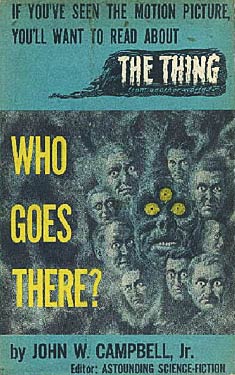
"Who Goes There?" by Don Stuart (a pseudonym for sci-fi pioneer John W. Campbell) is one of the acknowledged "great" stories in speculative fiction.

Part science-fiction, part horror and part psychological thriller, it tells of an isolated Antarctic research facility that discovers a flying saucer long buried in the ice.  Investigation leads to finding the saucer's sole inhabitant not too far away and taking the
BEM-sicle back to the Ice Station for analysis.

Of course, it escapes and this particular ET has a special talent—it can "pretend" to be anyone it has killed and "absorbed." Hiding in plain sight, the "Thing" starts picking off the scientists one by one, while the humans among them start to worry which of their (dwindling) number could be the wolf in sheep's clothing.

Paranoia strikes deep, but "The Thing" strikes deeper, able to replicate the men down to their blood-cells, which provides them with a nifty test to see who's genuine and who's a "Thing"-a-ma-job—take a blood-sample and dip a hot wire into it, and the alien-cells react and start to metamorphose, while the human hemoglobin merely sizzles.

Eventually, the alien is trapped by the scientists, while it is constructing an anti-grav ship to escape, forcing it outside into the cold, where it is torched by the scientists. Humanity triumphs that the alien has been thwarted from fleeing or spreading itself to another outpost. All's right with the world, especially considering that no other visit has occurred since the first ship crashed twenty million years before. No other invasion is expected anytime soon. The end.

From its origins in the August 1938 issue of "Astounding Stories," the tight, compact story was first adapted for the screen by Charles Lederer (with assists from Ben Hecht) and the film's producer, one of the great directors of American film, who put such a personal stamp on it that, to this day, there is debate about just how much work on it the listed director of record actually did.  And that man's influence has taken over the DNA of his film's clones, so powerful is his influence and legacy.
The researchers take a measurement of the saucer.
Hawksian team-work in The Thing (from Another World)
  

šŸ˜€šŸ˜€šŸ˜€šŸ˜€šŸ˜€šŸ˜€šŸ˜€šŸ˜€šŸ˜€šŸ˜€šŸ˜€šŸ˜€šŸ˜€šŸ˜€šŸ˜€šŸ˜€šŸ˜€šŸ˜€šŸ˜€šŸ˜€šŸ˜€šŸ˜€šŸ‘½šŸ˜€šŸ˜€šŸ˜€šŸ˜€šŸ˜€šŸ˜€šŸ˜€šŸ˜€šŸ˜€šŸ˜€šŸ˜€šŸ˜€šŸ˜€šŸ˜€šŸ˜€šŸ˜€šŸ˜€šŸ˜€šŸ˜€šŸ˜€šŸ˜€

The Thing (From Another World) (Christian Nyby, 1951).  Yes, it says "Christian Nyby" in the credits, but the film is such a prime example of Executive Producer Howard Hawks' style that folks just assume he had a hand in directing it as well.  He almost certainly re-wrote the script, as it crackles with wit, banter, and includes the requisite "Hawks woman" who's tough enough to play with "the boys."  In fact, the dialogue and human interplay are better than the film deserves and is more entertaining than the "monster movie" that is at its frozen core. 

Hawks puts it in the arctic, then tossed out Campbell's psychological element—his military/scientific crew are Hawksian professionals and suspicions about each other would drive a wedge into that mix (it's enough that one scientist want to emphasize research over self-preservation to cause some heated exchanges*), fraying the team-spirit necessary to get through the crisis and the simple goal of staying alive. Nope. It's simple. The "Thing" is bad. "It" wants to kill us. We kill "it" before "it" kills us. Research? That's what autopsies are for!
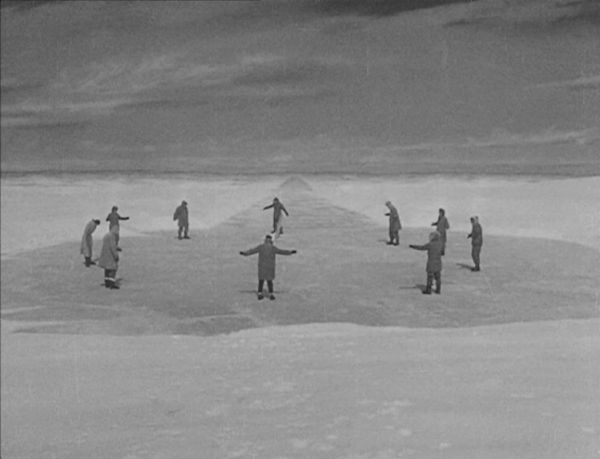
So, The Thing (From Another World) is much more of a monster movie than the study of paranoia the story is. Teamwork towards a common goal is emphasized—you can say that a lot of Hawks' films are analogies to the disparate gypsy-camp of film-makers working together to create a single film—and it boils down to survival. Besides the interplay of the characters, the film also boasts some iconic scenes: the Air Force officers and scientists spreading out on the ice to determine the size of the saucer;
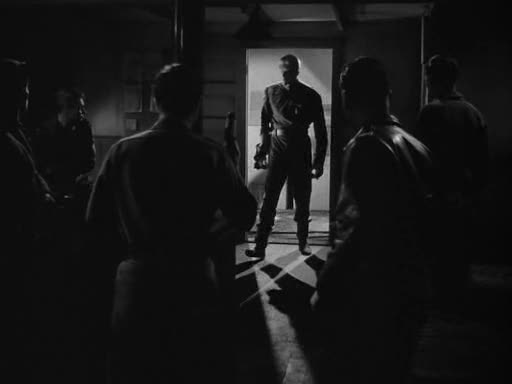
the sight of "the creature" (explained in simple unscientific jargon by one of the researchers as "an intellectual carrot") silhouetted in light as it kinetically bursts open the door of the room hiding the crew; the truly eerie scene of growing blood-sucking creature-clones like they were lethal daisies.


The Thing (From Another World) is a tough, no-nonsense monster movie with sides clearly drawn: us against them. But the only hint of the original tale's paranoia comes from the film's final line: "Watch the skies!"
Braised carrots are on the menu at the arctic station tonight.
James Arness (in a role he hated) gets fried in The Thing (From Another World)

šŸ˜€šŸ˜€šŸ˜€šŸ˜€šŸ˜€šŸ˜€šŸ˜€šŸ˜€šŸ˜€šŸ˜€šŸ˜€šŸ˜€šŸ˜€šŸ˜€šŸ˜€šŸ˜€šŸ˜€šŸ˜€šŸ‘½šŸ˜€šŸ‘½šŸ˜€šŸ‘½šŸ˜€šŸ‘½šŸ˜€šŸ‘½šŸ˜€šŸ‘½šŸ˜€šŸ‘½šŸ˜€šŸ˜€šŸ˜€šŸ˜€šŸ˜€šŸ˜€šŸ˜€šŸ˜€šŸ˜€šŸ˜€šŸ˜€šŸ˜€šŸ˜€

The Thing (John Carpenter, 1982) Director Carpenter has long been a disciple of Howard Hawks (his Assault on Precinct 13 is an urban remake of Rio Bravo, and Halloween is merely The Thing in costume), so it was only natural that he would take on the sole horror movie in Hawks' CV.

Bill Lancaster's script hews a little closer to Campbell's story, re-introducing the character conflicts and the assimilating alien (and eliminating Hawks' lone female character, making the station very much a "boys' club," comprised of Carpenter's "go-to" top-liner Kurt Russell—as chopper pilot McReady—and a "who's who" of veteran '80's character actors, Wilford Brimley, T.K. Carter, David Clennon, Richard Dysart, Charles Hallahan, Donald Moffat, Keith David, and Richard Masur).

In the Hawks version it was "us against them;" with Carpenter, it's back to "we have met the enemy, and he could be one of us."

Kurt Russell as MacReady in Carpenter's version
The tone is decidedly different, too. Carpenter's film is dark and brooding and creepy, punctuated by sequences of crazily unnerving violence concocted by make-up wizard Rob Bottin's creative realizations of the creature's ability to turn any part of a human's anatomy into a potential source of weapon or defense. It's icky and gooey and strangely goofy to see heads sprouting spider legs and skittering through the facility, or to see the detached head of one of the researchers pull itself along by whipping its tongue around a table leg and pulling itself out of harm's way.
Rob Bottin's creature creations for The Thing (1982) emphasize
a strange versatility when utilizing its human hosts.
Ultimately, though, for all the anarchic lunacy of the monster sequences, the movie boils down to a claustrophobic, paranoid fight between the men amongst themselves in their search for who is the monster among them, and Carpenter ends the film on a decidedly down note as the survivors of the carnage eye each other, each suspecting the other of being a creature, while they await certain death from the freezing elements, their previously secure station decimated by the events of the previous hours, providing no safety, no sanctuary or any warmth. There are no winners in the decidedly small intergalactic battle zone. 
And, though we're left with no ending and only a stalemate, we can be assured there will be no survivors, either. Any victory is hollow, and one is left pondering if any "thing" human came out of it.

😲😲😲😲😲😲😲☹️☹️☹️☹️šŸ˜¬šŸ˜¬šŸ˜¬šŸ‘½šŸ‘½šŸ‘½šŸ‘½šŸ‘½šŸ‘½šŸ‘½šŸ‘½šŸ‘½šŸ‘½šŸ‘½šŸ‘½šŸ‘½šŸ‘½šŸ‘½šŸ‘½šŸ‘½šŸ‘½šŸ˜¬šŸ˜¬šŸ˜¬☹️☹️☹️☹️😲😲😲😲😲😲


The Thing (Matthijs van Heijningen Jr., 2011) A direct prequel to Carpenter's film,** but basically the same plot. Spaceship found. Creature in the ice. Thaws out. Starts absorbing people.

What's interesting is that van Heijningen also pays tribute to Hawks, by turning the sex-tables on the story, making paleontologist Kate Lloyd (
Mary Elizabeth Winstead from Scott Pilgrim, who looks unnervingly like Zooey Deschanel and can rock a mean flame-thrower) the "guy-in-charge" after the official authority structure breaks down. Just as Hawks up-ended The Front Page by casting Rosalind Russell in one of the men's roles for His Girl Friday, van Heijningen provides an interesting dynamic by putting a woman in control of a station full of panicking men.
One doesn't have to have seen the Carpenter version to appreciate what is going on in the film, but if one has there are touchstones that one can appreciate (and check off if one is a "completist" or continuity-obsessive) along the way—especially at the end once the credits have started rolling—there's the merged double-creature that is briefly seen in the earlier film, the axe in the door, the suicide, the fleeing dog pursued by snipers. But, the giddy, manic quality of the creature-creations has been muted for straight-out horror effects—van Heijningen even has a cheap-shot "Boo" effect early on that still makes one jump—but Carpenter's (and Campbell's) blood-test sequence is neatly sabotaged for a simpler, more organic, and slightly creepier, test that anticipates a potential attack every time someone opens their mouth.
It does its job well, but one is left feeling it really wasn't necessary to make this entry, as it its only function seems to be to ride the coat-tails of its predecessor and fill in some blanks of an already competent version that left some audience-members behind (in the same way that
2010 did for 2001).

Kate Lloyd (Mary Elizabeth Winstead) rocks a flame-thrower.


* And we all know how disastrous heated exchanges can be at an ice-station!

** The film literally ends where Carpenter's begins, with a Norwegian helicopter  and gunman chasing a dog over the Antarctic wastes.