Showing posts with label Christopher McQuarrie. Show all posts

Friday, June 27, 2025

Mission: Impossible—The Final Reckoning

More Implausible Than Impossible
or
Deciding Not To Accept It

Mission: Impossible—The Final Reckoning may well be the last of the "Mission: Impossible" movies, the series based on the espionage TV show that featured a crack-team of specialists engaged in "heist-movie" scenarios for the government.* The films had some of the tropes, the "fuse" logo, the late Lalo Schifrin's pulsating, propulsive theme, the clandestine mission briefing (that then self-destructed leaving no trace). But, in the movies it spawned,  the "team aspect" always played second-fiddle to its star and champion, Tom Cruise, who increasingly dominated the films, while his character, Ethan Hunt, still remained a bit of a cypher as a character. Other than doing the hardest stuff, of course.
 
But this latest, maybe last, entry, given the evidence on display, indicates the series is past its self-destruct status. At nearly 3 hours in length, what could have been a lean and mean entry feels bloated with a first act crammed with flash-backs (ill-advised as they'd never connected story-lines before and even dropped connections with past movies at the drop of an un-negotiated contract) and a star who, at 62, is looking a little too doughy—in a Brad Pitt/Jerry O'Connell kind of way—to be romping around doing his own crazy stunts and skittering the world in his signature tin-soldier full-tilt run. 
All the worse, because this one really leans (and leans hard) in to Ethan Hunt being the end-all, be-all "only one" whose destiny it is to save the human race from Mutually Assured Destruction at the hands of an AI "anti-god" called The Entity...which featured in the last one and, it turns out, was the undefinable McGuffin dubbed the "Rabbit's Foot" from Mission: Impossible 3.** As The Church Lady would say "Isn't that convenient"***
At the time it came out, I thought it was a nice joke that the "secret thing that everybody wants" (and spends so much time obsessing over) in M:I 3 was so much vapor-ware in the story-line. Nobody knew what it was or what it could do, but it was important enough that everybody wanted it, whatever it was. Turns out, in reality (or film-reality, anyway), it was merely the plot-line of Colossus:The Forbin Project.
"Oh, yeah, there are other people in the movie..."
And Ethan Hunt turns out to be as mythic a lynch-pin to world affairs as Luke Skywalker or Paul Atreides.
 
It appears original, but it's merely a re-gift, just put in a new wrapper.
They also serve—briefly—watching Tom do the hard stuff...
So, anyway, the mission should you decide to accept (and I didn't) is that after the events of Mission: Impossible—Dead Reckoning Part 1, Ethan Hunt was in possession of The Cruciform Key, which would allow him to somehow destroy The Entity which is embedded in the Interwebs and is slowly but surely filling it with misinformation, turning the World Wide Web into a cesspool that has man turning against himself (as if it needed any help!) with the eventual end of taking over the nuclear capabilities of all the world's powers. What it would do then is anybody's guess, but even a digital anti-god would know that anything actually using those weapons would create a nuclear pulse and wouldn't do it any good at all, disabling any electronics throughout the world. If it's aim is murder-suicide then you need some other term than "artificial intelligence". Artificial psychosis", maybe? The Entity sounds like it's related to Monty Python's "Black Knight" ("You're a loony!")
They also serve who sit in boardrooms and clutch pearls...
Anyway, getting the thing to destroy The Entity involves two impossible missions: get to the Russian submarine Sebastopol (scuttled in arctic waters in the last movie) to use his Cruciform Key to obtain the Entity's "Podkova module" (containg its source code); then, using a "Poison Pill" developed by IMF whiz Luther Stickell (Ving Rhames), get that module to the world's "Doomsday Vault" located in South Africa—a huge mainframe designed to withstand said nuclear pulse even in a planet-wide armageddon—and plug the "Pill" into the "Podkova" thus isolating the Entity and somehow managing to contain the thing.
But, there are complications—there always are—such as the sub Sebastopol starting to roll down a continental shelf when Hunt is inside it (evidently it doesn't have a conning tower or fins or sail planes or...ya know...rudders that might impede the progress), or Hunt having to discard his hi-tech diving suit to get out of a jam and swim...in just trunks...in arctic waters...with no oxygen...and no decompression gear (except on the surface), or—a major one—the bad guy Gabriel (Esai Morales) manages to steal said "Poison Pill" making his escape on a bi-plane (...a bi-plane!), thus forcing Ethan to hijack another one and do a godawful amount of gyrating on wings and struts to get on the bad-guy's plane to get said "Poison Pill."
Now, look...the plot-line is insanely complicated and stupid...way too much so...as well as being openly subject to criticism by what Hitchcock called "The Implausibles" (I can't wait to see the "Goofs" tab on its IMDB page). Such things as Hunt being able to take out two competent goons moments after biting down on a cyanide capsule, or being able to survive "the bends" or the crushing water pressure of a deep-dive while only in his swim-trunks, then being able to do all that dangerous wing-walking the very next day boggles everything that I have left of a mind. The onslaught of implausibles tend to overwhelm such trivial matters as grabbing the barrel of a recently-fired automatic weapon without scorching your hands in the process.
Still, I can appreciate the length and breadths—in IMAX, even!—to which the cast and crew have gone to present such shenanigans. The rolling submarine set that they present is a wonderful little concept design for all sorts of mayhem, and the whole bi-plane sequence is an amazing showcase for what can be done with remote cameras and a star with a death-wish (but one with a goofy absurdist sensibility). As an actor, Tom traditionally dials it to 11, it's in these insane stunts where these proclivities really pay off.
However, the movie is a logical and editorial mess, with sporadic flashbacks that don't quite connect dots or light emotional fuses. It does provide considerable down-time between action set-pieces to make an assault on a snack-bar or sabotage a theater restroom.  
 
If that's your aim I will disavow any knowledge of your actions. Good luck.

*Poof!* hsssssss
Ethan cares, man. He really cares. 

* I'm throwing a lot of stick here, but the TV series, as great as it could be, had elements rolled eyes. For instance: why did every potential, autocratic, generalissimo, and revolutionary look like Martin Landau?

** That was, what, 4 movies ago, the one with Phillip Seymour Hoffman, which, when you see him in the flashbacks, causes actual grief.
 
*** Yeah, okay, M:I fans, I know that the James Bond series just wrapped up an uncharacteristically continuity-obsessive five-film arc, where everything tied together to the point where Bond super-baddie Ernst Stavro Blofeld turned out to be the step-foster-brother (or something) of Bond—in a plot-twist borrowed from (of all things) the "Austin Powers" series. Connecting the dots has a way of diluting the power of a story. In the Craig years, Blofeld wasn't so much an international criminal as a red-headed step-child. Just like in the first Michael Keaton Batman, the criminal who became The Joker was the one to kill Bruce Wayne's parents, rather than just some rando gunman. It waters things down, sometimes to an unpotable degree.

Wednesday, July 12, 2023

Mission: Impossible—Dead Reckoning, Part 1

"Couldn't You Have Told Me This a Little Bit Sooner?"
or
"Is There Anyone Not Chasing Us?"
 
One can't start out a review of Mission: Impossible—Dead Reckoning (Part 1) without giving props. It is one busy movie, filled with some amazing stunt work and a dedication to craft that one shakes their head in amazement that these things were thought up and brought to some spectacular life. The immediate reaction to one of these things evokes horror and then giggles as they are pain-stakingly realized to convince you that 1) they actually happened and 2) that they actually COULD happen. And a rueful head-nod must go to "Mr. Gung-Ho" Tom Cruise for putting himself "out there" just because he could. One has to say all this, because for the most part this review will trash this entry in the franchise, surely its weakest entry since Mission: Impossible 2.
 
But, wow, those stunts sure are amazing. The trouble is that's what the movie is all about, the stunts and those alone have never made a good movie. What they show is that the characters have an abnormal survival instinct and the tenacity of pit-bulls to pull though whatever obstacle can be thrown, dropped, propelled and fired at them. And that's it for character development. Oh, there's some ret-conning about "how Ethan Hunt became Ethan Hunt" as well as other agents into the IMF, but it's as unsubstantial as...well, as the entire make-up of the IMF apparently is in the spy hierarchy if we're to believe this movie.
The mission this time (should we decide to accept it, and I, frankly, didn't) is to recover the latest "McGuffin" in the series, the two-part "Cruciform Key", which is used to power up "an active learning defense system" which is touted by its Soviet creators as "the state of the art of war." Timely, since we're all worried about AI (and this is where I insert my "written by human hands" disclosure). The Vicious Thingy was last seen on board the Soviet submarine K699, the Sebastopol, which sits at the bottom of the Bering Sea a victim of its own system's ability to present false data to the sub crew causing them to launch a torpedo attack against a ghost target and blowing themselves up. This is one nasty little AI that can wreak havoc on countries and their defenses, but the world's governments don't want to destroy it, so much as control it. World leaders tend to have a lot of hubris; who wants to bet that they learn a lesson in humility in Part 2?
IMF agent Ethan Hunt (Cruise), despite his"habitual rogue tendencies," is enlisted to find the key. Who has it? Ilsa Faust (Rebecca Ferguson), late colleague, who is not so late and has one-half of the key. Hunt and the team (Ving Rhames and Simon Pegg) decide to go after the other half of the key, where they run into an atomic bomb trap (okay) and a pick-pocket named Grace (Hayley Atwell), who manages to lift the other half of the key from the prospective seller, complicating matters. Hunt also runs into a "face from the past" (Esai Morales), who seems to have the ability to not appear on surveillance systems. But, not the ability to make one of those full-head disguises that Ethan depends on in these movies.
What happens next? Chases. Lots of chases. Ethan and Grace are chased by land, foot, wheels, by the CIA, by Morales' "Gabriel"—along with Pom Klementieff's killing machine, Paris—by the forces of arms dealer The White Widow (Vanessa Kirby), by his own IMF Chief Kittridge (welcome back to the series, Henry Czerny!) by the local constabulary, and evidently anyone with a cell-phone or police scanner, until everyone meets on the Orient Express, and everything just goes literally right off the rails. Most of this is played with deadly earnestness, but one can't help but chuckle at the "Perils of Pauline" aspect of it, some of it is right out of silent movies.
But, the plot is a clunker. And the dialog at times is so vaguely inconsequential (and delivered so seriously) that you wonder if people are speaking in spy code. So, this entry in the series—the 7th—is overwhelming in stunts and underwhelming in story—and inventiveness—even though everyone bravely battles on.
I had much the same reaction to the very stunty recent Indiana Jones movie, which was only saved by a particularly risky (and fanciful) last act. This doesn't have something like that, but it does have another fight on a train with subsequent derailment, and another smashing car chase in a vehicle not built for those things.
 
The trailer for M:I7 exposed the weakness of the film by just showing stunts and fights, as that seemed to be all it has because, for the first time, they seemed to be borrowing from the James Bond series: the train fight from Octopussy, the Citroen chase from For Your Eyes Only becomes a Fiat 500e chase here, with Cruise and Atwell handcuffed as a similar situation in Tomorrow Never Dies, the whole "world-spy-network-hijack" idea comes from SPECTRE (notice that when the "Mission: Impossible" series borrows from Bond, it doesn't borrow from very good ones?), then that very hyped motorcycle jump has echoes of The Spy Who Loved Me. Usually, it's the Bond films that borrow from other films—maybe M:I is running out of ideas.
There are other odd little issues, like that director McQuarrie
(who has done some inspired work in previous film in the series) seems to have shot some dialog scenes using three cameras, that are edited in such a way that, when edited together, seems to have the actors not addressing each other in conversation. It's odd...and a little off-putting. Given the attention to detail in the action sequences, why would something like that occur?
 
Still, despite the reservations I have about the film, I hope it has a great box-office return. The film industry needs a little help right now, and this Summer's expected blockbusters have been under-achieving. A solid box-office return could reverse that trend, and help movie-makers battle the real-world challenges of AI.

Saturday, March 14, 2020

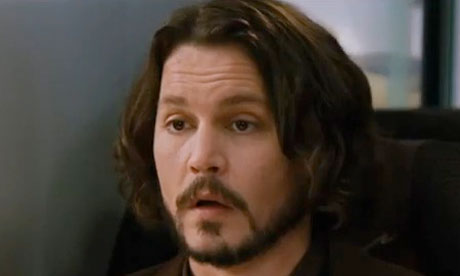
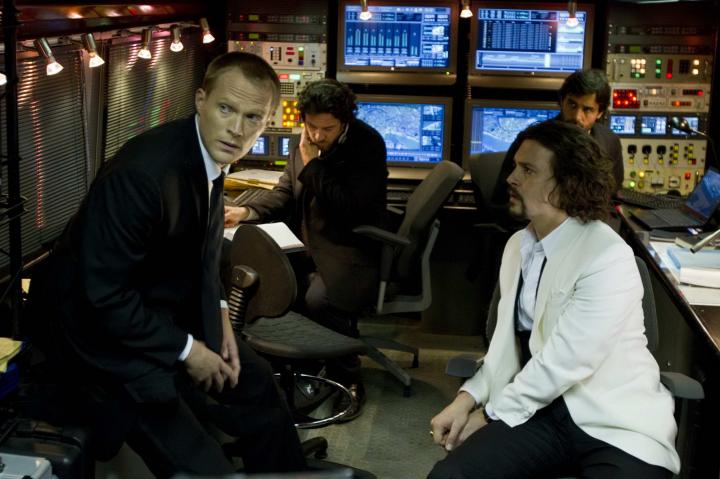
The Tourist

Saturday is "Take Out the Trash" Day

"Tourist Class"
or
"Just the Thing I Need...How Nice"

In between "Pink Panther" movies and his other comedies, director Blake Edwards used to make elegant truffles of movies with big stars, great locations, and high production values. But whatever the veneer of stylishness they showcased, there was always a kernel of truth to what he did. Edwards understood that even though the wrapping may be exquisite, the present it surrounded should be pretty special too.

So, I guess what I'm saying is The Tourist is a pretty lousy Christmas present.

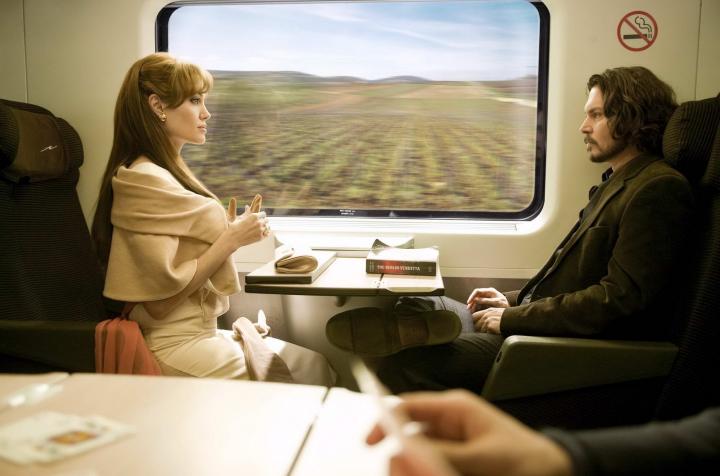
Oh, it looks spectacular, jetting (training and gondoling, actually) from Paris to Venice, all chi-chi and ritzy, but it falls flat as a caper, a romp, or even a good time.* Hell, it even falls flat in the half-hour review of its particulars with so many plot-holes and needless complications that, given the film's resolution, it makes little sense. Oh, you can see how it might work...but if it is what they say it is, then why....??? (Oh, don't ask why, oh, don't ask why....)
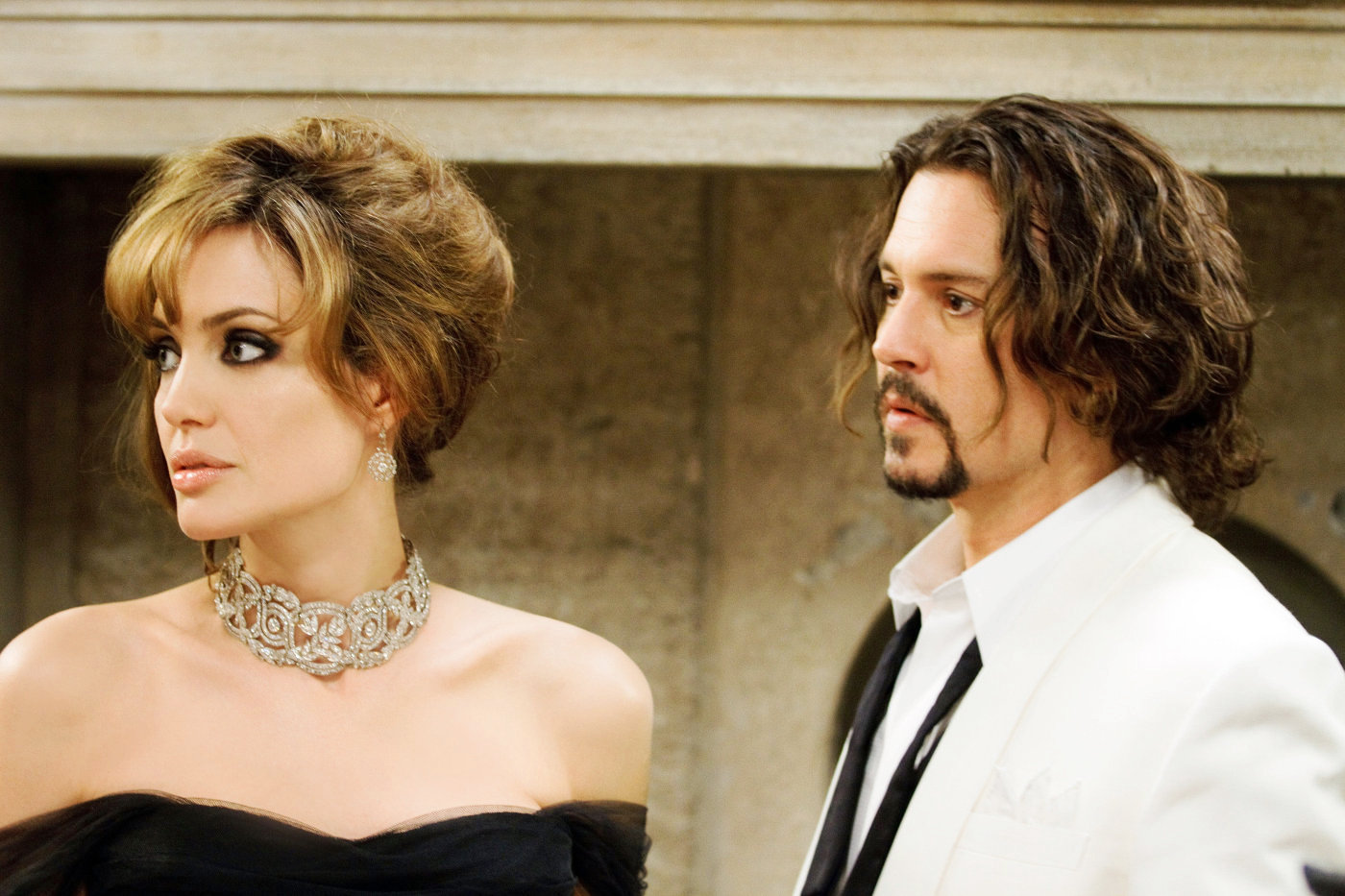
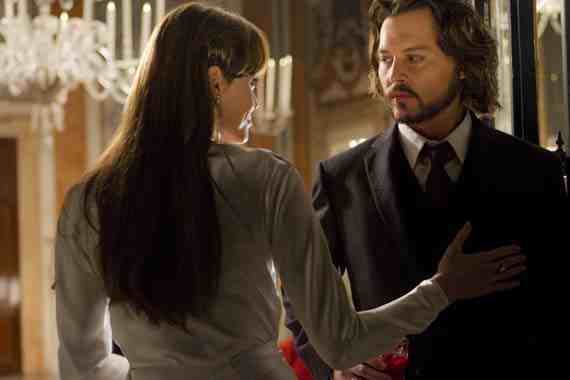
And when you start doing that analysis, you know that the thing hasn't really been thought through...they were just making it up as they were going along and hoping nobody would notice that the film only makes sense five minutes at a time. You're supposed to be distracted by the gorgeous decors, the elegant suits (and suites), Angelina Jolie's wardrobe (and how she fits in it**), and Johnny Depp's clowning*** to actually figure out that the movie is a shell-game, and a shell of a movie, as hollow as a chocolate bunny on Easter, and with as much nutritional value beyond being sugary.
Hard to believe, then, that the director—and co-scriptwriter, along with Christopher McQuarrie (The Usual Suspects, Valkyrie, MI-:4 and 5) and Julian Fellowes (Gosford Park, The Young Victoria, Downton Abbey)—is Florian Henckel von Donnersmarck, whose last film was the extraordinary Best Foreign Film Oscar winner The LIves of Others. That was a complex morality-play that moved across the demolition of the Berlin Wall, of how hunter and hunted can come to a mutual respect. But this can't even get its internal logic right. Even a finely-crafted Mercedes can fall apart if you don't throw some oil in it.
Add to the script problems the lack of any frisson between Jolie and Depp, both of their characters going through the motions acting as cool as cucumbers (him, comically; her, glacially). He tries to throw some bits of business around, but they're fairly subtle (and inconsistent)—like his language malapropisms (which will fly over most Americans' heads) and a tipsy act—that they get lost in the shuffle. 
Jolie has a tougher problem; she has to fight herself and her image. This is the second feature (after Salt) where Jolie is tasked with a poorly written role that requires no acting challenge, so much as present herself in an iconic way. In other words, she has reached the point in her career where she no longer has to be good, as she does to look good. This is a movie in Liz Taylor mode, Audrey Hepburn-style, the queen bee with drones hovering to do her bidding. But, she receives no help at all, not from the script, not from the cast (which includes Paul Bettany, Timothy Dalton, and Steven Berkoff—the latter two impressive, as always), the director lighting her well and showing her at her best. She is set apart—the only woman in the cast; she might be able to carry the box-office, but she can't carry the movie, poor as it is, and as enticing as it might look. She is a fine actress, as her awards-gathering early in her career demonstrated. But a few more of these vehicles and she may have to de-glam her career—as Charlize Theron (who left this project) did. 

They should have called it "The Tourist Trap," instead. 


* I'm sure it wasn't the movie, but I started to develop chest pains during it, and I began to think that all this sumptuousness was starting to clog my arteries, maybe I was just distressed, so, I shut my eyes...oh, for about 20 minutes...just listening to the soundtrack, and when I opened them again...gosh, I hadn't missed anything.


** In one sequence, French police are tracking Jolie's Elise Ward with cameras as she glides down a Paris street. Two of the officers zoom in to see if they can see a pantie line, and their superior admonishes them "Be more professional, guys." And as if to show just how professional the filmmakers are, director Von Donnersmarck cuts to a tight shot of Jolie's ass. No VPL. They may have been going for self-deprecation there, but, actually, I think, they nailed the problem. "Be more professional, guys."

*** Okay, I am now calling "b.s." on Depp's maintaining an artist's pose. This and the "Pirates" sequels point to a man picking up a paycheck. I used to have a lot of respect for him...but now...(According to IMDB, Tom Cruise was supposed to play the part—he and Jolie have been circling each other for awhile, as he was supposed to, play Salt—then Sam Worthington, who left over "creative differences")

Friday, August 3, 2018

Mission: Impossible—Fallout

The Perpetual "Mission" Machine
or
"We'll Burn That Bridge When We Come To It"

The sixth of the Tom Cruise "Mission: Impossible" films has slammed into theaters going 90, and it's getting rapturous reviews. Yeah, it's okay, but it's not the best of the series; the original and Ghost Protocol are the best, and the last one (which was also written and directed by Christopher McQuarrie)—of which this is a direct sequel—was quite good, too. McQuarrie must be scratching his head: "you mean I can have the barest bones of plot, but just make it wall-to-wall stunts, and people will love it more than if I make something really intricate? Who knew?"

Who, indeed? This one subtitled Fallout is cobbled together from elements of the other "Mission: Impossible" movies* as well as recent entries in the James Bond franchise (the first time in a long time that other movies are borrowing from them instead of the other way around), but the main thing it's borrowed from that series is a short-hand story-telling in service as lattice-work connecting the stunt sequences.

It's pretty basic stuff. 

Ethan Hunt is having those horrible foreshadowing nightmares you only get in the movies. They usually involve a Mission gone wrong, killing himself and those he loves in the process. Something goes BOOM! in the distance and they go boom in the shock-wave. Wake up! Time for a special delivery (special because it requires code-phrases). It's a Mission: the capture of Solomon Lane (Sean Harris)—from Rogue Nation—has not ended his menace. He has inspired a cult of terrorists called "The Apostles" who conduct attacks around the world. Led by a mysterious figure named "John Lark," they are attempting to acquire three stolen plutonium cores to be used to build nuclear bombs, designed by an extremist nuclear scientist Nil Debruuk (Kristoffer Joner). Hunt's mission—should he decide to accept it—is to intercept the sale and out-bid for it. As Lane says at one point: "I wonder, did you ever choose not to?"
Now might've been the right time; at the hand-off in Berlin, things don't go as carefully planned—Hunt and fellow IMF-er Benji Dunn (Simon Pegg) meet up with the sellers while Luther Stickell (Ving Rhames) does reconnaissance in a van some distance away. They're compromised and Hunt chooses to save his team-mates, and in the ensuing firefight, they lose the plutonium. Who has it? 
Turns out it's not The Apostles but some other bad people, led by a "broker" named "The White Widow" (Vanessa Kirby), who is to have a meeting with that "John Lark" in Paris in that most secure of locations, a disco. Given how well he did in the first-go 'round, IMF division head Alan Hunley (Alec Baldwin) assigns Hunt to track Lark and intercept the meeting, but Hunley is overruled by his boss at the CIA, Erica Sloan (Angela Bassett), who distrusts Hunt to get the job done and assigns him their best "minder," Agent August Walker (Henry Cavill) to keep him in his sights and in line.
Paris being a tough town to get into these days, Walker and Hunt stage a HALO jump (High Altitude-Low Opening) to land on the roof of the disco and infiltrate searching the crowd for Lark. The idea is to find Lark, incapacitate him, make a 3-D mask of his face and let Hunt impersonate him for the meeting with The Widow, but the guy they've tracked as Lark is a little tougher for them to take on—both Walker and Hunt are used as mops in a bathroom brawl, where the three pummel pusses and porcelain, and it is only the intervention of Ilsa Faust (Rebecca Ferguson, also from Rogue Nation) that keeps him from killing one or both of them. Unfortunately, though, amid her fortunate entrance into a men's room, she's killed the guy. "Could we still make the mask?" she asks. "You need a FACE to make a mask!" Hunt replies. 
So, they do what the IMF always does, they spit-ball—or, in the phrase Hunt uses throughout this one, "I'm working on it"—since no one knows what Lark looks like, Hunt elects to pose as him for the meeting with The White Widow—unfortunately, there are all sorts of assassins looking to take Lark out on sight and since his appearance with The Widow is a dead give-away, he and Walker and The Widow only make it out of the rendezvous by killing a few assailants among the bystanders. Some secret mission.
At the meeting, The Widow gives Hunt and Walker one of the cores and presents the price they must pay for the other two: spring Solomon Lane from captivity, which she has already carefully arranged for them, by creating a viable distraction, while Lane is being transported in Paris. As her thugs are a bunch of murderous sociopaths, Hunt conspires to do them one better with the help of Benji and Luther. They manage to capture Lane with as little collateral damage as possible except for the brick-and-mortar kind. 
But, it makes Walker suspicious: he tells his boss that it is his contention that Hunt is actually Lark, and that it's not just a pose. He thinks he's gone rogue, really, this time: "How many times has Hunt's government betrayed him, disavowed him, cast him aside? How long before a man like that has had enough?" All true, of course. Cruise's Hunt is the most trusted and LEAST trusted spy in the movies. And, not that he didn't understand it before, Walker is told to keep watching him, and if he can prove his suspicions, take Hunt out.
Cue music (Lorne Balfe does a fine job adapting Lalo Schifrin's iconic music, by the way), wind Cruise up and let him go. The remainder of the movie is, basically, chases—motorcycle, cross-country (or city, in this instance, which is London), and culminating in a helicopter chase in the mountainous terrain of India, with the purpose of getting the key widget of a doohickey that will allow his IMF team to stop the two nuclear bombs that are deployed nearby in a remote section of the country—why set them off in India as opposed to more populous cities is anyone's guess.
Cruise doesn't do all of the stunts—some of the motorcycle work is not him—but so much of the dangerous stuff IS him that you can't fail to be impressed...and come to the conclusion that the man is, basically, nuts, and must have one hell of an insurance policy.
He's obviously been watching the Craig Bond's and the "Bourne" films and saying "I could do that"—after spidering around Dubai skyscrapers and clinging to the outside of planes, jungle-gymming under helicopters might have seemed like a bit of a rest—"AND I can keep my face in the camera the whole time." Cruise's self-promotion is legendary, although it didn't help him when he was pin-balling through The Mummy and American Made.
Okey-dokey. Not sure that doing that actually improves the movie, or gets him in good with any stunt-person's union, but sure, big hand for Tom. Way to go, kid. You manage to keep the focus on yourself and make sure the audience is watching you no matter what is going on around you.
They needed to do something because the central mystery of the film—"who is John Lark?"—is easily suspected somewhat early on and confirmed half-way through the film. Not that it matters: as Bassett's Sloan says at one point, "The IMF is Hallowe'en"—it's part of the fabric of the Mission: Impossible series that no one is who they seem to be, by nature or latex disguise, and the gambit has been exhausted in the M:I series. One is hardly surprised by the reveal, because at that point, the film is on auto-pilot.
At this point in the film and the series, Mission: Impossible—Fallout has given up on interesting set-pieces—like the opera sequence in Rogue Nation or the Dubai hotel team-gambit in Ghost Protocol—and deception as its inspiration and just goes for the jugular with the hyper-activity of what has been termed "chaos cinema," that breed of action film begat by The Dark Knight, where you didn't need logic in your story-telling so much as momentum and spectacle. You could also go so far as ignore internal logic in a shot if it produced the desired "buzz" in the audience. Momentum keeps audiences from asking too many questions because the next shock dispels the memory of that question—it's quite effective in presidential politics, too! So, to borrow a phrase from the film, if the other films were scalpels, then this one is a hammer. A blunt instrument to beat out objections. Not too far afield from John Woo's strategy in Mission: Impossible II (and, as I remember, that one stunk).
Look, kids, despite everything that we've been shown the last few years in theaters, "kinetic" does not equal "great." It's one thing to move the camera, it's another thing to move the heart and the mind. And unfortunately, that's one mission that government-run spy agencies always seem to get wrong.
This is from the trailer but does not appear in the film....

* Well, Vanessa Kirby plays a character called "The White Widow" who is actually the daughter of "Max," Vanessa Redgrave's character from the first film, Ethan Hunt has to match wits with another agent as in M-I II, Michelle Monaghan is back as Hunt's...wife... from 3, who was supposedly killed between 3 and 4, but that was just a deception (aw, fergettit) and Rebecca Ferguson's Ilsa is back from 5, and Alec Baldwin's back again from 5...and on and on.

Thursday, August 25, 2016

Valkyrie (2008)

Written at the time of the film's release.

"Tom Cruise Takes on Adolph Hitler, Single-Handed"
or 
What do You Do About a 800 Lb Gorilla?

Man, they (the critics) have been rough on this movie and particularly Tom Cruise. It's been "Nacht der Langen Messer" for a lot of gossip columnists who fancy themselves critics (but had second-hand facts from their "sources").

Among the rumors that were cackled about was Cruise's lack of a German accent (there aren't any in the film and Singer makes a big show of having Cruise narrate the beginning of the film in German--a rather stilted, halting German--before transitioning to English), that he rather grossly takes out a glass eye in the film (he does—with his back turned to the camera), that he does a weird Nazi salute (his character—
the very real-to-history Count Von Stauffenberg—gets away with forgoing the usual "nicety" throughout the film until, in one of the film's best scenes, the War Minister (Tom Wilkinson) calls him on it—"I would hear you say it, Colonel"—and Stauffenberg, irritated that 1) he can't get away without it and 2) he's being forced to give allegiance to a man he's conspiring to kill, pointedly turns and yells the "Heil" while giving the standard right-handed salute—only he doesn't have a right hand, having lost it in the war, the stump of his arm protruding from his jacket, making a point. Good scene, that.

Look, I don't like Tom Cruise, either. His performances have dragged down many a movie, especially the vain-glorious ones. The man seems incapable of portraying more than one emotion at a time, and whenever his character must choose options Cruise falls back on an open-mouthed blank look.* Listening to him in interviews I get the impression that his acting process runs something like: "I have to do this, then I have to do this, then I have to do this, and then I have to do this."
But, though he's the King of Hollywood and the "Jesus Christ of Scientology," one could cut him some slack; none—none—of those rumors are true in the final analysis, and no one making those rumors is held accountable for them, shoddy and unprofessional as they are. But that's "Entertainment Reporting" for ya.**
Enough about the 800 pound top-gorilla. How's the movie? Good, actually. It is a true story (with a couple lies in it) and screenwriter Christopher McQuarrie and Director Bryan Singer (the team behind, and still trying to top, The Usual Suspects) lay everything out in a clear time-line, do their best to cast faces that have a 1940's German feel and maintain the illusion that it's that time and place. They keep the tension taut and make the most of the story's quirks and coincidences—the kind that make you say "if it weren't true, you couldn't write this." The fascination of the story is that the German bureaucracy that was running the war (badly, in the minds of the conspirators) was just as responsible for the conspiracy coming apart, and Stauffenberg was the only one with the Hoden who would push if there was any chance of success, both to his credit and the conspiracy's detriment. It's a real-life version of the "Mission: Impossible" scenario, something that Cruise is all-too familiar with.
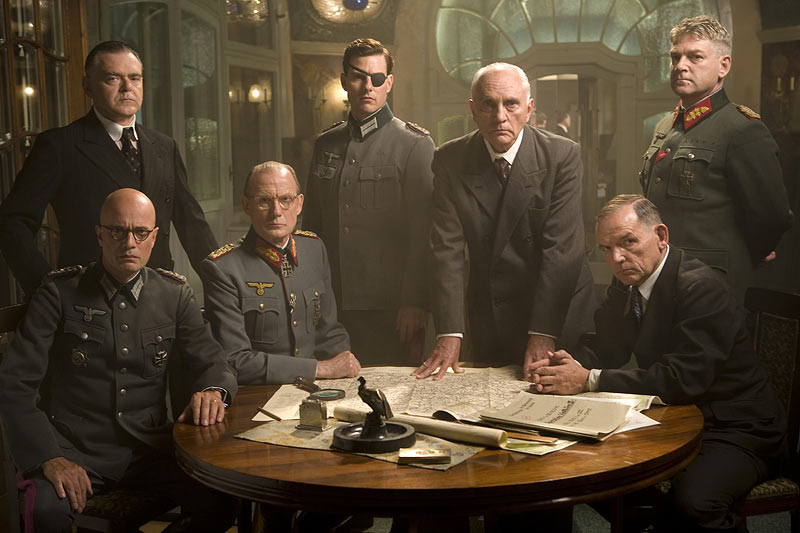
What's nice is that the film-makers turn the process of pushing through policy-changes into tense set-pieces that have just as much verve as a pistol shoot-out. In fact, there is a small fire-fight later in the film and getting Hitler to sign a policy-change (the "Valkyrie" operation of the title) is far more exciting. And the central gambit—there's a satchel with a bomb in it that's set to go off in a room full of men—is the classic Hitchcock example of tension versus surpriseThe film is top-heavy with fine British actors: Wilkinson, Terence Stamp (another fine portrait of an ineffectual pol), Bill Nighy, Eddie Izzard (!!), Ian McNeice, Bernard Hill, Tom Hollanderand Kenneth Branagh. That's a lot of impressive talent for a movie not written by Richard Curtis. And they're all spot-on. Branagh is particularly good as an initial conspirator who is whisked away to the front before the bombing of the Führerhauptquartier Wolfsschanze.
If there's a problem with the movie, it is Singer's sometimes too-elaborate direction—the most egregious example being a circular camera move that catches up to a record (and it's a 78!) so that it can stabilize on the label to read the word "Walkure" while the rest of the world keeps on spinning—an awful lot of effect for not much return. As such it parallels the story of the movie.*** The film of that story—of conscience over the brutal status quo—is much more successful.


* As opposed to Brad Pitt, another Hollywood pretty-boy, but who's managed to pick interesting roles (on occasion) and has grown as an actor of depth and subtlety. Something Cruise used to do. Cruise once was attached to The Curious Case of Benjamin Button.

** My favorite bit of bone-head journalism from Hollywood came from the "reporter" who asserted that Russell Crowe had gone off the deep-end because he said something about "Bob being his uncle." Shhyeah! Been out of Hollywood much? Then, there was MTV "reporter" Kennedy who asked Martin Landau what the heck HE was doing at the premiere of Tom Cruise's first Mission: Impossible movie, and he said "I was in the show!" to her stupefication. "You should READ about it" was his irritated reply.


*** There is such a rich vein of fascinating stories that came out of the ashes of World War II that would make compelling films. A similar story—of the elaborate civilian assassination of Hitler's "Golden Boy" (and probable successor) Reinhard Heydrich in 1942 I've always thought would make a compelling story of uprising. But one couldn't tell it without mentioning Hitler's utter crushing of the town of Lidice in reprisal for the attack. Update: You DID read the review of Anthropoid, didn't you?