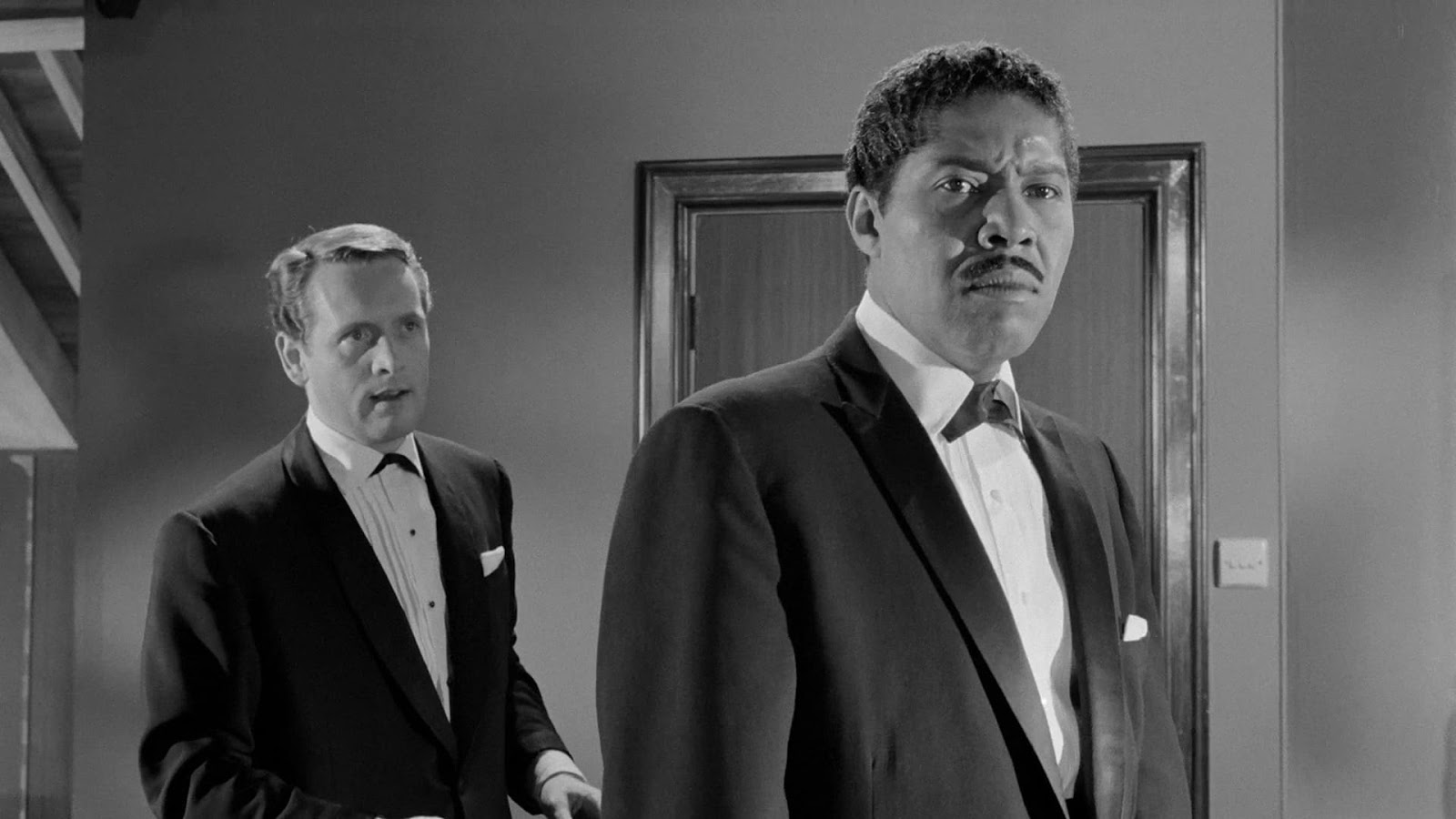
All Night Long (Basil Dearden, 1962) I've been watching a lot of Basil Dearden movies lately—the only ones already on the site, reviewed, are Khartoum and a horror anthology he'd participated early on in his career, Dead of Night—and they're pulpy but intelligently produced with an underlying social concern, interestingly framed, and with a sometimes perverse energy designed to take the audience slightly to the edge of their seats. They're at least designed to produce a nervous tick in the leg.
All Night Long, though, is more designed to keep a steady beat of foot-tapping, based as it is in the jazz idiom. In fact, for aficionado's, it's a bit of a must-see for performances by some "legends" (a much used word, but actually appropriate here), such as Charles Mingus (he gets lines to say!—"Hi, thanks for inviting me!"), Dave Brubeck, John Scott, John Dankworth, Tubby Hayes, Bert Courtley and Keith Christie. That's a great joy to the film, but I imagine it's frustrating for the very people who would want to see this for that purpose because it has a story and actors who distract from the performances and from the music for whole minutes at a time (I imagine that the first frenetic Beatles fans were frustrated with A Hard Day's Night for that same reason). On the other hand, for those folks into narrative in their films, they might be stymied by the story being stopped dead by performance drops. These people have never heard of or seen musicals.

The story is basically the story of Othello brought up to a jazz-beat (a bit uncomfortably) and a jazz-idiom. Entrepreneur and impresario Rod Hamilton (Richard Attenborough) goes to his club where he has prepared a very special night—a party celebrating the first anniversary of jazz King and Queen Aurelius Rex (Paul Harris) and wife Delia Lane (Marti Stevens), jazz pianist and songstress (retired), respectively. Guests are band-mates, acquaintances, and some notables in the industry and Hamilton has designed it to be a night of celebration and song for the happy couple. He should have checked the guest-list.

Brubeck and Scott and Dankworth are fine, of course—they're providing music. But along with Aurelius' inner-circle of Cass Michaels (Keith Michell) and his girl Benny (Maria Velasco), there is also drummer Johnny Cousin (Patrick McGoohan) and his wife, Emily (Betsy Blair). Cass is Aurelius' manager and completely loyal to him and a confidante to Delia. That relationship will become critical to the machinations of Cousin, who has been promised a side-deal for his own band by another manager, but only if he can persuade Delia to come out of retirement and join his band as vocalist. If he is to have any chance at success, he must drive a wedge into the happy marriage between Aurelius and Delia before she could even entertain fronting his group. And for that, he works on Cass.

He needs in-for-ma-tion. So, he invites Aurelius' manager to a private meeting on an outside landing and cozies up to Cass (who's been clean and on the straight and narrow for years and a dependable business partner) and plies him with some reefer, relaxing Cass enough to give Johnny inside intel on any weaknesses in the Rex-Lane marriage, which is (for him) disappointingly stable. But, he knows that Cass and Delia are close, so he devises a plan to make Aurelius suspect that the two are actually closer than her husband suspects. So, Johnny does a solo performance with everybody at the party, sewing doubts and intrigues and creating tensions where there are none.

It becomes apparent that Johnny Cousin is Shakespeare's Iago (and Cass is Cassio, which is not much of a name-stretch). But, where the bard's version goes through the play without any rationalization or motive for his actions (other than "I hate the Moor"), Johnny is totally and completely about getting his "gig" and, if a little chicanery and a marriage-split will advance it, then so be it. Suspicions are communicated between parties (at the party), but that can only go so far. And Johnny has a technological ally for fabricating proof.

Hamilton is a huge jazz fan, and part of his plans are to record a couple of sessions using a tape recorder (an EMI TR90 for you gear-heads), which Johnny uses to make recordings of some conversation. With that, he can take desired bits of conversation, and record his own voice for insinuating connections between the juicy bits to make it all seem like there's an affair going on between Delia and Cass to inflame Aurelius' jealousy. Anybody who's tinkered with tape will know that such an operation takes split-second timing (lest you erase the original) and you've got to have a stop-watch handy to be able to do it without editing—and in those days, you'd need a razor blade and tape, which is pretty obvious evidence of tampering. But, Johnny must be very good because his evidence doesn't even contain any electronic evidence that a tape has been started or stopped.

Technical quibbles aside, his gambit works—at least for a little while—and there is a real danger that he might get away with it, but not with the results he might want (this is based on "Othello," after all). There will be distrust and dust-up's, enough to ruin any high-class party, and certainly enough to interrupt any of the jazz interludes that pop up for the aficionado's.

It is a thrill to watch Mingus and Brubeck jam in one of the pieces, particularly to watch the effortless fingering on strings and keyboard. That comes early on in the film, but there's enough good material throughout to keep folks who just came for the music to enjoy. And stick around: McGoohan learned to play drums for the film and he has a frenetic solo towards the end that looks damned convincing, even if—as I suspect—he's just playing to a tracked music piece. He's an intense actor—around this time, he was right in the middle of doing the "Danger Man" series (it played in the U.S. as "Secret Agent" with a Johnny Rivers title song)—and the same intensity is born out in that solo.

This came out in 1962—1963 in America—and at that time, what was called "mixed marriages" were illegal in one-third of the States. It was an issue here and might have had a hand in the film's limited distribution and it's somewhat rare availability. It is refreshingly not an issue in this British-based film where nothing—absolutely nothing—is made of it. It's not even mentioned, other than the marriage is one for celebration...and strong enough not to be rent asunder by the conniving of an ambitious narcissist.
Another aspect that might have been controversial in the States is the on-camera portrayal of marijuana use. Even though the Hayes Code was dying of purposeful neglect during this period of film-making, drug use and distribution was prohibited under its strictures. Come to think of it, so was "mixed race" relationships. Something to consider while you're "bogarting" and considering the ash-bin of History and how time inevitably leaves prejudice there.

For whatever reason you come to it, for the music, or for the Shakespeare link, or you're a McGoohan fan/completist (or Attenborough...or Betsy Blair...or whoever), or if you're looking at the films when Dearden was telegraphing social messages and conspicuously pushing the barriers of what got on film—as Preminger was trying to do in the States—you come away with respect for this little doorway in the alleyway of film-noir sticking its neck out that although the world can be a nasty place, it's lit by the idea that the important things are devotion. And trust.
And all that jazz.