The Nail
or
Attack of the Drones: Showing Your Collateral
Patton loathed the modern age of warfare (circa 20th Century), not just in the movie bearing his name, but in his real life, too. Patton yearned for the era of the personal warrior, battles fought mano a
mano. He learned tank strategies at West Point, devised some of them himself, but generally despaired of
mechanized warfare and fantasized taking on Rommel in a one on one tank fight,
like jousters. Push-button warfare, he saw no point to it, certainly no glory,
certainly no triumph.
Patton was a bit crazy, but he had a point. No triumph also means no responsibility. You can't wash your hands from a killing. Ask Pontius Pilate. Ask Lady
Macbeth. No matter how far removed you may place yourself, culpability is still
there. In the 40's Humphrey Bogart's characters sarcastically derided
"push-button killers...killing by remote-control" especially when he was being
written by Howard Hawks. His opinion usually earned a drink thrown in his face—or
worse—for the remark, as it implied cowardice, shirking off responsibility.

Modern warfare (in the 21st Century) is conducted by drones, and one could look at that as killing
by remote control, if one wanted to over-simplify it. But, as the new film by Gavin Hood (X-Men Origins:
Wolverine—but don't hold it against him—and Ender's Game,
rather appropriately) Eye
in the Sky, shows it is hardly removed from responsibility. It
takes place over twelve hours, focusing on one military operation, dubbed
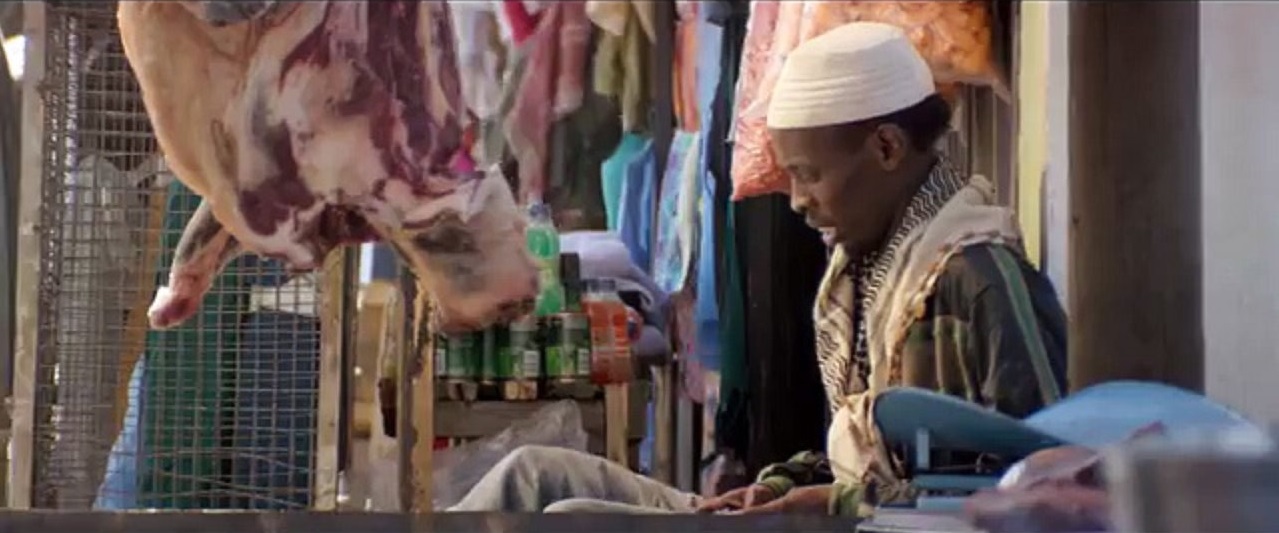
"Operation Egret," focusing on an Al Shebaab
terrorist cell in Nairobi, Kenya that has been under surveillance for several
months by British military forces, the operation headed by Col. Katherine Powell
(Helen Mirren).
This particular group, made up of Kenyan, American and British fanatics with
murder on their minds, is being monitored as they come from various parts of the
globe to converge on one house in a small Nairobi neighborhood. What they're
planning is not known, but, given their collective history, it can't be good.
The plan is to remove them from the terror equation by capturing them and
separate teams from around the globe are pressed to this purpose: In Surrey,
Col. Powell heads the direct operation; at Permanent Joint Headquarters in North
London the situation is being overseen by the Foreign Ministry and by Lt.
General Frank Benson (Alan Rickman in what will be his last filmed performance),
AG George Matherson (Richard McCabe), and observers Brian
Woodale (Jeremy
Northam) and Angela Northam (Monica Dolan)—their parts must have been described in the script as "insufferable bleeding hearts"; drone flight operations originate in Creech Air Force Base near Las Vegas, the pilots being 2nd
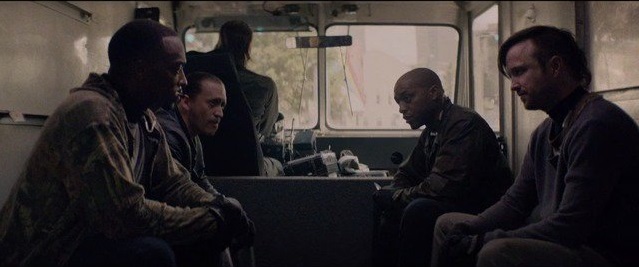
Lieutenant Steve Watts (Aaron Paul) and Carrie Gershon (Phoebe Fox); charged
with imaging intel at Pearl Harbor, Hawaii is Lucy Galvez (Kim Engelbrecht).
Oh, for the local angle, the "boots on the ground" are headed by Major Moses
Owiti (Vusi Kunene), with close surveillance by Damisi (Ebby Weyime), she of the
"hummingbird-cam" and Jama Farah (Barkhad Abdi of Captain Philips),
he of the "beetle-cam," who employ these ludicrous little surveillance systems to
get extraordinarily close views of the terrorists.
Then, there are the Mo'Allim family, who live in the same block as the
terrorist safe-house—Fatima (Faissa Hassan), Musa (Armaan Haggio) and 8 year old
Alia (Aisha Takow), who studies behind shuttered windows away from the
disapproving eyes of Al Shebaab thugs. Allah knows what they'd do if they knew
that she rocks a hula-hoop.

Aliah will be the focus of concern for all of the eyes in the sky, as her
daily chore is to walk to a corner table and sell the bread her mother bakes.
Today, her spare little stand is in a kill-zone, watched around the world and
discussed in urgent tones, especially when the surveillance shows that the
safe-house meeting is for the pre-blast meeting of a suicide bomber. As the C4
is unwrapped in a back bedroom, the "capture" scenario is upgraded to a "kill"
scenario, the troops are ordered to stand down, and the reconnaissance drone is brought to bear as a missile launcher. The clock ticks down and the discussions go up levels of
responsibility to the PM. Then the US, who is monitoring—they monitor
EVERYBODY—butts in to remind that these Al Shebaabers are, after all, No's 3, 4
and 5 on the East Africa Most Wanted list, and how often do you get to pull a
"hat-trick?"

The conversations turn slightly "Strangelovely" with talk of 45% versus 65% "kill probabilities," "real war" versus "propaganda war" victories, and "kill-chains," but the reality is those hovering pictures and the little girl with the bread-stand. A savage balance is weighed—her life versus the lives of the potential victims of the suicide bomber. The piloters in Vegas have their orders—if there's a 50% chance (or greater) that civilians will be killed (the "collateral assessment"), they can't launch—or, more appropriately, can go "by the book" and countermand the generals and refuse. And their evidence is on the same screen every one is looking at. That is more than a little unprecedented in modern warfare. It is certainly a far cry from "chateau generals," far removed from the repercussions of their orders. It is real. It is now. And the entire kill-chain of command must stare into the face of death, whether they're satisfied with the results or not.

I mentioned Dr. Strangelove earlier. This is more like Fail-Safe, warfare conducted in closed rooms, but, as opposed to that film, with the hand-wringing kept to a minimum (in the movie, but the film is tense enough to produce that result in an audience). Concentrated, focused, it is like a great BBC drama compressed into a taut, tense 90 minutes. Hood doesn't mess a lot with Guy Hibbert's screenplay, doesn't over-complicate it. He lets the situation and the superb crew of actors, some new, some veterans, do all the heavy lifting (one amazing bit of trivia is that the film was shot entirely in Hood's home country of South Africa).

Performances are universally good, although a bit too teary-eyed in places for professional soldiers, especially if it's more than their first week on duty. Mirren is back in her "Prime Suspect" phase with a chip on her shoulder that almost makes her hunch-backed. Paul cool and assured, even under duress, with his finger on the trigger, I was surprised by my delight at seeing Agbi, who's too keen a presence to disappear after his Oscar-nominated performance for Phillips.

And then, there's Rickman. The man died January 14th of this year and the film is dedicated to him. He also has the best, most multi-layered line (which he delivers with the cold, nuanced melancholy he excelled at), effectively ending the film as it hangs in the mind, not only because of the way it reflects on the entire film, but also in the way his reading of it complicates its wording, echoing, echoing, echoing. Eye in the Sky is provocative enough, one hopes it's not remembered solely for being his final visual bow, but he couldn't have had a better exit line.
Waste Not/Want Not
or
La Kosher Nostra
Michael Atwood (Chiwetel Ejiofor) has a very good crew that does very bad things. Made up of former Blackwater agents and current Atlanta cops, he plans and executes heists for high-end clients with particular avaricious interests. He is very good at his work, as he gears his work towards the clock and the Atlanta PD's response time, with the goal of getting in and out in 3 to 4 minutes.
He is very good at his work, but lousy at picking his friends. Right now, he's doing jobs for the Russian Mob, hiding in plain sight as a kosher meat distributor in Atlanta, and run by Irina Vlaslov (Kate Winslet), whose husband is being held in a Russian prison. Irina's sister Elena (Gal Gadot) is the mother of Michael's son, Felix (Blake McLennan), and to keep a tight rein on Michael, they keep an even tighter grip on Felix. As Irina says at one point, "Love makes great demands on us all."

At the start of the film, Atwood's gang charges into a bank to rob a safe deposit box of diamonds—Irina's husband needs them to bribe his way out—and they do it with brazen efficiency and cunning forethought. The five man crew walks in with automatic weapons, ski masks over their faces—the metal detectors go off but it doesn't matter, police won't arrive for at least four minutes. Everyone down on the floor, and—this is chilling, Facebook friends—Atwood silently grabs the bank manager and shows him...pictures, pictures of his house, pictures of his family, nothing needs to be said. Detective Jeffrey Allen (Woody Harrelson) puts it succinctly: "The monster has gone digital..." (for the record, catlol's are fine).

Criminals being criminals, one of the group grabs some cash and once they're out of the bank and making their way down the freeway, a marker bomb goes off, tainting the money a sulfurous pink, dousing the crooks, and blinding the driver. The detective in the van a few cars back monitoring sees it all go south and all he can do is keep the situation from wildly escalating out of control. An armed car-jacking provides another vehicle and an IED attached to a gas can incinerates any evidence in the getaway van. Everybody meets later and licks their wounds, and get bad on the one crook for doing something stupid.

The timing might have been better—they should have thought about doing something stupid before they did the job. Because—as there usually is with heist movies—there's gotta be "one more job" before the pay-day on the first one. The diamonds are useless without the verification files—and guess where they're kept? At Homeland Security. No way. There's no way that they can break into Homeland Security and get the files they need in 3 to 4 minutes (if everything goes well, and it's certain that the guards won't be cooperative). They need at least ten minutes of uninterrupted work, and the only way they can do that is by a distraction—a really big one, one that will generate a "Calling All Cars" response and focus the attention of the Atlanta PD on one location across town, and it has to be done with minimum collateral. The solution is a "Triple 9"—the police call for "Officer Down—Urgent." To buy the time they need, they need to kill another cop.

Triple 9 is a modern version of the old noir heist movies—like Rififi, The Asphalt Jungle, The Killing—about desperate men watching the clock; not only are their "big scores" on a second-by-second schedule, but they're also watching the sand run out in their own personal hourglasses. Usually, the jobs have the doomed inevitability of "the last job," the one they're going to retire on, the one they're building whatever tenuous future they have left with. That they rarely go as planned, and are subject to the vulnerabilities betrayed by their participants in their need, are part and purloined parcel of the sub-genre. Triple 9 is tough, gritty, unsentimental, but the vulnerabilities are just as real and just as harsh in their consequences.
And it moves fast. Director John Hillcoat is on his own time-crunch to get all the characters and relationships in play so they have maximum impact when they pay off—it take a good hour before all the individuals are clearly identifiable and their justifications for their actions made clear—part of that is that quite a few have been culled as expendable as the stakes get higher and the weakest links snap, or merely cut down.
Death is around every corner. Atlanta is a hot-bed of gang activity, which is the main focus of the PD. And while the apprentice criminals are acting up, making a lot of noise, the pros sneak under the radar, unnoticed. They're aided and abetted by some of their own with insider knowledge (hence the 999 idea), their loyalties divided, helping not to solve the crimes they've committed.

And they have the perfect target—Detective Allen has a nephew Chris (Casey Affleck) who has just rotated into the downtown district. He is given the usual rookie treatment of the tenderfoot, but he's no greenhorn, and he's not intimidated by or complacent with any gang member's bull-posturing, an attitude that clearly annoys his partner Marcus Belmont (Anthony Mackie) whose in Atwood's gang up to his neck and decides that Chris is the perfect 999—his uncle's in the force, has sway—that is, until Chris saves his life in a struggle for a weapon with a gang-member. But, loyalty only goes so far—about the length of a coin. Or the trajectory of a bullet.

Production values? The film is shot on location and, let's face it, when you're dealing with urban warfare, you don't do a lot of set-dressing. The tattoo budget must be impressive, though. And it's a good thing for the film-makers the price of gasoline has dropped. Hillcoat is fast and efficient and doesn't waste a lot of frames. More importantly, in this day and age, he doesn't shirk on them, either. And the actors are given latitude to set themselves apart from each other in terms of style and attitude, separating their characters in squads of those who know they're living in a tragedy and those who don't. Chiwetel Ejiofor, in particular, makes the most of the former camp, even as he pushes through it with a fierce defiance. Casey Affleck and Anthony Mackie are two of the best second-tier actors out there, who can make A-listers look flat in comparison, or as if they're working too hard, and their relationship is actually the strongest of any two characters in the film, in good and bad times, just by the looks they throw at each other. As per usual, the women are given short-shrift in this type of film. There's less dimension to Winslet and Gadot, merely because they're scowling as much as the Big Boys, although the casualness with which they do it should be noted—as if Winslet played villains every day.

The one relationship you don't believe is the Affleck-Harrelson nephew-uncle relationship; you don't believe that these two could ever be related to each other, despite Harrelson's mother-bear reactions to his nephew's predicaments. Harrelson's veteran cop is so tainted and Affleck's so effectively unaffected that you wonder how much time they actually spent with each other to have one influence the other. The script speaks of a bond, but if Hillcoat short-changed anything in the film, it's the scenes between Affleck and Harrelson...or the rehearsal time needed to make them a bit more sympatico.
The movie's not for everyone. It's a hard "R" for violence and language (no sex) and for the depiction of human misery that surrounds the events and informs them. Other than that, the story is a late-model LED-illuminated version of the type.
As they say in The Asphalt Jungle, Crime is only a left handed form of human endeavor. But in the age of cell-phones and IED's, check that bracelet to make that left hand doesn't get blown off.