Written at the time of the film's release. Saturday is traditionally "Take Out the Trash" Day...."What...Again?!"These things go in cycles, but every so often someone has to do the "If I Knew Then What I Know Now..." movie. Let's tick off a few, shall we? Big, Freaky Friday, Vice Versa, Like Father Like Son, Peggy Sue Got Married, 18 Again! (with Charlie Schlatter), 17 Again (with Zac Efron), they (and I'm sure I've left one or a dozen out) tell the story of a bitter adult who yearns to go back to the time when they were happy...before all "THAT" happened, and they learn...what, that life wasn't as good as they thought, or they'd probably do the same thing all over again...whatever, their eyes are opened to some basic truths about themselves or their times and that "there's no time like the present." It's the future, get used to it.
After so many variations (or are they parallel universes) on the theme, we should be used to it by now. Sadly, Hot Tub Time Machine is a roll-back to those films without significantly supplanting that feeling of Déjà vu while seeing it. It actually feels like a been there/done that version of Back to the Future (very much so*) in the process, with only an an upsurge in smut to recommend it. Even the era the quartet goes to (Reagan's 80's) is a recall of the period where these "do-over" films occurred with alarming frequency...again and again.
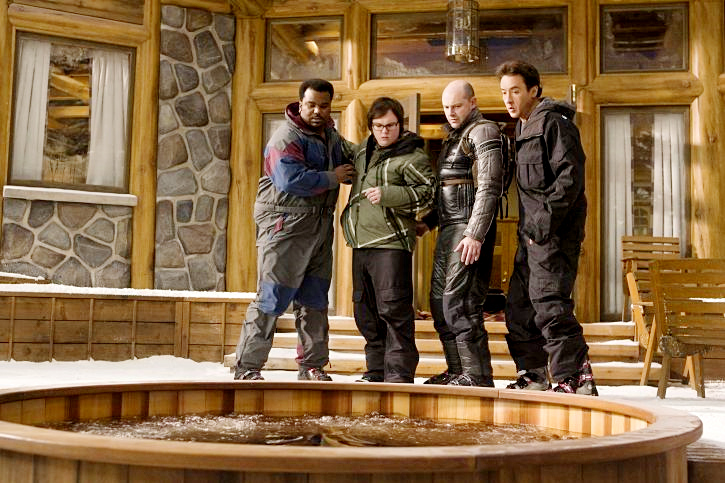
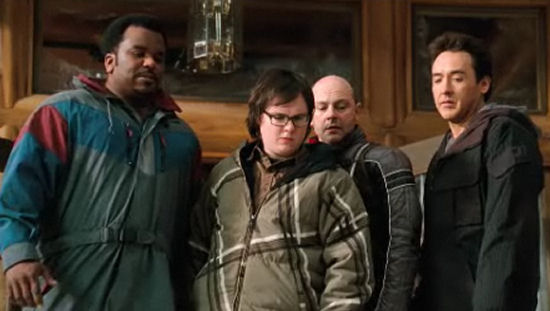
The basic plot is: after their friend Lou (Rob Corddry) attempts suicide, buddies Adam (John Cusack), a recently dumped insurance salesman, and Nick Webber-Agnew (Craig Robinson) decide to take their friend (as well as Adam's nephew, played by Clark Duke) on a sentimental journey for the weekend to their favorite party location—Kodiak Valley Ski Resort, which has fallen on hard times.
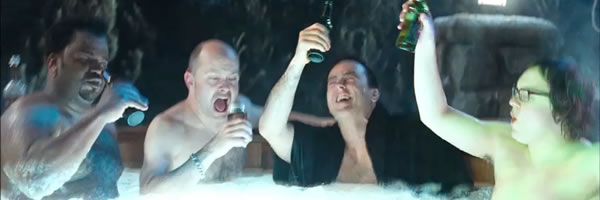
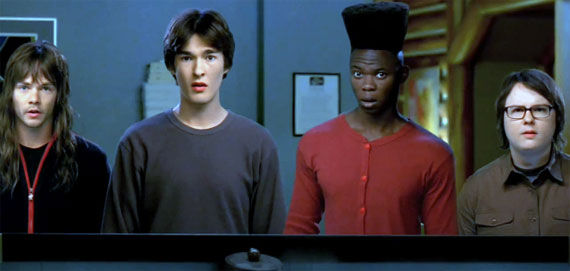
At least the room still has a hot-tub. But a drunken slob-party knocks vodka and an illegal Russian energy drink, Chernoblé, into the hot tub's controls sending the four back to 1986 and that one eventful week-end they'd celebrated before. After that, everything went down-hill for them, so it's conveeeeenient that the HTTM takes them to that one point in time. From then on, it's Big Hair, poofy parkas and leg-warmers, some minor time-goofs, and 80's references around every corner.
Corddry's character comes out strongest,** an anarchic spirit dispirited, a man so debauched that anything and everything can and should be tried if only to feel something, anything from the torpor he suffers from. For him, life is a gateway drug. He learns the valuable lesson: events in time are not fixed, they can be changed. He discovers this, first, to his pain, and then, to his delight, and its his very go-for-broke spirit that "makes things happen," to everybody's advantage. And for a movie guided by John Cusack and directed by Steve Pink (who co-produced the superior Grosse Pointe Blank starring Cusack), the movie adheres to a fairly conservative conclusion, where the entrepreneurial spirit (and a bit of insider-trading prescience) can conquer your inner slacker. W. would be proud.
I wonder if that's what they intended.
* Okay, instead of a Delorean Time Machine, this one is another 80's icon, a hot tub. The boys—it is SUCH a boy's movie—must recreate the disastrous weekend they'd experienced: Cusack's character suffers a nasty break-up, while being stabbed with a fork, Cusack's nephew keeps zapping away—rather than fading—if his conception doesn't happen, Richardson's character introduces a song that hasn't happened yet—"but you'll love it" he says—Corddry's character must suffer the same fight-humiliation he originally did, and uses his knowledge of the future to alter events. Crispin Glover's in both films, and Chevy Chase's character could be Doc Bown in disguise. Sure, it could be an "homage," but it plays like a set-piece by set-piece remake—and that was done in Back to the Future, Part II. In fact, the more I think about it, Zemeckis and Gale have a potentially lucrative law-suit brewing. But then it's released through United Artists, so maybe "lucrative" doesn't apply).
** Who comes off the worst is Chevy Chase in an ill-conceived half-idea of an Alternate Reality Hot Tub Maintenance Man. Maybe they thought Chase would add something to the proceedings with some choice ad-libs, but if he did, the part was a real dud to begin with. I kept hoping that he'd be revealed to be Clark Griswold thrown out of the time-space continuum by a Christmas lighting disaster.
Written at the time of the film's release...
 "Beautiful Soup"
Hesitant, I am, these days. Hesitant, I says.
After rushing the review for Shutter Island and dismissing it as "minor Scorsese," I found it had stuck like a bur in my hair and remained in my thoughts and my brain for a longish time. I went back and changed my rating—it's a "Matinee" now*—but not the review, because my complaints are the same. But it's really good "Scorsese" and slots right into the body of his work, despite being unique in its qualities and unlike anything he's done before.
But, I can't tell you why. Curiously, this doesn't stop me from going on and on about it, because it's so rich, and after an essential second viewing, you realize what a dance it is with story-logic and the use of image to show you—and NOT show you—what's going on. It's a trip, and a breathless display of what a master of cinema can do with the form.

Which is why Martin Scorsese should have directed Alice in Wonderland in 3-D. Sure, your kid's head would explode. But it'd be a great movie!
I've been looking forward to Tim Burton's take on Lewis Carroll. Seems like a match made in anyplace but Heaven. Burton's lapses in story-logic and not playing by the rules in past movies make him the perfect Carroll adapter; he's the "just go with it" director, as he frog-jumps from set-piece to set-piece. If you have to ask questions, you're going to slow the tour-bus down. And his arrested art-student sensibility is so dark that it keeps Alice exactly where it should be—underground with the muck and the weevils and the roots tearing at your extremities.
So it's a MAJOR disappointment that Disney's Alice in Wonderland in 3-D (A Film by Tim Burton) is such a wisp of a movie and—dare I say it—conventional, that it misses the mark of being a great movie (and a good representation of Lewis Carroll) by a hedgehog-croquet slice.**
Here's the problem. The "Alice" stories are stuff-and-nonsense. Charming stuff-and-nonsense that can make little girls giggle and college professors scratch their heads. Buried deep in its purple marrow is the satire of the vagaries of Society, not of adults, necessarily, but of Society—of class distinctions and petty politics—the Games People Play (when they're not playing games).
It shouldn't make sense. It is full of new words and language that fire the synapses of minds, like when Mommy talks about something called pilates, or you have to find out why you can't steal a base before the pitcher throws. It's all bright and shiny and new and simply incomprehensible, and Carroll is just as fantastical for trussed-up adults as it is for children. The glory of it is children have the upper-hand in connecting with it—they don't have so far to fall down the rabbit-hole.

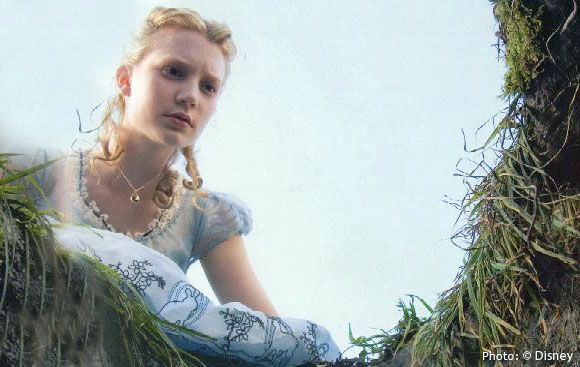
And Burton (and his screenwriter Linda Woolverton, who's worked on several Disney animations) know this to a point. When we first meet 19-year old Alice Kingsleigh (Mia Wasikowska, looking dark-eyed and sallow—a perfect Burton heroine), she has been invited to an engagement party—hers.** It's a surprise, but it's not, and it is not going well for the hostess, Lady Ascot (Geraldine James) the mother of the groom-to-be, as everything is not...perfect. And Alice has this annoying habit, besides being late, of being...unconventional...and distracted by anything. Alice likes to see the Nature of things. The party made by adults just uses Nature as a tightly-controlled back-drop. At the moment the question is popped, Alice excuses herself to the party (as they're all watching, and it's for their benefit more than hers) saying that she "needs a moment." (Did they "need moments" in the 19th?).
This is pretext to Alice wandering off from the party, in her moment of highest risk of being cosseted, to follow a white rabbit and once more stumble down a rabbit-hole, returning to "Wonderland."***

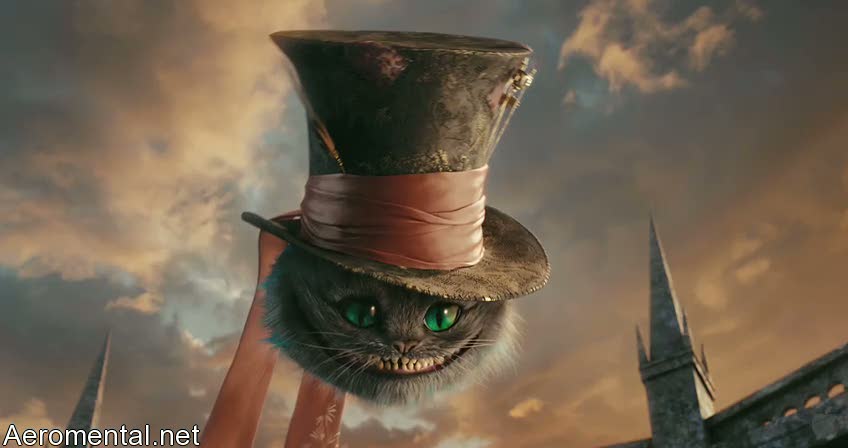
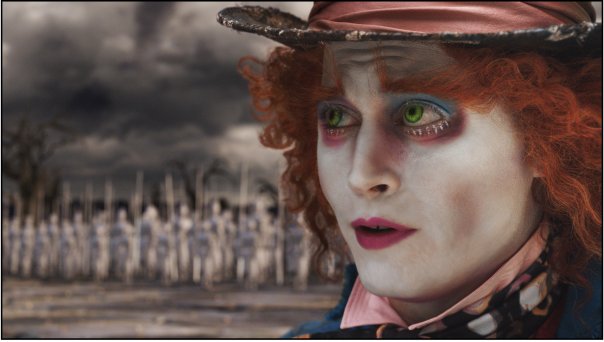
It's here, as you'd guess, that the movie takes off. The colors more vibrant, the effects-work (by four FX houses but primarily Sony) magical, even the 3-D has more depth. The characters adhere to a mixture of Burton and first edition illustrator John Tenniel, and more in that direction than the way the Disney animators drew the characters for their 1951 adaptation. The film is nicely cast with Burton's usual suspects (Johnny Depp—top-lined as The Mad Hatter, Helena Bonham Carter—simply delicious as The Red Queen, the voices of Alan Rickman—the caterpiller, Timothy Spall—Bayard the hound, Christopher Lee—as the Jabberwock, Paul Whitehouse—as The March Hare, and Michael Gough—as the Dodo) New to Burton are Stephen Fry as the Cheshire Cat, Michael Sheen as the White Rabbit, Matt Lucas as Tweedles Dum and Dee, but most impressively, Crispin Glover as the evil knave Stayne, and Anne Hathaway as the White Queen. One wonders why Glover has never been in a Burton movie before—maybe Burton thought he was uncontrollable?—but he brings a hissing nastiness to what could have been a typical bad-guy role, and that Burton sets him up against Depp's Hatter is one of those movie match-up's you love to see. And Anne Hathaway proves once again that she's not afraid to explore her dark-side. Her creepy "Liza-Minelli-in-a-straight-jacket" White Queen evokes Burton's long-time exotic paramour Lisa Marie.

Quite the ingredients for a film, and with Burton doing the stirring, one salivates at the possibilities. There are lots of laughs, moments of exquisite beauty—wispy seeds occasionally enter the frame and at one point, we park in front of a dew-drop hanging underneath a mushroom (Robert Zemeckis would have shoved us through it)—the whole movie is filled with beautiful images and nice ideas to keep you in your seat. But, it has no staying power, and it might be because this "Alice in Wonderland" has the parts, but not the nonsensical sinew that has made "Alice" a classic.

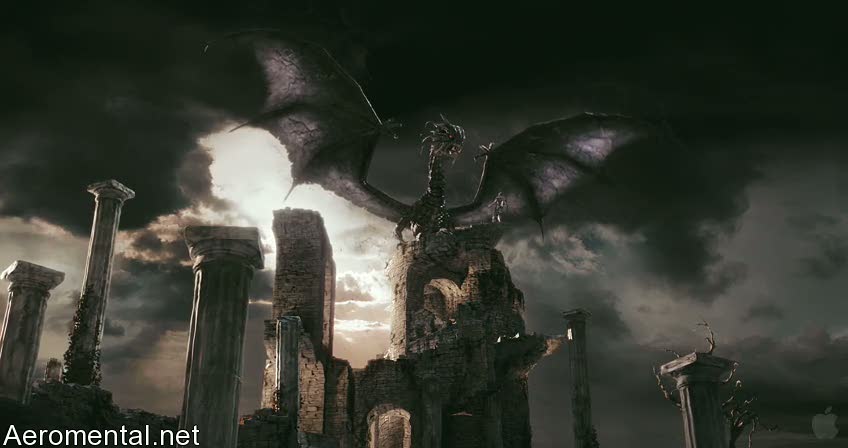
Wolverton and Burton take the essential pieces and make a typical action-adventure story-line out of it. There is some half-sized satire about political squabbling, but mostly it's a cut-and-paste job, based on "The Jabberwock Poem." That classic piece of nonsense turns into a fable "that will make everything alright." And it involves one of the characters defeating the Jabberwock in battle with "the vorpal sword" to invoke "the frabjous day" and blah, blah, blah. It's a silly poem, people, not a video-game scenario. By the time we get to the climax, there's a "Lord of the Rings" dark-sky battle between the characters, and we could just as well be in "Narnia" for all it matters. And it has an after-school special message to it, that is nice and all, but is a bit like cherry-flavored medicine.****

This is a lot of talk for a movie I'm only luke-warm about, but the bottom-line is, it's fun while it lasts, but it's like eating cotton candy in the rain. So, yeah, take the kids, it's imaginatively done (when it is), and they'll love it. But don't be surprised if they get sullen and whiny an hour after. Rich it may be, but it's mostly empty calories.****

* A word of explanation: this was written for an old movie blog of mine, now consigned to pixel dust, but written at a time when I still believed that you needed to sum up your view of a movie with a "Rating" (you know, 8 stars of 10, or, the most egregious "Thumbs Up"👍 or "Thumbs Down👎." The way I pigeon-holed films was very basic—"How much money do I think you should spend on it?" So, the ratings went like this:
1) Full-Ticket Price. The cost of a first-run evening show. The movie is worth seeing in a theater for whatever reason, even at full price.
2) Matinee Not worth a full-price ticket, but still worth seeing on the big screen, but save some of your money because it's no Citizen Kane.
3) Rental For whatever reason, pick it up on your own terms, in your own home. Not worth making an appointment or going out of your way.
4) Cable-watcher Less than Net-flix, because cable gives you more options for viewing. Don't schedule your life around this film, in fact, there are probably better options channel-surfing. If it's a distraction, and it just happens to collide with your eye-balls, this is it.
5) A Waste of Film (or video--don't get technical!) Don't waste your life along with it. There's nothing to get from this film, and the only thing the makers got was another notch on their resume/imdb site.
** Here's the rub: Alice in Wonderland dropped out of my head very fast. One trip to the hardware store and *POOF!* it was gone like a puff of hookah-smoke (or was that diesel?). Now, I waited to write this, fearing another Shutter Island mis-take, and I found the movie shrinking away—shrinking, shrinking, shrinking, waiting for a cake to say "Eat me" to bring it back to size. Never showed up.
*** There's a subtle joke there, as it's mentioned that the party has been in the works for twenty years...but Alice is only 19!
**** Woolverton and Burton add a nice touch that Alice is constantly questioned whether she's the "real" Alice—the Alice that showed up in "Underland" when she was six. She's grown up and the residents hardly recognize her as the strange child who changed the name of the place to "Wonderland." The original story's name was "Alice's Adventure Under Ground."
***** SPOILERS AHEAD: To show you how cookie-cutter this "Alice" is, somebody gets captured and has to be rescued, there's a last-minute save from an unexpected source, a character must claim an essential ingredient by facing danger, and a foe becomes an ally. Oh! And one character's actions provides the method for their eventual freedom. And there's no place like home. I may be a little harsh here, but "Pan's Labyrinth" showed that you could do something different with this sort of myth-weaving and still make a compelling movie.
****** See it in 3-D? I dunno. It will probably be brighter in 2-D, but betray the flatness of the images, and Burton has the same problem as James Cameron of bringing non-essential things on the frame-edge, like ferns and such, too close to prevent double-images. Zemeckis, Dreamworks and the Pixar folks are the champions of 3-D so far.
Written at the time of the film's release.
 Getting Pixelated at the Mead Hall
Beowulf tells the age-old story about the hero who rides into town to defeat a inhuman beast, then its mother, and finally, late in life, a fearsome dragon which proves to be his final battle. Robert Zemeckis directs from a screenplay by Neil Gaiman ("Sandman," "Stardust") and Roger Avary (Pulp Fiction).
First off, the screenplay by Gaiman and Avary takes a few liberties with the old text, making Beowulf something of a blow-hard, the struggle of Beowulf and Grendel's mother a different kind of tussle, and that fateful dragon becomes the issue of that liaison, just as Grendel is the product of an earlier assignation between Grendel's mother and Hrothgar. That ties it all very neatly together, and sets up a nice little "sins of the father" echo.
It also neatly dispels one of the problems I always had with the story (I first read it in a Scholastic Book Club edition) was that Beowulf maims Grendel, tearing off his arm, then marches off to dispatch Grendel's mother. Having done so, he marches back to the Mead Hall bearing the head of Grendel. Grendel? What about Mom? Since he's taking souvenirs, why doesn't he bring back her head? I mean he cut it off, did he lose it somewhere? Struck me as a bit of a disconnect, it did, and I went on with the story vaguely distracted by that point.
So Gaiman and Avary, citing that Beowulf is boastful, supposes that Beowulf didn't kill Grendel's Mom, but was seduced by her instead, thus the only trophy he could bring back, save for a "loathsome" disease, would be Grendel's head, and he just says he killed her. And that child is the dragon that King Beowulf fights to their mutual destruction.*
As I said, tidy.
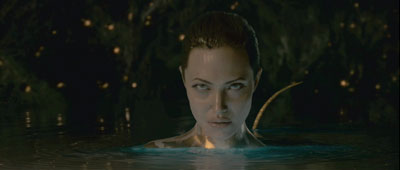
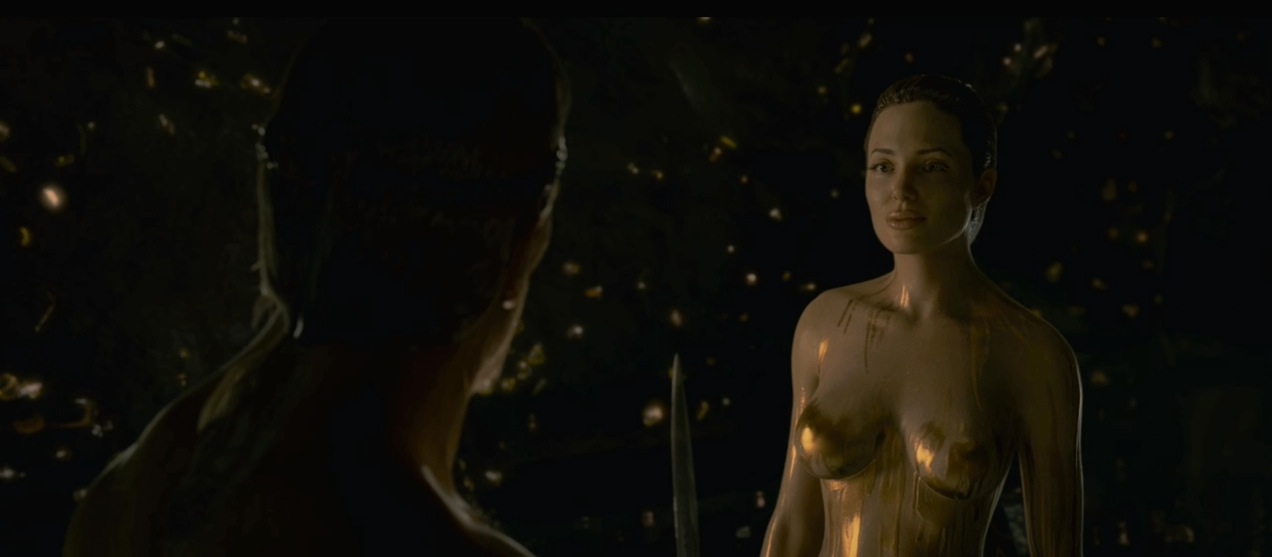
This is Zemeckis' second big motion-capture film after The Polar Express,*** the "beloved" children's story made slightly creepy because all the characters look like those artists models, with resemblances of people plastered on them. One wishes to say that it's a "revolution" and all, but I'm still unimpressed, despite the thousand of person-hours involved to produce it. The landscapes and inanimate objects look great, but the people still have a clumsy way of walking and expressing themselves that takes you right out of the moment. The eyes seem all wrong, and the animation of the mouths when talking looks pinched and unconvincing, as if every character has had a few rounds of plastic surgery--the women in this are all unlined and Barbie-doll-ish. The characters played by Hopkins, Malkovich, Wright-Penn and Jolie all resemble the actors, which is also a bit of a distraction--they've done a lot of work to get Jolie "just so," but despite that there are instances where it looks like Jolie morphing into Jennifer Garner.** But Ray Winstone, and Brendan Gleeson look like totally original characters that make them a bit more accessible. Generally, everything looks wonderful in dim-light scenes, but in the glare of daylight, the illusion falls apart.

A few other things bother, like the fight where Beowulf vows to fight Grendel naked (just to keep things even), and we are presented with object after object getting in the way of proving it. It was a running joke in Austin Powers and The Simpsons Movie, but here, it's done completely straight-faced--which makes it all the more funny. The presentation of Angelina Jolie as Grendel's Mother makes the seductress role a little easier to see, but when she approaches Beowulf in all her "might-as-well-be-nakedness," there is a shot of her feet, which are cloven--but have spiked heels. Claws, yes. But spiked heels? Did Grendel's mother get the image to present herself from "Victoria's Secret?"***

Then, there's the problem that I'm seeing in more CGI movies--the "we're under a tough deadline, so let's make everything move really fast, so we don't have to do a lot of detail work" that shows up in such things as Spiderman 3 and this film. Propulsive? Yes. Distinguishable? Not a bit. But it's easier to do a complex sequence if your make everything kind of a "smear." Finally, there's Crispin Glover as Grendel--one of those handful of roles you could say that Glover was BORN to play, but even here he's bizarrely strange--his words undecipherable, and his performance turned to "11." Like a lot of things in the film, it may produce unintended fits of giggling.

Also, this may be an animation film, but there is no way that a kid should go to this. There's a lot of gooey, icky violence, disturbing images, and nudge, nudge jokes that will have them in therapy within a week. Also, I didn't see the 3-D presentation of it--a lot of pointy things get stuck in your face in both versions--but I've been told the 3-D effects are, indeed, staggering and probably the most successful 3-D process yet produced.
I know a lot of things will stay with me--particularly the way Ray Winstone says: "Moi Nime is Baya-woof! An' Oi've cahm to kill yo' monstah"
* I'd cite some sort of "Spoiler Alert" here, but as it's the oldest manuscript in "British" literature, and was written around 1100 AD, you've had plenty of time to read it by now!!
** A trick not beyond Zemeckis, who in the space-warp segment of Contact, morphed Jodie Foster's face with Jena Malone's, the actress who played the character as a child.
*** He would make a motion capture version of A Christmas Carol, subsequently.
*** Want to know what's really weird? You go to the web-site that has the Beowulf translation on it, and there are two google ads: one for "Olde English" and the other for "sexy pics" of Angelina Jolie. One has to wonder whether the film-makers have done more harm than good.