Showing posts with label Jessie Buckley. Show all posts

Tuesday, May 21, 2024

Wicked Little Letters

Post Pardon Depression
or
A Comedy of Ill-Manners
 
I think I've mentioned before that you can't watch a British mystery series without one episode involving the investigation of a rash of poison-pen letters (that may or may not be true) that disrupt a community. There was one major movie, Henri-Georges Clouzot's The Raven, that we mentioned previously. 
 
The origin of this particular trope came from the scandal of the "Littlehampton Letters", a Sussex incident that caused quite the scandal between 1920 and 1923. The general story is that Edith Swan, a spinsterish woman who lived with her upright Christian parents, began to receive letters of an unseemly manner and of such vulgarity that she made complaints to the police. Suspicions immediately turned to Edith's neighbor on Western Street, Rose Gooding, as Rose seemed a person of questionable character, known for causing rows and for her obscenity-laced language. It didn't help that the letters appeared to be signed by Rose. That first letter started: "You bloody old cow, mind your own business and there would be no rows. – R." That Rose had a child and was living with a man didn't help things. Nor did that the letters appeared after Rose was reported to Child Protective Services by someone in the neighborhood.
Rose was arrested and charged with criminal libel, and as she could not afford bail, she was in prison for three months. During Rose's incarceration, the letters naturally ceased. When she was released, the letters began again, expanding in scope, and Rose was again arrested, convicted and sentenced to 12 months in prison.
All neat and tidy, said the law. But the story didn't end there, through the efforts of a dogged police-womanSussex's first
Woman Police Constable Gladys Moss, who began to suspect that things weren't as neat and tidy as her male counterparts believed it to be. With the help of Scotland Yard, she was able to trace who the letters were coming from—the courts wouldn't allow writing analysis in the trials—and catch the actual culprit in the act.
Wicked Little Letters tells the story of the case, and, truly, it lives up to it's opening title: "This is more true than you'd think." Oh, there are little changes here and there, mostly for the sake of diversity in casting, and to ram home the point that those times were more prejudicious than our own (although it's ironic that they try to make the point of how good we've got it by casting non-white players to signal to us that these people are dealing with oppression and prejudice*). Actually, our times are just as bad, only less by a matter of degrees.
Edith Swan is played by 
Olivia Colman, her parents by Timothy Spall and Gemma JonesJessie Buckley is Rose Gooding and her live-in man is Malachi KirbyAnjana Vasan plays Woman Police Constable Moss, and Rose's neighborhood allies include Eileen AtkinsLolly Adefope, and Joanna Scanlan. However much kerfluffle may have been going on in Western Street in the 1920's, it couldn't have been as entertainingly chaotic as this cast makes the circumstances involved. Colman, particularly, is a study in contrasts. Initially making friends with Buckley's Rose, Colman's Edith couldn't be more thrilled—a little shocked at her raw forthrightness—as Rose is as free-spirited as Edith is repressed, belittled, and subjugated in her father's household. When the whole letter-thing is delivered at her doorstep, she becomes alternately victimized, outraged, and (once the papers get ahold of it) prideful of her role as upright citizen standing up for the decency of civilization. Her performance is a master-class of expressiveness whatever the role Edith takes on.
And Buckley holds her own with the more ostentatious part as Rose, unapologetically coarse even as she's being accused of coarseness, while fully realizing that she is just a gavel's slam away from losing her family as a consequence. But, her Rose is a scrapper, not willing to go down without a fight, even as it appears as her whole world is falling apart. And Vajan, after years of bit parts and one-line roles, pops right out of the screen as a determined copper not content to merely know her place, her eyes almost comically revealing the frustration and battling fierceness required to see justice done. 
Wicked Little Lies careens between comic (it's rated "R" for hysterically "pervasive language"), dire, and subversive—when dealing with authority figures (predominantly male)—and made with the intent of taking the mickey out of the status quo. There is just the hint of hysteria in the parties involved rebelling against their circumstances, even if the actions don't quite push through the complacency. One wants to call it a comedy of manners, if it wasn't so enthusiastically ill-mannered.
It's also rather deliciously quaint, as one can only imagine the reaction any of these characters would have if they were exposed to social media.
 
Crikey!
 
* I don't want to harp on this too much, because I'll sound like some backwards stick-in-the-mud—you cast people because they're good, not because they're a "type"—but it occurs in the same way with the writers portraying Rose Gooding as an Irish immigrant, to reinforce that she was an outsider of "low" character. Gooding was born in Lewes in Sussex, and merely moved into the neighborhood, rather than coming from Ireland. Sometimes I think these things are betraying prejudices in the act of pointing them out. Anyway, the real people were all lily-white, and the actors portraying them are damned good.

Saturday, February 4, 2023

Women Talking

Only Women Bleed
or
...Then What's a Heaven For?
 
"The Following is a Product of Female Imagination" says the title once the opening narration of Women Talking is finished—opening line: "This all happened before you were born"—and it's a bitterly defiant statement as we've just learned that the women of a Mennonite colony--who are being systematically drugged with cattle tranquilizers, raped, beaten and often impregnated--have been chastised by the men of the colony that their accusations are hysterical, or that they're being visited by ghosts or demons or that it is all a product of "wild female imagination," and holds no truth in reality. Their reality.
 
"Wild female imagination." "Female Imagination" does not bruise and it cannot make pregnant. Men do that in their male imaginations and plots. Because they can. Because they think they can get away with it. Because they can't do it any other way. Because they're allowed to get away with it. Because their authority can't be questioned.
 
And because accusing the men of it (they say, because it's "their colony") will mean that the women won't be able to go to Heaven for their "lies." The men, presumably will, because there's nothing in The Ten Commandments about hypocrisy.
The men have now gone into the neighboring town to try and make bail for the accused attackers. They will be gone for more than a day, and, when they return, the women are expected to apologize...and if they don't recant, they will face excommunication and, of course, not be able to reach the Kingdom of Heaven.
So, while the men are gone, the women take a vote—their first—and because they are prohibited from learning to read or write, It's done with pictographs and X's. 
There are three choices. Stay and Submit. Stay and Fight. Flee. Leave the colony.
The vote is split between "Stay and Fight" and "Leave the colony" and so, the women choose representatives to discuss what will be done, the ramifications, the logistics, what will come next. And to keep a record of their discussion, they recruit the one male left behind, August (Ben Whishaw)—whose family was excommunicated due to his mother's objections to the men's dictates—to record the minutes of their meeting, a record to be left behind.
Three generations of women discuss what comes next: elders Agata (
Judith Ivey), Janz (Frances McDormand), and Greta (Sheila McCarthy), daughters Ona (Rooney Mara), pregnant with the child of her attacker, Mariche (Jessie Buckley) and her children, and Salome (Claire Foy) all gather in a barn-loft to discuss their options and make the decisions before the men-folk come back. They know the situation is intolerable—although Jenz decides that she will stay and leaves the discussions early—and they have to decide what sort of life they want for themselves. And for their children, who are also subject to the men's attacks—the most recent attack was on
Salome's four year old daughter.
It's a particularly appropriate time to have movies like this, as women's autonomy is under attack in this country and throughout the world (it's why the recent adaptation of "The Handmaid's Tale" recently resonated so much in the collective zeitgeist—while the 1990 film of it couldn't make its costs back—and as the #MeToo movement exposed the pervasive inequities in the power structures as women cemented their places in the workplace and in government). The only way to fight the entrenched power structure is in an organized group-dynamic that can up-end the status quo and maybe drown it out.
Women organizing and re-asserting power is as old as "Lysistrata," but writer-director Sarah Polley (Away From Her and Stories We Tell), has other things to discuss in Women Talking besides Fight or Flight. Good Lord, one of these days the Library is going to have a "Revenge" genre in their DVD selections, and that easy solution is dissected and vivisected in the course of the movie, because some of the women just want revenge. This multi-generational congress weighs options based on need, principals, philosophies, and viable futures...which includes going to heaven. In a way, it is it's own version of Twelve Angry Men—call it Eleven Angry Women—where prejudices are revealed, motivations are explained, and minds are changed. And it's performed by some of the best and subtle actors in the field.
If there's a complaint, it's that the introduction is a little rushed, some of the circumstances of the women involved not made clear from the outset, leaving an audience-member confused rather than intrigued. And Polley desaturates her images so far into the gray scale that it could almost be black-and-white. As some directors (Welles and Bogdanovich and Ford) have pointed out, sometimes color can be just too pretty for what you're trying to convey and the film-matter, though set on acres of fields is far from verdant. The film is a tough-sell, anyway, perhaps the distributors insisted on a color film, and this was Polley's solution.
And for anyone who grouses that the film is any sort of "stretch" it's based on a book that took as its inspiration, what was called "The Ghost Rapes of Bolivia," where, beginning in 2005, women in a colony began to be subjected to this type of outrage and decided to leave, trusting in God that She would provide.

Saturday, June 4, 2022

Men

I was going to publish this earlier in the week, but even as I parsed out the film while writing this, I decided that it would best be left for Saturday, which is traditionally "Take Out the Trash" Day.
 
They're All Alike
or
Literally, I Don't Know What's Going On
 
Harper Marlowe (Jessie Buckley) wants to "get away from it all." She's just suffered a traumatic incident in her life: an argument with her husband James (Paapa Essiedu) over a divorce has resulted in his death—but whether it was a deliberate suicide or an accident is a matter of conjecture. Harper, however, feels responsible, even if the argument was a case of deflection, mutual accusations and a fight ended in her being hit. She had no control over James' actions and was locked in her apartment when she suddenly sees husband him fall past her window to be smashed on the pavement below. 
 
Some time has now passed and we watch Jessie drive away from London in her Ford Fiesta as the roads get narrower and the surroundings get more rustic. She is in the country, moving away from us to the background of Lesley Duncan's "Love Song" promising calmer surroundings and bucolic settings in which to recover, heal, and contemplate. She's alone now, and it appears that there will be plenty of time for her to get herself together.
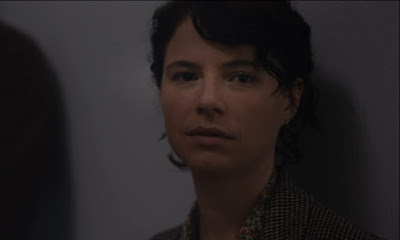
Her destination is a country house four hours out of town, and its a lovely old structure, 500 years old—"Shakespeare. Or pre-" explains the owner, Geoffrey (
Rory Kinnear)—but with all the modern conveniences like inside plumbing, gas range, motion-sensor lights outside, and a lovely orchard dominated by a large apple tree, which (of course) compels her to pluck a fruit and take a large bite—Oh, that never works out good in stories. Geoffrey even makes a joke out of it "No-no-no-no-no-no-no. Mustn't do that. Forbidden fruit" then, he smiles a wide toothy grin and says it's just a joke, eat all she wants "make a chutney if you want." He gives her a tour of the place and it's a combination of ancient and modern, the walls painted an earthy red. That'll come in handy later. Blood-splatter and all.
She's all by herself—although Geoffrey reassures her he lives right down the lane—alone with her thoughts. She's still going over the argument in her mind, and the image of James falling past her window. She's haunted by it, the image of him on the ground, ankle shattered and twisted at an odd angle, his arm impaled at the wrist by a wrought-iron fence. She can't shake it, so she takes Geoffrey up on a suggestion to go on a nature walk. The pathways are rough and she gets a little lost until she comes across an overpass that produces a long tunnel with some interesting echoing aspects. But, at the other end she sees a figure who watches her and then runs towards her. She turns and runs back the way she came, but she gets lost and when another blocked overpass stops her cold, she roughs it up an embankment and continues her way back to the B and B.
She passes by a ramshackle house in terrible disrepair and decides to take a picture. But, when she views the snap...standing in front of it is a naked man (
Rory Kinnear). She looks up from the camera and there he is, scratched up, scarred and watching her. She runs back to the B and B and calls a friend (Gayle Rankin), but while she's talking to her she doesn't notice that the man is now in the orchard and staring in the windows at her. When she finally notices, she calls the police and the man is arrested by a couple officers (Rory Kinnear and Sarah Twomey) and he's taken away—a vagrant, apparently, and considered "harmless."
But, he's not, is he? After her estranged husband's death, and then this creep, Harper no longer feels safe, not even in the house. But, the guy's in jail, right? So she goes on another walk around and comes across an ancient church. No one there. So, she sits and contemplates and the grief comes pouring out of her. The church vicar (
Rory Kinnear) observes from afar, but does not approach. Outside, she encounters a tween (Rory Kinnear) wearing a Marilyn Monroe mask and starts hectoring her. The vicar interrupts, words are exchanged, and the kid stomps away, leaving Harper and the vicar to discuss her break-down in the church. But, the conversation leans into the accusatory even as the vicar leans in to touch her leg.
Ew.

Alex Garland's third film, Men, is a creepy, methodical horror film that finds dread in even the most innocent-seeming circumstances. One starts looking around corners of the screen for the out-of-place and off-putting, every note, every beat, every sound designed to put you on your guard. All that detail and all that deliberateness stands in the service of putting us in Harper's head-space of grief and isolation, where inner thoughts and outer appearances are mutual threats to the being. Then, when these men (Rory Kinnear) start showing up, all of them are passive-aggressive or just plain aggressive, not passing up an opportunity to imply, or judge, or man-splain, or dismiss...or accuse...or invade. It's clear that Garland is saying something about the lot of women, and the guarded world-view of threat that is endured on a day-to-day basis.
All well and good. Up to a point. As good a job as Kinnear does playing multiple roles in distinctly creepy ways, the fact that all the men are him creates a sense of false narrative to the point where we start questioning not them...but her and her state of mind. These guys can't be all the same person—there's a bar scene where everybody is played by Rory Kinnear (Rory Kinnear)—so, is there something wrong with her, with her perceptions? If the point was to show her threatened in a toxic man-verse, adding the doppelganger casting undermines it...and her.
The problem is compounded in the film's closing moments when the film escalates into gory/grotesque assault mode with stuff that surpasses the creepiness factor of John Carpenter's version of The Thing. What are we to make of these manifestations popping out of each other's orifices? Is it real? (Probably not). Is it some sort of alien manifestation...ala The Thing? (No evidence of this has been implied). Is it a manifestation of her guilt and just her imagination (Which throws her character under the bus and doesn't explain all the blood that shows up in the house).
This is the danger with "metaphorical horror." In trying to make a point, you lose the thread of the story. Is it real or is it imagination? Is she to be believed or is she a false narrator? I tend to be sympathetic with the view that a world of men—all with their instincts and neuroses and phobias and fetishes—can be a challenging, even a frightening challenge for women (I've heard and sympathized and emotionally grumbled over too many stories of men in cars keeping silent pace with a lone female walking a street and witnessed the predatory nature of men in all sorts of situations not to be). Perhaps it's a matter of a studio wanting a "wowser" of a third act to sell a movie—I've heard a lot of that, too—but A24 is an art-house studio with a track record of leaving projects alone. No, I think it's a matter of an unreliable writer/director trying to make a point visually that has already been made...and betraying the lead character that sympathy has been built around. 
I mean, even if all the gory manifestations were true, would anyone believe her? Or will they blame her, obsessing, say, on what she was wearing? Or whether the timeline of her story held up. Or, whether, by their reckoning, such a thing could be possible, and so, her story must be false. What about her body language, for God's sake? I've seen too many trials and confirmation hearings to believe otherwise.

And that's a true, more pervasive horror. Nothing metaphorical about it.

Saturday, January 8, 2022

The Lost Daughter

O Mother, Where Art Thou?
or
"They Really Put Us Through it, Huh?"
 
Leda Caruso (Olivia Colman) is on a "working holiday" in Greece and for awhile, it's quite idyllic. She has the beach to herself and time is not an issue. She works on her studies—she's a professor—and when she tires of that, she sleeps in the sun or goes floating. There is no intrusion on her time, and, for awhile, there's no intrusion on her solitude. At first, there's only Will (Paul Mescal), the resort "boy" whose job it is to be solicitous. He's useful, when you don't know where to get a glass of water or when he offers an ice treat. Then, there's Lyle (Ed Harris), an ex-pat American who owns the resort, and is your typical ex-pat—he's helpful but a little stand-offish. He likes things the way he has them, carved out a life for himself by carving out everything else, and is basically living in the "now." His "now." He has a past, but he's not going back to it.

And, for awhile, it's good. The weather is temperate, the water is warm. Oh, there's that annoying light house that, when conditions are right, slashes light into the night of a room and "whooms" so incessantly that you have to sleep with a pillow over your head to try and drown out the sound. But, responsibilities are few. With very few invasions of privacy, it's perfect.
It can't last. It might with somebody else, but not with Leda. Soon, a family from New York shows up at the resort, and, to her, it feels like an invasion. She watches them suspiciously, as they talk loud and curse casually. Vasilli (
Panos Koronis) and his young wife Callie (Dagmara Dominczyk) are the ostensible heads of the family, but there's also Toni (Oliver Jackson-Cohen) and his wife Nina (Dakota Johnson) and their daughter Elena (Athena Martin Anderson). Things get off on the wrong foot when Callie asks Leda if she'll move to another lounge chair so the family can all be together and Leda haughtily refuses. There's a lot of stink-eyes and muttering just within ear-shot, but Leda has been eying the family before.
At the same time, Leda watches them—and director Maggie Gyllenhaal keeps us locked in on her point-of-view so that it almost becomes claustrophobic—she starts to think back to when she was a young mother (
Jessie Buckley takes over as Leda at this point) with two small girls. Two very needy little girls that tax Leda's time and her patience, taking her away from her translation work which takes a lot of concentration. There are little parallels between what she sees and what she remembers. And she catches every nuance of Nina's interaction with her child—the hesitations, the annoyances, the impatience, the reluctant giving-in—all to which she can relate.
Leda's "Kravitzing" does have a good result; when Nina is distracted by something, little Elena goes missing, and the family starts to panic, freaking out rather than trying to figure out where Elena could have wandered off. They're not organized at all. Leda, seeing Nina's distress and remembering a time when she experienced the same thing, assists in the search, and ultimately does find Elena to the relief and gratitude of the family. The earlier touchiness evaporates and Leda is empathetic enough that the family fairly embraces her. Nina, in particular, is drawn to Leda, seeing her as a kindred spirit who understands the pressures and toils of raising young kids. She does. But, Leda's approach is to internalize it as a burden, one that can come to a breaking point if allowed to fester.
Thank God for Olivia Colman. The Lost Daughter would be a very tough slog if it weren't for the excellent work done by her and the rest of the cast. Not that the movie is dull. It's that you have to spend so much time in Leda's head. It's a situation shared with the character. Leda is so internalized that there shouldn't be much of an exterior at all. All that studying, translating, her inner life is so much more fascinating to her than her external one. But, she indulges it to the detriment of those around her, be they friends, colleagues...family. And her obvious grasping for approval in the young Leda scenes contrasts with the less satisfying, messy, chaotic world of raising a child. Who gets acclaim for that?
It's a tough thing to raise children. It is not easy and there can't be a consistent plan or syllabus to cling to. So, Leda lives her life in her head, playing mind-games with herself and others, just her against the world. At times you see what the character is doing and wonder why on Earth do that? I have suspicions—which have to do with control and punishment and teaching lessons—but to delve deeper would be to take some of the shocks out of it, and deprive the viewer of questions that will inevitably arise.
And that would be a pity because Colman wears Leda's neurosis so much on her sleeve that it's fascinating to see her mercurial performance playing across her face. At times, you're aware that not even she understands why she does what she does and the film becomes less about the issues she has with the world than about her own, and how she imposes them on the world, with the inevitable consequences, intended or otherwise, that become self-fulfilled prophecies. It's a psychological adjunct to all those Kubrick movies where smart people make bad choices, intellect be damned, and gives truth to the old saw that people can be too smart for their own good.
 
It's like the thing I read on Twitter today that was attributed to Nicola Tesla: “One must be sane to think clearly, but one can think deeply and be quite insane.” The Lost Daughter walks that razor edge, fortunately, with Olivia Colman's nimbleness.

Friday, January 22, 2021

I'm Thinking of Ending Things

The Beautiful Mind of Charlie Kaufman
or
"I Suppose I Watch Too Many Movies." "Everybody Does; It's a Societal Malady."

Writer-director Charlie Kaufman is a creator of a particular niche, but nothing so ephemeral as a consistent genre or style. He's not someone you go with expecting a "twist ending" or a particular visual "language". His projects take you down roads nobody has ever travelled before in movies with concepts wholly original, whether metaphorical or philosophical. You recognize the landscape as being of "the real world" but there it ends as far as a frame of reference for where he's taking you is filtered not though the physical eye, but the mental point of view. His fables and myths are of the mind and its undiscovered countries. 

Most movies make you feel. Kaufman's make you think. Sometimes painfully.

Whether they ponder identity and wish-fulfilment like Being John Malkovich, or emotional response as in Eternal Sunshine of the Spotless Mind and Anomalisa, or the act and process of creation—Adaptation. or Synecdoche, New York—Kaufman takes the "what if?" approach to crystallizing the concepts, the same way a science-fiction writer throws a magnifying lens on a subject by imagining its inverse or subverting traditional norms. Watching Kaufman is like watching "The Twilight Zone" but not going to a "fifth dimension" but definitely "to the pit of man's fears and the summit of his knowledge."
Kaufman's new film (streaming on Netflix) I'm Thinking of Ending Things is based on the 2016 novel by Iain Reid—but not the way Adaptation. is based on "The Orchid Thief". For that film, Kaufman made a screenplay of trying to "crack" the writing of the screenplay, and made his own difficulties doing so part of the narrative (and having done that, tossed away the book's specifics to get to its heart). For Reid's book, he took the method the writer was employing and wrote his own more visual ending while staying true to his resolution.
The result is a meandering stream of conscious quilt of a movie that involves the fears and tensions of interaction, the arbitrariness of life—and thought, and, something that might be of concern in these days of COVID, the bubble of "interiority". It can be a healthy mode of analysis or it can be a trap in a hall of mirrors.
We start out with a young couple (Jessie Buckley, Jesse Plemons) on that ritual step of dating—meeting the parents (his). This can be the stuff of comedy (Meet the Parents) or the stuff of horror (Get Out). With Kaufman, it's a little bit of both with a mutated dash of Lynch. We see the couple—her voice-over talking about how she's "thinking of ending things"—as they drive through the snow, the conversations of fits and starts, the mis-understandings of meaning, the doubts of the relationship despite having "so much in common." She's loquacious, even animated, while he has a nervous remoteness, bordering on a muted hostility, nervous, perhaps, about her entering into the family sphere he is only too familiar with...and (as they say) familiarity breeds contempt. 

He's driving. He'll always be driving.
Once we meet Jake's parents—after a prolonged, uncomfortable wait, where she meets the farm's dog with perpetual shaker syndrome and a door leading to the basement with scratch marks on one side and masking tape on the other—things to start really getting weird. Dad (David Thewliss) appears to be palsied and Mom (Toni Collette) is a paroxysm of nervous laughter. Jake turns slightly diffident and embarrassed by his parents and all she can do is try and make the most of it, but things are clearly out of whack here. It isn't long before she starts making excuses to leave because she has work in the morning.

Besides, the snow is starting to really come down. You have to be careful. The roads are treacherous.
Kaufman occasionally cuts away, without warning, to an elderly janitor cleaning a high school in the middle of the night. It's also snowing, and the theater troupe is practicing in the gym, and on his break he watches a TV movie.
But, things are getting weirder back at the farm. The snow's not letting up, and, although everybody's holding up their end of the conversation, there are things Jake doesn't want to talk about...like how they met at a trivia contest, and he was so good at it, and they had so much in common that he asked for her phone number. It's funny about the picture of him as a child on the wall, though. It looks just like her as a child. That's just...weird.
What...just, wait...what is going on here? After awhile, one wonders who's having the brain infarction: her or you? There appears to be a logic to it, but...no. To talk about details will be to spoil surprises...that is, if you have the patience to go along with it, and wonder exactly where you're being taken in this snowstorm. It may not be your idea of entertainment. In which case, reading the 1-star reviews over at IMDB might be more your style (some of them are almost clever!).
But, let's admit it: this one's not for everyone. For those who aren't engaged by a movie in the first 20 minutes it's a non-starter (and you'll think of ending it, lol—those IMDB commenters are a hoot!) If you have a favorite Charlie Kaufman movie, this isn't like it, and you'll like it only if you're into the off-beat and you're not comfortable in the David Lynch-end of the universe. Oh, there are joys: at one point Our Heroine goes into a straight-up imitation of Pauline Kael criticizing A Woman Under the Influence (1974), which is a hoot—even her cigarette comes out of nowhere. 
But, it's Kaufman playing around with the form, and sometimes that can be frustrated if one wants things tied up with a bow, or already chewed and spat into your brain. This one's about depression and loneliness and despair and "what-might've-been" and sometimes watching something like that can be depressing in and of itself.
But, it can also be intriguing and imaginative. Oh, I wouldn't blame ya for I'm Thinking of Ending Things

But, it's my cup of arsenic.