Showing posts with label Nick Offerman. Show all posts

Thursday, April 18, 2024

Civil War (2024)

America "in the Twilight Zone"
or
"You Never Know What's Coming Around the Next Corner."

There was part of me that wanted to write a long preamble prior to watching Alex Garland's Civil War and lead with that. I'm glad I resisted that idea. Because if there's one thing I've learned about Alex Garland is that he never makes the movie you expect he's going to make. That was true of Ex Machina and Annihlation and Men. None of those—two of them sci-fi and one out-and-out horror film—defied expectations and were something completely different from either your expectations or experiences. You may come out confused, or disoriented, but you would hardly be bored.

You might even walk out pissed off.

But, not bored.

But, Civil War is not science fiction, it's speculative fiction (and oblique speculative fiction, at that)...there's no fancy technology—this war is conducted with Humvee's, automatic weapons, and helicopters (there's not even a drone in sight!). It's speculative...but not the way you might think it is...like, with some recognizable political perspective that reflects the fractured state we appear to be in now. There's plenty of things for people to cherry-pick (we'll look at those), but just as many things to confound that perspective (we'll look at those, too).
The President (
Nick Offerman) is preparing a speech to the Nation about America's latest victories in the war with the "Western Front"—a group of secessionist states at war with the government. "It is," in his words, "the greatest victory in the history of military campaigns."
That's hardly "The War to End All Wars" language. But, it is enough to raise literal questions among a quartet of journalists embarking to set off to Washington D.C. to try to interview the President, despite POTUS labeling the press as "enemy combatants." The group is Sammy (
Stephen McKinley Henderson), a veteran reporter who writes "for what's left of The New York Times" and who labels the President's latest announcement as "nothing, he could have chosen words at random; Joel (Wagner Moura), a war correspondent from Reuters, who seems to have a "jones" for being in the thick of the action; Lee Smith (Kirsten Dunst), a award-winning photojournalist, also from Reuters; and Jessie (Cailee Spaeny), a young up-and-coming photojournalist wannabe, whom Lee saved from getting concussed by a bombing of an Environmental Protection truck at a New York City protest. Sammy walks with a cane and Lee thinks he's too old and too fat to be useful where they're going, and she's pissed at Joel for letting Jessie talk him into letting her go on their journey. She thinks all the "baby-sitting" will get in the way of getting the story.
Their passengers should be the least of her worries. The 857 mile trip to D.C. will be littered with evidence of a country in crisis. Major highways are clogged with abandoned cars, shopping malls appear to be ground-zeros for attacks with crashed choppers in the paring lot and the ubiquitous short-stay high-rise hotels are chunked by missile damage. Tracers dot the skies at night amid the muffled reports of automatic weapons fire. Snipers occupy roof-tops, and an abandoned stadium is a handy, if crowded refugee camp for Americans bombed out of their living quarters. Spielberg tried to depict the concept of "American refugees" in his version of War of the Worlds, but Garland's version has all the verisimilitude of the nightly news, only a bit tidier.
So, what happened to us? Nothing is spelled out—we aren't given a long opening crawl to read at the beginning—we're just plopped down in the middle of the chaos (not unlike 
Haskell Wexler's Medium Cool) to learn what we can. Some of it sounds plausible: possible questions the group might ask when they reach their destination are tossed around like "Mr. President, do you have any regrets during your third term?" (third term?) "How about your dismantling of the FBI?" "Do you regret ordering air-strikes on American citizens?" When they stop to get gas, the surly militia guys guarding the pumps won't fill the tank for $300...but they will for $300, "Canadian."
But, there are disconnects that take you out of direct parallels: Lee is most famous for "the legendary picture of 'the Antifa massacre'." The "Western Forces" moving into Washington D.C. are a combined unit of the states of California and Texas (with reinforcements from the "Florida Alliance"). Both of those concepts jolt you out of thinking Civil War has anything to do with reality, but its concept of a trigger-happy America with grudges around every corner skews a bit closer to the home we know. As is the section where they drive through a seemingly normal rural town—reminded that there's a civil war going on, a shop-clerk says "we try to stay out of it" while the roof-tops are scouted by snipers.
The civil war isn't really the focus of the movie, either, but the back-drop in which reporters have to thread their way through "unprecedented times" to "get the story." And record truth in the same way they record conflicts in foreign countries. The good and the bad, but mostly bad. And they do it unblinking because someone has to look. And tell the tale. So others can decide. Although Lee admits that when she was covering foreign hot-spots, she was hoping to send home the message "Don't Do This."
 
For all the good it did. Most people ignore it or "stay out of it." Lucky them.
"Where's Joel?"
"Processing..."
For however preposterous the particulars, the general idea is that it can happen here...and might. And then the Constitution starts shredding, as people start to force their own interpretation on others. There is one cracker-jack of a scene—at some point it'll show up as a Sunday "Don't Make a Scene"—that features an un-billed Jesse Plemons as a militiaman in charge of a dubious operation that the quartet stumble upon that quickly escalates to a hostage situation, the "Are you American? What kind of American are you?" scene that is only hinted at in the trailers. He's crossed over where he doesn't need to know particulars ("Reuters? What's that?") nor does he care to learn. He makes decisions cavalierly and unhesitatingly and doesn't care if he makes a mistake—he'll just bury it. Plemons is so good at playing casually dangerous that the scene crackles with the authenticity of a body-cam and with escalating horror. Yeah, it could happen. It could definitely happen.
If there's a fault to be had, it's of the "Chekhov's Gun" variety—things talked about in the opening become significant in the second and third act as the stakes build. But, one can concede the point that this is veterans talking about the dangers and imparting wisdom to uninitiated. They impart that wisdom in the hope that it doesn't happen. But, it's happened before, so they talk about it, knowing full well that what's happened before...
The movie ends when the particular goals are met and things achieved. But like most Garland movies, it leaves you asking "What Happens Next", although the most typical scenario is discussed—as if by order of Chekhov. But, that is not Civil War's concern. It rack-focuses your mind back to the journalists and what has just transpired because at some point the movie has to end, and one is left contemplating the "Who" and the "What" and the "When" and the "How."

But, never the "Why."

Saturday, December 10, 2022

The Founder

The Founder
(
John Lee Hancock, 2005) "Build a better mouse-trap and people will beat a path to your door." That's how the old saw goes to inspire a capitalist economy. But, old saws can become rusty with the new tools of business acquisition, mergers, takeovers (hostile and non) and buy-outs. They're enough to take those better mousetraps and have their builders snapped by their own inventions.
 
Take McDonald's. The world-wide phenomenon had humble beginnings...but few locations. At the beginning, it was successful—the efficiency and fine-tuning that went into it producing Mcburgers on an industrial scale like Henry Ford's assembly lines almost insured it. But efforts to expand it fell by the way-side like so many paper wrappers due to consistency issues, as in quality control or an arbitrary change of menu on the part of the manager. The originators—Richard and Maurice McDonald—could manage their one San Bernardino location. But, out of sight/out of managerial control was the order of the day. Without the McDonald boys riding herd, the others were the Wild, Wildly Unprofitable West.
Which is when Ray Kroc (Michael Keaton) wanders into town. John Lee Hancock's peripatetic little film tells the story of how Kroc made a multi-national corporation out of a hamburger stand and created an empire that straddles the oceans with golden arches. Kroc starts the film out as a salesman for "5-spindle" milkshake mixers for the company Price Castle. We watch as he goes down the road, lugging his mixer sample going from drive-in to drive-in, delivering his message of positivity and opportunity: "You increase the supply, and the demand will follow... Increase supply, demand follows. Chicken, egg. Do you follow my logic? I know you do because you're a bright, forward thinking guy who knows a good idea when he hears one."
But, even Ray is starting to sour on it, as he goes from crappy drive-in to crappy drive-in where the service is shoddy, the wait is frustrating, and the scenery is a bunch of JD's hanging out with nothing better to do. He props up his no-sales attitude with "Power of Positive Thinking" motivational records until he follows up an order for eight of his multi-spindle milkshake mixers at a location in San Bernardino, California. What he sees is different. People are lining up to get food. He goes up to a window, orders a burger, fries and a shake, all for 35¢...and it's given to him right there right then. "What's this?" "It's your food." Knife, fork? Nope. Just eat it. Where? "Anywhere you want."
Ray is dazzled, not only by the efficiency, but also the line of people who get served pretty darn quick. He goes to meet the managers Dick (Nick Offerman) and Mac (John Carroll Lynch), who are only too proud to show him their set-up (and grateful for the mixer order being delivered), but also are dying to tell him their story of failure after failure...movie theaters, other restaurants...until they came up with the formula, their "Speedee Service System" a designed, engineered, even choreographed assembly line that guarantees a steady supply of product with no customer-waiting and an iron-grip on quality control that ensures cleanliness of the facility and consistency of product.
Kroc is besotted with the earning possibilities of the restaurant and spends his return trip thinking up angles. The McDonald's formula is basically set-and-forget and is a money-maker and he wants in. But, these guys, the McDonalds, have shown him everything, every secret that they have, and detailed plans for a prototype restaurant design (with attention-getting "golden arches") that is small, efficient and easily copied. He doesn't steal all of this information. Instead he suggests franchising the thing with the McDonalds in a partnership—they already tell him that franchising doesn't work, that there are other "McDonalds" restaurants, but with varying menus and a lackadaisical approach to efficiency and quality control. Kroc convinces them, after info-gathering visits to those owners, that their success CAN be repeated...if only their plans are followed to the letter. To the very proud and meticulous thinker Dick, this is music to his ears, and they go into business with their apparently like-minded partner. 
Kroc mortgages his house (without telling his wife, played by
Laura Dern) and starts to make plans to open those "golden arches" restaurants in the mid-West to much fanfare, with his face as the main booster for the new locations—with Dick and Mac already busy with their original place in San Bernardino. He follows their plans, their hiring practices, their choreography, everything, but insinuates himself with the powers-that-be that okay the locations and see him as each community's "rain-maker," a role that the salesman in Kroc likes. He wants to expand further, faster, but the profit margin of each restaurant is too low to build at the pace he wants, so he proposes changes. He gets firm "no's" to the changes by Dick, but Ray goes ahead with the changes at every location...except the brothers' San Bernardino location. 
Already the partnership is starting to fracture. But, it was doomed to fail from the beginning, even as it began to explode. Dick and Mac are inventors; Ray is a salesman. Dick and Mac take pride in their work and are content to maintain the status quo; Ray never had to do the work they did, but appreciates the brilliance of the ideas, recognizes it's a winner and wants to be the man behind the dream. Dick and Mac are thinking about McDonald's; Ray is thinking about himself. A quote in a book I just read* says "Ideas are the trash of the business. Execution is everything." And Ray knows how to execute...in all senses of the term.
Ray will eventually and literally "drink their milkshake" (in the psuedo-profunditry of the line from There Will Be Blood) through a series of agreements and one out-of-the-box thought given to him by an accountant (
B.J. Novak)("You're not in the hamburger business...you're in the real estate business") that would never have occurred to the original McDonalds, so concentrated are they on maintaining their original business that they can't see the future for the present. It's the difference between givers and takers and evolution is a bitch. And learning new lessons can be hard.
It's a wonderful film about the American Dream and the Individual's Nightmare, and how a good idea can be stolen right out from under you. Hancock's direction is straightforward and fast-moving, enhanced by a wickedly fast-paced editing style. And acting honors go to Offerman, but especially Keaton, who easily transitions from huckster to shuckster to diabolical kingpin without seeming to show the difference between them. Keaton is always fun to watch, even when his characters turn your smile into a toothsome rictus, and the film is an amazing thing to watch.

Just don't be surprised that your next meal at MickeyD's might have a bitter taste you didn't notice before.
 
* The Big Bang Theory: The Definitive, Inside Story of the Epic Hit Series" by Jessica Radloff 

Wednesday, July 6, 2016

In a World (2013)

Written at the time of the film's release.

The Cult of Non-celebrity
or
Lies, Damn Lies, Statistics...and Marketing

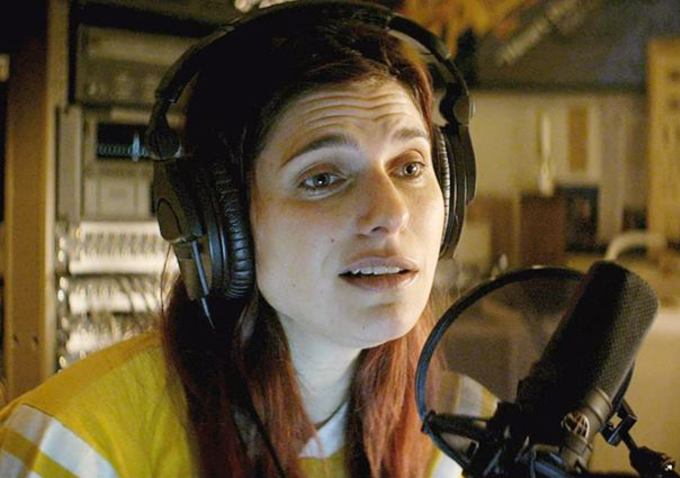
Lake Bell's comedy In a World (she wrote, directed, stars in, and wins The Welles Award for over-achievement this year) is a funny, funny look at the L.A. studio scene, or at least the LA studio scene of a few years ago.* She gets the nuances right of the bubble-verse that a lot of folks get into, and the sexist nature of the industry—female voice-overs for commercials have broken the glass recording booth ceiling, but movie trailers are still reliant on the paternalistic "Voice of God" to "sell" the image the studios want.

Bell stars as Carol Solomon, a periphery actress, semi-content to act as a vocal coach to other artists (like Eva Longoria because her cockney accent makes her sound "like a retarded pirate."), carrying around a mini-recorder to capture any vocal inflections to add to her collection (a habit that has more than one irritation and complication in the film) and generally do The California Hang Out, professionally waiting for the big break to happen.
That big break translates to not telling others how to do voice-work, but doing it herself, whether voicing commercials, or, even better, movie trailers, the toughest nut in voice-over work to crack. The reason?  Women don't "do" voice-overs for trailers. How does she know? Her father (Fred Melamed) does voice-overs for movie trailers, and is only too happy to tell her that it's a man's market, and that she can't possibly break into it because 1) women don't do voice-overs and 2) she can't do voice-overs because she's not as talented as he is and he does voice-overs. 
In any industry there are out-sized egos, and the voice-over field is no different.** Most have a healthy sense of perspective and a genuine gratitude for being paid to (as one voice-over guy described it) "talk out loud for a living." But, there are those (and sadly, you don't know who you are) who see it as "art" and their every syllable is "golden." Carol's dad is one of them, and despite his extraordinary ego, he still sees himself following in the wavelengths of the King of Trailers, the late Don LaFontaine, who, "legend" has it (or at least Don had it), "created" the "in a world" tag-line, and who, in his honor, the line has been retired since his death.***  

However, there's a new chic-lit-based "quadrilogy" movie series coming out, and they just might be using that "In a world..." line for their trailers. Carol's father, in his largesse, bequeaths it to up-and-comer Gustav Warner (Ken Marino), who's lost a couple of gigs to "some chick" over a throat ailment, and the two chortle about how they can screw her over—not realizing that "some chick" is his own daughter.

At about this time, anybody with a few movies under their eye-lids is going "Oh, he'll find out it's her, feel remorse, and turn over a new leaf..." Bell's movie isn't that easy. In fact when he hears that she might get the gig, he decides that he'll audition for it himself ("Auditioning," oh, the humiliation. Don't they know who he is?), in a fit of ego and competitive envy. That's surprising. But...I gotta say, not out of the realm of reality.  

If the movie were all that, it would be a thin script, indeed. But Bell complicates this world, with others in the fringe—Carol's sister, Dani (played by Michaela Watkins) a concierge, whom Carol has to crash with when her Dad tosses her out so his 30-something girlfriend (Alexandra Holden) can move in with him, thus messing up the lives of her sister and her husband (Rob Corddry, proving he can play a normal guy, for once), a reality television editor. Then there are the studio crew, including her engineer-friend (Demetri Martin) who promotes her work, enabling him to keep burning the torch he has for her. The repartee among these players is refreshingly spontaneous-sounding, with half-finished sentences, colliding overlaps and repetitions, stray asides, floating exiting explanations, and general discomfiture, making great use of actor/comedians for improv/mumblecore cred—the difference being that it's actually funny here, and not just awkweird.
There's a line from In a World... that does raise a point, despite it coming from one of the most insufferable characters: "a great voice isn't just a blessing, it's a choice." Bell takes it somewhat seriously, she was/portrays a vocal coach, and makes it a point several times to decry the up-inflected "sexy baby voice" that seems to be "the rage" these days, after it's been perpetuated by reality-show denizens and nondescript and untrained readers, like the kind that fill up "This American Life." She has a point, but a narrow one. The commercial world reflects the real world, but not very far, and certainly without any degree of real innovation, as it's always art by committee. And once the mad men discover a trend, they do it "to death," until it passes into the cliche mode and stops making the short-term money. But, I found it a little disingenuous for Bell to be on her soap-box about how people talk, because, as the line implies, we can't all be blessed, nor can we all afford vocal coaches.  We work with what we have, whether it fits into an "acceptable" niche or not. In a World does a good job of turning its eye on the chauvinism in the marketplace, but it's blind to it in its own little bubble-verse.

Easy for her to talk. 

A compilation of movie trailer cliches as voiced by Hal Douglas, Peter Thomas, 
Dom Morrow and (three or four times) Don LaFontaine


Hal Douglas can't say 'In a World...'


A rare female voice on a trailer...Melissa Disney (featured in In a World) for Gone in 60 Seconds

* "In a world" of DSL lines, fiber-optics transmission, satellite feeds and home studios, the voice-over business is not quite as concentrated in Los Angeles as it used to be.  It's where a lot of production is done, but a lot of the voice-over artists now do things from their own home and "travel" when the technology demands it (or the egos of the producers do).

** During one session in my memory, one well-known national voice-over talent was told by the writer-producer that he'd "fluffed" a line and the response was "Fluffed?!  FUCK YOU!"  And then there are those famous out-takes by Orson Welles and William Shatner.

*** This is bull-shit.  The line has certainly been used (and probably too much in the past few years since LaFontaine's death) as a pop culture cliche—an easy go-to  laugh  among the most dull of hipsters.  And it's also bull-shit because LaFontaine was only one of the voice actors who did that style of "read" (the most prominent probably being Hal Douglas), but spent the last year of his life (sadly) promoting himself as the "In a World..." guy.  THE "In a world..." guy.  And the only way he got away with it (and the man was dying, so the industry let him) is because so many people have a tin ear and can't tell the difference between LaFontaine and the other dozen or so voice-actors who "do" trailers. One wonders, besides marketing, why he did it.  The ones who did the news stories and puff-pieces did it because...well, they didn't know any better and bought the hype for a good story.  LaFontaine had great pipes. 

 But he was no Ken Nordine.