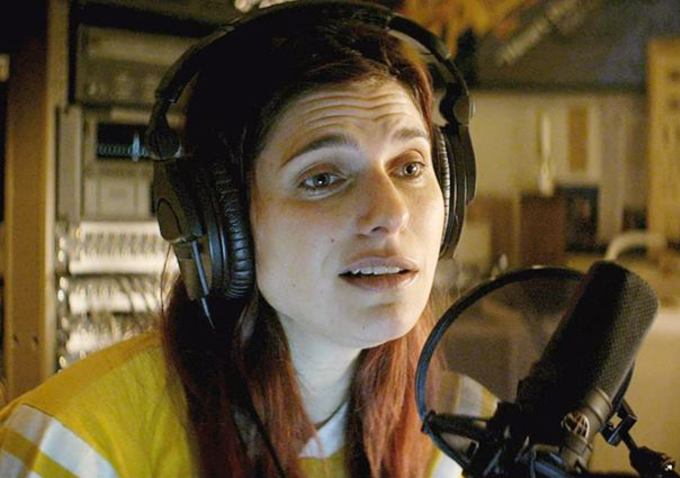
Ang Lee has spent almost his entire career showing the common humanity in the disenfranchised, whether they be the lower rungs of Class Society, gay cowboys, set-apart and -upon martial artists, political spies, and Incredible Hulks—the commonality of the different. Even with the slightly lighter touch he employs here, he does the same for Catskill Jews and Hippie culture in Taking Woodstock. Both groups are isolated and flung apart, but come together—initially uneasily, but soon in mutual satisfaction, to produce something intangible and real, that would change everything.  By that time, the Tieschberg's are in constant motion as their hotel is over-crowded, water-shortaged, beer-deficient and out of control, if not for the efforts of Mr. Tieschberg and self-appointed head-buster Vilma, a trans ex-Ranger with a baseball bat (Liev Schreiber, in a bad blonde wig and a Southern Belle's wardrobe, looking just like you'd expect him to, and bringing a rueful dignity to the enterprise).
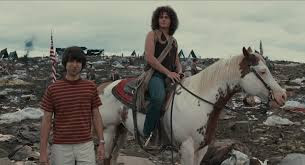 As long as Lee focuses on the chaos, the film is a raucously good-natured train-wreck. Once he leaves the side-show for Elliott's Odyssey to "The Festival," the film becomes one of those earnest little movies that tells you its important but can't show you, just as it can't show the concert going on. Oh, you hear snippets of song-track that was featured at Woodstock, but not the actual performances (as they're owned by somebody else, I guess) reverberating in the background. There's a couple of FX shots that suggest the scope of the thing (one an LSD-influenced version that shows the crowd turning into an undulating sea-scape that would be more effective...oh, if you really were on acid, say), but the whole sequence is not only un-involving, it diminishes the event...far-off, rather than far-out.
 Woodstock has been romanticized so much over the last 40 years that it might better be called "Three Days of Peace, Love and Understanding and All the Crappy Parts You've Forgotten." But, Lee doesn't shy from the problems (segmented into easily focused nuggets of information through a split-screen technique which was the vogue at the time), although nothing is dwelled upon: the famous "brown acid" is mentioned, the muddy conditions, the interminable traffic jams, the inconsistent weather and jerry-rigged wiring that combined to cause so much metal on the grounds to shock when touched, the unsanitary conditions, the constant air-lifting of accidents and overdoses. and the fact that damned few people heard much music. It was enough to "be there," and that entailed a super-human ability to "go with the flow," of which, with the rain, there seemed to be plenty. It's all catalogued, but briefly, because like a lot of movies about "big events," it boils down to who's telling the story and how much they really played a part in it.
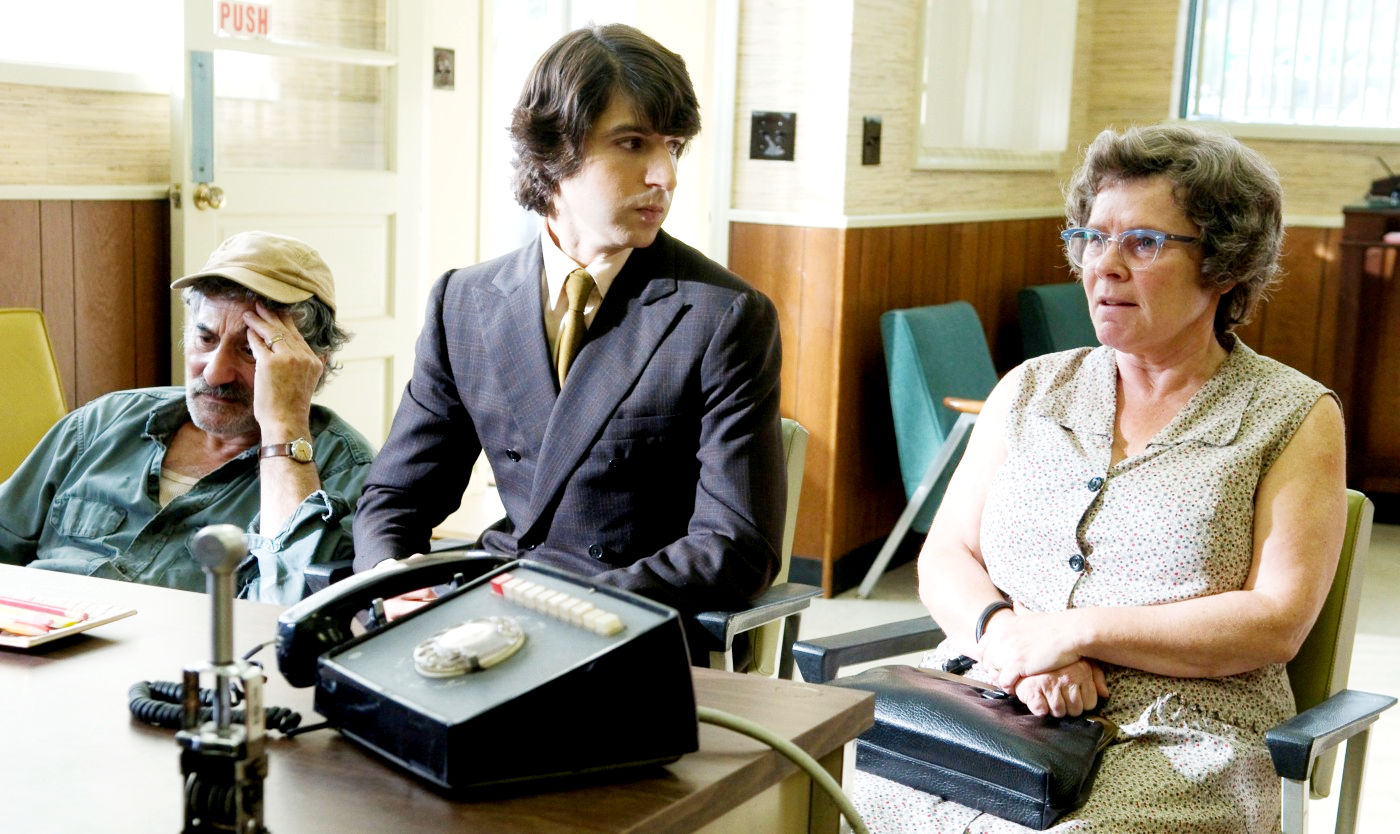
 For the sub-title of the movie should be "Elliott Tiber and what he did at Woodstock." Tiber's account has been questioned by organizer Michael Lang* who claims that he may have had the permit, but he wasn't present at all the places he claims he was. And so the movie is reduced to the old conundrum of who gets to re-write history as Tiber shows "how Woodstock was important to him," as well as how "he was important to Woodstock." This might have been a bit more convincing if Tiber weren't portrayed by Demetri Martin. Martin is a gifted comedian as his stints on "The Daily Show," and his own "Comedy Central" series have amply displayed. But, "Taking Woodstock" shows none of the puppyish energy that makes his observations so hilarious. Instead, his Tiber is slackly reminiscent of Chance the Gardener in Being There, wandering like a ping-pong ball through the movie, with just as much dramatic weight. He is handily eclipsed by Goodman and Staunton, Schrieber and Emile Hirsch's "Charlie"-obsessed Viet-vet.
 In the end, it's a let-down—like being stuck in the traffic jam and missing the concert, although Lee does manage to show us a lot of entertaining portraits while missing the big picture.
 In the final irony, the cost of a ticket to the "real" Woodstock was $8.00. An evening ticket to "Taking Woodstock" costs upwards of 10.
For a little while.
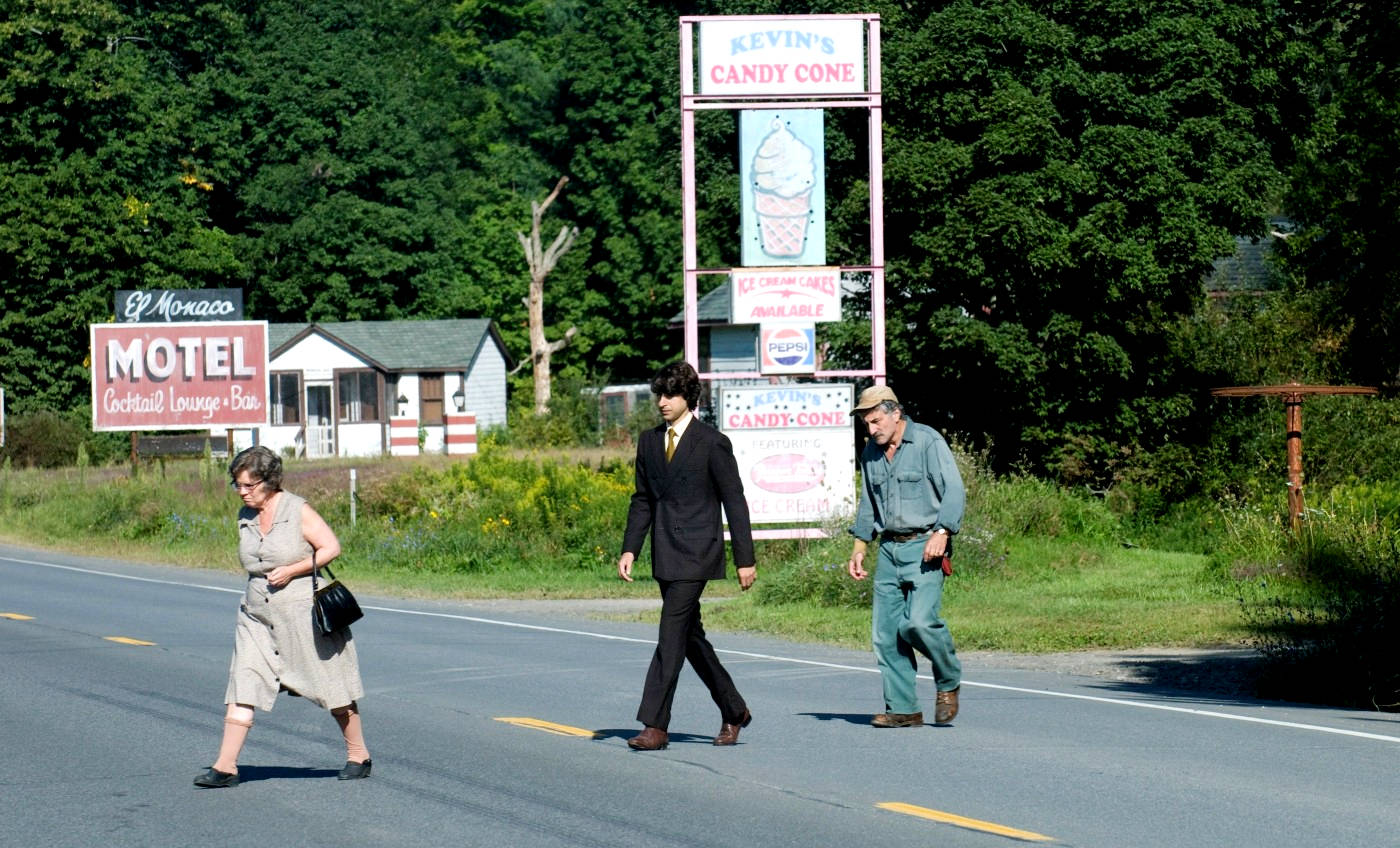
Elliott Tiber, nee Tieschberg, (Demetri Martin) is a repressed jangle of contradictions, a cosmopolitan boy lost in the woods. He's hasn't quite left the nest of his parents (Henry Goodman, Imelda Staunton) who own—barely—the El Monaco Hotel in the Catskills town of White Lake. He hasn't quite left the closet, either. A painter, he hasn't met with success in The Big Apple. He deals with the banks about the Hotel's financing, but has nothing to say about how it's run, despite trying to stir up business. He's the President of the White Lake Chamber of Commerce...which is basically just a Chamber, but in a Church basement, and little Commerce. The one thing he has going for the Hotel is a low-key Arts Festival he puts on every year, featuring a couple folk-singers and the gonzo theater-troupe who inhabit the barn on their property. Until...the planned "Woodstock" festival with a few choice acts is driven out of their original venue by the locals, and Tiber makes it known to the organizers that he has a permit for an arts festival, a rare thing with the reluctant townspeople, who are content with the "regular crowd" and don't want much disruption. Pretty soon, the Tieschberg's and local dairy farmer Max Yasgur (a genially subdued Eugene Levy, making more of less) are persona non grata around town as the area is crowded with a motley crew of organizers, "suits," crew-men, helicopters, expectant hippies, and, as the concert grows closer, one of the largest traffic jams in the Nation's history.


*Lang is played by Jonathan Groff as an intensely smooth corporate hippie, who never seems to sweat the small stuff...or the big stuff, for that matter. In fact, he rarely seems engaged in any of the complexities of the festival, concentrating on "The Big Picture."