Showing posts with label John Lee Hancock. Show all posts

Wednesday, March 20, 2024

The Rookie (2002)

I was going to post this next week—the start of the 2024 baseball season—but, according to PBS News Hour (and other confirming sources), the season actually starts today with a series going on in Korea. So...we'll bunt.

Written some seasons ago...


The Rookie (John Lee Hancock, 2002) With all the fuss being made over The Blind Side, attention must be paid to the director's previous sports-film that proved popular, like The Blind Side, also based on a actual story that's just this side of incredible and told with a clear-eyed lack of pretension.

John Lee Hancock's first film in the Majors
,* The Rookie, is a double-header of a sports film that manages to tell its male-weepie "dreams do come true" stories, both of them essentially true, with a minimum of sentimentality—the principals are actually quite bitter throughout the film, weighed down by the burden of "what might've been," and to a certain extent paralyzed by it. Coach Jim Morris, a former Big League prospect makes a deal with the High School team he coaches he'll "re-up" if they win their division. It then moves on to top itself to tell the consequence of that first story to the coach who must fulfill a promise to his team...and himself...to try out—again—for the Majors at the age of 39, a time when most pitchers are eyeing retirement, not opposing pitchers.
And because it's situated in Texas (for the most part), there's not an awful lot of talking about it, but, instead,
there is a lot of scowling and stewing and time spent in solitude beating themselves up by transference in the form of hurling a baseball in frustration as fast as can be at some woe-be-gone target.
It might have been that baseball abuse added a few feet per second to
Jim Morris' pitch, or it might be an arm strengthened by scar-tissue that can top his fast-ball at two ticks shy of a hundred mph. Whatever the reason, the science teacher/baseball coach in the arid football town of Big Lake, Texas must put-up or shut-up to his high-school team after his exhortation to pursue their dreams (and some batting practice with his blazing fast-ball) sharpens them up to become division champions.

That's story one. Story two is Morris' old-man hoofing it through try-outs and the farm system at the off-chance of being called to "The Show." It is an unlikely scenario, but Morris manages to do it, the film ending on
the fairy-tale night that he must pitch in his first Major League game in his home state in front of his team and friends and family.
The movie could have been a sob-fest
, but instead Hancock hinges it on dark nights of the soul and doubts about responsibility. This isn't some up-beat Rudy story where "wishing makes it so," (despite being produced by Disney). Morris (Dennis Quaid) must make a personal journey of dealing with a lifetime of disappointment and what might-have-been to accept the result of his efforts. After a life of compromise and making-do (and blaming others), he has to learn the grace to accept the gifts he has been given and the opportunities he's been afforded. Whatever pain goes behind each pitch, he must also put behind him.
Grace? Sacrifice? Forgiveness? Where do you go to learn such traits? Such inspiration usually is found at the Cathedral, the Temple, or the Mosque, but in the sports-world the big stadium is the source of humility. Hancock stages Morris' first walk into the Texas Rangers stadium as if he was walking into the Vatican, the high-arched entryway with the sun streaming through that stretches to a vanishing point that evokes a long journey, but also the long history of a game that, more than any other sport, is a competition with the ghosts of the past as well as the Boys of that particular Summer. The arches reach to the sky to define the goal but also press down with the weight of tradition, dwarfing the new recruit, challenging him to fill the space. In the distance, his fellow rookie, half his age, looks on in amusement at the old duffer hanging back in awe, anxious to start his journey and not thinking he may be looking at a flash-forward to a future of regret. It is a poignant moment of film, that says volumes in a single image and no words.
It's a good story told well. The characters are not larger than life, merely as large as they need to be. And no decision is made with a self-serving speech and heraldic trumpets—
decisions and their consequences are agonized and fretted over. It's a story of people who not only have a lot to lose—they know it—but take the chance anyway for whatever amount of time it may last. The Rookie manages to make it look not quixotic, but essential.

Jim Morris' baseball card
* After writing two quirky off-beat films for Clint Eastwood: A Perfect World (1993) and Midnight in the Garden of Good and Evil (1997).

Wednesday, June 7, 2023

The Blind Side

"98% Protective Instincts

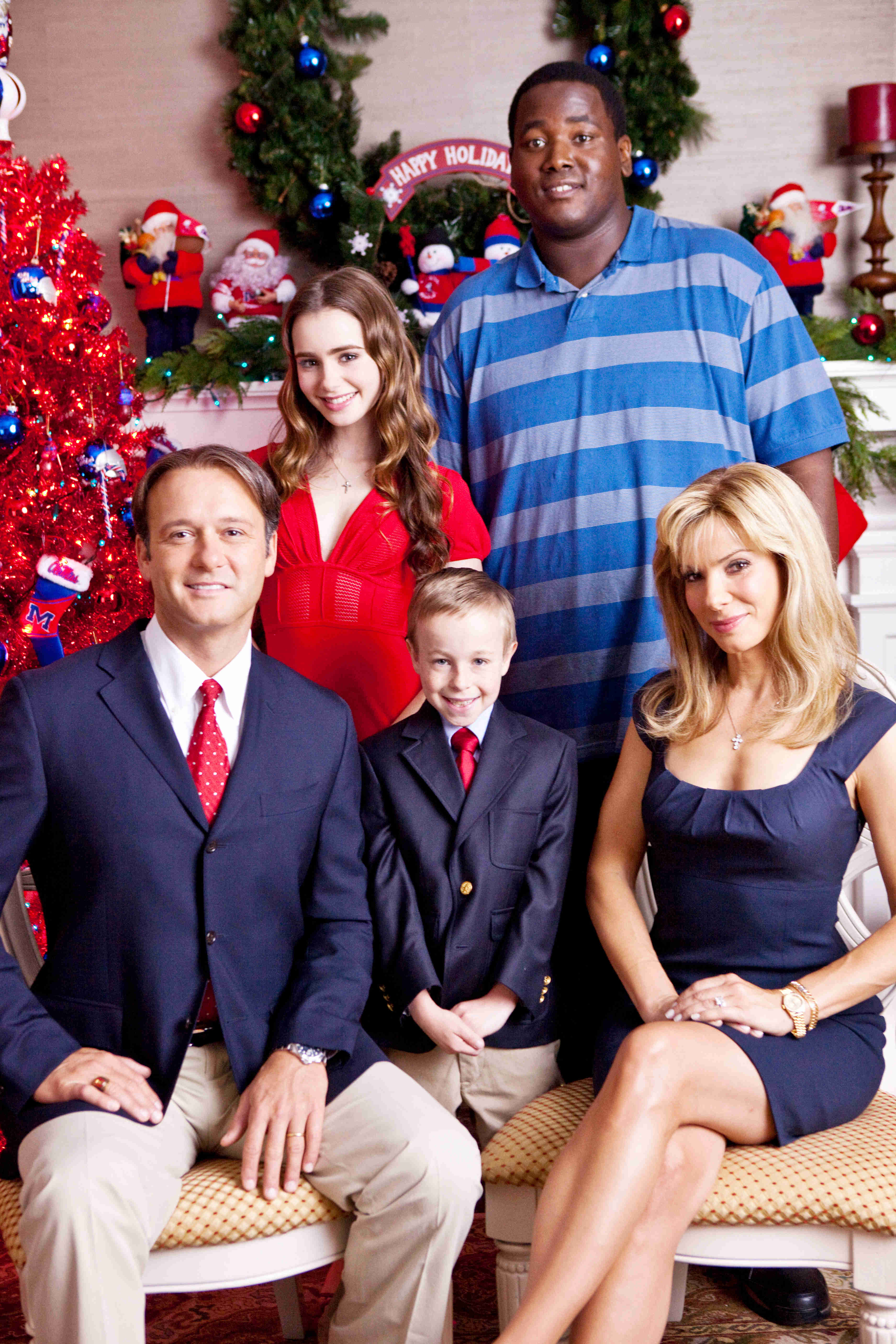
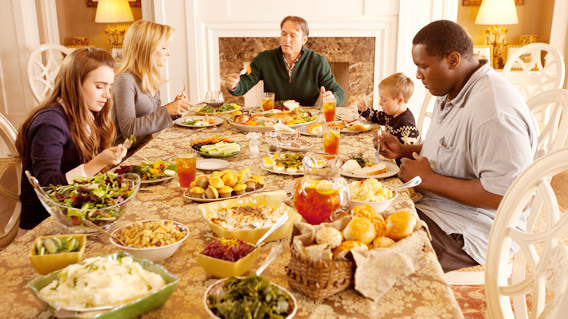
The true story of All-American Michael Oher is the very stuff of feel-good uplifting movies. Impoverished son of a crack-addict mother and disappearing father gets a break by being so damned good at sports that a religious prep school is willing to look past his abysmal GPA (0.6 in the movie, 0.4 in real life). While attending, the homeless kid is given a place to flop for the night by Leigh Anne and Sean Tuohey, and, basically, stays on, becomes family, and with their tutorship and support, gets his grades up enough to join sports, and the opportunities fall from the sky like linebackers.

The ads and the poster make it look icky, like Oher is the stray dog who just needs love from the do-gooder white folk, or worse, one of those "reverse Oreo" movies where the compelling stories of minority struggles are overshadowed by the white stars playing earnest observers.
*
Fortunately, the movie is written and directed by John Lee Hancock, who made one of the best sports movies a few years back—The Rookie—and managed to salvage a bit of the abandoned Alamo project. As screenwriter of Midnight in the Garden of Good and Evil, and A Perfect World (both for Clint Eastwood), he's shown himself to be a writer who embraced quirk, then moved on to write compelling characters rather than walking exploited stereotypes. You like his unsentimental people and root for them no matter their hurdles.
It comes in handy in
The Blind Side
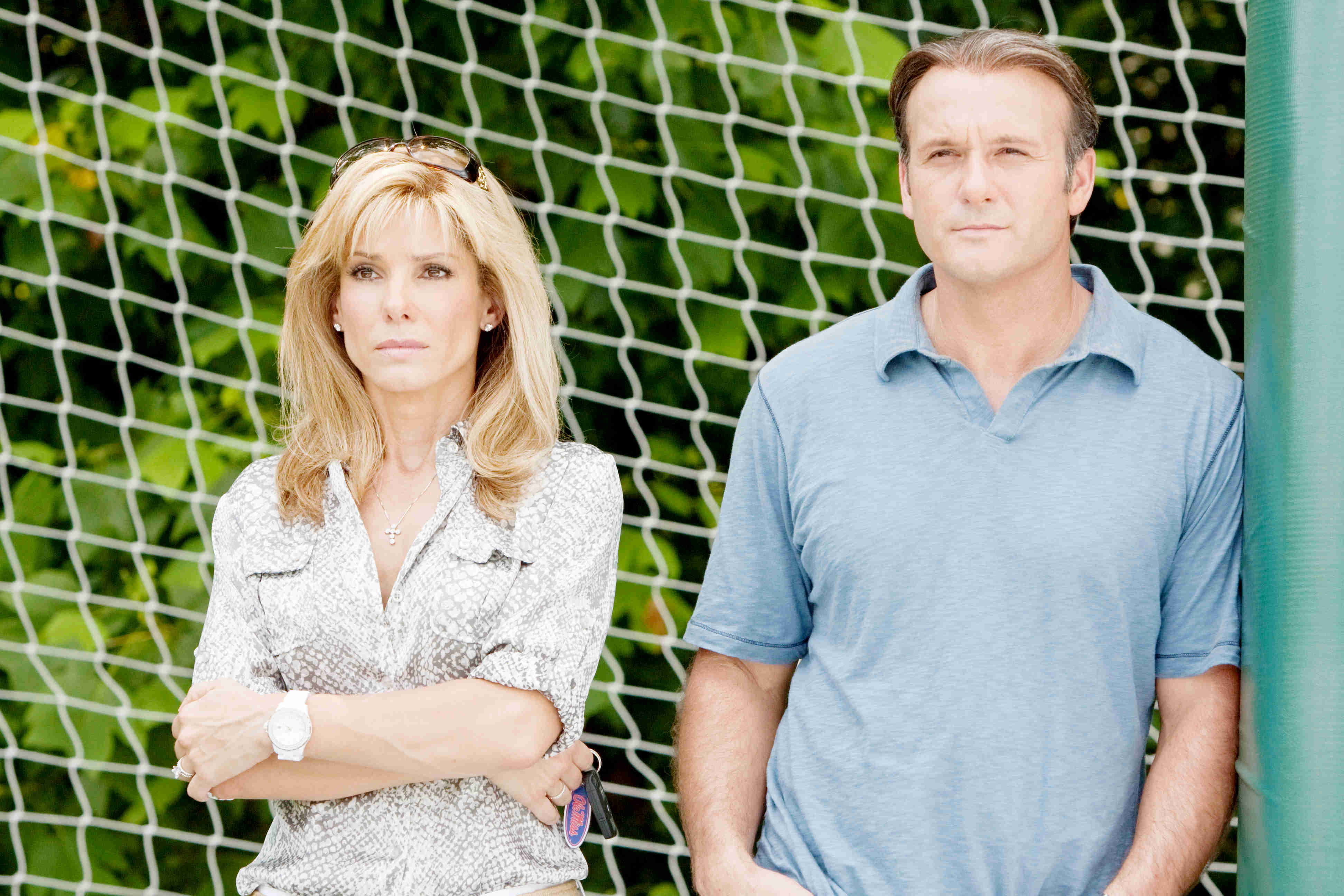
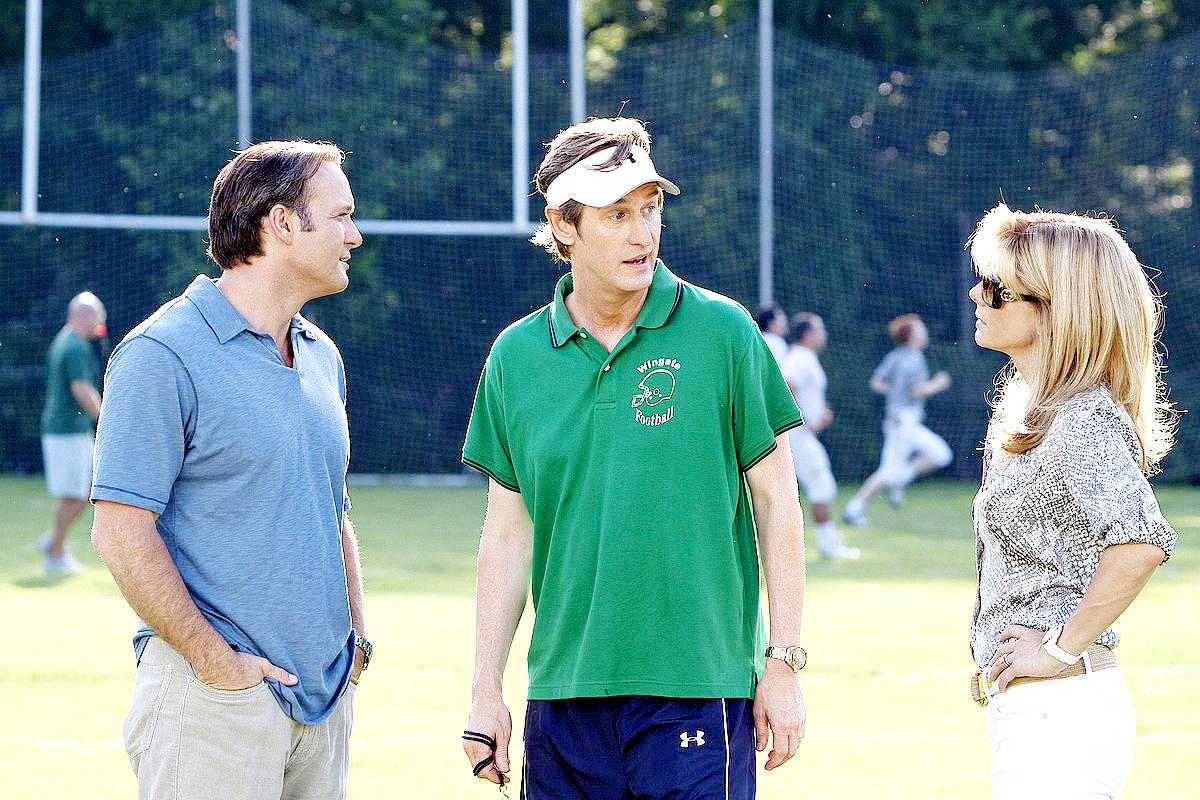
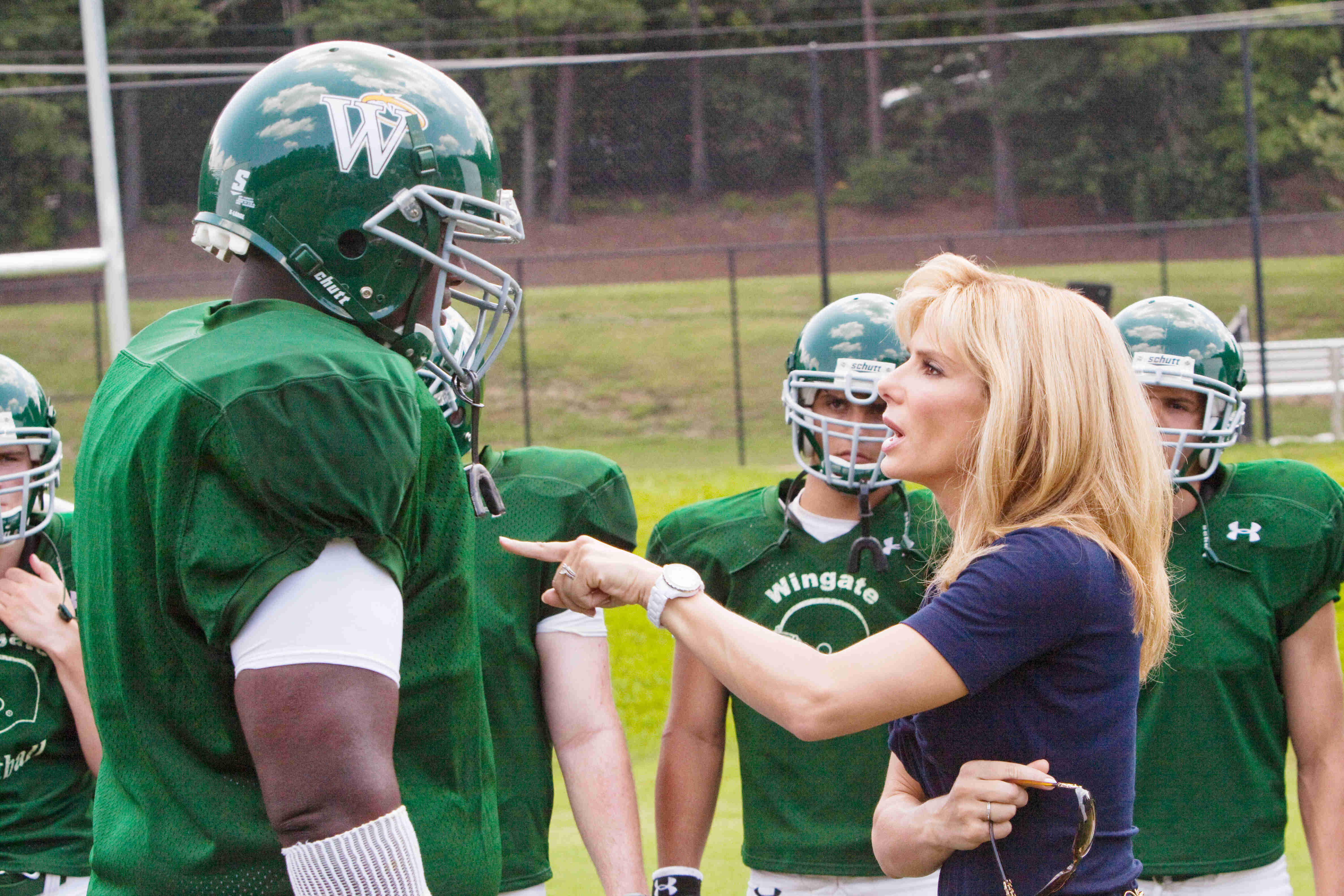
. Once Oher (Quinton Aaron) sleeps over one night, that's it, he's a part of the Tuohey family, no if's, and's and but's, and the matriarch, Leigh Anne (played by Sandra Bullock like a Kathy Lee Gifford with sass and a laser-eyes—she's what y'all call a "spit-fire"), walks the talk of her Christian upbringing in providing a practical resource for his needs. No argument is broached, no catty remark is left unchallenged, and schmaltz avoided at all costs. Bullock's Leigh Anne Tuohey is a Mama Tiger, the like not seen since Susan Sarandon's "Michaela Odone" in Lorenzo's Oil, to the point where all Hancock has to do is keep her in frame when she walks up to her kid's coach from the background and one begins to feel genuine fear. A revelation of the extent of Oher's poverty elicits a polite "Excuse me," a walk down the hall to her room, shutting the door and an erect sitting posture to indicate that no amount of bad news is going to get to her or deter her. Bullock isn't afraid to make her character cold or a bitch. She just is, take it or leave it.
But it's Oher's story, his character has more screen-time than Bullock, though far less dialogue, and
Hancock found a god-send in Aron, who has a face the camera loves. Since he has to carry a hefty amount of the drama silent, it serves him well, and is a nice fit with Bullock's all-talk, but reserved expression, counter-point.
At passing glance, it looks awful, but in its straight-forward, unpretentious and un-preachy style, The Blind Side wins over any cynicism.


* I'm sure you can name one—Mississippi Burning, Glory, Amistad, Come See the Paradise, Snow Falling on Cedars ... the list goes on, ad nauseum.

Saturday, December 10, 2022

The Founder

The Founder
(
John Lee Hancock, 2005) "Build a better mouse-trap and people will beat a path to your door." That's how the old saw goes to inspire a capitalist economy. But, old saws can become rusty with the new tools of business acquisition, mergers, takeovers (hostile and non) and buy-outs. They're enough to take those better mousetraps and have their builders snapped by their own inventions.
 
Take McDonald's. The world-wide phenomenon had humble beginnings...but few locations. At the beginning, it was successful—the efficiency and fine-tuning that went into it producing Mcburgers on an industrial scale like Henry Ford's assembly lines almost insured it. But efforts to expand it fell by the way-side like so many paper wrappers due to consistency issues, as in quality control or an arbitrary change of menu on the part of the manager. The originators—Richard and Maurice McDonald—could manage their one San Bernardino location. But, out of sight/out of managerial control was the order of the day. Without the McDonald boys riding herd, the others were the Wild, Wildly Unprofitable West.
Which is when Ray Kroc (Michael Keaton) wanders into town. John Lee Hancock's peripatetic little film tells the story of how Kroc made a multi-national corporation out of a hamburger stand and created an empire that straddles the oceans with golden arches. Kroc starts the film out as a salesman for "5-spindle" milkshake mixers for the company Price Castle. We watch as he goes down the road, lugging his mixer sample going from drive-in to drive-in, delivering his message of positivity and opportunity: "You increase the supply, and the demand will follow... Increase supply, demand follows. Chicken, egg. Do you follow my logic? I know you do because you're a bright, forward thinking guy who knows a good idea when he hears one."
But, even Ray is starting to sour on it, as he goes from crappy drive-in to crappy drive-in where the service is shoddy, the wait is frustrating, and the scenery is a bunch of JD's hanging out with nothing better to do. He props up his no-sales attitude with "Power of Positive Thinking" motivational records until he follows up an order for eight of his multi-spindle milkshake mixers at a location in San Bernardino, California. What he sees is different. People are lining up to get food. He goes up to a window, orders a burger, fries and a shake, all for 35¢...and it's given to him right there right then. "What's this?" "It's your food." Knife, fork? Nope. Just eat it. Where? "Anywhere you want."
Ray is dazzled, not only by the efficiency, but also the line of people who get served pretty darn quick. He goes to meet the managers Dick (Nick Offerman) and Mac (John Carroll Lynch), who are only too proud to show him their set-up (and grateful for the mixer order being delivered), but also are dying to tell him their story of failure after failure...movie theaters, other restaurants...until they came up with the formula, their "Speedee Service System" a designed, engineered, even choreographed assembly line that guarantees a steady supply of product with no customer-waiting and an iron-grip on quality control that ensures cleanliness of the facility and consistency of product.
Kroc is besotted with the earning possibilities of the restaurant and spends his return trip thinking up angles. The McDonald's formula is basically set-and-forget and is a money-maker and he wants in. But, these guys, the McDonalds, have shown him everything, every secret that they have, and detailed plans for a prototype restaurant design (with attention-getting "golden arches") that is small, efficient and easily copied. He doesn't steal all of this information. Instead he suggests franchising the thing with the McDonalds in a partnership—they already tell him that franchising doesn't work, that there are other "McDonalds" restaurants, but with varying menus and a lackadaisical approach to efficiency and quality control. Kroc convinces them, after info-gathering visits to those owners, that their success CAN be repeated...if only their plans are followed to the letter. To the very proud and meticulous thinker Dick, this is music to his ears, and they go into business with their apparently like-minded partner. 
Kroc mortgages his house (without telling his wife, played by
Laura Dern) and starts to make plans to open those "golden arches" restaurants in the mid-West to much fanfare, with his face as the main booster for the new locations—with Dick and Mac already busy with their original place in San Bernardino. He follows their plans, their hiring practices, their choreography, everything, but insinuates himself with the powers-that-be that okay the locations and see him as each community's "rain-maker," a role that the salesman in Kroc likes. He wants to expand further, faster, but the profit margin of each restaurant is too low to build at the pace he wants, so he proposes changes. He gets firm "no's" to the changes by Dick, but Ray goes ahead with the changes at every location...except the brothers' San Bernardino location. 
Already the partnership is starting to fracture. But, it was doomed to fail from the beginning, even as it began to explode. Dick and Mac are inventors; Ray is a salesman. Dick and Mac take pride in their work and are content to maintain the status quo; Ray never had to do the work they did, but appreciates the brilliance of the ideas, recognizes it's a winner and wants to be the man behind the dream. Dick and Mac are thinking about McDonald's; Ray is thinking about himself. A quote in a book I just read* says "Ideas are the trash of the business. Execution is everything." And Ray knows how to execute...in all senses of the term.
Ray will eventually and literally "drink their milkshake" (in the psuedo-profunditry of the line from There Will Be Blood) through a series of agreements and one out-of-the-box thought given to him by an accountant (
B.J. Novak)("You're not in the hamburger business...you're in the real estate business") that would never have occurred to the original McDonalds, so concentrated are they on maintaining their original business that they can't see the future for the present. It's the difference between givers and takers and evolution is a bitch. And learning new lessons can be hard.
It's a wonderful film about the American Dream and the Individual's Nightmare, and how a good idea can be stolen right out from under you. Hancock's direction is straightforward and fast-moving, enhanced by a wickedly fast-paced editing style. And acting honors go to Offerman, but especially Keaton, who easily transitions from huckster to shuckster to diabolical kingpin without seeming to show the difference between them. Keaton is always fun to watch, even when his characters turn your smile into a toothsome rictus, and the film is an amazing thing to watch.

Just don't be surprised that your next meal at MickeyD's might have a bitter taste you didn't notice before.
 
* The Big Bang Theory: The Definitive, Inside Story of the Epic Hit Series" by Jessica Radloff 

Sunday, September 5, 2021

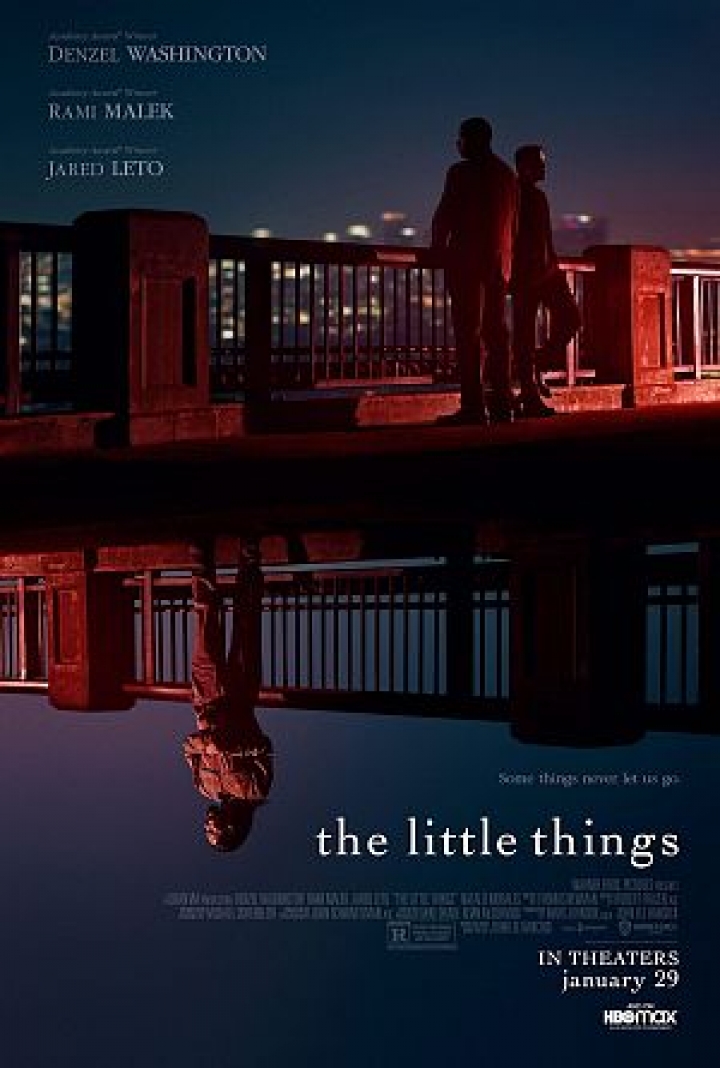
Don't Make a Scene: The Little Things

The Story: Still mourning. Still thinking the five stages of grief. Denial. Anger. Bargaining. Depression. Acceptance.

And, here, in the recent film The Little Things, we have bargaining.

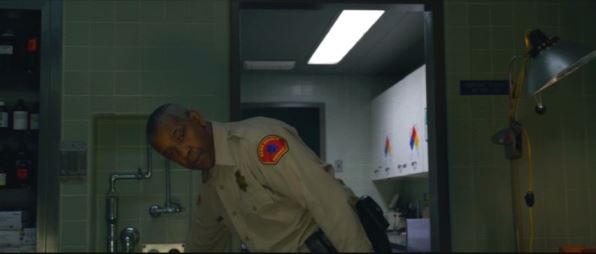
But, it's an odd thing, an odd scene. It takes place in a morgue, a place not unfamiliar to Deputy Sheriff Joe Deacon. He's left alone with the corpse of a recent killing, the latest in a string of murders that feel all too familiar to him. That he couldn't bring in the perpetrator weighs on him—especially now that it seems to have continued. He might not be here, talking to this woman's body if he had. Complications—failings of his—took him off the case and forced a relocation, an exile of sorts, to Bakersfield.

And he starts talking. To the corpse. He's not expecting any answers, but he's going through the steps that might have led to her killing. He's interviewing the witness, trying to get answers, trying to understand...the steps it took for why they are both there. It's grief. It's transference. It's looking for answers. It's a strange and creepy head-space to be in.

The Set-Up: Deputy Sheriff Joe "Deke" Deacon (Denzel Washington) has returned to L.A. where he was once a detective with the County Sheriff's office. The trip is to collect evidence from their lab needed for a prosecution, but, back in his old digs, he starts living again in his old haunts. The Sheriff's office is investigating a serial killer, one with a modus operandi of his last case with the department, one he couldn't solve. He asks a former co-worker for a piece of evidence from the last case. She's reluctant, having gone too far for Deke in the past. When she leaves, he's left alone with the most recent victim. And he begins to talk.

Action.


Deke nods. Flo sighs and walks out of the room. 

Deke stares at the dead girl. 
He reaches out, touches her tenderly. 
DEKE
You knew him, didn't you? 
DEKE 
Or at least he knew you. 
DEKE
Huh.
DEKE 
That's why he did that to your face. 
DEKE 
You let him in, huh? 
DEKE Did he make conversation? Seem like an okay guy? 
DEKE 
And you thought...
DEKE 
"Hmm..."
DEKE 
Not your type but... 
DEKE ...
maybe could be a friend; 
DEKE ...
can't have enough of them, right? 
DEKE 
You had that one little feeling --
DEKE 
 -- You saw the ‘what if?’ -- 
DEKE 
-- but you waved pushed it away; 
DEKE ...
thought ‘Ah what the hell,’ 
DEKE 
...life's too short.
DEKE 
And you were right. 
DEKE 
Life is too short, Julie. 
DEKE 
You shoulda listened. 
DEKE 
You shoulda listened
 to that little feeling
DEKE 
just like I'm listenin' now. 
DEKE 
You can talk to me... 
DEKE 
I'm all the friends you got. 
Flo returns, carrying a file -- a "poor boy." 
FLO Who you talkin' to?
 
 
Words by John Lee Hancock
 
 
The Little Things is available for streaming on HBOMax and on DVD and Blu-Ray from Warner Home Video.