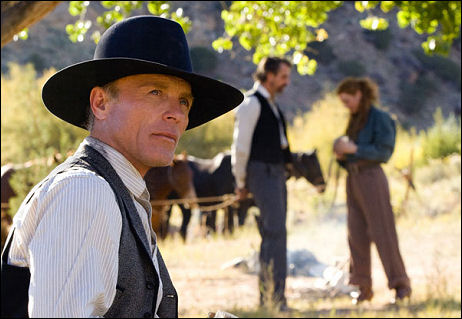
Virgil Cole and Everett Hicks (Ed Harris, Viggo Mortensen) law enforcers for hire, have been "pards'" for a long time now. They're two peas in a pod, and when they ride into the town of Appaloosa (in the New Mexico Territory, circa 1882) they already know what they're gonna say to the town-fathers about their marshaling problem. They've done it before; the two form a unit in everything: conversationally, they finish each other's sentences, and where Cole is a pistol man with a fast draw, Hicks has an 8-gauge shotgun that can distribute a wide enough pattern to make a mob think twice....before it cuts them in two. Cole's contract with the town is simple: if he's going to enforce the law, he has to make the laws. As Hicks explains, "Whatever Mr. Cole states, it's law." Ed Harris' sophomore directorial effort (after the particularly well-done bio-pic Pollack) is a minor western, limited in population and scope. Based on Robert B. Parker's* novel of the same name, it still manages to do what it does very well, and provides a collection of very good actors (including Harris, Mortenson, Renée Zellweger, Jeremy Irons, Timothy Spall and Lance Henriksen) with complex roles that they clearly enjoy taking on. These people are infused with quirk, and character drives the story-line. Where Harris is brittle and short with words, Mortenson is laconic and lanky. Zellweger's Allie French happily screws up her face in a pinched manner that I haven't seen before--either mighty pleased with herself, or trying to keep the prairie dust off her face, I'm not sure which. Irons carries on the long tradition of English gentlemen-actors lovingly chewing western scenery.
After making a none-too-subtle point about a town that wants security giving away its freedoms, the film settles into the...what's that word?...resolution of the conflict between Irons' predatory land-baron, Bragg, and the homespun issues that occur with the arrival of Zellwegger's Allie French. Will a triangle develop? Who gets the girl? What happens to men of principle when the compromise of love enters the picture? A held prisoner in the jail reminds one of the Alamo consequences of Rio Bravo, but it's not dwelled upon for very long, and the story keeps advancing, despite the well-traveled terrain into unknown territory.
And I've always had a fondness for Western colloquialisms that arise from each new author tackling Westerns, and Parker and Harris and co-scenarist Robert Knott do not disappoint.
Little details stand out: Harris makes a point of showing the high forehead tan-line that's a permanent part of every hat-wearing citizen of Appaloosa (of course, that would be true, but it's too rarely seen in "perfect make-up" movie Westerns), and his gun-fights are brief, brutal affairs that are over in a flash of wills and smoke. "That happened quick!" muses Hicks after a long-odds gun battle is finished. "Everybody could shoot!" is Cole's tight-jawed reply.
And situations are repeatedly presented showing how much will is required "out there." Hesitancy could mean death. And the rules of the jungle claim jurisdiction even in a desert covered in clap-board. It's refreshing to see a Western that doesn't cloak itself as an epic. The aims of Appaloosa are small, but ring true.
* After John D. MacDonald, Parker is a favorite author when one is looking for pleasingly composed, enjoyably readable genre story-telling. His "Spenser" novels are his C'sTF, but his westerns, and his post-Chandler Phillip Marlowe stories are great fun to relax with.
Pan's Labyrinth is in the grand tradition of "fantasy worlds within worlds" stories ala Oz and Narnia and the others that have been dusted off and are in various stages of film-production since "The Lord of the Rings" hit the big time.
It is Spain in 1944 and Ofelia and her very pregnant mother are going to live with Spain's version of an evil step-parent--an autocratic fascist captain smoking out a small cadre of rebels in the hills. Though his wife is frail and sick, Capitán Vidal has demanded she give birth to their son at his command post, owing to some generational obsession. Little Ofelia hates him, hates moving and is forthright about her feelings, at least when she isn't retreating to her fairy-tale stories.
Along the way in a road alive with floating seed-fluff she finds a piece of masonry that is the eye of a weathered totem. When she replaces it, she releases...a creature, a shape-shifter, a familiar that follows her to the dank, depressing castle of her evil step-father and plunges her into the dark underworld where she is welcomed as a prodigal banished princess who must complete three tasks to return home.
Sound familiar? Of course it is. It's a fairy-tale. And Del Toro excavates deep into our collective subconscious to present the episodes in the two worlds and decorates them in his distinctive chiaroscuro designs that are gross and horrifying but also startlingly beautiful.
Would that children could see this film without fear and that, as in the film, reality could be transposed with fantasy, and disbelief in one could be interchanged with the other. For in the deep recesses of Del Toro's darkness is a damned good story with a denouement that is earned in triumph even while it tears at your heart.
Del Toro has always dredged through the creepy shoals of fantasy and horror, scoring hits with Blade II and Hellboy, but those films, like so much of the horror genre, depended on an audience's perverse charity to overlook lapses in logic as well as taste, and he's often taken advantage of that to achieve his effects. This film is not so lax. It earns its shocks with a discipline of story-logic and makes his fantasy elements an integral part of its real-world story. For fantasy to reflect reality has long been a staple of this genre of film. Here, Del Toro has gathered his elements of horror and fantasy and made them reflect a world-view where it is justified.
But it's not for the faint of heart. It's not for the innocent.
* Well, almost perfect. The sound design is too much (especially in the squishy squinchy sounds of the Captain), too obvious and mixed far too loudly, but I'll give that a pass. ** Also, you should be warned--do NOT walk in late to this movie. The first shot is a crucial and haunting one. It provides a context that resonates and expands the film.
 "The Unforeseeable"