Showing posts with label Mandy Patinkin. Show all posts

Saturday, July 3, 2021

Dick Tracy (1990)

Saturday is traditionally "Take Out the Trash" Day...

Dick Tracy (Warren Beatty, 1990) Chester Gould's gangster comic strip, "Dick Tracy," started October 4, 1931 and, because it was so popular, it migrated to radio, movie serials, and even a short-lived television series. Gould's style was flamboyant, violent—bullets passed through bad-guy's bodies—and more than a little serio-comic (the villains had names that matched their physiques, so "Flat-Top" actually had a flat-head, and such). Gould made no mistake whose side Tracy was on, as his jaw was so square, you could slice sandwich meat on it, and sometimes ventured into the techno-exotic with Tracy's "two-way wrist radio" beating the I-watch by some 50 years. About the time I started reading it, Tracy and family was traveling to the moon on a magnetic Space Coupe and Tracy's son fell in love with the daughter of the Moon's Supreme Leader!

So much for the grit of a crime strip.
Tracy was popular, and after the successes of recycled comics on movies and Broadway, movie people started to buy up marketable properties. "Dick Tracy" was picked up in the 1980's for the inevitable film adaptation, and went through "development hell" through the hands of many creatives and studios, starting with United Artists, then a co-production between Universal and Paramount, and stars like Clint Eastwood, Harrison Ford, Mel Gibson, Richard Gere and Tom Selleck (the usual suspects in the 80's) were sought out to star as Tracy. And Warren Beatty.
Beatty'd wanted to make a Tracy movie since 1975, when the rights weren't available, and watched from the wings as the film went through script development, director changes, and studio involvement, then purchased the rights in 1985, taking the film to Disney, and directing the film himself when the studio's Jeffrey Katzenberg couldn't interest any other director to take the reins. Beatty had already left the project once when director Walter Hill wanted to make the film more realistic and violent. Beatty had another idea, making a stylized homage to the old-style strip with a limited (just seven, with no gradients), but eye-popping color pallet, supervised by production designer Richard Sylbert.
With Beatty onboard, casting came easily...almost too easily. Glenne Headly played girlfriend Tess Trueheart, Charlie Corsmo played an orphan whom Tracy will eventually adapt, Seymour Cassel as co-hort Sam Catchem, James Keane as Pat Patton, and Charles Durning as Chief Brandon. But, as he did with Reds, Beatty started to hire pals to fill up the film and take on smaller characters, particularly the villains, who—unlike the leads—would be encased in prosthetic make-up (designed by John Caglione and Doug Drexler) to resemble Gould's group of bad-guy uglies.
Entombed in polyurethane are Al Pacino (as main villain "Big Boy" Caprice), James Caan (as a "Godfather"-type), Dustin Hoffman, Paul Sorvino, R.G. Armstrong, Henry Silva, William Forsythe, Ed O'Ross and other character actors who get the make-up, while Kathy Bates, Dick Van Dyke, Alan Garfield, John Schuck, Hamilton Camp, Catherine O'Hara, Estelle Parsons, and Henry Jones get minute screen-time, just enough for recognition.
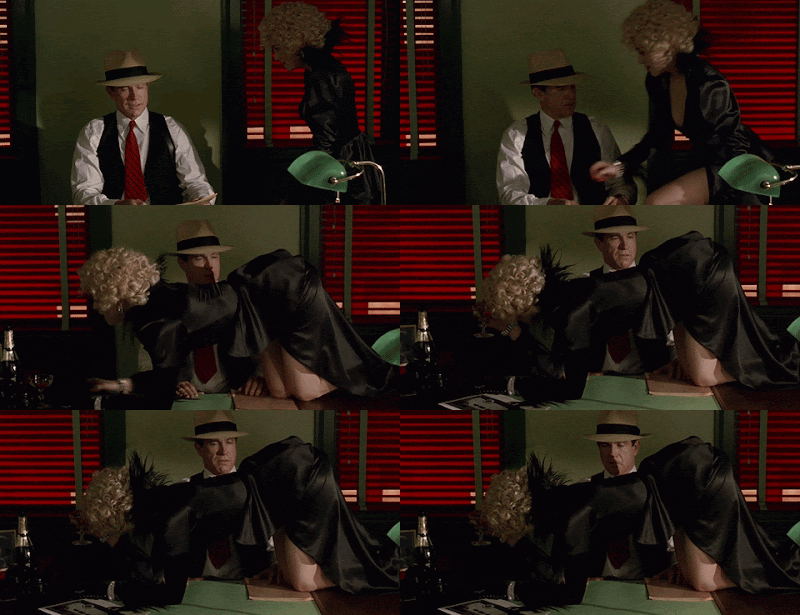
And then, there's Madonna. The pop-star's role as a "bad-girl" femme fatale was, no doubt, beefed up when "The Material Girl" was cast, and of all the cast-members she seems to get the most screen-time besides Beatty, effectively crowding out the "Tess Trueheart" storyline for vamping in the tried and true Mae West manner. To be sure, she gives the movie a lot of cross-promotional material, releasing an album in support, and doing her best with the Stephen Sondheim songs Beatty acquired for the film. But, the role is slight in importance and its prominence merely there to put posteriors in theater-seats. So, she was indulged.
Which seems to be the over-arching—emphasis on the "arch"—theme of the film. Studio-bound and slightly inert, that limited pallet (which only distracts rather than serves a purpose) makes the enterprise look cheaper than it should, and, overall, Beatty's Tracy is an over-indulgent mess, flabby with excess, and uneven in pace, when the model of the thing should have been the tight, break-away austerity of film-noir. The thing went so far over-budget and the results still look dodgy and stagey. In fact, the film reminds of something that achieved the same results with greater success but hemmed in with a bargain basement budget in the 1960's.
And that was the "Batman" TV-show. It, too, had stars as villains, with a lot of make-up and a lot of scenery-chewing, the comic aspect of the characters were played up, the fights were unbelievably choreographed and tongues were placed firmly in cheeks. However, the "Batman" TV series had a "camp" sensibility, deliberately over-staging the drama and acting styles to achieve comic effect. It knew it was over-the-top and aimed high to achieve it. It knew it was deliberately jumping the shark (before "jumping the shark" was a "thing") Dick Tracy has very little of that intentionally self-deprecating humor, and plods along like it knows it's funny...even when it isn't. And although Adam West's deliberately haughty Batman persona wouldn't play for Tracy, give West his due in finding a way to effectively tight-rope the material; Beatty plays the character fairly straight...which is a bit dull. Pacino knows that he's going for comedy, but he doesn't have the timing or comic discipline to make it work. Sure, he gives it the energy (he always does), but that doesn't make it funny.

My memory of Dick Tracy was that it was elephantine in the way the film version of Annie was, but with none of the charm, or the ability to project something genuine without hedging its bets, lest it be thought unhip. Everything is encased in artifice, even in its rooting for "the good guys" with their sense of right and wrong. If they can't even do that with a straight face, then they just don't know Dick. 

Tuesday, May 26, 2020

The Princess Bride

The Princess Bride (Rob Reiner, 1987) The Princess Bride just misses being an "Anytime Movie"—I watch it whenever I see it appear while browsing through my cable list as it's a genuine crowd-please (this crowd, anyway)—but it barely doesn't make it because the direction is a bit...ordinary. Ordinary with enticing touches of brilliance.

The story of Princess Buttercup (Robin Wright) who meets, then loses her one True Love (caps) in the stable-boy Westley (Cary Elwes) at a time of turmoil in the lands of Florin and Guilder was written by William Goldman with the conceit that his version was merely the "Good Parts" abridgment of a longer tale by S. Morgenstern was released in 1973 and had a fabled history in not being turned into a film (by such as Francois Truffaut, Richard Lester, Robert Redford and Norman Jewison). Goldman found the process so frustrating that, at one point, he actually bought the film rights back to retain some measure of control.
When Reiner, after making This is Spinal Tap, and while filming Stand By Me, was asked about future projects, he mentioned "The Princess Bride" but was told it wasn't possible. Too many studios had tried. Too many had failed. But, with seed money from Norman Lear and Goldman's support and screenplay, the "unfilmable" book began production. 
The film only had moderate success at the box office—the distributor, 20th Century Fox, didn't quite have a handle on how to market it—but the film has achieved a cult following, buoyed by video distribution and an undeniable charm that is nearly irresistible, due to several aspects that strengthened the work, but may have made that marketing strategy somewhat "inconceivable."
1) The casting couldn't have been stronger, despite a lack of bankable stars. Wright was working on a U.S. soap opera, but when she showed up on Reiner's door-step back-lit by the sun, Goldman sealed her casting by saying "That's what I wrote." Elwes had a couple movies under his belt, was Errol Flynn-handsome, but also possessed a razor-sharp comic timing and sense of the absurd that conveyed a maturity beyond his years and nails both the romantic and slap-stick aspects of the character—you take him seriously even if the character doesn't always.
The rest of the film is suffused with wonderful character actors—and the charming Andre the Giant—who take the fairy tale seriously in ways both ironic and heart-felt (and then, Billy Crystal and Carol Kane shuffle in, throw all that out and ad-lib hilariously). Goldman's characters all have their particular quirks and the actors slot their performances neatly into place...to the point where the lines become distinctively quotable—in their precise inflections.
2) That melding of actor with dialogue goes a long way to making the film enjoyable and also indelible in the memory. It is a sure thing that you can quote at least five lines from The Princess Bride, probably stretch it to ten and even more. Any work place that starts with one line will insure a good ten minutes of others adding another. I've based two "Don't Make a Scene" posts on my favorites: "Life is pain, princess. Anyone who says differently is selling something" and "You fell victim to one of the classic blunders. The most famous is never get involved in a land-war in Asia." But, there could be others, many others. And there's enough grace in The Princess Bride that they all don't have to be laugh-lines or cynically charming. In fact, the best line paying off relying on audience memory is one used through-out and has its largest pay-off as the last line of the movie: "As you wish."
3) The structure of The Princess Bride is rather magical. Just as Goldman uses the conceit of an abridgment in the book version, the movie uses a narrative structure where a young boy (Fred Savage), sick and kept out of school, is read the book by his grandfather (Peter Falk), with interruptions and protestations about "kissing" scenes and lapses in logic that allows the movie to get to the "good parts" without bothering about transitions or belaboring sentiment. Those scenes are unique to the movie and give it an added emotional resonance, especially given Falk's duty as narrator of the story. The book-ending (no pun intended) structure buttresses the story, imbues it with the warm glow of parental story-telling and manages to link fable with life, in a shared secret of experience and affection. That's a master-stroke.
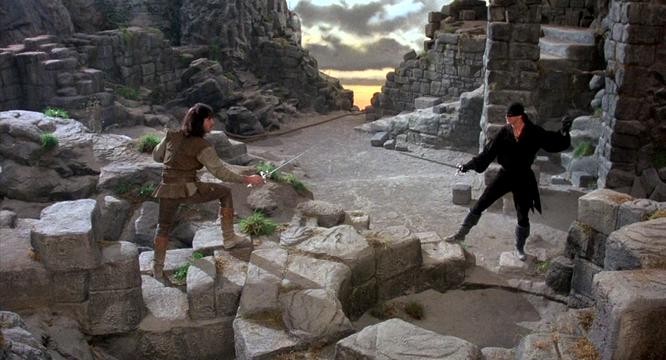
For me, it isn't perfect (but, that just me—I'm a curmudgeon). I wish that the whole movie could have the look of the picture above. There are times when the movie is just beautiful...and others when it looks a bit clunky, staged haphazardly and shot more for TV soap opera than fairy-tale. Some of the sets—I'm thinking particularly of the top of the Cliffs of Insanity but there are others—are so set-bound that it jars with the complex verdure found in a lot of the movie. There is an amateurish charm to some things, creatures and machines, that—if one were righting a defending thesis—could be just the limited imaginings in the child's head. But, that's making excuses when the most reasonable one is "budget." 
And the score. Mark Knopfler's themes are sometimes quite nice, but lose the organic feel and human touch as calculated on a synthesizer. An orchestra, or just a few mixed-in strings could have gone a long way to putting some breath into the music, instead of the mechanics that sometimes clash and distance. There's no resonance to it and an absence of the human touch.

Quibbles! Nit-picking! There's been talk of a musical version being done—all have come to naught. There's been speculation of a remake—to which Cary Elwes had the best tweet: "There’s a shortage of perfect movies in this world. It would be a pity to damage this one." 

This one succeeds so much that it would be best to just leave it be.

As we wish.