Showing posts with label Peter Falk. Show all posts

Thursday, October 13, 2022

Murder By Death

Murder By Death
(
Robert Moore, 1976) Neil Simon was busy in 1976. He'd seen a successful film made of his The Sunshine Boys, his play "California Suite" was opening on Broadway, and he was re-tooling an earlier scrapped screenplay "Bogart Slept Here" (that was to star Marsha Mason and Robert De Niro and be directed by Mike Nichols) to ultimately be released as The Good-bye Girl.
 
Why, in God's name, he would write a parody of the typical country house mystery during this time is a mystery in and of itself.
 
However, I suspect the motive was money. Not only that, fellow comedy writer Mel Brooks was making a mint with genre parodies (such as Young Frankenstein), so why not? And if could it generate income as an original work, all the better.
 
The material is a bit weak, the jokes sometimes thudding, and Simon is at his best doing observational comedy as opposed to sketch-writing, which this essentially is. But, he does have a fine time making fun of some basic mystery tropes, characters and mystery writers, specifically Agatha Christie and Dashiell Hammett.
"You are cordially invited to Dinner and a Murder at 22 Lola Lane, Saturday evening 7 P.M." says the invitation sent to many prominent detectives. The host is millionaire Lionel Twain (Truman Capote). Using the photo above as reference, the invited guests are socialites Dick and Dora Charleston (David Niven and Maggie Smith), P.I. Sam Diamond and his secretary Tess Skeffington (Peter Falk and Eileen Brennan), amateur detective Jessica Marbles (Elsa Lanchester), Belgian detective Milo Perrier (James Coco)—with chauffeur Cassette (James Cromwell's first movie!)—and Inspector Sidney Wang (Peter Sellers).* The blind butler, Jamessir Bensonmum (Alec Guinness) assists with the help of deaf and dumb kitchen-maid Yetta (Nancy Walker).
It's a wonderful cast. One wishes it was just a better movie, starting with the premise: at dinner (after various attempts on their lives) Twain appears and challenges the detectives to a sort of duel: he has come up with a mystery that he believes they cannot solve—a murder is going to occur in the house at midnight and both the killer and the victim are in that room. If the mystery is solved, that sleuth wins $1 million. The group then finds a couple of victims, disappearing bodies, disappearing rooms, and many courses of unchewable dialog and rather stale jokes.
But, it also has conflicting stories, made-up alibi's, mutually exclusive excuses, and a double-cross that should have been clever, but is only saved by Alec Guinness' sheer brio in his willingness to get laughs.
Oh, there's a couple of things that work. The mansion's door-bell is Fay Wray's scream from King Kong and that manages to be a consistent laugh just as the horse-scream whenever "Frau Blücher's" name is mentioned worked in Young Frankenstein. There's a nice gag when Nancy Walker's deaf-mute maid runs into the dining room and screams...in total silence. And the cast is uniformly game, but the stand-out is Peter Falk's Sam Diamond, evoking Bogart's gumshoes to a tee.**
 
Ultimately, Murder By Death merely kills a couple of hours.

* The inspirations for these characters are (of course) Nick and Nora Charles from Hammett's "The Thin Man", Sam Spade from Hammett's "The Maltese Falcon," Agatha Christie's Miss Marple and Hercule Poirot, and Earl Derr Biggers' Charlie Chan.
 
** Falk would get his own sequel of sorts—The Cheap Detective—from the same writer-director team.


Tuesday, May 26, 2020

The Princess Bride

The Princess Bride (Rob Reiner, 1987) The Princess Bride just misses being an "Anytime Movie"—I watch it whenever I see it appear while browsing through my cable list as it's a genuine crowd-please (this crowd, anyway)—but it barely doesn't make it because the direction is a bit...ordinary. Ordinary with enticing touches of brilliance.

The story of Princess Buttercup (Robin Wright) who meets, then loses her one True Love (caps) in the stable-boy Westley (Cary Elwes) at a time of turmoil in the lands of Florin and Guilder was written by William Goldman with the conceit that his version was merely the "Good Parts" abridgment of a longer tale by S. Morgenstern was released in 1973 and had a fabled history in not being turned into a film (by such as Francois Truffaut, Richard Lester, Robert Redford and Norman Jewison). Goldman found the process so frustrating that, at one point, he actually bought the film rights back to retain some measure of control.
When Reiner, after making This is Spinal Tap, and while filming Stand By Me, was asked about future projects, he mentioned "The Princess Bride" but was told it wasn't possible. Too many studios had tried. Too many had failed. But, with seed money from Norman Lear and Goldman's support and screenplay, the "unfilmable" book began production. 
The film only had moderate success at the box office—the distributor, 20th Century Fox, didn't quite have a handle on how to market it—but the film has achieved a cult following, buoyed by video distribution and an undeniable charm that is nearly irresistible, due to several aspects that strengthened the work, but may have made that marketing strategy somewhat "inconceivable."
1) The casting couldn't have been stronger, despite a lack of bankable stars. Wright was working on a U.S. soap opera, but when she showed up on Reiner's door-step back-lit by the sun, Goldman sealed her casting by saying "That's what I wrote." Elwes had a couple movies under his belt, was Errol Flynn-handsome, but also possessed a razor-sharp comic timing and sense of the absurd that conveyed a maturity beyond his years and nails both the romantic and slap-stick aspects of the character—you take him seriously even if the character doesn't always.
The rest of the film is suffused with wonderful character actors—and the charming Andre the Giant—who take the fairy tale seriously in ways both ironic and heart-felt (and then, Billy Crystal and Carol Kane shuffle in, throw all that out and ad-lib hilariously). Goldman's characters all have their particular quirks and the actors slot their performances neatly into place...to the point where the lines become distinctively quotable—in their precise inflections.
2) That melding of actor with dialogue goes a long way to making the film enjoyable and also indelible in the memory. It is a sure thing that you can quote at least five lines from The Princess Bride, probably stretch it to ten and even more. Any work place that starts with one line will insure a good ten minutes of others adding another. I've based two "Don't Make a Scene" posts on my favorites: "Life is pain, princess. Anyone who says differently is selling something" and "You fell victim to one of the classic blunders. The most famous is never get involved in a land-war in Asia." But, there could be others, many others. And there's enough grace in The Princess Bride that they all don't have to be laugh-lines or cynically charming. In fact, the best line paying off relying on audience memory is one used through-out and has its largest pay-off as the last line of the movie: "As you wish."
3) The structure of The Princess Bride is rather magical. Just as Goldman uses the conceit of an abridgment in the book version, the movie uses a narrative structure where a young boy (Fred Savage), sick and kept out of school, is read the book by his grandfather (Peter Falk), with interruptions and protestations about "kissing" scenes and lapses in logic that allows the movie to get to the "good parts" without bothering about transitions or belaboring sentiment. Those scenes are unique to the movie and give it an added emotional resonance, especially given Falk's duty as narrator of the story. The book-ending (no pun intended) structure buttresses the story, imbues it with the warm glow of parental story-telling and manages to link fable with life, in a shared secret of experience and affection. That's a master-stroke.
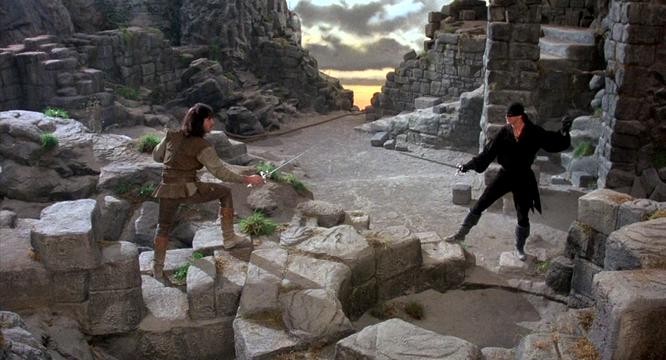
For me, it isn't perfect (but, that just me—I'm a curmudgeon). I wish that the whole movie could have the look of the picture above. There are times when the movie is just beautiful...and others when it looks a bit clunky, staged haphazardly and shot more for TV soap opera than fairy-tale. Some of the sets—I'm thinking particularly of the top of the Cliffs of Insanity but there are others—are so set-bound that it jars with the complex verdure found in a lot of the movie. There is an amateurish charm to some things, creatures and machines, that—if one were righting a defending thesis—could be just the limited imaginings in the child's head. But, that's making excuses when the most reasonable one is "budget." 
And the score. Mark Knopfler's themes are sometimes quite nice, but lose the organic feel and human touch as calculated on a synthesizer. An orchestra, or just a few mixed-in strings could have gone a long way to putting some breath into the music, instead of the mechanics that sometimes clash and distance. There's no resonance to it and an absence of the human touch.

Quibbles! Nit-picking! There's been talk of a musical version being done—all have come to naught. There's been speculation of a remake—to which Cary Elwes had the best tweet: "There’s a shortage of perfect movies in this world. It would be a pity to damage this one." 

This one succeeds so much that it would be best to just leave it be.

As we wish.