 Witness for the Prosecution (Billy Wilder, 1957) Lady Justice is having some work done as we first approach "The Old Bailey," where the majority of the drama for Witness for the Prosecution takes place. Good thing, too, although some attention should probably be paid to the legal loop-holes that keep cropping up inside the chambers. This Agatha Christie-penned theater chestnut is given a nice presentation by Wilder, who has added much comic-relief in the form of giving brilliant barrister Sir Wilfrid Robarts, QC (Charles Laughton), a nurse after a debilitating heart attack (played by Laughton's wife, Elsa Lanchester).*
It was the third re-write of the story in as many adaptations, starting with Christie adding a justifiable coda to her original story for the theater adaptation, and Wilder providing further complications in order to have Lanchester's presence, and giving Marlene Dietrich a song and a romantic scene with Tyrone Power in flashback (although both actors can't really pull off playing young at this point in their careers).

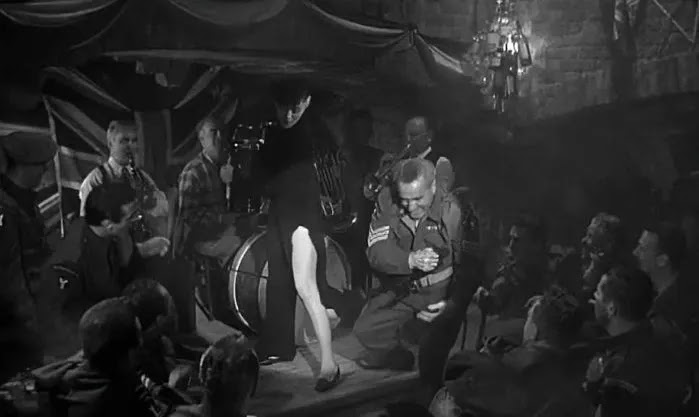
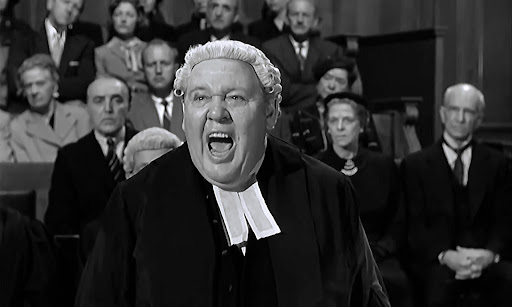
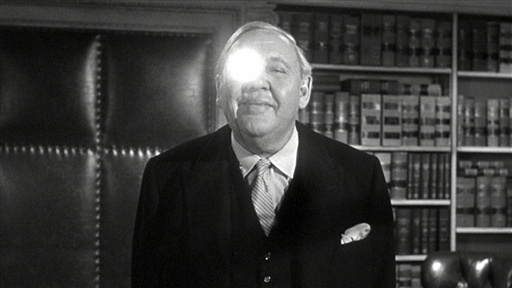
And that's an interesting point: the acting is what this one is all about. This is Power's last completed film, and his anguished defendant is an interesting mix of distraught agitation and Big Studio Heart-throb mannerisms. Laughton's performance is hilarious and dry as vermouth, while Lanchester fusses and kvetches.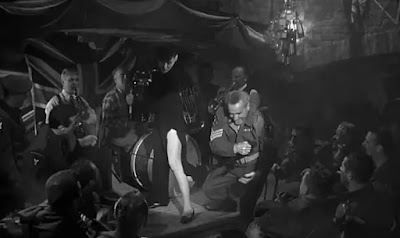 And Dietrich is as cool as can be. A bit past her prime as a fascinating beauty, she is still fascinating (and a beauty), playing her Christine Vole as cold and aloof—Dietrich excelled at that, but with a simmering quality underneath the surface, especially in her work with Joseph von Sternberg, like an iceberg with a volcano at its heart. She always was just on the edge of camp-sexiness,** but the heavy lidded smoldering eyes always had an air of superiority that were deadly serious. And those eyes are still in play here, never revealing much, and keeping the characters and the audience off-guard...and then on, especially when she turns on the dramatic fire-works in the latter stages of the film.

* Er...she plays the nurse, not the heart attack...
** Her mannerisms were devastatingly lampooned by Madeleine Kahn in Blazing Saddles.
*** He lost to Alec Guinness for The Bridge on the River Kwai, and she to Miyoshi Umeki for Sayonara. Can't argue with the first one.


_01.jpg)


