Showing posts with label Tyrone Power. Show all posts

Thursday, January 25, 2024

Witness for the Prosecution

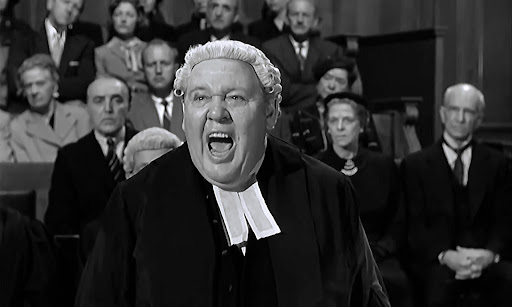
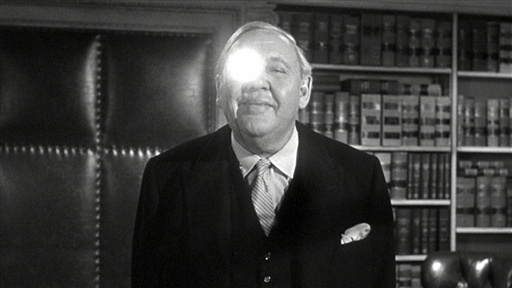
Witness for the Prosecution (Billy Wilder, 1957) Lady Justice is having some work done as we first approach "The Old Bailey," where the majority of the drama for Witness for the Prosecution takes place. Good thing, too, although some attention should probably be paid to the legal loop-holes that keep cropping up inside the chambers. This Agatha Christie-penned theater chestnut is given a nice presentation by Wilder, who has added much comic-relief in the form of giving brilliant barrister Sir Wilfrid Robarts, QC (Charles Laughton), a nurse after a debilitating heart attack (played by Laughton's wife, Elsa Lanchester).*

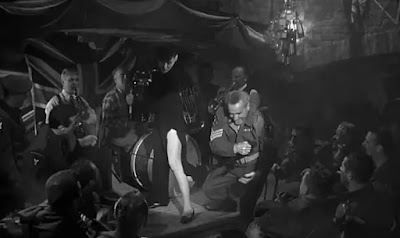
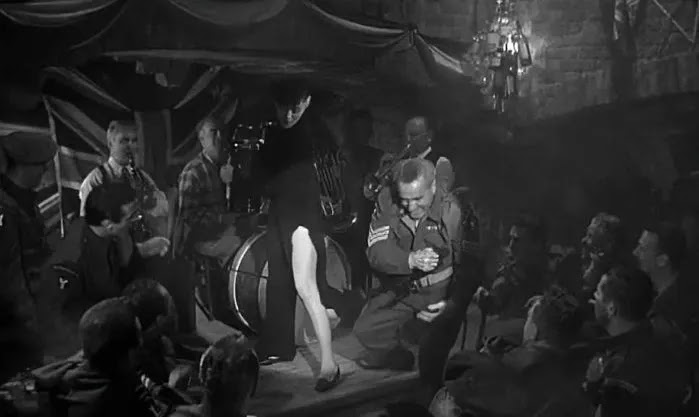
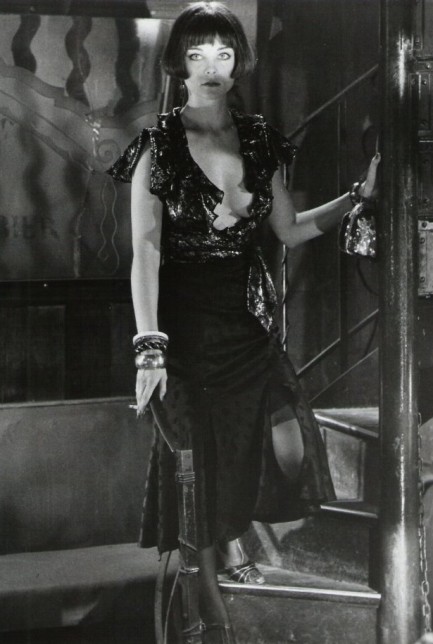
It was the third re-write of the story in as many adaptations, starting with Christie adding a justifiable coda to her original story for the theater adaptation, and Wilder providing further complications in order to have Lanchester's presence, and giving Marlene Dietrich a song and a romantic scene with Tyrone Power in flashback (although both actors can't really pull off playing young at this point in their careers).
And that's an interesting point: the acting is what this one is all about. This is Power's last completed film, and his anguished defendant is an interesting mix of distraught agitation and Big Studio Heart-throb mannerisms. Laughton's performance is hilarious and dry as vermouth, while Lanchester fusses and kvetches.
And Dietrich is as cool as can be. A bit past her prime as a fascinating beauty, she is still fascinating (and a beauty), playing her Christine Vole as cold and aloof—Dietrich excelled at that, but with a simmering quality underneath the surface, especially in her work with Joseph von Sternberg, like an iceberg with a volcano at its heart. She always was just on the edge of camp-sexiness,** but the heavy lidded smoldering eyes always had an air of superiority that were deadly serious. And those eyes are still in play here, never revealing much, and keeping the characters and the audience off-guard...and then on, especially when she turns on the dramatic fire-works in the latter stages of the film.
Laughton and Lanchester were given Oscar nominations for their performances,
*** but I'd make a case that Dietrich was robbed of a nomination—maybe because of the stunt-casting, the nature of the part, but also...maybe...because they didn't recognize how good she is.

* Er...she plays the nurse, not the heart attack...

** Her mannerisms were devastatingly lampooned by Madeleine Kahn in Blazing Saddles.

*** He lost to Alec Guinness for The Bridge on the River Kwai, and she to Miyoshi Umeki for Sayonara.  Can't argue with the first one.

Thursday, December 23, 2021

Nightmare Alley (1947)

Nightmare Alley
(Edmund Goulding, 1947) With Guillermo del Toro's remake in theaters, I thought it was a good idea to look at the original, notable because it's a film noir, the film that Tyrone Power thought was his best, and that it was withdrawn from circulation and unavailable for a long time—it was considered too dark and did not do well at the box office. But, it was revived after Power's death in 1958, and gained a reputation, enough to become a part of The Criterion Collection.
 
It was also produced by George Jessel. "That" George Jessel.
 
"Stan" Carlisle (Power) has a question. He's working for a traveling carnival as a "boob-catcher" and he's fascinated by the "geek," the freak show that attracts the most and lowest of the customers. "I don't understand how someone can get so low?" he asks Zeena (Joan Blondell) the fortune-teller and she has nothing to offer but "It can happen."
Stan can't imagine. He's on an upward spiral from a religious reform school to being on his own as an adult and barking for Mademoiselle Zeena, with her alcoholic husband Pete (Ian Keith) reduced to scrawling hidden answers on a chalkboard (when he's sober). He and Zeena used to be a great mind-reading act with a fool-proof code, but when Zeena started two-timing behind his back, Pete retreated to the bottle and never pulled himself out. A mind-reader is a terrible thing to waste.
Now, Stan is her partner in two-timing and wants that secret code and even offers to buy it from her, but Pete and Zeena aren't selling, seeing the code as being their nest egg once Pete can find it in him to sober up. And Stan is upping the ante by flirting with Molly (Colleen Gray), who is being minded by Bruno (Mike Mazurki) the carney's strong-man, able to see that she's attracted to the barker but too weak to do anything about it. The things that make or break a carnival are the attractions and right now, the most interesting things are going on behind the curtain. And sparks are flying back there.
Stan wants that code, staying as close to Pete as he can to pick up any secrets, but it back-fires on him. Unable to score any hootch from the carnival's Big Boss, he inveigles Stan to share his just acquired bottle of moonshine, which Stan has hidden away. Unfortunately, where Stan hid it was also the place the camp kept their wood alcohol and when he retrieves the stashed bottle, he picks up the wrong kind. Pete dies, and Stan fills the void by learning the code—taught to him by Zeena and Molly—to be her signaler in a new mentalist act that kills, and the success goes a bit to his head, using his secret knowledge and ability to "read" people to deflect the local sheriff from shutting the place down.
But, he's warned. Zeena also reads Tarot—or, as Blondell pronounces it "tarrot"—and the cards warn that Stan will come to a bad end, spelled out by the "hanged man" card which indicates sacrifice. Stan dismisses her worries as superstition, although she swears by the cards' abilities to predict fate. Nothing can prevent him from taking his new skills and trying to make a better life for himself, this time with Molly in tow, by developing a mentalist act among a higher-class clientele. A rube is a rube, and he prefers the ones with larger wallets.
Where Nightmare Alley gets interesting is when Stan and Molly's act becomes a success, and he soon becomes enticed by big offers with big pay-outs by the rich and powerful. By this time, completely cynical, he comes under the sway of Dr. Lilith Ritter (Helen Walker), a psychiatrist specializing in neuroses of the rich and, using her inside knowledge, runs a couple of long cons on a couple society big-wigs and hoping to parlay their donations into a church racket. To Stan, it's all the same racket, whether it's mentalism, psychiatry or religion—just different ways to separate people from their money—but Molly warns him that he's playing with fire, especially when he's pretending to become a spiritualist with a direct line to God. If only he had the power to predict the future...

Nightmare Alley is a cracker-jack little story that sits quite well in the film-noir category—despite the trappings of the mystic, that's all they are, trappings. But, the whole idea of the world populated by sheep for the right wolf to come along only to realize that fate is a hunter makes the movie as dark as pitch. And that's what appealed to Tyrone Power. Director Goulding had worked with him the year before, making The Razor's Edge, and one can see why, after years of matinee idol roles and swashbucklers, he wanted to test his image by playing an out-and-out bad guy. And it works. Stan Carlisle is charming, and Powers doesn't really have to change his acting style from the "star-quality" he was used to in order to play a con artist. The confidence of the star sells the connivance of the character without having to resort to villainous looks. Carlisle is a man who thinks he can get away with anything; he just hasn't realized his mental powers are not as good as he thinks they are.

Power, who loved flying, bought his own plane the same year as Nightmare Alley. He christened it "The Geek."

Wednesday, December 13, 2017

The Rising of the Moon

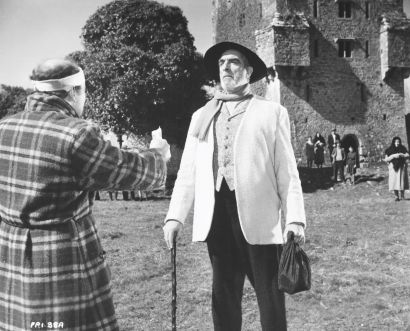
The Rising of the Moon (John Ford, 1957) Interesting, charming anthology film from Ford, featuring three short stories (of approximately thirty minutes each) from the Emerald Isle.

Ford was able to parlay his success with The Quiet Man—made on a shoe-string (and with a Western in the bargain for Republic Pictures) and reaping a pot of gold—to make this labor of love to promote the Irish film industry, with a cast of actors from the country's Abbey Theater (which figures prominently in the film's third sequence). As a carrot for American audiences, Ford uses Tyrone Power as a presenter for each of the stories, each different in tone and style, but bearing Ford's ability to bring out the best in his cast, while also keeping a reign on several threads of character arc interlacing throughout each tale, to make a verdant pattern full of blarney. Each one also has a distinct style of shooting, one landscaped, one close-quartered, one urban and chiaroscuro, that slyly reflect themes and moods of the story, even if the whimsy is a constant factor.

The three stories are thus: 

"The Majesty of the Law"—A police inspector (Cyril Cusack) ventures to the country-side, wind-blasted and rough-hewn to arrest a man for assault.  He attracts the interest of some locals, briefly toys with a rapscallion (Jack McGowran) who is trying to avoid him, then visits an old friend to shoot the breeze. Things are not what they seem, and the segment ends on a complicated note.
"A Minute's Wait"—A busy, typical day at Dunfail station.  A brief stop-over opens the bar and the train empties of passengers. Then things get complicated involving a match-making minister, a honeymooning British couple, young lovers, a goat, and a ghost story-in-passing. Just when things get resolved, more complications ensue, and the train is delayed another "minute's wait." The train empties again...and again...and again, as places change, stories get crossed, and get schedules get thrown out the window, while everyone gets increasingly drunk. Man schedules, God laughs, and life gets in the way...and nothing is stationary.
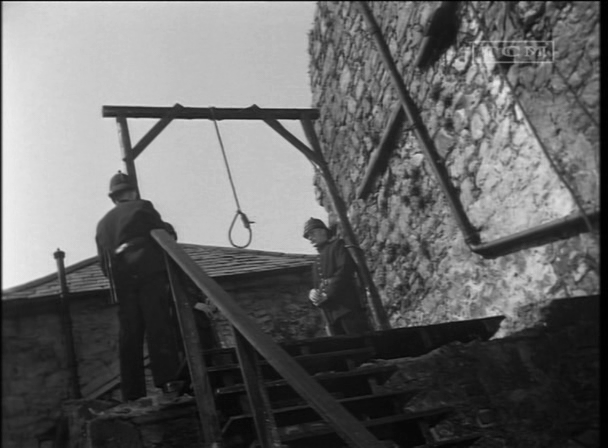
"1921"—The entire world seems to be a little off-kilter and threatening to fall into the abyss in this story set during the Black and Tan Wars, and the height of the British/Irish conflict. Sean Curran (Donal Donnelly) is set to be hung for treason. A snaking queue of townspeople parades in protest in front of the prison as the scaffold is prepared ("That step is loose. Fix it or he'll break his neck before he falls" says the Irish prison functionary in a display of gallows humor) Curran is set to hang and the Brit overseers are feeling the pressure keeping the lid on a situation that could quickly get out of hand.  A visitation by nuns, one of them Curran's sister inflames events and the intrigue moves to the streets as the Army presence builds up and loyalties are tested. "There's a little treason in all of us," says a local bobby working for the Brits, summing up the situation and the tale.
It's great story-telling all the way through, with nothing familiar in the Ford crowd-pleasing arsenal: no John Wayne hook, no western fallback, no Ford stock company dependence, just the Old Master weaving his magic, with an artist's eye and a director's sense of pace, detail, and theatricality, each episode given its own look and feel, everything fresh, but rooted in the man's  presentation and gifts, unfamiliar, yet unmistakably Ford country.

Psycho is not my favorite Hitchcock film, but I revere it as a display of the director at the top of his story-telling gifts and mastery of the form. In the same way, The Rising of the Moon shows Ford's abilities to play with the arts of tale and film, and is the purest example of the director's gifts..and his craft.  

Thursday, June 15, 2017

The Double-Edged Razor

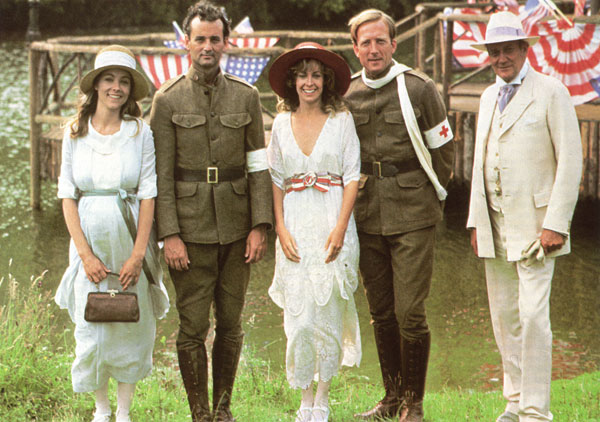
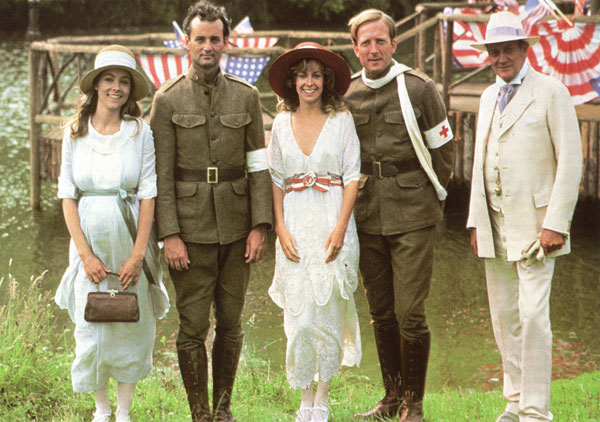
The Razor's Edge (Edmund Goulding, 1946) "The Razor's Edge" is a favorite book of mine, one I was inspired to read after a disappointing film adaptation, starring Bill Murray, who stood out from an otherwise respectful version like a howling sore thumb. But, it had been filmed before, in 1946, under the tutelage of producer Darryl F. Zanuck and directed by Edmund Goulding, only two years after the novel's first publication.

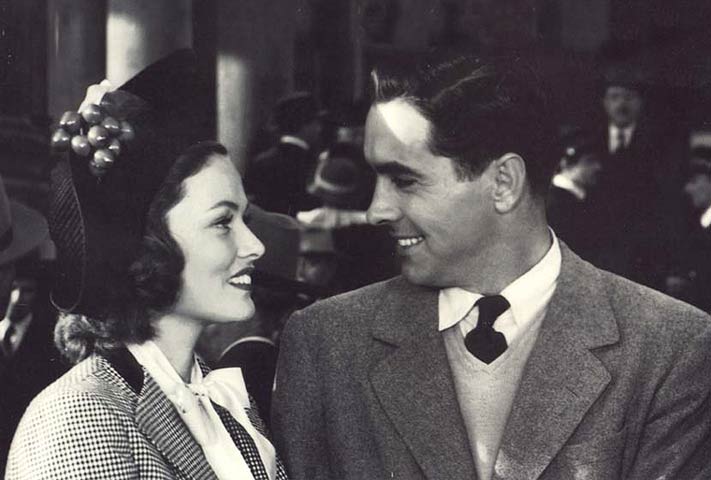
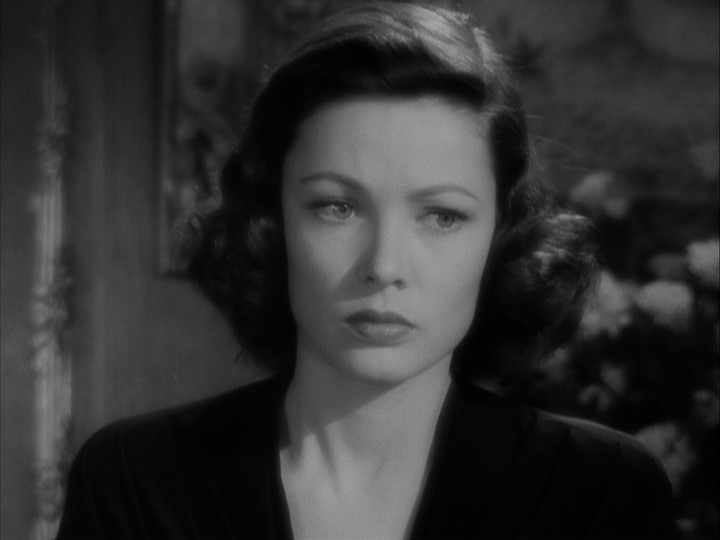
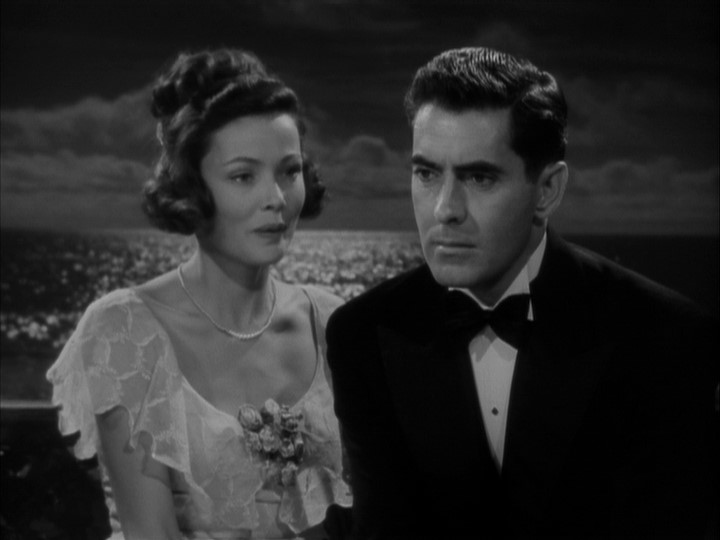
W. Somerset Maugham's book documents (in absentia) the travels of Larry Darrell (played in 1946 by Tyrone Power), who returns from pilot duties during World War I,* deeply affected by the death and devastation he's seen, and takes a period of time to "find himself"—a lot of time. This seems odd to his high society friends, especially the family of his fiancee, Isabel (Gene Tierney), who can't seem to understand why Larry won't settle down, put his nose to the grindstone and make sure that she gets to live in the manner she's accustomed to. Larry travels to Paris, ostensibly under the supervision of Isabel's prissy Uncle Elliott (Clifton Webb) (who does NOT approve), but Larry would rather live the life of a bohemian, working menial jobs. After a year's separation, Isabel comes to visit and is appalled by Larry's simple living conditions. She breaks off the engagement after taking one last attempt to seduce Larry back to her way of thinking, then returns to Chicago, where she marries Larry's millionaire friend.
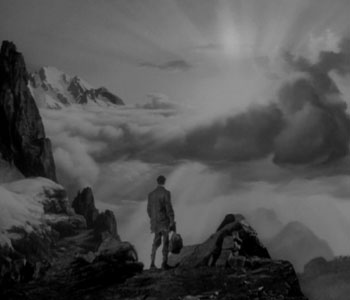
Larry continues his life in Paris, still searching for answers. Eventually, he makes a pilgrimage to India,** where, after studying and living a monk's existence in the Himalayas, he achieves a measure of happiness, finds his answers and returns to Paris to find that Isabel and her husband have lost everything in the 1929 crash, and are now living off her Uncle's charity. His old friends have all suffered various tragedies and are at a loss how to cope...and Isabel still loves him, complicating everyone's lives.
The Goulding version hews fairly close to the book, dulling the razor edges that might have ruffled the feathers of the Hays Office, and implying what could not be said in Maugham's book—Uncle Elliott's gay, Isabel is a too-willing adulteress, and their mutual friend Sophie (Anne Baxter), who suffers her own tragedies, has turned to drink and prostitutionLarry would seem to be the answer to everyone's problems, but he knows that the problem lies in living in a material world and the cheapening of human life to get ahead. And the 1946 version also includes one character that the '84 version excluded—the author (played by Herbert Marshall). Maugham wrote "The Razor's Edge" as a roman a clef, an observance as he made his way between world wars through society as a successful author, settling in Paris and the Riviera. The post-war version relies a bit too heavily on him, while the John Byrum version with Murray manages to make due without. The author becomes a sounding board in the book and first film, revealing characters' innermost thoughts—a little too forthcoming, actually (one should never get too cozy with an author)—and revealing a little too much about what they're feeling.
Power is a good Larry, but not a great one (whereas Bill Murray could have been great, if his propensity for ad-libbing goofily hadn't gotten the better of him).  It's a little too hard to distinguish just what about him changes from "troubled" to "enlightened," other than a little too much intensity in the eyes. Not the greatest of emoters, his war-weary Larry seems merely peeved and a shade brittle, but his post-pilgrimage Larry seems not so enlightened as slightly moony when reflective and somewhat superior and self-satisfied when things go his way. Gene Tierney's Isabel seems far more shallow than the actress is capable of and when she turns vindictive, its done with a raising of the eyebrows and a haughty air—it's more a pose than a performance (as opposed to Catherine Hicks who wasn't afraid to make Isabel conspiratorial. Clifton Webb has as much fun with Templeton as Denholm Elliott did (a role John Gielgud coveted), and Anne Baxter has some very good moments as Sophie, although her theatricality gets the better of her in the more demonstrative scenes (it did win her an Oscar, though), but she doesn't hold a candle to Theresa Russell's "fragility with a spine" Sophie.
One comes away with no definitive screen-version of "The Razor's Edge:" you'd like to take the supporting cast of the 80's version, find a new Larry and keep the later's travel footage as a replacement for the pristine (and wholly set-bound) ashram from the '46 version (were they trying to evoke Shangri-La from Lost Horizon?  Why does it look like a Hollywood hotel lobby designed by Frank Lloyd Wright?). The dissatisfaction is high with both, with flaws impossible to overlook, but there is a great movie in there somewhere, and each film supplies some answers to what that might be like. 
The pilgrimage continues. 

* In the Murray version, he was an ambulance driver.

** In the the latter version, he goes to Tibet.
_______________________________________________________________________________
The Razor's Edge (John Byrum, 1984) The collaboration between Bill Murray and John Byrum on the screenplay is a case of good and bad: the screenplay's very good, respectful of Maugham, but also digging into Larry Darrell's experiences in World War I that made him a part of the "lost generation," and seek a higher truth than his social-climbing friends; the bad part is that Bill Murray stars in it.

At this point in his career, Murray was a popular comic genius,
taking a rather lackluster first year on "Saturday Night Live," and parlaying it into a film career where he virtually ad-libbed Meatballs into a surprise box-office success. StripesWhere the Buffalo RoamCaddyshackTootsie (uncredited, so as not to distract) all built his reputation to where he was becoming a box-office phenomenon (and the capper, Ghostbusters, he agreed to star in to secure The Razor's Edge being made).

Byrum does a fine job directing the film: the locations (particularly the Tibetan ones) are lush and filled with color, and the performances are spot on: Theresa Russell does wonders with a role that can fall into cliche, but she brings a freshness to it that makes it all the more poignant, and Catherine Hicks makes her "Isabel" more sympathetic and far less hissable than she was in the 1946 adaptation.
The "sore thumb" is Murray—but not entirely. When called on to be dramatically appropriate he is there, but the temptation for the young star to punch up scenes with ad-libs that seem too contemporary or are dramatically inappropriate was not squelched by the director*—either because he owed Murray too much for getting it made, or because he didn't want to throw a bushel over Murray's "star-power."
And one can understand why Murray did it. Larry Darrell is supposed to be an attractive, if slightly remote and disconnected, man. There has to be a reason people care about him so much, especially as he abandons them to go off on his spiritual quest, and why Isabel takes the course of actions to keep him to herself. Tyrone Power, in the 1946 version, employed a "thousand yard stare" to suggest deep-seated consciousness, unconvincingly—and, he was Tyrone Power, and the man's "star quality" was sufficient motivation. But, Murray turns Larry from a "party-boy" to a troubled "slacker" with a goofy sense of humor. He's always the funniest guy in the room, and his quips are his expression of affection for his friends. It's the "silver chord" that is shared by pre-war Larry and post-war Larry, and that binds him to his old friends. It's a neat solution to the problem of Murray not being Tyrone Power in looks. But, Murray's funny is a bit too hip for a 1920's room. And though it may occasionally crack up his co-stars, it also makes him the odd man out in the entire scenario.
It's too bad. Given a bit more restraint, this might have been the adaptation of one of Maugham's best books. As its stands, it did make me dissatisfied enough to want to search out the original book, for which I'll always be grateful.
* The most egregious being Larry's empathetic subterfuge of presenting the stricken Uncle Elliott a much desired invitation to a function and Murray's ad-lib: "If it's a costume party you could wear that cute little bunny suit..." It's so out of left-field, especially at that particular juncture, that it undercuts one of the most dramatic moments of the movie, and Denholm Elliott's terrific performance, it's a bit grand-standing on Murray's part. Maybe I'm being unfair and it wasn't supposed to make the final cut and Columbia insisted there be more "Murray comedy," but it is such an artistic gaffe, that you would think that someone would have objected.

Tuesday, September 29, 2015

Jesse James/The Return of Frank James

Jesse James (Henry King, 1939) Despite its popularity when it was first released,* and its subsequent help in gilding the legend of Jesse James—racist, Confederate guerilla, bushwhacker, bank and train-robber...and psychopath—if any movie deserves to be in the hypothetical Movie Hall of Shame, it might be this one. Nunnally Johnson's history of outlaws Jesse James and his brother, Frank, bankrolled somewhat hesitantly by Darryl F. Zanuck, is more full of holes than the Northfield, Minnesota First National Bank, painting them as Robin Hood-like heroes who only robbed banks and trains to avenge the murder of their Mother (Jane Darwell).

As if money had nothing to do with it.

In the film, the bank (represented by Brian Donlevy) is trying to move Mrs. Samuels** off her land for lease to the railroad, but she won't budge, leading the bank agents to remove her in the most subtle of ways, by fire-bombing her house (and yes) killing her—this after an altercation with Frank James (Henry Fonda), resulting in the brothers, Jesse (Tyrone Power) and Frank going on the lam. Once they hear of their mother's death, the two James boys (no other siblings are mentioned) seek revenge for their mother's murder by robbing the symbols that killed their Mother, the banks and the railroads.
Which, of course, isn't true. The truth is that she died at the age of 86 of a heart attack (on a train, ironically), and is credited with writing Jesse's epitaph (seemingly a very tough thing to do from beyond the grave) and, while alive, made a pretty good living giving tours of Jesse's birth-house to yokels who wanted to believe fiction rather than the ugly truth.
But, she dies in the movie, and that's what turns Frank and Jesse into thieves and terrorists, rather than as Confederate separatists who would disfigure Union sympathizers they came across. Why, the movie even gives them a "colored" friend named Pinkie (Ernest Whitman), when the truth is a bit less white-washed (Jesse was known to have black acquaintances—if they supported him with food, money, or a hastily acquired transportation). As William Wellman said of studio sabotage with his intended "warts-and-all" film of Buffalo Bill: "It made me want to vomit." That one, as well as the white-washed Custer picture They Died With Their Boots On (starring Errol Flynn), and Jesse James are three of the more artfully fictionalized legends of American history.

But, the idea was never to be "true" to the story of Jesse James, any more than the dime novels and subsequent museums and festivals in Missouri dedicated to his memory (and for taking a buck from the unsuspecting), are meant to be true. But "if the legend becomes fact, print the legend."***
But, it looks great in Technicolor (the version I saw, anyway), and Tyrone Power makes a photogenic Jesse—to the point where cinematographers George Barnes and W. Howard Greene give him the spotlight rather than ingenue Nancy Kelly (playing his wife "Zee"—no mention is made that they were cousins). Henry Fonda gets the best lines as older brother Frank

Jesse James is notable for one thing, historically: after this film, movies began to have the now-familiar credit "No animals were harmed in the making of this motion picture" as audiences raised a hue and cry for one scene in particular in which a horse died after being pushed off a cliff, and movie filming began to be monitored by the American Humane Association.****

The Return of Frank James (Fritz Lang, 1940) With the death of Jesse in that first film, there couldn't really be a sequel but as it was 20th Century Fox's big hit in that year, one was rushed to production with Henry Fonda and most of the surviving cast returning for the story of Frank James coming out of hiding to find Robert Ford (Carradine, again), the man who shot his brother in the back in his own house. 
 
Frank has been living as a farmer—his occupation before the events of the first film that "inspired" his life of crime. But, when he hears that the cowardly Ford brothers are not being convicted of Jesse's murder (due to the influence of some powerful businessmen), Frank decides to take matters into his own hands. Things are further complicated when the James' farm hand Pinky is about to be hung for being an accomplice to the James gang.
With the son of a slain James gang member, Clem (Jackie Cooper), Frank starts to go after the Fords, all the while pitching the story that Frank is still dead and that he saw him slain with his own eyes (a story that is part of the legend of both Frank and Jesse). But the local newspaper (run by Henry Hull, who was also in the previous film) sends a reporter (Gene Tierney in her film debut) to interview "the man who saw Frank James die" and she becomes suspicious.
Where the first film's director Henry King keeps things bright and in focus to keep the Technicolor popping in the original Jesse James, the director of The Return of Frank James is the German ex-patriate Fritz Lang, as unlikely a director for a Western yarn given his dark, fantastical films in his own country (M, Metropolis, Dr. Mabuse). But one immediately sees a change of tone between the two films despite the same level of flim-flummery in the script. If Lang couldn't do anything about the story, he did at least bring a more practiced eye to Return with an expressive use of shadows, which was just as impressive in Technicolor as it was in his black and white films.
Lang's direction and the presences of Fonda and Tierney make Return the better of the two films, as popular as the first was. And one might argue that a movie true to history is rarer than hen's teeth. Beyond the ones mentioned, there's Braveheart and Gladiator, Pearl Harbor and Shakespeare in Love, Amadeus and Krakatoa, East of Java (it was west of it, actually).  In fact, the history of history in movies is filled with the facts of lies as frequently as thunder is placed simultaneously with lightning and why viewing any movie, even one "based on actual events," should be served with popcorn generously dashed with grains of salt.
Jesse James and Frank James

* In 1939, one could argue the movies' "best" year, it was the fourth highest grossing film after (get this) Gone with the Wind, The Wizard of Oz, and The Hunchback of Notre Dame. Fifth, by the way, was Mr. Smith Goes to Washington.

** Her real name was Zerelda Elizabeth Cole James Simms Samuel.  No "s." They couldn't even get that right.

*** A line from The Man Who Shot Liberty Valance (said by a newspaperman) and could be said to be John Ford's mantra for the history portion of his early career. In his later career, legend became less of a concern than casting aside myth. 

**** That footage was re-used in the sequel and the 1957 Nicholas Ray film The True Story of Jesse James.