Nightmare Alley (Edmund Goulding, 1947) With Guillermo del Toro's remake in theaters, I thought it was a good idea to look at the original, notable because it's a film noir, the film that Tyrone Power thought was his best, and that it was withdrawn from circulation and unavailable for a long time—it was considered too dark and did not do well at the box office. But, it was revived after Power's death in 1958, and gained a reputation, enough to become a part of The Criterion Collection.
"Stan" Carlisle (Power) has a question. He's working for a traveling carnival as a "boob-catcher" and he's fascinated by the "geek," the freak show that attracts the most and lowest of the customers. "I don't understand how someone can get so low?" he asks Zeena (Joan Blondell) the fortune-teller and she has nothing to offer but "It can happen." Stan can't imagine. He's on an upward spiral from a religious reform school to being on his own as an adult and barking for Mademoiselle Zeena, with her alcoholic husband Pete (Ian Keith) reduced to scrawling hidden answers on a chalkboard (when he's sober). He and Zeena used to be a great mind-reading act with a fool-proof code, but when Zeena started two-timing behind his back, Pete retreated to the bottle and never pulled himself out. A mind-reader is a terrible thing to waste.


Nightmare Alley is a cracker-jack little story that sits quite well in the film-noir category—despite the trappings of the mystic, that's all they are, trappings. But, the whole idea of the world populated by sheep for the right wolf to come along only to realize that fate is a hunter makes the movie as dark as pitch. And that's what appealed to Tyrone Power. Director Goulding had worked with him the year before, making The Razor's Edge, and one can see why, after years of matinee idol roles and swashbucklers, he wanted to test his image by playing an out-and-out bad guy. And it works. Stan Carlisle is charming, and Powers doesn't really have to change his acting style from the "star-quality" he was used to in order to play a con artist. The confidence of the star sells the connivance of the character without having to resort to villainous looks. Carlisle is a man who thinks he can get away with anything; he just hasn't realized his mental powers are not as good as he thinks they are.
Power, who loved flying, bought his own plane the same year as Nightmare Alley. He christened it "The Geek."
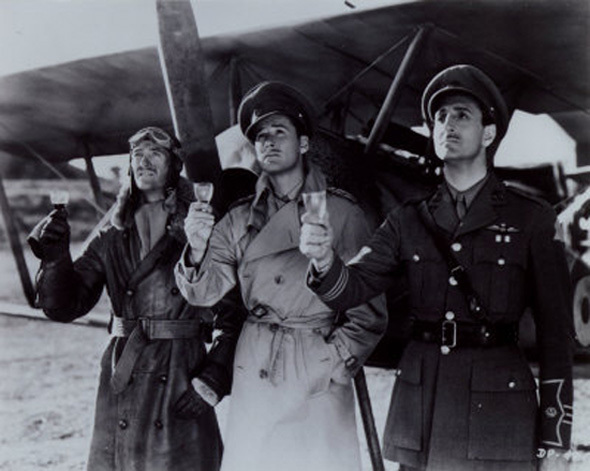
 The Dawn Patrol (Edmund Goulding, 1938) Eight years after the pre-Code Howard Hawks hit starring Richard Barthelmess and Douglas Fairbanks, Jr., the same studio released this remake, knowing that taking advantage of sound technology to enhance the story, not only in the roar of engines in combat (they even used the same planes from the Hawks version), but also the fellowship of song (a Hawks staple, by the way--I'm very curious to see how the first film got away without it, with no music and no use of the emblematic "Hurrah for the Next Man Who Dies.") This time, it's Errol Flynn as the pilot with the longest shelf-life, reporting to superior Basil Rathbone (who sits and waits, listening for the sound of each plane returning) aided and abetted by Donald Crisp, who does the paper-work, writing the letters home to bereaved families.

Headquarters is a slap-dash dormitory/strategy room with a 24 hour bar (tended by Barry Fitzgerald)/rumpus room, done in late German atrophy and a blackboard containing the names of the squadron on duty and the chalk-dust that is left of the honored dead. It's a rotating complement of young men dealing with the pressure cooker (with heavy seasoning) of combat and the existentialism of transitory bonhomie. Very quickly, rookies become veterans and the dreams of youth evaporate in the shots of whiskey and the oil grime that cakes their faces after every sortee.
They're all brothers in the air, dueling and jousting in the machines they pilot, and when they fall, there's enough honor to salute the plummeting. These pilots are so joined that when a captured German pilot is brought to the barracks, he's welcomed to the party, even though he's just shot down one of their comrades (David Niven) and if someone holds a grudge, well, that's just bad manners, what?
A little odd for a war film,* but an example of Hawksian work ethics—do your job, be a professional, even in war-time. It's just a grudge-match between nations, anyway, and once everyone's on equal footing—in this case, terra firma—you don't hold a grudge against professionals. One has to prove oneself worthy, of course, but the general rule is to keep the war in the skies, keep your chin up and your upper lip stiff.

It's not a Hawks film, understand, just an interpretation of Hawks material. And Edmund Goulding is quite adept at making the material soar, both in the skies and on the ground. It's a British cast, so the bantering is quite formal with well-defined rules of engagement. Goulding doesn't match Hawks' trademark at-the-shoulders camera compositions, choosing, instead, a more versatile shooting scheme, which are, at times, artful. But, it is one odd war movie, removed from the geopolitics, insular and private. You get the impression that these guys might be doing this, anyway, if it wasn't for the damned turnaround. But, it is remarkably free of jingoism, glorification and other self-serving sentiments. War is a hell of job, even in the first light of mourning.

* Odd, yes, but not without precedent, especially given the odd episode of the Christmas truce during WWI (a variation of which Steven Spielberg used for an episode in his War Horse film). And, in these economic times, there are parallels: I have friends who work in a call center, who oft-times don't see the escorting off the premises of co-workers, while the "new recruits" keep revolving into the ranks to replace them. I've suggested more than once the idea of a tontine for the "last man standing" from the many cliques that form in such situations.
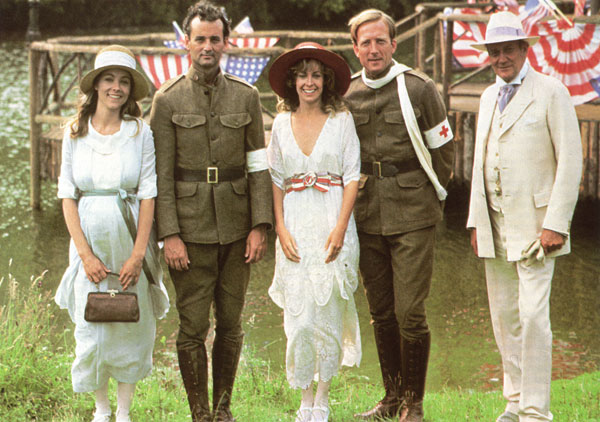
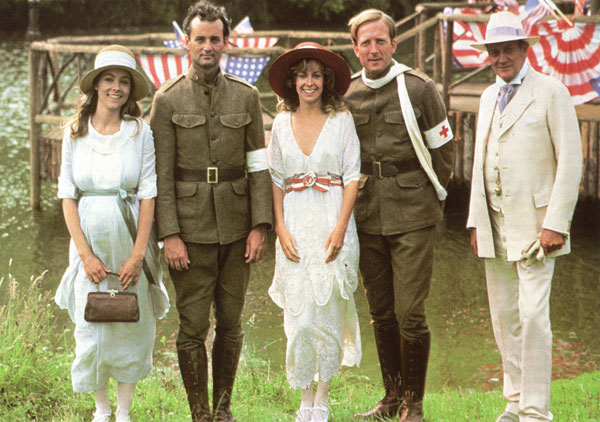
 The Razor's Edge (Edmund Goulding, 1946) "The Razor's Edge" is a favorite book of mine, one I was inspired to read after a disappointing film adaptation, starring Bill Murray, who stood out from an otherwise respectful version like a howling sore thumb. But, it had been filmed before, in 1946, under the tutelage of producer Darryl F. Zanuck and directed by Edmund Goulding, only two years after the novel's first publication.
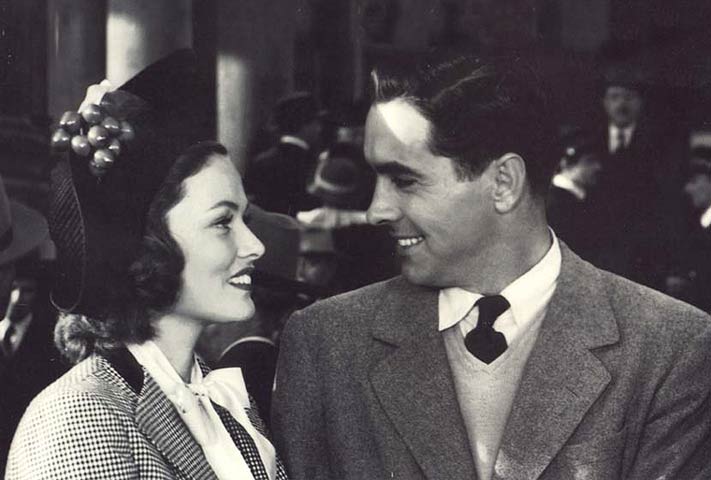
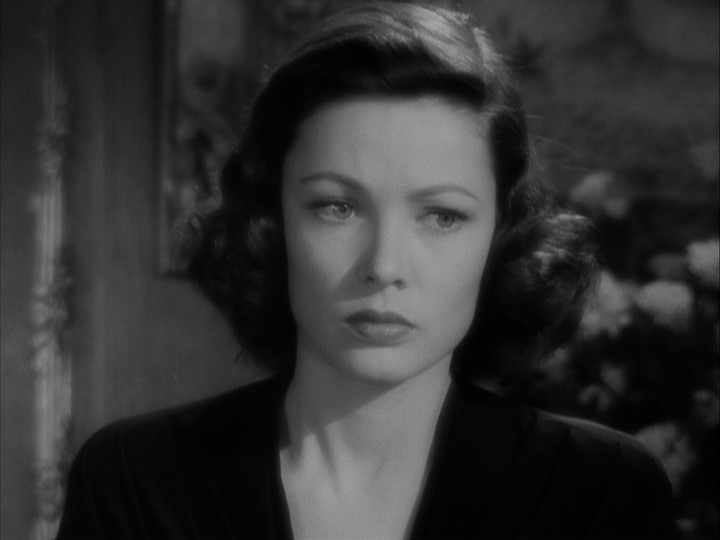
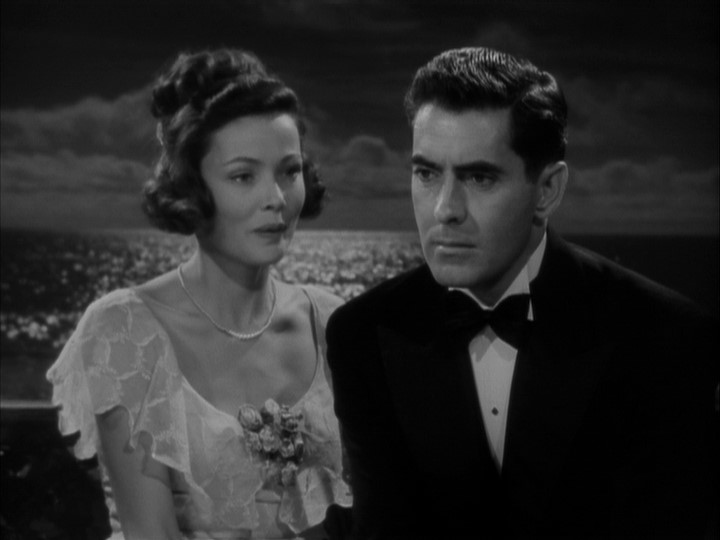
W. Somerset Maugham's book documents (in absentia) the travels of Larry Darrell (played in 1946 by Tyrone Power), who returns from pilot duties during World War I,* deeply affected by the death and devastation he's seen, and takes a period of time to "find himself"—a lot of time. This seems odd to his high society friends, especially the family of his fiancee, Isabel (Gene Tierney), who can't seem to understand why Larry won't settle down, put his nose to the grindstone and make sure that she gets to live in the manner she's accustomed to. Larry travels to Paris, ostensibly under the supervision of Isabel's prissy Uncle Elliott (Clifton Webb) (who does NOT approve), but Larry would rather live the life of a bohemian, working menial jobs. After a year's separation, Isabel comes to visit and is appalled by Larry's simple living conditions. She breaks off the engagement after taking one last attempt to seduce Larry back to her way of thinking, then returns to Chicago, where she marries Larry's millionaire friend.

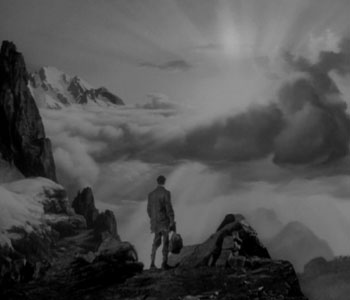
Larry continues his life in Paris, still searching for answers. Eventually, he makes a pilgrimage to India,** where, after studying and living a monk's existence in the Himalayas, he achieves a measure of happiness, finds his answers and returns to Paris to find that Isabel and her husband have lost everything in the 1929 crash, and are now living off her Uncle's charity. His old friends have all suffered various tragedies and are at a loss how to cope...and Isabel still loves him, complicating everyone's lives.

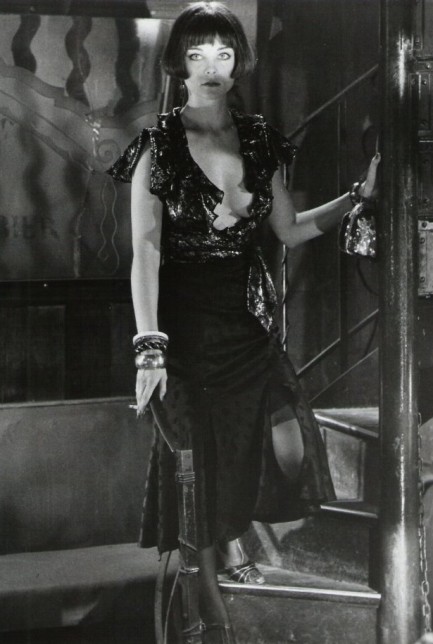
The Goulding version hews fairly close to the book, dulling the razor edges that might have ruffled the feathers of the Hays Office, and implying what could not be said in Maugham's book—Uncle Elliott's gay, Isabel is a too-willing adulteress, and their mutual friend Sophie (Anne Baxter), who suffers her own tragedies, has turned to drink and prostitution. Larry would seem to be the answer to everyone's problems, but he knows that the problem lies in living in a material world and the cheapening of human life to get ahead. And the 1946 version also includes one character that the '84 version excluded—the author (played by Herbert Marshall). Maugham wrote "The Razor's Edge" as a roman a clef, an observance as he made his way between world wars through society as a successful author, settling in Paris and the Riviera. The post-war version relies a bit too heavily on him, while the John Byrum version with Murray manages to make due without. The author becomes a sounding board in the book and first film, revealing characters' innermost thoughts—a little too forthcoming, actually (one should never get too cozy with an author)—and revealing a little too much about what they're feeling.

Power is a good Larry, but not a great one (whereas Bill Murray could have been great, if his propensity for ad-libbing goofily hadn't gotten the better of him). It's a little too hard to distinguish just what about him changes from "troubled" to "enlightened," other than a little too much intensity in the eyes. Not the greatest of emoters, his war-weary Larry seems merely peeved and a shade brittle, but his post-pilgrimage Larry seems not so enlightened as slightly moony when reflective and somewhat superior and self-satisfied when things go his way. Gene Tierney's Isabel seems far more shallow than the actress is capable of and when she turns vindictive, its done with a raising of the eyebrows and a haughty air—it's more a pose than a performance (as opposed to Catherine Hicks who wasn't afraid to make Isabel conspiratorial. Clifton Webb has as much fun with Templeton as Denholm Elliott did (a role John Gielgud coveted), and Anne Baxter has some very good moments as Sophie, although her theatricality gets the better of her in the more demonstrative scenes (it did win her an Oscar, though), but she doesn't hold a candle to Theresa Russell's "fragility with a spine" Sophie.

One comes away with no definitive screen-version of "The Razor's Edge:" you'd like to take the supporting cast of the 80's version, find a new Larry and keep the later's travel footage as a replacement for the pristine (and wholly set-bound) ashram from the '46 version (were they trying to evoke Shangri-La from Lost Horizon? Why does it look like a Hollywood hotel lobby designed by Frank Lloyd Wright?). The dissatisfaction is high with both, with flaws impossible to overlook, but there is a great movie in there somewhere, and each film supplies some answers to what that might be like.
The pilgrimage continues.
* In the Murray version, he was an ambulance driver.
** In the the latter version, he goes to Tibet.
_______________________________________________________________________________
 The Razor's Edge (John Byrum, 1984) The collaboration between Bill Murray and John Byrum on the screenplay is a case of good and bad: the screenplay's very good, respectful of Maugham, but also digging into Larry Darrell's experiences in World War I that made him a part of the "lost generation," and seek a higher truth than his social-climbing friends; the bad part is that Bill Murray stars in it.
At this point in his career, Murray was a popular comic genius, taking a rather lackluster first year on "Saturday Night Live," and parlaying it into a film career where he virtually ad-libbed Meatballs into a surprise box-office success. Stripes, Where the Buffalo Roam, Caddyshack, Tootsie (uncredited, so as not to distract) all built his reputation to where he was becoming a box-office phenomenon (and the capper, Ghostbusters, he agreed to star in to secure The Razor's Edge being made).

Byrum does a fine job directing the film: the locations (particularly the Tibetan ones) are lush and filled with color, and the performances are spot on: Theresa Russell does wonders with a role that can fall into cliche, but she brings a freshness to it that makes it all the more poignant, and Catherine Hicks makes her "Isabel" more sympathetic and far less hissable than she was in the 1946 adaptation.
The "sore thumb" is Murray—but not entirely. When called on to be dramatically appropriate he is there, but the temptation for the young star to punch up scenes with ad-libs that seem too contemporary or are dramatically inappropriate was not squelched by the director*—either because he owed Murray too much for getting it made, or because he didn't want to throw a bushel over Murray's "star-power."

And one can understand why Murray did it. Larry Darrell is supposed to be an attractive, if slightly remote and disconnected, man. There has to be a reason people care about him so much, especially as he abandons them to go off on his spiritual quest, and why Isabel takes the course of actions to keep him to herself. Tyrone Power, in the 1946 version, employed a "thousand yard stare" to suggest deep-seated consciousness, unconvincingly—and, he was Tyrone Power, and the man's "star quality" was sufficient motivation. But, Murray turns Larry from a "party-boy" to a troubled "slacker" with a goofy sense of humor. He's always the funniest guy in the room, and his quips are his expression of affection for his friends. It's the "silver chord" that is shared by pre-war Larry and post-war Larry, and that binds him to his old friends. It's a neat solution to the problem of Murray not being Tyrone Power in looks. But, Murray's funny is a bit too hip for a 1920's room. And though it may occasionally crack up his co-stars, it also makes him the odd man out in the entire scenario.

It's too bad. Given a bit more restraint, this might have been the adaptation of one of Maugham's best books. As its stands, it did make me dissatisfied enough to want to search out the original book, for which I'll always be grateful.
* The most egregious being Larry's empathetic subterfuge of presenting the stricken Uncle Elliott a much desired invitation to a function and Murray's ad-lib: "If it's a costume party you could wear that cute little bunny suit..." It's so out of left-field, especially at that particular juncture, that it undercuts one of the most dramatic moments of the movie, and Denholm Elliott's terrific performance, it's a bit grand-standing on Murray's part. Maybe I'm being unfair and it wasn't supposed to make the final cut and Columbia insisted there be more "Murray comedy," but it is such an artistic gaffe, that you would think that someone would have objected.