Showing posts with label Richard Linklater. Show all posts

Thursday, April 7, 2022

Apollo 10½: A Space Age Childhood

Drawn to the Past
or
"Well, You Know How Memory Works..."
 
Some film-makers go back to recapture their youth. Supposedly, Orson Welles made The Magnificent Ambersons because it reminded him so much of his early childhood. Fellini made Amarcord. Francois Truffaut made The 400 Blows. George Lucas made American Graffiti. Francis Coppola drew on his family life on quite a few of his films. One always gets the impression from Wes Anderson's films that he's tapping into his early years. Robert Benton made Places in the Heart. Mel Brooks produced My Favorite Year. Noah Baumbach made The Squid and the Whale. The trend seems to be gathering momentum. Alfonso Cuaron made Roma. Lee Isaac Chung made Minari. Last year, Kenneth Branagh made Belfast. Paul Thomas Anderson made Licorice Pizza. Spielberg's next movie is The Fabelmans, which started as a screenplay by his sister, now adapted by Spielberg and Tony Kushner, and based on...growing up Spielberg.
 
Richard Linklater seems to specialize in it—both Dazed and Confused and Boyhood are coming of age movies drawn from his past. 
And now, he's hitting the nail on the head with Apollo 10½: A Space Age Childhood(streaming on Netflix), using animation to literally draw his past, growing up as a "space kid" in a Houston suburb during America's race to the Moon. A self-described "fabulist", Stan (Milo Coy, voiced as a narrating adult by Jack Black) is a clear-eyed recounting of everything about his childhood, from schoolyard games, pop culture, the usual fascinations and distractions of a male kid before he notices girls, but when it comes to the space program, his imagination takes him out of this world. In this way, he's a more extreme version of his Dad (Bill Wise), who works in shipping at NASA, but from listening to him, you'd think the whole program depends on him.
Stan is one day recruited by a couple of NASA officials, who, noting, his extraordinary abilities playing in the schoolyard, say that he's just the kid to take care of a little problem the space agency has—they've built the Lunar Excursion Module just a little too small to hold an adult, so they want to send him into space him to test land it on the Moon in secret before Apollo 11 attempts it in front of the whole wide televised world.* They'll explain his absence that he's "at camp" so the parents aren't concerned and nobody asks any questions, and then the kid will get a condensed version of the years of training in a month, so that he'll be best prepared do all the things that three astronauts can do...alone. With such a well thought-out plan, what could go wrong?
Yeah, it's not a documentary. But, you wouldn't know it from the rest of it. The details that Linklater fills his tale with are spot-on and recognizable to anyone growing up in the 1960's. From the eclectic library of "oddity" music to the touchstones of movies, games and TV (the rights issues on this thing must have been enormous). As one of those old coots who remember that time, Apollo 10½ made long-dormant synapses firing off every few moments, whereas younger viewers may be traumatized by the era's ever-present habit of smoking (in the house!!), neighborhood DDT "runs" and the last vestiges of the Eisenhower era of fashion. Heck, this was the era before computers and cell-phones; that's enough to discourage any millennial from time-traveling back to it.
One little error in this—Planet of the Apes would probably have had a second feature as part of a double-bill.

Those expecting a straight-ahead SpaceCamp kiddie space adventure will probably be miffed that Linklater spends so much of the film's screen-time on Earth-nostalgia—it's fully two-thirds of the film—rather than creating some complicated space scenario. Hey, it's his fantasy—believe me, at the time going to the moon was enough, and the revolutionary kid's space movie, Star Wars, was still eight years away. Plus, there's only so much you can do with a "going-to-the-moon" scenario, that is if you're going to stick with science fact in your science fantasy. Going to the Moon meant a lot of switch-flipping, dial monitoring, math, and keeping your lunch down until you had to do something that might kill you, like try to land the most-unlikely flying machine ever engineered on a pillar of flame without landing on a crater lip and toppling over.
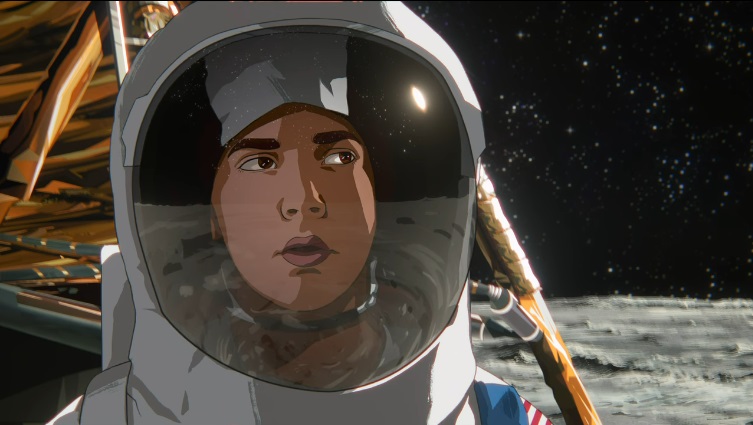
For me, the nostalgia is the fun part (although it may feel as strange as steam-punk to anyone born this century). The space stuff is well-tread territory we've seen before and can smirk at here for its presumptions and naivete in its dream-like simplicity. Because it is a dream. It was a dream. It will continue to be a dream until they have a McDonald's on the Moon...and the other common things that made up daily life in Houston of 1969. And it was a dream shared by a planet full of sky-watchers, whose parents did the same, who can trace their lineage to the hominids who wondered what that thing in the sky was and watched its travels anticipating that time it might move closer and crash on us like a rock...as other rocks do.

And if Apollo 10½ doesn't recreate the moon landing as diligently as First Man did, what of it? It does recreate—just as carefully—what it was like being a kid...in thrall with the Moon.

* Yeah. No. I won't go into it but there are a LOT of reasons why this isn't real, but merely a child's fantasy with all the logic of a child's fantasy ("You ever get a 100% on your math tests? No? Well, there ya go..."). It's funny...there WAS an Apollo 10 a few months before with the mission to do everything Apollo 11 was supposed to do EXCEPT land. They went within 9 miles of the lunar surface and had to come back, without going that last 1%. Imagine how THAT felt. Tom Stafford, Gene Cernan and John Young were the astronauts on that frustrating mission. Young and Cernan got to land on the Moon and Cernan is the last man to walk on the Moon...so far. 


Saturday, November 24, 2018

Me and Orson Welles

Written at the time of the film's release.

"Waiting for Orson"

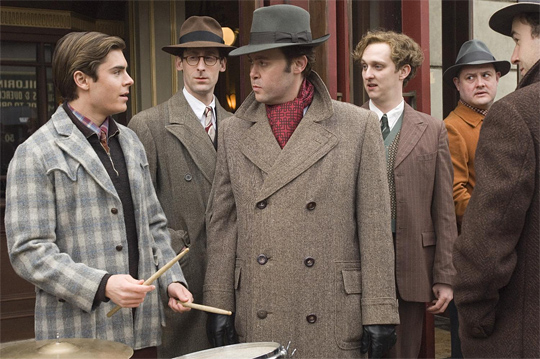
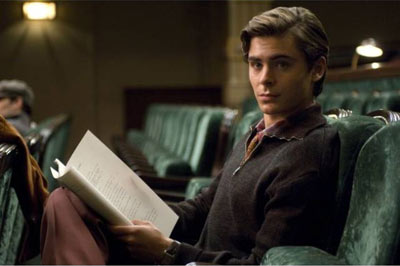
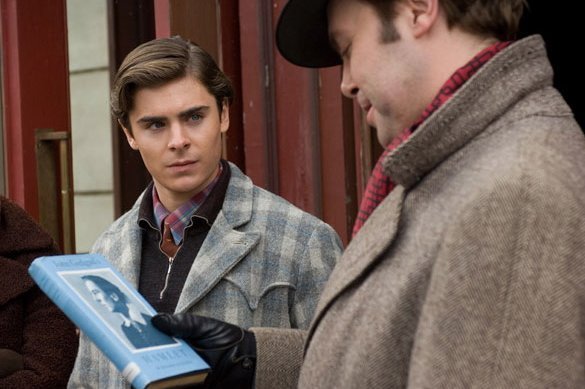
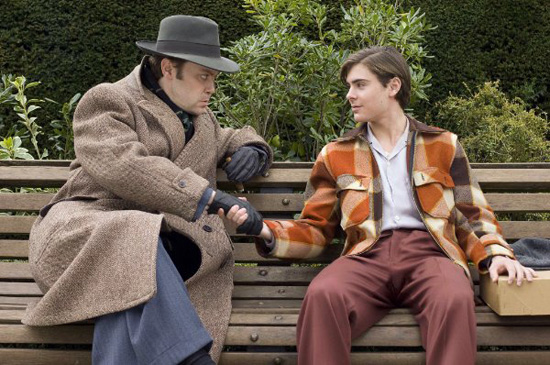
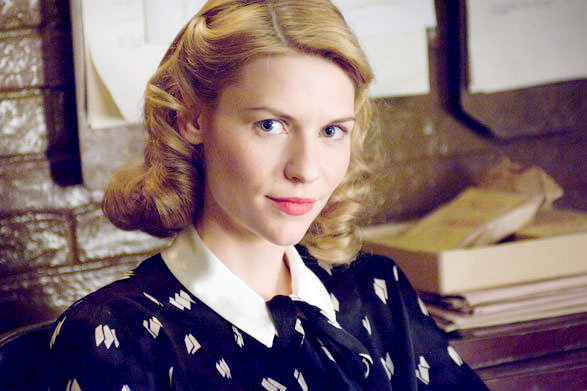
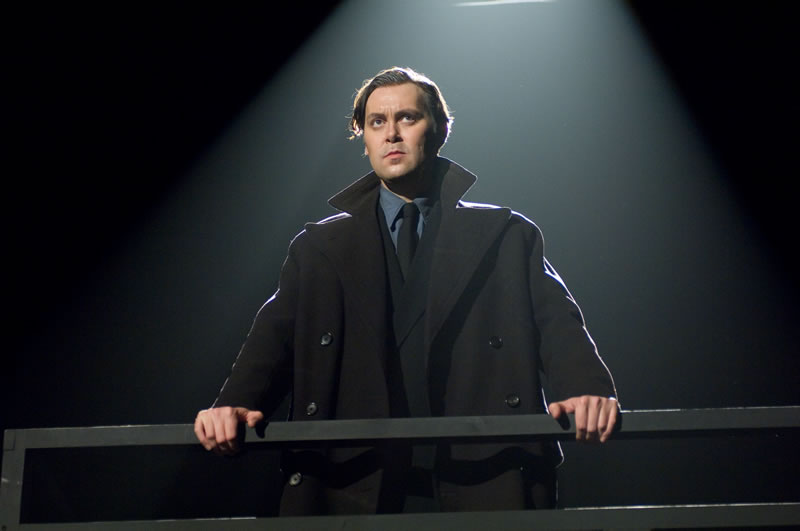
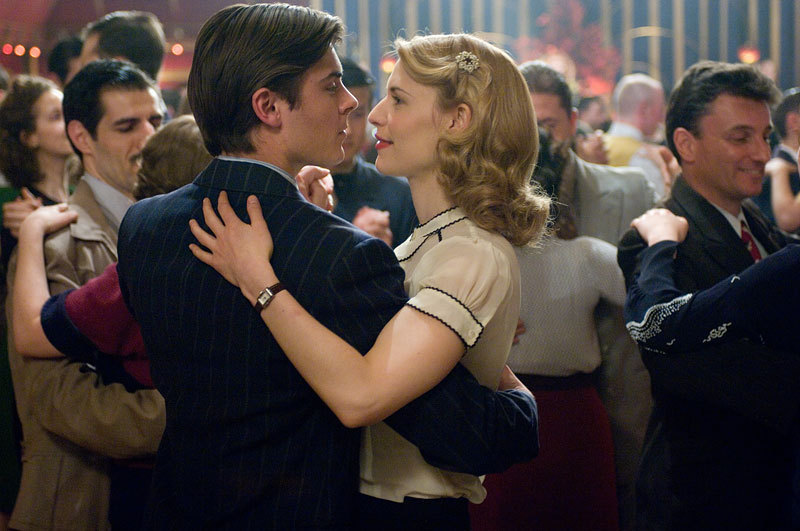
Young Richard Samuels (Zac Efron) is 17, "almost an actor," which puts him just a few hefty years (and worlds) behind the 22 year old Orson Welles (Christian McKay), who has established (by a shoestring) his Mercury Theater in New York, where he is in rehearsals for his modern-dress version of "Julius Caesar"—that is when he is not being whisked from studio to studio by ambulance to perform in various network radio shows, carrying on affairs with ballet dancers, associates, and "just met" women behind the aching back of his pregnant wife.*

Young Samuels manages to vocally pad his resume a bit and kibitzes with some of the players, just enough that
when Welles himself shows up to see the lighting of the big neon sign outside of "his" theater, he sees another bright, shiny object, and as he's about to fire a troublesome actor and "junior" can play the ukulele, Welles hires him on the spot...so he can fire the other kid. "He had a personality problem with Orson," says the Mercury's girl Friday Sonja Jones (Claire Danes). "Meaning he had a personality."

And that just wouldn't do. It's all about Orson, even when it isn'tThere's not that much difference between on-stage and off-stage because the star of it all is Orson Welles, manufacturing drama where there is none, generating excitement even needlessly, and making sure that the limelight is on him. He is the hero of it all and the villain with the best lines. He desires to be, as Alice Roosevelt said of her president-father, "the bride at every wedding and the corpse at every funeral." Life isn't enough, and art has to be stretched to accommodate him.
So do budgets. This fascist recreation of "Julius Caesar" is "modern dress" because there is no money for costumes, but nobody has to know that, it looks like a comment is being made and art is reflecting life au courant. Just like doing a "Voodoo" Macbeth means his all African-American cast is that much cheaper. It looks like a statement, but its merely the ones with a bottom line.
But it's a fine recreation, and if you're not interested in the details, it still makes a compelling story of getting what you need, whether you want it or not. For those who do know the history, it's particularly fun to see
Big Names tossed off: there's Joe (James Tupper), and Lloyd (Leo Bill) and Coulouris (Ben Chaplin) and Jack (Eddie Marsan).** McKay only slightly resembles Welles, and his voice is a timbre higher, but his phrasing, his articulation are spot-on....if the mannerisms seem to be those of the Welles that is familiar on-screenAnd if Zac Efron isn't entirely up to the task of playing his part, that's okay. His role is "Candide," trying to run with thoroughbreds, while he's still admiring the track, crushed with more experienced hoof-tracks. And Efron has just enough skill to do nothing when playing a kid who "doesn't know what he doesn't know." It's a boy's version of The Devil Wears Prada, but it's also The Stunt Man, where illusion is all and practiced and can dazzle the rubes. "J.H. (John Houseman) says everything about theater is bull-shit." says Sonja (which she explains is spelled with a "j" but pronounced with a "y"). But the trick is getting the bull-shit to flow in one direction and that's towards the audience, so they can't see the gears in the background, and the compromises, and the cat-fights and ego-clashes and the spit flying in the klieg-lights. It's new and they've never seen it before, and like the magician he was, Welles was good at deflection while making you never want to blink.

And director Linklater (Dazed and ConfusedA Scanner Darkly) suddenly seems to understand that. Where before he was content to trace his way through movies, now he's using it as a weapon to win over the audience rather than merely please himself. The big joke at the beginning of the film is a seemingly endless number of production companies that "present" Me and Orson Welles. Hell, the Isle of Man Film Commission is a producer and so is the special effects company that maintains the period illusions (they had me at the "Re-Elect Laguardia" bumper-sticker on the phone-booth), for like Welles, Linklater is trying to make his movie any way he can, and in one telling shot in the latter part of the movie, he shows how deep he knows his themes. He starts with a close-up of an orchestra singer, and she's nothing to look at. But as the camera moves back, back, back in the hall, soon all you hear is her voice and the spangling of her dress and at some point, it doesn't matter where—she's the most beautiful girl in the world and she can make you fall in love. It's a simple camera move, just a way-stop to what is important in the scene, but it speaks volumes about illusion and The Moment.

It's this trickery and the fascination with the curtain that distinguishes this little recreation of Welles' prestidigitation from Tim Robbins' hyper-serious (and more than a little dull) Cradle Will Rock. At times, it seems like Robbins was making a judgmental spoof rather than telling the story, which in its own way reveled in the incalculable effect of stirring theater.
And Linklater has a keen grasp of what makes Welles tick (not in his words, because "the official" Welles confounds biographers by telling different stories of his past), but by his actions. Welles had a fascination with the ephemeral, of the moment that could disappear in a flash and make you wonder if it was ever really there to begin with. Not wanting to be tied down, or set things in stone, he was finally confounded—not in the confused sense, but the frustrated sense—with film and its opening dates and burned-in images and permanent records. Change it, compress it, speed it up, keep everybody on their toes—they might see something up there—that was the Welles credo. Keep it fresh, or, at least play it fresh. Everything is fleeting, nothing is permanent, so you better move fast and enjoy it, or move past and forget it. "Ripeness is all." In that way, Me and Orson Welles is in the same radar zone with Up in the Air.
At a time when James Cameron is recycling his old stuff as futuristic, and trumpeting it as revolutionary at the top of his ego, the most amazing thing in this movie season is how two boy-filmmakers, Guy Ritchie and Richard Linklater, grew up to make stellar, fun and deep entertainments out of the past. Like Quentin Tarantino, these film-makers always gave off an air of being too hip for the screening room, but like Tarantino's Inglorious Basterds, Sherlock Holmes and Me and Orson Welles are smart, tough entertainments that may only appeal to the loges, but the fact that, given the materials, these directors can rise so magnificently to the occasion is the most eye-opening of movie-going experiences.
For awhile now, I've been peppered with little alerts about this movie on Welles-groups on the Internet and taking them with a grain of salt. There've been other movies about those wild early years, even a couple of TV-movies about "The Night That Panicked America," and "RKO 281" (about the making of Citizen Kane) and they've been tepid exercises that oftentimes embellished the facts. But, I think Welles would have enjoyed this one, and even roared with laughter a couple of times. But he would have had one problem with it.

That billing
.


72 Years difference: the NYT Hirschfeld cartoon for "Julius Caesar"

The 2009 cartoon of "Me and Orson Welles" in The New Yorker.


* The story is fiction based on fact: Author Robert Kaplow saw a photograph of the "Julius Caesar" production of Welles with a young man playing a lute, and decided to write a story about that young man. Except for the fact that his story is fictional, the rest if fairly accurate. Odd. Usually goes the other way.

** That would be Joseph Cotton, Norman Lloyd (who, like Cotton, worked with Hitchcock-becoming Hitchcock's Supervising Producer on "Alfred Hitchcock Presents" and starring as Dr. Auschlander on "St. Elsewhere," George Coulouris (who had a long, storied career on stage and in Hollywood), and John Houseman, who produced theater and films for many years and then, late in life, became a character actor, first in Seven Days in May, then became ubiquitous, first winning a Best Supporting Actor Award for his Professor Kingsfield in The Paper ChaseHe EARNED it).

Tuesday, February 2, 2016

Hitchcock/Truffaut

Master Class
or
Tremble With Fear/Quiver with Love

I've done a LOT of writing about Alfred Hitchcock. I've seen all of the movies that anyone could see (the remaining ones from the silent era, if completed, may show up smoking in a warehouse somewhere) and written about them extensively.

So, I've been very much anticipating Kent Jones' documentary about one of the "bibles" of film makers and scholars, Francois Truffaut's "Hitchcock/Truffaut," which was published in 1966. It was the result of Truffaut's week-long interview with the director in 1962, and featured analyses of each film focusing on major themes and craft and was liberally illustrated with screen-shots of the films, sometimes even showing Hitchcock's elaborate cutting schemes for key sequences. At the time of the interview, Truffaut was 30 years old and had made three films. Hitchcock was 63 and would only make three more films. One was just starting his career and the other winding down, and Truffaut's intent was to do a scholarly work to rescue Hitchcock from a reputation as a brand-name creator of popular entertainment and show him to be a film artist of the highest caliber. And to shame American film critics for neglecting what they had right under their noses.


I bought my copy in 1974 at the University Book Store in Seattle, which had a good, if sparse, film section at the time—if a new book hit the shelves, it was immediately noticed. I still have it, now yellowed and a little brittle, scuffed and dog-eared. And it is one of the few books that I've carried through moves and marriages. It is indispensible. I've also listened to the interviews—they're available online—and have been amused at where the translation fails and where the measured script of the text in Truffaut's book does not show the moods of Hitchcock during the process—mostly engaged, sometimes sad, at times peeved, sometimes bored or perplexed where Truffaut was going with questions and analyses. Also, like outtakes, it's interesting (and sometimes telling) what was left out.
The book of the films is now a film of the book of the films, with film scholar Kent Jones' Hitchcock/Truffaut, which is a good primer on the book and does a nice job of collating interviews with many prominent film-makers about the influence the book had on their understanding of film (via Hitchcock) and their subsequent careers—Wes Anderson says his copy is now just a stack of pages held together with a rubber band. The film is a nice collage of remembrances by Truffaut, snippets of the interview itself, augmented by generous segments of illustrative film and a large dose of talking white guys weighing in on their own theories, some of which might be valid, but usually revealing more about the theorist than the subject.
James Gray says that there is no reverse angle on this shot, because the most
important elements from the observer's POV is the curl in the woman's hair
in real life and the painting.
As I said, I was anticipating this one and looking forward to it with great enthusiasm.

In fact, probably too much. It might be fascinating if you've never heard of the book or knew that it existed, and it's a nice little distillation of Hitchcock's career (as well as Truffaut's) and touches on the major themes that influenced The Master—his Catholicism, his exploitation of fears, use of color and architecture, the delicacy in finding the most illustrative and emotive angle (no matter what the actor was doing, acting) and matching it with the next, his dependence on film craft to the forsaking of performance and its nuances, and his focus on the audience and how they would respond in the acting of seeing and reacting.

Peter Bogdanovich says that on this shot, audiences could no longer be complacent
and "going to the cinema became dangerous,"

There's a lovely little section of tape where Hitchcock explains why "logic is dull," which is tied up with his artist's desire to surprise his audience, to one-up their sophistication of "I know what will happen next..." "My reply should be "Do you?" The puckish contempt in Hitchcock's voice at that point is lovely.

Moments like that made it worth seeing, but I found it slim. A highlights reel with extra emphasis in the later stages on Vertigo and Psycho, masterpieces of one sort or the other, as high art or manipulation—with Hitchcock, the two were part and parcel (it's just that he was so singularly GOOD at it). A digest for mass-audiences to absorb easily and without offense.
Gray considers this "the most important shot in motion picture history."
Don't get me wrong, it is good that it was made. Hitchcock, with his daughter Pat out of commission to protect his reputation, has taken quite some hits lately, mostly on the gossipy side, with attempts to tarnish and sully in broad strokes in mass entertainment (his favorite weapon). It was about time somebody came out and said "you can speculate all you want about the man, but look what he produced." There was a stringent discipline there in technique, a precision in craft. That he produced them out of his recognition of his frailties and being so attuned to them is rather amazing. For a man who exploited his own fears, he was, in many ways, quite fearless in using them.
I should face it, I wouldn't be happy unless there was a 12-part series, along the lines of "Cosmos," going over Hitchcock's career. He did, after all, create his own filmic Universe and attuned us to its idiosyncracies and peculiarities. He was a great communicator, sharing our knowledge and taking advantage of it. He was also (and this isn't mentioned in the movie except in example) just fun. Inventive to the extreme (and when some claim "typical Hitchcock" to his movies, they're not saying that it's atypically more sophisticated than most film technique), with an eye toward humor even in the worst circumstances, even a "bad" Hitchcock film is a jolly ride, even when it invites us to stare into the abyss. Even though the term "thriller" evokes a generic response, the films of Hitchcock still thrill, either by content or technique, which ever suits your fancy. 
James S. Wilson thinks this shot is emblematic of Hitchcock's innate desire
to satisfy audience's requirements in entertainment (half-jokingly)

Wednesday, August 27, 2014

Boyhood

Our Annual Family Reunion
or
"May the Circle Be Unbroken"

So, what has director Richard Linklater been doing the last twelve years? Well, he's been making mainstream movies (School of Rock, a remake of Bad News Bears) interesting indies (Me and Orson Welles, two of the "Before" movies with Ethan Hawke and Julie DelpyBefore Sunset and Before Midnight—and Bernie), even a dramatic knock-off of a documentary (Fast Food Nation). He also made A Scanner Darkly, an experimental low-budget animation, live-action hybrid of a Philip K. Dick story.

But in the background, he's been doing something even more ambitious—pushing the boundaries of cinema possibility—by transcending cinema-time—with an untitled project he's been filming in dribs and drabs every year, like a family reunion. Like Orson Welles (of whom he knows quite a bit), he'd film a little when he had the money, his cast able to assemble, and the germ of an idea for what to film.  


The idea is at once ambitious and as simple as could be—to film the interaction between children and parents over twelve years, from first bursts of independence to young adulthood. The result, finally titled Boyhood, is simultaneously an extraordinary idea for a film and a bit of a letdown as a film, probably because of the loosy-goosy nature of the story—when Linklater has a solid script, he rocks it; when he's being improvisational—well, he takes what he can get.
This idea of watching actors age naturally on-screen is hardly new—Francois Truffaut did several films in the Antoine Doinel series, and Satyajit Ray made the Apu trilogy over a series of years (Hell, we can even throw in the "Harry Potter" films for the amazing growing up we, as an audience, got to witness in the actors—the best thing about that series, actually).

The difference here is that Linklater does it in one 2 1/2 hour film and we see the changes those twelve years make quickly. In the space of an edit, another year has passed and the changes to the kids in the film (primarily Ellar Coltrane and Lorelei Linklater, the director's daughter, who plays Coltrane's sister) are profound, starting out subtly and then galumphing in large strides in their teen years. In the early sections of the film, you don't even know that time has passed until some indication that something has happened in the lives of the birth-parents (Patricia Arquette and Ethan Hawke...again).

And a lot happens. When we're first introduced to the already-gone-nuclear family, Mom is struggling singly with the kids and a whiny relationship with some guy, and Dad takes them on the occasional weekend, when he's down from Alaska (they're in Texas). The kids wonder if they're going to get back together, but it's not going to happen—they married as kids and quickly grew apart, as she thinks about family and he (being male) thinks about himself. She moves the brood to Houston to live with her Mom and to attend classes at the University.

She begins a relationship with one of her professors (Marco Perella), they marry and the two families blend, and without much difficulty. But the professor has a different way of raising kids than Mom does, and that leads to clashes and he begins drinking and abusing her. She and the kids escape to a friend's house, splitting the family apart.
Mason jr., prone to video games to escape
Mom begins teaching psychology at the University and becomes established, and begins dating one of her students—she doesn't learn anything at this University—and young Mason, now a teen, discovers girls...and drugs...and alcohol. Mom marries her student, and, once again, the cycle of alcohol abuse begins anew.
The incidents start small and become incrementally larger and life-changing. Dad marries a Christian woman and semi-cleans up his act. Mom gets out of another abusive relationship, as the kids grow older and start their own. While watching Boyhood, one gets the sense that nothing much is happening, as kids approach adulthood and their parents approach the realization of what their lives have amounted to. But, with the perspective of time, one sees the cyclical (and cynical) nature of life in broad strokes in the film—the incidents seem less important than the overall arc, the shape of it.  

And if that is the intent, then the film is best appreciated in the remembering than the experience. If Linklater did build the film to show the parallels of parent to child, of experience and folly handed down from generation to generation, then maybe it is saying something profound, about life and its nature, of how the generations learn from their parents and might be doomed to repeat the same cycles, despite trying to break free and achieve their own sense of independence, finding their own way—but not entirely, just doing things a bit differently—from the paths imprinted on them by their parents.

I can't say I enjoyed Boyhood. But it has stayed in my brain, a memory that only has achieved a profound resonance over time. Not too unlike life itself.