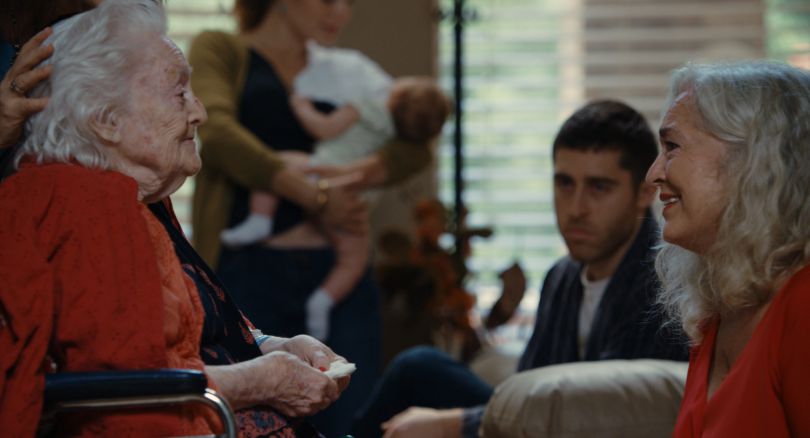
Showing posts with label Bill Wise. Show all posts

Thursday, April 7, 2022

Apollo 10½: A Space Age Childhood

Drawn to the Past
or
"Well, You Know How Memory Works..."
 
Some film-makers go back to recapture their youth. Supposedly, Orson Welles made The Magnificent Ambersons because it reminded him so much of his early childhood. Fellini made Amarcord. Francois Truffaut made The 400 Blows. George Lucas made American Graffiti. Francis Coppola drew on his family life on quite a few of his films. One always gets the impression from Wes Anderson's films that he's tapping into his early years. Robert Benton made Places in the Heart. Mel Brooks produced My Favorite Year. Noah Baumbach made The Squid and the Whale. The trend seems to be gathering momentum. Alfonso Cuaron made Roma. Lee Isaac Chung made Minari. Last year, Kenneth Branagh made Belfast. Paul Thomas Anderson made Licorice Pizza. Spielberg's next movie is The Fabelmans, which started as a screenplay by his sister, now adapted by Spielberg and Tony Kushner, and based on...growing up Spielberg.
 
Richard Linklater seems to specialize in it—both Dazed and Confused and Boyhood are coming of age movies drawn from his past. 
And now, he's hitting the nail on the head with Apollo 10½: A Space Age Childhood(streaming on Netflix), using animation to literally draw his past, growing up as a "space kid" in a Houston suburb during America's race to the Moon. A self-described "fabulist", Stan (Milo Coy, voiced as a narrating adult by Jack Black) is a clear-eyed recounting of everything about his childhood, from schoolyard games, pop culture, the usual fascinations and distractions of a male kid before he notices girls, but when it comes to the space program, his imagination takes him out of this world. In this way, he's a more extreme version of his Dad (Bill Wise), who works in shipping at NASA, but from listening to him, you'd think the whole program depends on him.
Stan is one day recruited by a couple of NASA officials, who, noting, his extraordinary abilities playing in the schoolyard, say that he's just the kid to take care of a little problem the space agency has—they've built the Lunar Excursion Module just a little too small to hold an adult, so they want to send him into space him to test land it on the Moon in secret before Apollo 11 attempts it in front of the whole wide televised world.* They'll explain his absence that he's "at camp" so the parents aren't concerned and nobody asks any questions, and then the kid will get a condensed version of the years of training in a month, so that he'll be best prepared do all the things that three astronauts can do...alone. With such a well thought-out plan, what could go wrong?
Yeah, it's not a documentary. But, you wouldn't know it from the rest of it. The details that Linklater fills his tale with are spot-on and recognizable to anyone growing up in the 1960's. From the eclectic library of "oddity" music to the touchstones of movies, games and TV (the rights issues on this thing must have been enormous). As one of those old coots who remember that time, Apollo 10½ made long-dormant synapses firing off every few moments, whereas younger viewers may be traumatized by the era's ever-present habit of smoking (in the house!!), neighborhood DDT "runs" and the last vestiges of the Eisenhower era of fashion. Heck, this was the era before computers and cell-phones; that's enough to discourage any millennial from time-traveling back to it.
One little error in this—Planet of the Apes would probably have had a second feature as part of a double-bill.

Those expecting a straight-ahead SpaceCamp kiddie space adventure will probably be miffed that Linklater spends so much of the film's screen-time on Earth-nostalgia—it's fully two-thirds of the film—rather than creating some complicated space scenario. Hey, it's his fantasy—believe me, at the time going to the moon was enough, and the revolutionary kid's space movie, Star Wars, was still eight years away. Plus, there's only so much you can do with a "going-to-the-moon" scenario, that is if you're going to stick with science fact in your science fantasy. Going to the Moon meant a lot of switch-flipping, dial monitoring, math, and keeping your lunch down until you had to do something that might kill you, like try to land the most-unlikely flying machine ever engineered on a pillar of flame without landing on a crater lip and toppling over.
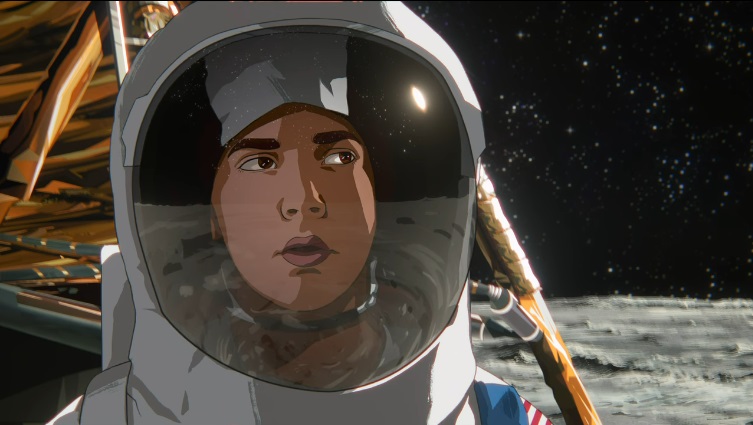
For me, the nostalgia is the fun part (although it may feel as strange as steam-punk to anyone born this century). The space stuff is well-tread territory we've seen before and can smirk at here for its presumptions and naivete in its dream-like simplicity. Because it is a dream. It was a dream. It will continue to be a dream until they have a McDonald's on the Moon...and the other common things that made up daily life in Houston of 1969. And it was a dream shared by a planet full of sky-watchers, whose parents did the same, who can trace their lineage to the hominids who wondered what that thing in the sky was and watched its travels anticipating that time it might move closer and crash on us like a rock...as other rocks do.

And if Apollo 10½ doesn't recreate the moon landing as diligently as First Man did, what of it? It does recreate—just as carefully—what it was like being a kid...in thrall with the Moon.

* Yeah. No. I won't go into it but there are a LOT of reasons why this isn't real, but merely a child's fantasy with all the logic of a child's fantasy ("You ever get a 100% on your math tests? No? Well, there ya go..."). It's funny...there WAS an Apollo 10 a few months before with the mission to do everything Apollo 11 was supposed to do EXCEPT land. They went within 9 miles of the lunar surface and had to come back, without going that last 1%. Imagine how THAT felt. Tom Stafford, Gene Cernan and John Young were the astronauts on that frustrating mission. Young and Cernan got to land on the Moon and Cernan is the last man to walk on the Moon...so far. 


Friday, November 25, 2016

Krisha

A confession of sorts: I've known and worked with Krisha Fairchild, the star of this film, for...(oh, let's say) "quite some time" since back in the day when she graced Seattle with her talents. She has always been jaw-droppingly good at what she does, where, as an actress, or just applying those skills to voice-work, she always imbued everything with an authentic drama that emanated, seemingly, from the marrow in her bones. I'm an admirer and a big fan, so you could say this review is a little biased.

But then...aren't they all?

Krisha of Habit
or
The Little Home-Movie That Could...

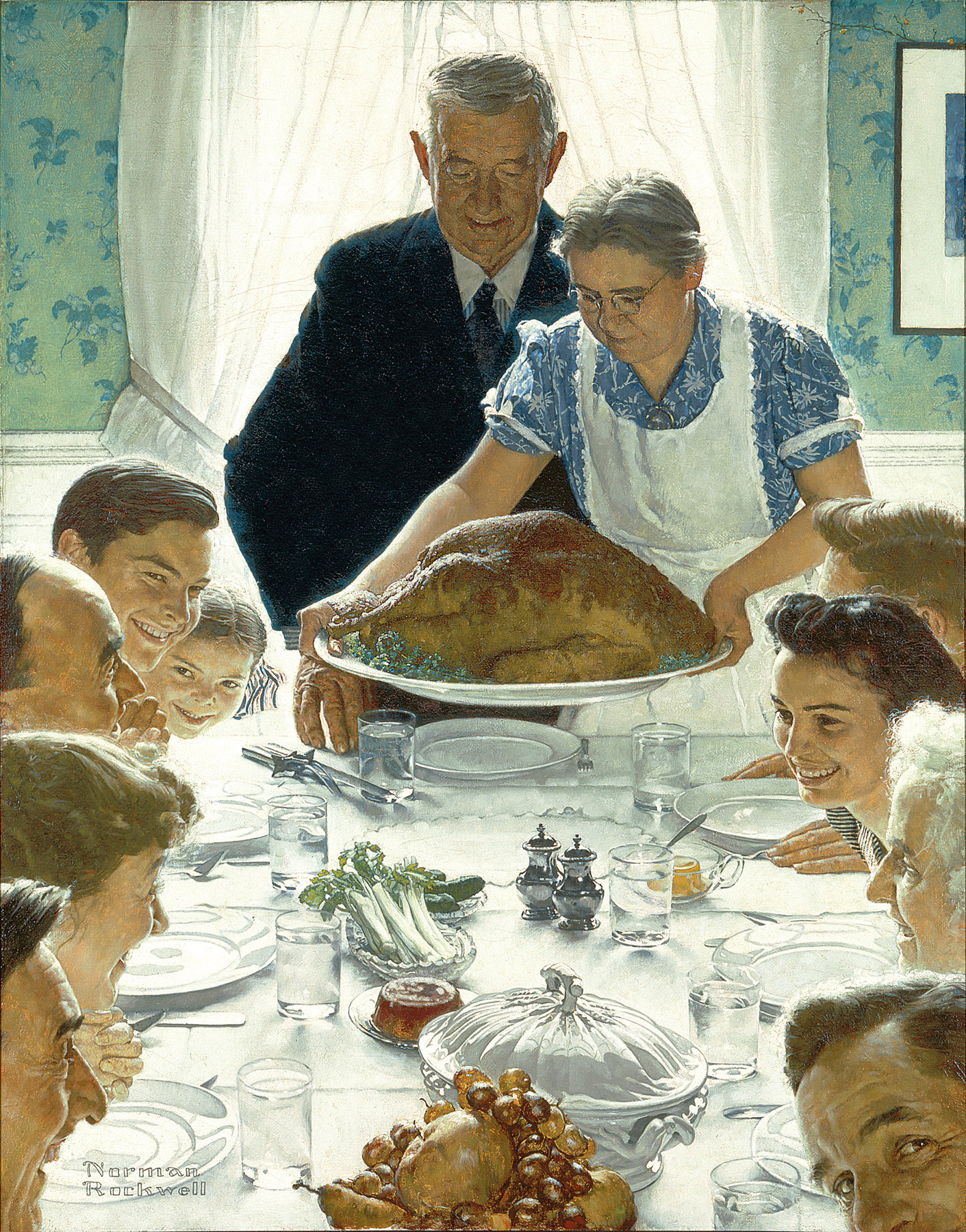
Family gatherings have been the launching point for all sorts of drama and comedy in the arts. They're such a rich source of conflict with good intentions soured by bad karma. Along with that are the family rituals culminating in "the family meal" where everyone tries to "out-Rockwell" Rockwell. But in the meantime, there's a lot of down-time where one can get into trouble, the past simmering as much as the bird in the oven.

Krisha (Krisha Fairchild) harrumphs out of her rental and stomps to her sister's house, muttering the entire way, her rolling carry-on trailing behind like so much baggage. It's been awhile since she's been there, enough that she first goes to the wrong house, then walks to the right one where she gets herself together at the stoop, puts on her "social" face before the door opens, then lights up when she's greeted, the mask looking genuine and natural.
She goes in and meets and greets, the voices high and welcoming, the hugs varied in intensity from crushing to fragile, and the chaos apparent. The household is scattered and busy, football's on and pets are astray as everybody busies themselves and occupies their time and space.
But, Krisha has an agenda. Estranged from her family, battling addiction, she's been away for years, set in her own space, finding her head. She has fences to mend—especially, critically, with her son (director Trey Edward Shults)—and binding ties that have become frayed in her absence.

That's the intent, anyway. But enough bridges have been burned in her wake that it's going to be slow-going. When she can finally have a heart-to-heart with her son, he listens petulantly, passive-aggressively. She's dying inside, really wanting to re-connect with him, but there's a wall of resentment that she's stepped out of his life. A brother-in-law (Bill Wise, the only other working actor besides Fairchild in the cast) is argumentative and has a tendency to poke raw places, which Krisha deflects as if she were hard-as-nails. She isn't. Even Teflon is temporary.

Her toughest critic stares at her in the mirror. She primps and prepares and whispers under her breath, her travelling bag of pills and an emergency bottle of booze nearby. As she paces back and forth—at one point, Shults has her compulsively circling a kitchen island in obsessively increasing orbits—the camera hovers as close as guilt, creating a building tension, which you know, deep down in your gut, is going to break. How and when is the question.
In the overview, this may seem like "Lifetime" material, but the brilliant thing about Krisha is the way Shults has conceived and shot it. It's doesn't feel like a family drama; it's done like a horror movie (I was half-way tempted to post this before Hallowe'en). The movie veers between crowded scenes of jangling activity and Krisha's isolation, creating a clear demarcation of tension between the two sides: Krisha and everybody else. She's the outsider in the family, given the benefit of the always-looming doubt. The unknown, the one being watched. We feel the palpable unease, even if candy-coated with sweetness. At any time, from the family's point of view, she might cross the line, and that line shifts depending on the family-member.
We feel the pressure because Shults always provides Krisha's point-of-view. No matter how normal the family may be, they're a challenge from this perspective—just as she is from theirs. That deep-seated antagonism and sense of dread is what differentiates Krisha from any other domestic drama not involving a hatchet. Krisha is not a monster or a psychopath, far from it, but the reactions to her are muted versions of dread and horror—family-style, with the implied normalcy. And Shults book-ends the film with the same unforgivingly naked straight-on slow zoom her face, as it tries vainly to keep composed and fails, crumbling. She is out mirror into the fragility of our souls.
Krisha was shot over 7 days, with a minimal budget and a cast consisting primarily of family members—and yet, you never catch anybody acting or seeming unnatural or stilted in their performance. The film was released to the film festival circuit where it would consistently be noticed and nominated for top honors, winning the Audience and Grand Jury Awards, then went to Cannes. Shults has garnered his share of nominations, and, suddenly, people noticed Krisha Fairchild, for her raw-nerve performance and ability to carry an entire movie on her shoulders. It is amazing work and stays with you long after you stumble out of the theater, wrecked.
Krisha haunts.