Sunday, July 17, 2016

Don't Make a Scene: Patton

The Set-Up: Patton is a biography and a war film--it has to be because the subject was never more alive or at his best than when he was at war. Gen. George S. Patton, Jr. was a warrior in every sense of the word. He studied campaigns and the history of warfare and knew battles backwards and forwards. His ideas on the mechanization of warfare and tactics were almost a throw-back to a by-gone era, and he came to believe that he might have actually lived in the past, so vivid was his recall of past battles.* Of all the tacticians during the second world war, Patton was an odd duck in a room of bureaucrats—colorful, eccentric, vain-glorious, and a promoter of his own myth, as this scene illustrates. But he was aggressive, pushing his troops to their limits, though always on achievable goals, not simply "staying the course" for the purpose of saving face.

When I was a kid, I was fascinated by Patton, but it was because he was such a fascinating personality—it never occurred to me at that age that he might be so colorful because he was so screwed up. What I saw was excellence and eccentricity and I was drawn to that.

In High School, I did a report on the general, and got an "A" on it, but the teacher drew me aside after class to tell me why he liked the report. He had served with Patton during the war (so did my Uncle, and the teacher and Uncle's memories of the man matched) and told me that of all his commanders, Patton was his favorite—he was the only one who got into the trenches with the men, talked to them, and got to know the men he commanded, as opposed to some who would ensconce themselves in the Ivory Towers of the Field Office and treat the war and the men they ordered like they were of some glorified chess game.** My teacher had seen some of the worst of it, and he'd been there opening up one of the concentration camps. He said the screen "Patton" was more reflective of actor George C. Scott in officiousness than the real general, but that it was a fine portrait, nonetheless.

This was his favorite scene of the movie. Something about the magnificent wide-screen photography (Franklin Schaffner had a great eye for framing), and Patton reminiscing among the ruins, surely. It's a compelling, strange scene of Patton "playing" Patton, and the audience is left shaking their heads, as much as Malden's Gen. Bradley probably does. But Patton's biographer Ladislas Farago did mention this happening—of Patton commanding his driver to a battlefield no one knew about. Patton was a student of warfare, after all. He could have known it was there. But, still....


The Story: Patton (George C. Scott) has just arrived in North Africa to take command of the First Army after a crushing defeat of Allied forces by German Field Marshall Erwin Rommel. Patton finds the soldiers demoralized, undisciplined and begins to make radical changes. On a tour of the area with General Omar Bradley (Karl Malden), he takes a little side-trip.

Action, goddammit!


Gen. George Patton: Hold it. Turn right here.
Driver: Sir, the battlefield is straight ahead.
Patton: Please don’t argue with me, Sergeant, I can smell a battlefield!
Gen. Omar Bradley: He was here just yesterday, George!
Patton: It’s over there! Turn right, dammit!

(Patton gets out of jeep, then Bradley)
Patton: It was here. The battlefield was here.
Patton: The Carthaginians defending the city were attacked by three Roman legions. The Carthaginians were proud and brave but they couldn’t hold. They were massacred.
Patton: The Arab women stripped them of their tunics and lances.
Patton: The soldiers lay naked in the sun.
Patton: 2,000 years ago. I was here.
Patton: You don’t believe me, do you, Brad’?
Patton: You know what the poet said:
"Through the travails of ages, amidst the pomp and toil of war..."
Patton: "...Have I fought and strove and perished countless times upon a star."
Patton: Uh..."As if through a glass and darkly, The age old strife I see..."
Patton: "For I’ve fought in many guises, many names...but always me."
Patton: You know who the poet was?
(Bradley shakes his head)
Patton: ...Me.


Patton

Words by Edmund H. North and Francis Ford Coppola

Pictures by Fred J. Koenekamp and Franklin J. Schaffner

Patton
 is available on DVD through 20th Century Fox Home Video
* The music for "Patton" was composed by Jerry Goldsmith, and, as was his style, he wrote for the interior story of Patton the man--his theme comprised of electronically echoing trumpets (suggesting reincarnation), an organ background (suggesting religiosity) and a Irish jig-like melody (for Patton's joy of battle)

** My favorite story of Patton was the time he was visiting troops during a bivouac, and he casually mentioned he'd forgotten to eat, and one of the men said, "Have one of my K rations, general! They're pretty good." Reportedly, Patton teared up, and told the dog-face, "I love every goddamn bone in your goddamn head!" I don't exactly see Scott doing that...

Saturday, July 16, 2016

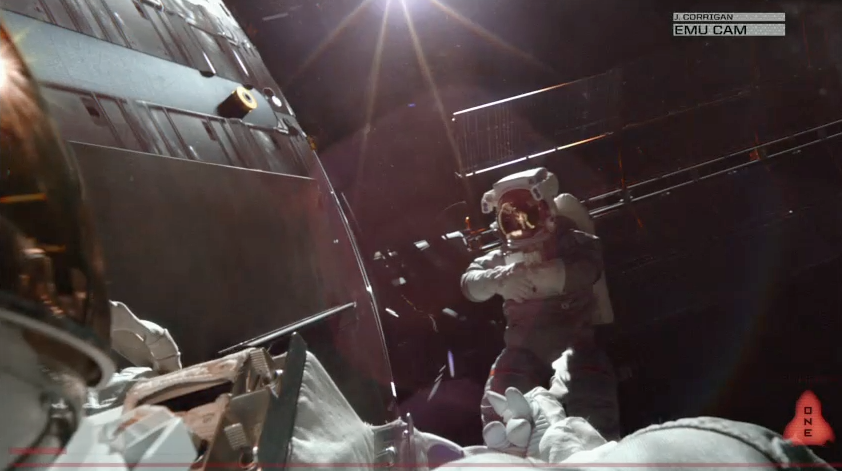
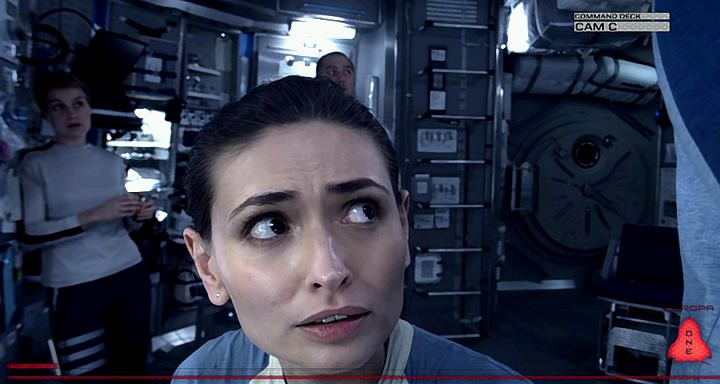
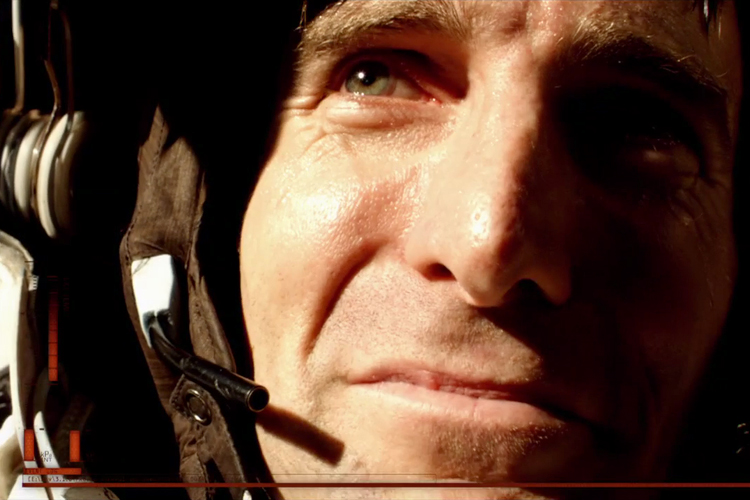
Europa Report

Europa Report (]Sebastián Cordero, 2013)  Sci-fi/adventure film crossing several styles of film-making, but primarily done in a faux-documentary/found footage style about a long-range NASA flight to the Jupiter moon of Europa, which, it has been speculated by many looking at it from afar and across many different spectra, is the most likely of our neighborhood system's bodies that could, maybe, possibly support life as we know it (if all the ingredients and conditions necessary for it outweigh everything that would prevent it).

The whole thing is staged like a documentary. There are pre-flight press conference archives, post-event footage of interviews (giving us a nice sense of complacency), some scrambled interference to give us the "fallible narrator" idea, and lots and lots of "normalcy" footage (something that proved useful to The Martian, which makes Europa Report, seem less of a waste of space in presentation). 
The other thing that's neat about it, is that NASA advisers worked with the film-makers to give it a sense of verisimilitude.  The gear is "lowest-contract-bidder" looking, we get a sense of the routine (just so we can tell when it gets broken), and we become acquainted with the various camera set-ups that record what's going on automatically. It looks very authentic, much more so than misfires like that lousy Apollo 18 movie a couple years back, or even the clever Ridley Scott "transmission" footage used to hide the scale models and flaws in its "planet-side" footage in Alien. 
The film is cast well and game, maybe a little too game, as you don't get the sense that these guys are astronauts or pilots or physicists or ice geologists or whatever they're supposed to be.  But, any more casual "reading you five-by-five, Houston" and you wouldn't have been able to distinguish one from the other at all, and that wouldn't do well with what the film wants to do, which one will become aware of fairly early on in the proceedings. It does cast a couple of fairly well known "anonymous" actors—in other words, it's not George Clooney, Sandra Bullock or Brad Pitt—but it is Michael Nyqvist (from the first versions of the "The Girl with the Dragon Tattoo" series) and Sharlto Copley (of District 9, The A-Team, and Elysium) Embeth Davidtz (of Schindler's List, Army of Darkness and "Mad Men"), and Karolina Wydra (she was briefly Mrs. House on "House, M.D."), all very good international actors that few would recognize. A good strategy, that, even if it does make it it a little hard to keep track of everybody.
And that's the main problem, here. The story is pretty standard stuff in the murder/horror realm, as we lose crew-members one by one, a sort of "Ten Little Astronauts". But by how or by what, we have no idea in a world of possibilities (other than the age-old problem of everybody ignoring the transmission to "get back in"). Ultimately, this is what limits Europa Report, despite the fact that its intention is to expand our horizons and conceptions. We know what's going to happen. We know how it's going to end. And whatever great discovery and what it might mean to our ideas of the Universe as put out by the film are overshadowed by the rote way in which its conveyed. Any uniqueness is swallowed by convention.
Which makes you wonder: if we do find life in the Universe besides us, is our reaction going to be: "Uh-huh, so what else is new?"

Friday, July 15, 2016

Sweet Land

Written at the time of the film's release.

Let us hope that we are all preceded in this world by a love story.
Don L. Snyder "Of Time and Memory"


This was Valentine's week and the requisite rom-com, Music and Lyrics, opened on the day to generally luke-warm reviews. I was looking at Roger Ebert's web-site, and reading Jim Emerson's half-hearted 3-star review of The Fountain that ends with him saying "but I'd much rather watch somebody shoot for the moon when the stakes are sky-high than sit back while they play it safe" and I thought only a film-reviewer who'd seen too many half-hearted, limp romantic comedies could say that.
 
Myself, I'd rather see a film that succeeds, however humble its aspirations.
So to find a film like Ali Selim's feature debut Sweet Land is something of a miracle. It is simple to the point of artlessness and has the genuine tone of a film where the camera is simply turned on and happy accidents allowed to fill the screen. Of course, it was meticulously planned to appear that way (14 years, in fact) but never once does this multi-generational love story tell its oft-told tale of love and struggle in the heartland in a way that feels less than fresh and improvised. Even a descent into Capraland is greeted with something of relief.
There's more to it than this simple outline, but Sweet Land tells the story of a Norwegian Bachelor Farmer who sends for a war-bride in the days following World War I. Trouble is, she's German, speaks but a smidgen of English ("Hello" and one useful exclamation of hunger) and has no "papers." Without them, their arranged marriage can't be performed and the two must get along under the watchful eyes of their neighbors, the suspicions of the church and the post-war fear of all things German (One could say it's a film for the times, but given its long gestation period one has to conclude, sheepishly, that its a film of any time). There are the inevitable complications, but ones born of the awkwardness of the situation, vagaries of the time and the realities of the harvest. One comes away with the entirely appropriate feeling that love isn't "star-crossed" and superficial, but very hard work. A refreshingly truthful idea, that. One wants these kids to work it out, despite the odds. Most rom-com's have me wanting them to get it over with.
A good chunk of the film is spoken in Scandinavian and German, never needing to stoop to sub-titles, and that is due to the lived-in performances of its two leads, Tim Guinee--explosively self-contained and reticent as the NBF--and the gifted Elizabeth Reaser, so transparent and natural an actress that she could have done the entire movie in German and still communicated every emotion economically and fascinatingly. They say that for a movie to succeed takes a lot of work and some form of miracle and Reaser is this film's miracle. 
They are supported by many marquee names, John Heard, Ned Beatty, Lois Smith and Alan Cumming, who also produced. Audiences should be grateful to him for championing this powerful little movie of the heart, with its discreet camera work, extraordinary performances and story that transcends time and celebrates place. Released in 2005, but making it to Seattle at the end of 2006, it would have been a shame to see this exquisite movie die on the vine.
2016 Update: Ten years later and I still fondly recall Sweet Land, so special is this film—not a lot of narrative, but a lot of good film-making went into telling the story. Tim Guinee has been doing a lot of television work—a LOT of television work—and Reaser has done extended work on "Grey's Anatomy," "The Good Wife" and "Mad Men," but is probably best known as being the matriarch of the Cullen clan in the "Twilight" movies. Ali Selim has done some directing work for television, but hasn't done any feature work since. 
 
Somebody give this man some money. Sweet Land showed the mark of a brilliant director and those are few and far between and should not lay dormant.

Thursday, July 14, 2016

The History of John Ford: The Horse Soldiers

When Orson Welles was asked what movies he studied before embarking on directing Citizen Kane he replied, "I studied the Old Masters, by which I mean John Ford, John Ford, and John Ford." 

Running parallel with our series about Akira Kurosawa ("Walking Kurosawa's Road"), we're running a series of pieces about the closest thing America has to Kurosawa in artistry—director John Ford. Ford rarely made films set in the present day, but (usually) made them about the past...and about America's past, specifically (when he wasn't fulfilling a passion for his Irish roots). 

In "The History of John Ford" we'll be gazing fondly at the work of this American Master, who started in the Silent Era, learning his craft, refining his director's eye, and continuing to work deep into the 1960's (and his 70's) to produce the greatest body of work of any American "picture-maker," America's storied film-maker, the irascible, painterly, domineering, sentimental puzzle that was John Ford, John Ford, and John Ford.

The Horse Soldiers (John Ford, 1959) Ford made few Civil War dramas—he preferred seeing the Nation being built than coming apart at the seams—and The Horse Soldiers is more of a small skirmish movie, remarkably free of battles, but more of undercover work—and one battle that is notorious in Civil War history. That anyone might think of it as anti-war—how could it with John Wayne, and a decade before it became fashionable—would mean that they had to by-pass the promotional material and actually watch the thing.

But, the older Ford, seeing the tight studio-hold begin to lighten as they began to lose power to television, might have thought that it was time to speak truth to legend. For the legend, he would go to Ireland, but in the 1960's and 1970's, he went back to his film-making roots, dug them up out of the desert scrap and examined a little more closely the truth behind some of his earlier films and the history of the country. He would present the weeds along with the garden.

Ford's framing takes a cue from Matthew Brady's daguerrotypes
The Horse Soldiers is based on history—the track of Col. Benjamin Grierson to de-stabilize supply routes to the Confederate forces, but the players are all fiction. Wayne plays Colonel John Marlowe, a railroad engineer, who uses his experience to find the weak points along rail routes—spending his time in war destroying what he might have built in the peace. 
He is sent into the heart of the South to Tennessee and Mississippi on a route to Baton Rouge, with the main purpose to destroy a depot at Newton's Station that will cut off supplies to forces at Vicksburg. Marlowe's troop does a lot of skulking around trying to avoid detection by the Confederates, their mission is undercover, but that is a tough prospect commanding 1700 men, all dressed in blue.
Wayne out front, checking the progress of Confederates while his are concealed behind trees.
A troop behind enemy lines finds it tough to have their own supplies ferried to them if they want to avoid detection, so part of the mission is to raid local plantations, use the grounds as bivouac, and "commandeer" supplies, frequently "under protest." One of those so affected is the Greenbriar plantation, being overseen by Hannah Hunter (Constance Towers) and her remaining slave Lukey (tennis champ Althea Gibson). Although gracious to a fiddle-dee-dee, and outwardly manipulative, Miss Hunter holds great antipathy towards the Yankees, remains loyal to the South, and when it's been discovered—by the ever-mindful "saw-bones" Hank Kendall (William Holden)—that she's been listening (via fireplace vents) to the secret plans of the troop, Marlowe has no choice but to take her and Lukey on the campaign, lest she betray them to "Johnny Reb." That just makes her more resentful, causing clashes between her and Marlowe.
Anybody familiar with Ford films knows that such a situation can lead to an ambiguously heartfelt relationship—Marlowe and Hunter fall into a chaste yearning relationship, through a combination of her seeing the effects of battle on both sides rather than holding to an ideological ideal, and his being besieged from all sides—from his superiors and from his own men, including a begrudgingly supportive one from Kendall, on top of having to battle the Confederates, who at the late stage of the war are desperate enough to throw whatever they can at him, including children from a military academy.
Her protests, her new-found vulnerability in danger, and her work tending the wounded, cut through the Wayne crust and probably seem like a comfort amidst the rest of his situation. In the movie, that relationship doesn't play well, sadly, through no fault of Towers—she's great in this film (she usually is), able to bring up the fire that Ford's favorite, Maureen O'Hara, brought to his films and Ford would use her again in his next, Sergeant Rutledge—but Wayne isn't up to his part, managing the quaint courtliness required, but not the vulnerability needed to make it pay off, falling back on a shyness that runs counter to the character's actions, or to Wayne's strengths as an actor.
Marlowe finds Southern deserters in the form of Denver Pyle and Strother Martin
who act and look like they dropped in from a future Sam Peckinpah movie.
Holden's role as a conscientious objector/surgeon who frequently clashes with Wayne over the troop's actions is also a bit under-developed. Look, this is William Holden here. He's one of the few male actors who could stand up to Wayne and by wily enough to not get blown off the screen. But, the character, while of some interest and giving Holden a uniform to fill, doesn't serve much of a point other than to be an irritant, something the movie already has plenty of. To that point, it seems a weakness of the film that Wayne's Marlowe is constantly under the gun and presented with no-win scenarios that reach the breaking point when he must command his troop to fire on civilians.
That slaughter leads to an extended scene in a bar where Marlowe gets drunk and lets down the reserve that has kept him going through what he'd earlier described as "this insanity." It's a powerful scene, even if one gets the sense that Wayne isn't fully committed to it. He can rail all he wants, but there's no sense of release or breaking here, again, not one of Wayne's strengths, as he tends to be at his most powerful in moments of stillness or circumspect emotion. Wayne is at his best when he's not "making a scene," but being the most powerful thread in a fabric.
This is not the John Ford of The Cavalry Trilogy, where one might snatch some phyrric victory out of defeat. There are no scenes of triumph in the film, and the scenes of battle have a bitter tinge to them: one is based on the Battle of New Market in which Union soldiers fought Southern forces that were joined by VMI cadets—children, really—which occurred on March 15, 1864. Ford mines it for irony, pathos, and some odd insertions of comedy for a situation that is so jingoistic that it is horrific and absurd simultaneously. That it is true, well, that is insanity.
The Horse Soldiers was filmed in vibrant color by William Clothier, who'd been working since 1923, but only in the 1950's did he start coming into his own as a director of photography for such directors as John Ford and William Wellman. He became John Wayne's favorite cinematographer and was renowned for masterful location work. The Horse Soldiers is one of his best, but the film fell into neglect and disrepair until restoration for Blu-Ray release suddenly revealed its stunning imagery and eye-popping color done under the direction of Ford.

I'd seen The Horse Soldiers before, but seeing it restored is like seeing it for the first time.
One of the most memorable sequences of The Horse Soldiers-
The Battle of New Market. Both funny and sad simultaneously. 
The poster of this clip cut out Anna Lee taking her kid out of the procession, 
despite his whining protests.

Wednesday, July 13, 2016

Marat/Sade

Marat/Sade (aka The Persecution and Assassination of Jean-Paul Marat as Performed by the Inmates of the Asylum of Charenton Under the Direction of the Marquis de Sade) (Peter Brook, 1967) July 13, 1793 Jean-Paul Marat, revolutionary fire-brand afflicted by a debilitating skin-disease that confined him to a bath was murdered by Charlotte Corday, who had once sided with Marat and now thought his more radical views of the revolution would only bring more disaster and destruction onto France. 

July 13, 1808. It is 15 years later to the day, when Napoleon is Emperor of France and the revolutionary fervor has died down now that France is in the ascendancy as a world-power, even while things are pretty much the same for its citizens that still have their heads attached. In the asylum of Charleton, one of its inmates, the Marquis DeSade takes advantage of some revolutionary therapeutic techniques to stage the murder of Marat with the inmates of the asylum acting out all the parts. An audience of gentry are invited to observe the performance behind bars, while the asylum's director uses the opportunity to curry favor and talk up the sanitarium's accomplishments through its advanced therapies, demonstrating them by holding the performance in the facility's hydrotherapy chamber. 
What could possibly go wrong?

The play goes well after the director's flowery and self-congratulatory introduction, the inmates escorted to the "stage," Marat is played by a paranoiac (Ian Richardson), Corday by a woman (Glenda Jackson) suffering from narcolepsy, the chorus commenting in verse and in song are all done up in clown face, and the Marquis (Patrick Magee) sits sullenly, feigning civility and docility, while putting his invective into the script.
Oh, the layers. It's a film of a play within a play. We are an audience watching (and standing in for) an audience, who could be considered either in front of or behind bars. The play itself is a historical drama with commentary and interjections from the author who inserts himself frequently in the narrative. And the dynamic of jailers overseeing the production of mad-men reflects the government thinking themselves in charge of an unruly mob, a revolution has been mollified, after all, and the right people are in charge in a France that is stronger than ever, led by the proverbial man on a white horse.
Oh, what one could say if one wanted to be pedantically current. But, one could find undercurrents of all sorts of transitions and "revolutions" in the discussions in Marat/Sade—how, for awhile, when things get bad, the public spontaneously combusts, worries the power-brokers about their handle on things, things get better and go back into a torpor as the crowd is satiated with their bread and circuses. Nothing much changes but attitude. And maybe some budgets to be allowed to "trickle-down."
But the play is a microcosm of revolution. De Sade was once a revolutionary, but by the time of play's events, he's found another way. at various times, protests are made of the script and the asylum director steps in to say that things have gone too far, names should not be named to avoid scandal and the Marquis symbolically rips up the script to appear to allow the play to keep going. Because the play is the revolution. To allow it to go on keeps the flame of anarchy alive until such a time as spark can flame and everything descends to chaos.
Because that is the aim. It is one thing to rant and rave and wave one's arms in the air and make a big show. It is quite another to appear docile and allow small victories to keep the show going on. Placate to distract. The end result will still be chaos, because that is the Nature of things, despite our schemes to control them. And when the root is madness...well...

Not even Napoleon could control that.

Tuesday, July 12, 2016

Our Kind of Traitor

Our Man in Nirvana
or
It was My Mother...You Get Sentimental.

It seems to be another good year for John le Carré adaptations. The BBC did a quite honorable version of his 1993 "The Night Manager", and this, Our Kind of Traitor—one of David Cornwell's shorter books—is just concise enough to make it to feature film length without feeling like cheating the source. I have a particular love for le Carré's books, as I've been reading them since the Cold War days with their intricate chess strategies between spy networks, undermined by human frailties and loyalties, often drawn with Dickensian complexity and piquancies. With glasnost, le Carré's antagonists moved from behind the Iron Curtain and into the boardrooms of friendly nations, criminals by nature but with an undercover veneer of prosperity and prominence. Their goals were not political (were the others, really?) so much as a craven desire for power...and more of it and taking down any threats to acquiring it. Although the targets were different, the battles were business, as usual.

His protagonists are not larger-than-life secret agents hiding in plain sight, but government functionaries, rumpled men, flawed and quite extraordinary in their ordinariness, or Hitchcockian innocents caught in the gears of machinations they were quite unaware of working in the background. 

Le Carré's characters either are professionals keeping secrets or amateurs having secrets thrust upon them, but are compelled by their Nature to do the best they can, even to the point of sacrifice. Sometimes they suffer for their efforts and sometimes they can't accomplish their goals with 100% satisfaction. In the current political climate, such might be labeled "losers." They've always been heroes to me, even if they're mourned rather than lauded.


But, the stakes have changed. In the earlier simpler times, they've fought for ideals, for governments. But, around the time of "The Russia House," that changed. In that version of Casablanca-turned-on-its-head, it is not that "the problems of two little people don't amount to a hill of beans in this crazy world," but they weigh a lot more in a topsy-turvy crazy world of overstuffed bureaucracies in which ideals are sacrificed for not much and for the most worthless of McGuffins. The loyalties are spoken very plainly in that novel (and film) by it's ex-pat Brit: "You're my country now." When the country of your birth proves undeserving of loyalty, better to take it personally, on a human level, and protect what you can...and what you should.
Perry Makepiece (Ewan McGregor) is good at keeping secrets. A teacher on Holiday in Marrakech with his lawyer-girlfriend Gail Perkins (Naomie Harris), he's trying to patch things up with her after having an affair with one of his students. But Gail is diffident, not trusting him, and business back home pulls her away from a dinner at an expensive restaurant, leaving Perry alone. What do you do to fill the gaps left by absence?
Perry is invited by a fellow restaurant patron, a garrulous, gregarious Russian, Dima (Stellan Skarsgård, looking the worst for wear but giving one of his best performances) to join him for some after-dinner drinking. Drinking leads to gamesmanship and an invite to a party with sex, drugs and rock and roll, but when Perry stumbles on a rape in progress, he interferes despite being physically outmatched by the perpetrator. Dima interjects, and perhaps noting Perry's tendency to "white knight," invites him and Gail to his daughter's birthday party. When Perry comes back in the morning, his lawyer-lover cross-examines him about where he's been and why he's scruffed up, suspecting that he's catting around again. But, Perry tells her about his encounter with Dima and mentions the birthday party. Gail is reluctant, but accompanies him.
At the party, the two are overwhelmed by Dima's extravagance (his daughter is given a camel for her birthday...a camel, not a pony) and by his generosity with his time and his family. But, at some point Perry and Dima disappear, leaving Gail fuming a bit, but this may be one of those times when it's best not to find out too much.

Dima gives Perry a flash-drive, which he wants delivered to "MI6." Dima is a money launderer for a Russian drug cartel, which is going through a spate of extremely hostile take-overs by a kingpin calling himself The Prince. A friend of Dima's, a fellow "account manager," has been murdered, along with his wife and oldest daughter and Dima suspects his organization's next, and when that happens...Perry is tasked to contact Intelligence so that Dima can get his family, and with luck himself, to the West. Perry agrees. He doesn't tell Gail.
At customs, Perry reveals what he's got and authorities detain him, bringing in investigator Hector Meredith (Damian Lewis) and Luke Weaver (Khalid Abdalla) to question him for hours, leaving Gail quite peeved. When she finds out about all the hub-bub at the airport hub, she thinks Perry has gone mad—what has he gotten himself into now? A suspicious alliance forms between Perry and Hector, who has his own reasons for handling all this personally—he's on the "outs" at the Service, due to the arrest and incarceration of his son for drug possession, a prosecution pushed for by a government official (Jeremy Northam) Hector has been investigating for collusion with the Soviets. He's warned by his boss, Billy Matlock (Mark Gatiss, co-creator and "Mycroft" of the new "Sherlock") to not take it too personally or any gains might be "disappeared" again.
But, it's personal for everybody. As personal as family. And governments, bureaucracies and spies know bupkis about "family values." They know little about trust. And act accordingly.
Performances by the cast are measured and assured throughout, everyone having outstanding moments and director Susanna White keeps things low-key and lived-in. Its another fine adaptation of le Carré with no false notes or grand-standing. Definitely recommended, it's my kind of movie.