 Alfred Hitchcock—The Master, Compromised
I've been doing most of these "Now I've Seen Everything" posts starting with the earliest work, and working forward in time to the latest films. I can't do that with Hitchcock and feel good about it.* For in the years following Psycho, Hitchcock, certainly one of the top five film craftsmen ever, was having difficulty making pictures. Fact of the matter was, Hitchcock was old, often in ill health, and he was seen by the studios financing his films (primarily Universal under the control of former Hitch agent Lew Wasserman) as something of a has-been, a fogey—someone with old-fashioned ideas who couldn't bring "the kids" into the theaters. He was good for publicity, but they'd rather he just stayed in his bungalow office and didn't make any more movies, and with every mediocre success, his value decreased. After all, in Hollywood you're only as good as your last picture (Billy Wilder's response was "You're only as good as your BEST picture!" but he was having trouble getting financing, too). At times, the big back-lot of Universal must have seemed like a pasture he was being put out to. But Hitchcock continued to make films as long as his stamina held out, though his pace was slowing, and the care he took with planning each film (or planning, then abandoning) stretched his output to six films in fourteen years. Another disadvantage at this time was that the team of artisans he had been working with in the decades at his peak (and had the best communication with) were starting to desert him—whether through disagreements with Hitch, or death. It only added to the compromise that the Master of Suspense had to contend with in the last years of his career.
Nevertheless, a lifetime of making films exploring fears, fetishes, phobias and film-making limitations will still find its way into Hitchcock's films no matter what the circumstances. One can tick them off, as if on a checklist: the vexing mother figure; the innocent, wronged; the struggles over nothing (the McGuffin); the vertiginous angles; the voyeurism; the threatening presence of constabulary; the way architecture informs character; the banality of evil; and finally, the ice-cool blonde with tightly bound hair dressed in a grey suit that barely disguises her seething sexuality. Sir Alfred was one phobic, complex dude. But they informed some of the medium's most thrilling films (in content and construction) while simultaneously being some of the most personal films to be found in any director's career.
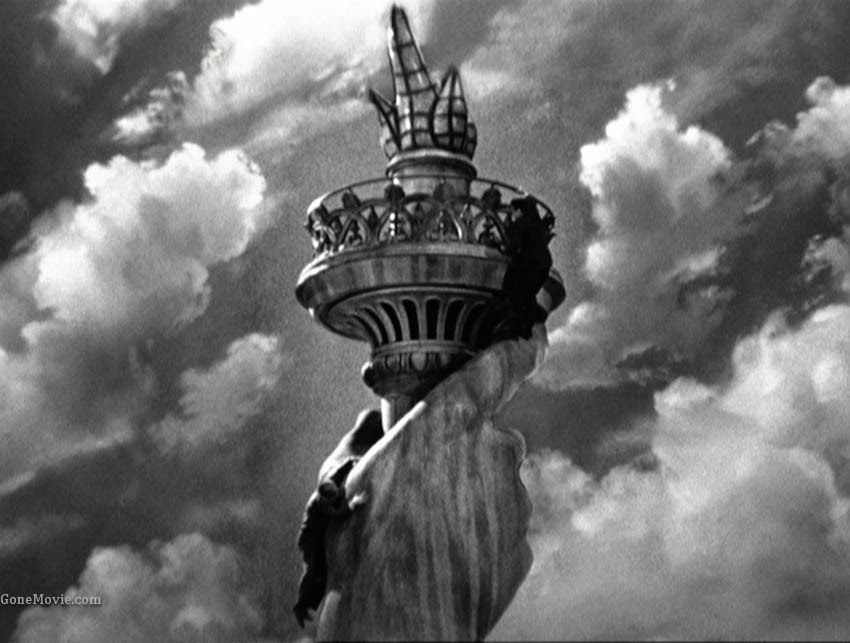
WARNING! SPOILERS ABOUND IN THESE CAPSULE SUMMARIES!! WHATEVER YOU DO, IF YOU HAVEN'T SEEN THESE HITCHCOCK FILMS, THEN DO NOT READ ANY FURTHER (By all means, go to the attic OR the basement, take a shower OR a ride on a carousel, wait in a corn-field OR the schoolyard, visit Mt. Rushmore, the Statue of Liberty, the Bates Motel, OR the beach at Monte Carlo, or for that matter, just sit in your room and watch your neighbors, but for the love of an omnipotent uncaring God...) I REPEAT, DO NOT READ ANY FURTHER!!!
(Thank you and have a nice day)
 Alfred Hitchcock's Family Plot ** (1975) There is always some humor to varying degrees in a "Hitchcock film," whether its dark humor, some punning banter, or even merely his playful manipulation of the medium (ie. staging a meeting in North By Northwest in the exact opposite place as the cliched "dark alley"—an expanse of flat prairie in the high-noon sunshine). But Hitchcock hadn't done an out-and-out comedy since Mr. and Mrs. Smith in 1941 (The autumnally sweet The Trouble with Harry doesn't count). But the bizarre Family Plot, reuniting the director with his North by Northest screenwriter Ernest Lehman combines a caper film with a lot of humor as a hapless grifter couple (Barbara Harris and Bruce Dern) get embroiled with some serious bank-robbers (Karen Black and William Devane, who, having just made a splash playing JFK in "The Missiles of October" on TV, replaced Roy Thinnes.). There are trademark touches and some surprising violence that kind of upsets the mood. But one gets the sense that Hitch produced 2/3 of a film. It lacks polish and substance, though the performances can't be faulted. Even a Hitchcock not firing on all cylinders can still design a film with some thrills.
A further, later thought: Family Plot may seem an odd film "to go out on," but, it's always timing in Hollywood. There were two sides to Hitchcock, the dark neurotic one who exploited an audience's (and his) fears, and the one who chortled and reveled over the tricks he pulled, and the puckish one, the one of good humor. Family Plot, like his Mr and Mrs. Smith and The Trouble with Harry, had a light heart, but a dark sensibility. After making his previous film Frenzy (in which he showed that "the old bird" could still shock, appall and "push the envelope," the director probably wanted to make something a bit lighter, although still in the dark shades, along the line of some of the more "twee" episodes of "Alfred Hitchcock Presents." One can't have a steady diet of murder—how much fun would that be? In retrospect, Family Plot may not be a directorial tour de force of suspense, but it couldn't have a more apt image to end the director's career: a "fourth wall" breaking wink at the audience (and Hitchcock is seen in the poster in the same action). Looking at the totality of the man and his work, it couldn't be more perfect.
Cameo: Hitch silhouette behind the "Registrar of Death and Birth" door @ 41:00 in. ***
 |
| Hitchcock's "farewell" shot |
 Alfred Hitchcock's Frenzy (1972) Wow. If the old man had gone out on this one, nobody would have squawked. In it, Sir Alfred goes home to London--not the posh London of Carnaby Street and "Mod," but the squalid London of his childhood. There's even a visit to the Covent Garden market where his father worked...and a particularly evocative overhead shot of an innocent man being thrown into a jail-cell...as was done to young Alfred to teach him "what happens to bad little boys." It's another case of innocence traumatized, and considerably "rougher" than any previous Hitchcock film, with cursing, nudity and very beastly behavior: the neck-tie murderer is strangling women throughout the city and the police are baffled, with bodies turning up in all sorts of unexpected places. An Innocent Man is accused, and must find the killer to clear his name...but said killer has enough knowledge of said innocent man to make sure that never happens. Meanwhile, Scotland Yard's investigator is having issues at home—his wife is learning how to cook french cuisine (with extraordinarily small portions). No matter how heavy the proceedings (and Hitchcock is positively cruel in the depiction—and non-depiction—of the murders), he still inserts moments of levity. Frenzy has a great ending that slams the movie shut like a steamer trunk. The screenplay is credited to "Sleuth" author Anthony Schaffer, but however strong a presence the screenwriter, its Hitchcock's blueprint they're building on.
Cameo: Hitch is not applauding an environmental speaker on the banks of the Thames... seconds before they find something else polluting the river. @ 4:00 in.
 |
| After presenting one of the most brutal sequences of his career, Hitchcock retreats (or recoils?) from the next, leaving the audience helpless. |
 Alfred Hitchcock's Topaz (1969) I remember Hitchcock appearing on the "Today" show to promote Topaz, spinning yarn after yarn about anything but, then interrupting himself every so often to turn to the camera to say "Topaz, by the way..." Maybe that says something about how the film turned out. Topaz is a curiosity. There are rumors that it was forced on Hitchcock by "the suits" at Universal, but the duplicitous world of spies has held fascination for him before. And one can tell by the many shots of newspaper headlines that it was Hitchcock's intent to tell the story behind the story. There are also rumors that he was foiled from getting an "all-star cast," Or that he was "incensed" at paying Julie Andrews and Paul Newman $750,000 apiece in his previous film. Maybe so. But casting "names" would have distracted from the reality of the story--as it did to a certain degree with The Wrong Man. As it is, Hitch gets good work out of his international cast (John Forsythe, from The Trouble with Harry and several "Alfred Hitchcock Presents..." reunites with Hitchcock and is as close to a name star as the film gets, while Frederick Stafford is a bit of a stiff in the lead role). There are good sequences: everyone remembers Karin Dor falling dead into her dress, and Roscoe Lee Browne's undercover florist picks things up a bit. But Hitchcock never gets too frivolous with the plot--as he points out real lives were at stake, while a clueless public blithely read about it all in black and white, (and, as it is one of Hitchcock's least idiosyncratic movies, it may have been to attract an Oscar--he never won one, but was awarded the Irving G. Thalberg Award in 1967) The film's score by Maurice Jarre is not good, sometimes laughably so, and Samuel Taylor's (Vertigo) script only almost jells.
Cameo: Half an hour in, Hitchcock is wheel-chaired through an airport lobby.
 |
| Juanita (Karin Dor) melts into her dress as she dies. |
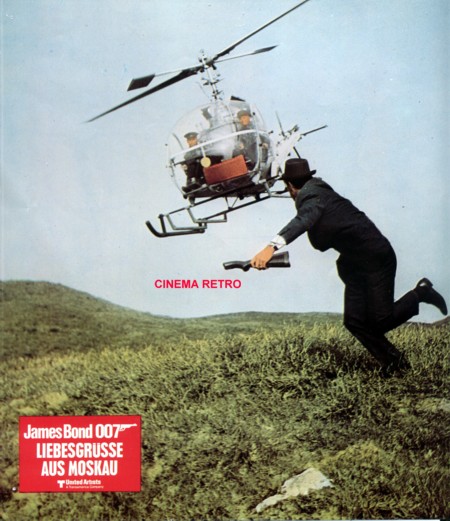
 Alfred Hitchcock's Torn Curtain (1966) After Marnie failed at the box office, Hitchcock had some pressure put on him to make a more commercial film, so he went back to a suspense format with spies and spying during the "spy-film" craze of the 60's. Then he cast two of the biggest stars at the time, Julie Andrews and Paul Newman. And he instructed his regular composer Bernard Herrmann to write a more "commercial" score. All for not. Herrmann responded with a dark score, meant to heighten the totalitarianism of the countries behind the Iron Curtain, and when Hitchcock heard it, he fired his longtime collaborator and they never worked again. Newman, a "Method" actor had problems with Hitchcock's "photo-acting" style, and try as he might, Hitchcock just couldn't sex up "Mary Poppins" (after Poppins and The Sound of Music it was impossible for most theater-goers to see Andrews as anything but a plucky care-giver, although several directors with several million dollar projects tried—and failed—to show her range). And for a spy movie, it just didn't have the thrills audiences expected from the current spy formula--the "James Bond" movies (despite the fact that the "007" producers cribbed an awful lot from The Master's play-book, specifically North By Northwest).
There are great sequences: the killing of Soviet "minder" Gromek in a farm-house—done in such a way as to not arouse any noisy suspicion...and to show how difficult it really is to kill a man—is Hitchcock at his practical, gruesome best; and the old saw about yelling "Fire" in a crowded theater (while, in house-of-mirrors fashion, the film is playing in a crowded theater...) is put to Hitchcock's good use as the lovers are separated by a wave of panicked theater-goers.
But despite everyone's best efforts to create a box-office smash, those elements seemed to work against Hitchcock when the film premiered...and it cost him one of his best collaborators. For years on, Bernard Herrmann would be hired to compose scores of dread, like the ones he'd made for the Old Master.**** One of the greatest collaborations in the history of film was no more.
Cameo: Early in the film, Hitchcock can be seen (back to the camera) in a hotel lobby, holding a baby on his knee, then moving the child to the other knee, after an apparent accident.
 |
| Sarah and Michael have differences as big as a widescreen frame (1.85 :1 ) |
 Alfred Hitchcock's Marnie (1964) Intended to lure Grace Kelly back to the silver-screen, Marnie is a powerful psychological drama with multiple suspense elements thrown in, considerable acting opportunities, costume changes and "entrances." But when the Princess decided to stay in Monte Carlo (keeping her promise to Prince Rainier to give up her film career), Hitchcock turned to his new "discovery," the blonde willowy 'Tippi' Hedren, another trademarked classy, tightly coiffed "Hitchcock blonde." The role might have been a bit beyond her, but Hedren excelled at playing mysterious behavior, and when she engages in serial kleptomania, the audience is with her—though not sure why, after all, we want to know her secret and to do that she has to be found out.
 As her getting caught by the police would end the movie right away, the investigation falls to the male lead, Mark Rutland (wink, wink) played with a tamped-down smoulder by Sean Connery.***** Rutland is no Hitchcock hero ala Cary Grant. He has more of Jimmy Stewart's aberrant behavior magnified ten-fold: he's a sexual predator with a perverse interest in animal motivations. One follows Rutland's efforts with interest, but the fact of the matter is he's just as screwed up as Marnie with power issues that make her the injured victim. He sexually stalks her, kidnaps and blackmails her, keeps her his prisoner, finally raping her on their forced honeymoon. Some hero. Hitchcock is exploring new psychological territory, but like his Spellbound, it feels a bit forced and false, perhaps because Hitchcock's film language can't communicate it, or the restrictions of the movie industry at the time prevented it.****** It doesn't help that Bernard Herrmann's score, though wonderful, is still in the romantic mode of Vertigo, and love is not what this film is about: obsession is. In the end, Marnie gives off mixed signals. Hitchcock is at the top of his film-making skills and when he explores psychological themes he may do so with some understanding, but he also does so in a highly exploitive manner.
Cameo: Hitchcock is seen (very prominently) exiting a hotel room after the passing of the dark-haired Marnie at @ 5:00.
 |
| For Marnie ('Tippi' Hedren), red is not "her" color |
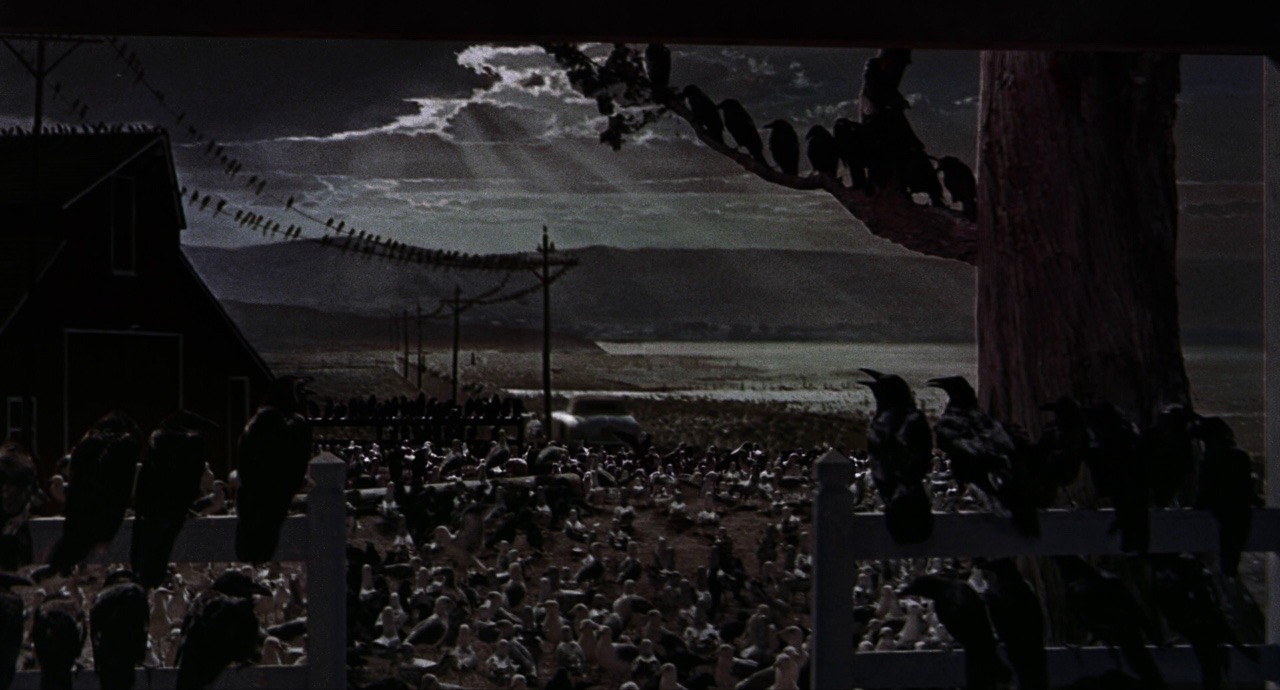
 Alfred Hitchcock's The Birds(1962) An extraordinarily polarizing film, The Birds is also Hitchcock at his best and his most experimental-- from its stylized Main Titles to its meticulously composited but enigmatic final shot, it is a special effects extravaganza. It also finds all sorts of interesting ways to invoke dread and terror, sometimes with staged practical effects, sometimes with opticals, and sometimes merely with sound (it is the only Hitchcock film to not utilize a musical score, although regular composer Bernard Herrmann worked with early electronic musicologists to "orchestrate" the bird sounds, showing how much Hitchcock trusted Herrmann with the sonic/psychological side of his films—he would change his tune, literally, with Torn Curtain). He has a marvelous cast: Jessica Tandy, Rod Taylor, who with his wry intelligence and physique made a great Hitchcock lead, and Suzanne Pleshette, the dark brooding counter-point to his female star, 'Tippi' Hedren.
'Tippi' appeared to be the perfect Hitchcock blonde—a model who moved well with expressive eyes and an enigmatic smile, Hitchcock was her Svengali (ala Vertigo), training her to act in the Hitchcock manner, with no pre-concieved notions, and whose modelling background made her unfussy about wardrobe (a big Hitchcock concern). The director introduces her in the same way he first saw her in a Sego commercial—with a little boy whistling at her on the street. Hedren never really ingratiated herself with audiences, due, in part, to Hitchcock casting her in somewhat unsympathetic roles that a star with a following—like Grace Kelly—could have risen above. But she's a good actress, capable of the character development her roles required. She does win an audience's respect if given a chance.
But one reason that The Birds might have left audiences and critics unsatisfied was another Hitchcock experiment—a deliberately open-ended and unresolved finale. It's never explained why the birds become so aggressive, and without that, the movie feels unfinished (unlike the extended explanation at the end of Psycho). But dramatically, it is resolved: The now-harmonious Brenner family ******* is allowed to drive off into the dawn with Nature, like them, in a temporary truce. How long that will last is anyone's guess. It could change at any time. What else would you expect from the Master of Suspense?
Cameo: at 02:18, as 'Tippi' walks into the pet store, Hitchcock walks out with two scottish terriers (yes, they were his).

* Also, "I Confess" I haven't really seen everything Alfred Hitchcock has directed--there are a couple of his TV shows I haven't seen.
** The American version of Hitch's films all have titles with the director's name in the possessive. This often led to some amusing juxtapositions when taken with the name, so I've included his name in all the titles, e.g. Alfred Hitchcock's The Birds or Alfred Hitchcock's Psycho. Was it intentional to do this? You've seen his movies. What do YOU think?
*** If you want to see all of Sir Alfred's cameos on one page go to this link.
****And usually for Hitchcock disciples, like Truffaut, Larry Cohen, DePalma and Scorsese. Hitchcock hired Henry Mancini to write the score for Frenzy (ironically, as what led to the Hitchcock-Herrmann "break-up" was the studio's desire for the Torn Curtain score to be less symphonic, more "pop" oriented—of the type Mancini was producing at the time, even for Hitchcock pastiches like Charade) which, given the film and the masterful Hitchcock-Herrmann collaborations, he the composer wrote very much in the Herrmann mold that he had admired. When Hitch heard it, he reportedly said, "If I wanted Herrmann, I'd have hired Herrmann" and promptly fired Mancini.
***** At Hitchcock's AFI Lifetime Achievement Banquet, while Connery was was standing up and talking about his time working with Sir Alfred, Hitch pointedly turned to Ingrid Bergman and asked "Who's he?" not recognizing the older, bald and bewhiskered star of his Marnie.
****** One of the more shallow criticisms of Marnie is the obvious use of process shots--a staple of Hitchcock films. Those shots filmed in front of a movie-screen are usually well-considered in a Hitchcock production, not only for the safety of the performers, but also to show the protagonist isolated in their environment. They do serve a psychological story-telling purpose.
******* Maybe, as she's accused in the diner, the disruptive Melanie Daniels really is evil.
Next segment: Alfred Hitchcock, The Master of Suspense Meets his Musical Match!


.jpg)



/PDVD_00003.jpg)
/PDVD_02724.jpg)
/PDVD_02210.jpg)
/PDVD_02520.jpg)
/PDVD_01238.jpg)
/PDVD_00955.jpg)
/PDVD_02456.jpg)


/PDVD_00596.jpg)


/PDVD_01358.jpg)


/PDVD_00152.jpg)
/PDVD_01289.jpg)


/PDVD_01465.jpg)
/PDVD_01475.jpg)
/PDVD_01478.jpg)