Just Dementia...
or
Practically Peculiar in Every Way
I'm sure that every Tim Burton film is, to him, a labor of love, so particular to his dark sensibilities and interests are they, in whatever manner he chooses to create them, whether live-action or animated, drama or comedy. Though others have tried to tap into his sensibility (see Into the Woods or Maleficent), Burton is unique, an adolescent-director of Hallowe'en tastes, who is as capable of going overboard into parody as he is of doing serious work. The latter, though, are few and far between, because the kid in Burton is just too jovial to take anything too, too seriously.
But, when he does, it is something magical. Miss Peregrine's Home for Peculiar Children (based on the novel by Ransom Riggs, adapted by Jane Goldman—who wrote Kick-Ass, Kingsmen, and the first young X-men movies) is so very much a concoction for Burton, it might as well have been written with him in mind, the same way "D'entre les Morts" had Hitchcock in mind in the writing.
Jacob Portman (Asa Butterfield, who was Martin Scorsese's Hugo) is a stocker at a large convenience store. He's a loner, an introvert, not well understood by his parents—in other words, your typical Tim Burton hero. When he finds his beloved grandfather Abe (Terence Stamp), murdered in the woods by his house, Jake is devastated, because the older man paid far more attention to him while he was growing up than his self-involved parents, and intriguing him about adventurous stories from his youth. During the second world war, Abe was sent by his parents in Poland to Wales, where he lived with an extraordinary gaggle of children—an invisible boy, another who was full of bees, a girl who could manifest fire and another who could float in the air and was only kept on the ground by her heavy metal boots. The house was run by a Miss Peregrine, who protected the children from the vagaries of a world at war.

When Jake finds grandfather Abe, he is dying, his eyes ripped out of their sockets, and some strange creatures have been seen nearby in the fog. But, those are just oddities to Jake. For him, the most important thing is his beloved grandfather is dead. He is inconsolable. His parents, worried that the traumatic event will take him down a depressive road, take him to a shrink (Allison Janney), who notes Jake's close ties to Abe and even suggests sending the boy to Wales as a way to connect and find closure. Jake's parents think that's a crazy (and inconvenient) idea, but, reluctantly, they agree and Jake's father makes arrangements to take the mournful boy to England.
Both males are fish out of water in Wales. Dad wants to keep his head down and let Jake make friends with the locals, but the boy has his mind set on visiting Abe's old haunt, Miss Peregrine's school, which he finds is now a bombed-out ruin from a German bombing in 1943. But, as he picks through the rubble, he is shocked by things going "bump" in the shadows and mysterious figures that glow in the shafts of light that blast in from the crumbling walls of the formerly grand house. Not wanting to end up like Abe, he runs back to the public house he and his Dad are staying at, and is stopped from going up to his room by the bartender, who's not the same one as he remembered. Seems there aren't any rooms to let up there, but his big clue is that the jukebox is playing "In the Mood."

He has, somehow, managed to go back in time to 1943. But, before he can register that idea, things start flying around the room creating chaos and he's dragged from the pub by some children (one of whom starts a distracting fire for the locals to contend with), who take him back to the peculiar home, which, now, is fully restored—it being September 3rd, 1943, the very day the house was bombed.
He is introduced to the woman Abe told him about, Miss Peregrine (Eva Green), an "Ymbryne" (magical beings who can transform into birds) whose charge is to take care of the children in a time-bubble that she has created that must re-set before the bombing occurs. They all live day-to-day in one day, never aging, never dying either, but taking life one day at a time—only it's always the same day.
He's introduced to the kids—Millard the invisible boy (Cameron King, although we'll never know for sure), Hugh the bee boy (Milo Parker), Bronwyn, who is super-strong (Pixie Davies), "the twins" (Joseph and Thomas Oddwell)...
Fiona, who can control all things vegetation (Georgia Pemberton), Olive the pyrotechnic lass (Lauren McCrostie), Horace who can project his dreams (Hayden Keeler-Stone), Enoch who can animate anything, including the dead (Finlay McMillan), Emma who floats and has control over the air (Ella Purnell) and then there's little Claire (Raffiella Chapman) who has an unusual eating disorder...

Jake spends some time with the group, getting to know their "peculiarities," their gifts (if you would), making friends—all the kids like him, but Emma has a strong attraction to him (Enoch, on the other hand, distrusts Jake as he came to distrust Abe). It's fortuitous that Jake arrives when he does—the other "homes" scattered throughout the world in their own time-loops are under attack by a villainous group of "peculiars" led by Barron (Samuel L. Jackson), who, in an experiment gone awry has turned them into bizarre manifestations called "hollowgasts" who can only return to some semblance of normal appearance by plucking out and eating the eyes of peculiars.
Abe was one of their victims and another Ymbryne, Miss Avocet (Dame Judi Dench) has already come under attack and is seeking shelter in Wales. Jake will play an important part in defending the house, despite his protests that he isn't "peculiar" at all. But, Miss Peregrine insists that he is "peculiar," and that his own talent will manifest itself—as it did with Abe—when the time is right. And Miss Peregrine knows all about time.
That is a lot of back-story, and a lot of challenging exposition that has to be carefully disseminated and illustrated. But, Goldman deftly structures the film to make it go by quite breezily, and Burton is as scrupulous and disciplined in his editing as he's ever been—there's not a lot of dilly-dallying with this one and no pointless distractions that take away from the story-telling—and if there is (like a telling chalk-mark in the grounds of the Home) it gets utilized very quickly and without slowing down the pace of the film one iota.
 |
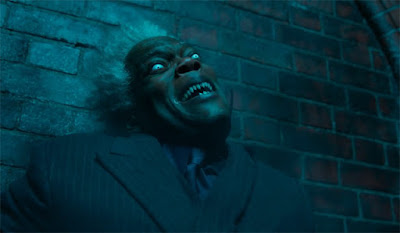
| A "Hollowgast," straight out of a Burton nightmare. |
If Burton is more disciplined, it doesn't hem him in for doing that one thing he does best—creating startling, haunting, and even strikingly beautiful images that are startlingly evocative and and make for the purest form of movie-magic. One looked at the previews for Miss Peregrine with a certain amount of...well, horror (one should be cautious about expectations caused by previews...always) that the story-line would just be a cluster-muddle with bombers and creatures and sunken ships and just too much going on to be enjoyable—not unlike, say, Burton's Alice in Wonderland.
Not here. Up until a rather chaotic battle royale (that might have been edited a bit too tightly for its own good), Miss Peregrine is one of Burton's best, even lovely, films, with images that stick in your mind at the wonder of it all.
There's a moment when Horace is entertaining the children with projections of his dreams, some scary, some beautiful, but entirely his, streaming direct from his mind and consciousness, and I thought "Yeah...this is when Burton wanted to do this." All of his films are labors of love, and, with his focus on outsiders and fringe-dwellers, entirely personal. One can't see that image and think of the director seeing a projection of himself, inviting patrons to a showing of what's in his own head.
Miss Peregrine, Jacob, Emma and Enoch
illustrated tin-types from Tim Burton.
 "One for the Kid"