Showing posts sorted by relevance for query Into the Woods. Sort by date Show all posts

Wednesday, January 7, 2015

Into the Woods

Not as Grim (as Grimm Can Be)
or
The Family That Slaps Together Raps Together

Rob Marshall's output as a director has been problematic. He managed to make a fully fleshed-out version of the stage schematics of Chicago, then followed up his multi-Oscar-winner by making a mess of Memoirs of a Geisha, then only managed to sporadically liven up a film version of Nine (but without evoking any ghosts of Fellini, on whose work the whole thing is based). One looked at the plans set photos for Into the Woods and wondered if Marshall was making it or Tim Burton.

However he got there, it was the right path, because Into the Woods, his adaptation of Stephen Sondheim's 1987 Grimm fairy tale mash-up may be his best movie ever after. Marshall's directorial touch post-Chicago has been mostly heavy-handed and cheerless, and only occasionally lightening up in musical moments. Here, the film doesn't flag whenever the music stops.
Blunt and Corden practice their baby-holding techniques
The "real world" of Into the Woods is a fairy tale land where anything is possible...in the confines of one village. There, various stories from the imaginations of The Brothers Grimm intersect to form one story of wishes coming true and going horribly (horribly) wrong and the resulting consequences. In the village is a baker and his wife (James Corden and Emily Blunt) who cannot conceive a child due to the curse of a witch (Meryl Streep) owing to the previous generation's actions. There is also a little girl (Lilla Crawford) in a red cape who is on her way to visit her invalid grandmother, a matriarchal family of women (Christine Baranski, Lucy Punch and Tammy Blanchard) who regularly abuse the runt of the litter (Anna Kendrick), a rather dull-witted farmer's son (Daniel Huttlestone), tasked by his mother (Tracey Ullman) with selling the family cow, and the sister of the baker (Mackenzie Mauzy) (abducted by that same witch) who is locked away in a tower with nothing to do but let her hair grow.
Lilla Crawford as "Red"
The story's machinations and complications take place in a nearby woods which are lovely, dark and Johnny Depp'd (he plays the Big...well, smallish...Bad Wolf), with a crowded thicket of swamps, quick-sand, dangerous cliffs, ghosts and spirited trees, crowding the path to the castle of the King who has two charming, handsome, and extraordinarily dramatic princes (Chris Pine and Billy Magnussen) who must have inherited the trait from their Mother's side.
Anna Kendrick as Cinderella
The music and songs are by Stephen Sondheim (slightly toned down by the Disney studio, which produced) who has a fine time mixing and matching rhyming schemes—but with a difference.  Most movie-goers experiencing musical fare (like...Disney...again) have their "tent-pole" songs (called that because they support the structure of the movie with key-points, like tent-poles, roughly one every 15 minutes) expressing emotions in stasis (or "this is what I'm feeling right now").  
"The woods are lovely, dark and Johnny Depp'd"
Sondheim goes a couple steps better as both song-writer and dramatist—his song's catalogue a character's change of emotion or realization, their thought processes more than their emotions, their motivations, not their feelings. Sondheim's songs travel, propelling the story and characters along, not stopping the show to get a song in, and the lyrics are so dexterous and nimble that, if anything, the pace increases, rather than slows for a musical "time-out."
Mauzy as Rapunzel "lets her hair down"
It is Marshall's best film to date—well cast and performed (everybody can sing...and well), nimbly paced and production-designed somewhere on the border between Burtonville and the Gilliam-verse.  It's fairy-tale land, but things can turn pretty Grimm (despite Disney's efforts to homogenize the material*)—one notices early on that there's a lot of face-slapping going between families. Things do not turn out happily ever after, and the consequences are irrevocable, despite some hocus-pocus, bovine resurrections and after-lives.  But, the through-line is the journey from life to myth, the passing of reality into legend, as it should be. Nothing down-beat about that.
Chris Pine does...some...Shatnering...as the Prince
Performances are uniformly excellent and done with verve, but standouts are Streep, Blunt, Depp and Pine (the "Agony" duet is a comic highlight), working with good material that is consistently entertaining and deep, adding extra dimension to the so-familiar words on pages, breathing life and giving voice to old chestnuts and bringing them to full bloom.

* For instance: the Wolf's song "Hello, Little Girl" has some of its more wicked aspects stripped from it, the princes' reprise of "Agony" (which makes them even more fickle) has been cut, and the ultimate fate of Rapunzel (who is given short shrift, anyway) is not even mentioned.  Sondheim did approve the changes (as he did with Burton's film of Sweeney Todd)

Thursday, July 26, 2018

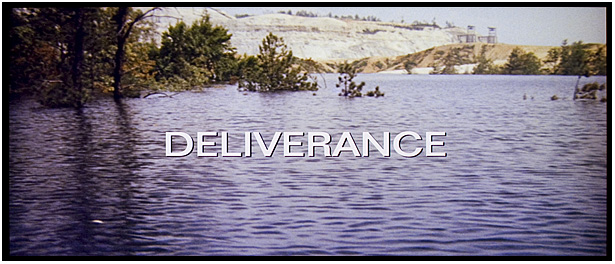
Deliverance

Deliverance (John Boorman, 1972) Let me start with an anecdote: I had a dog who was as feisty as all get-out. There's not too much he was afraid of, other than missing a meal, and, a Blue Heeler, he could be quite aggressive in protecting his perceived territory. 

I would take him camping, which he enjoyed immensely. That is, until it came time to sleep in the tent. At that point, the dog would become quite agitated, especially because he could see through the tent's mesh to the outside world. He could hear what was scrabbling about outside. He could smell anything like it was in the tent with us. Of course, he kept acting as if the whole idea was absolutely insane: "Sleep? Out here? There's nothing but some fabric to protect us! Are you crazy?" He wouldn't sleep all night—and subsequently, neither did I—as he would dutifully pace around to make sure everything was safe, especially his idiot-master who thought a tent—in the wilderness—was the same thing as a well-constructed house in the suburbs. "Are you human beings mad??!"

And the answer was—and  is—"Yes. Yes, we are."
I tell that story only because the dog realized something only a non-biped would realize--that Nature is raw and rife with a thousand natural disasters and is entirely cruel in our scheme of things. Cruel in tooth and claw, as they say. But, even so, "human" Nature's got it beat ten ways from Sunday in finding new demonstrations of cruelty. For every natural disaster we see in the headlines, the disasters imposed by man can fill out the rest of any edition of the Sunday paper.
And so Deliverance, from the novel written by the poet James Dickey that I was quite fond of back in the day...when I was a kid. I was a skinny, un-athletic little nerd with anger issues limited impulse control—what I knew about life, I learned from the movies, so I knew more about melodrama than I did about what living was like. When I read the book, it seemed an indictment of macho posturing and of the inner strength that can be brought to bear when necessity forces it upon you. For me, it seemed a hopeful book—I, too, could find my strength, when confronted by the challenges of life, despite my lack of stature and the emotional immaturity I used to supplant it. What can I say—I was a kid.
At the time Deliverance appeared in theaters I was worried about its adaptation because the simple story, of four city-boys who take on the adventure of canoeing a river about to be dammed out of existence, could have been made into a very crude film. And it skirts that by being so direct and just a shade surrealistic. The actors did their own stunts, the make-up team did some bizarrely realistic injuries that, rather than repulse, seemed almost fascinating—it looked like it hurt like hell, but fascinating nonetheless. And, under the austere direction of John Boorman, it's themes of ecology and fool-hardiness, vain-glory and finding strength where none was expected are enhanced and made into an almost mystical experience by the film-maker.
Four rather complacent suburbanites—Ed Gentry (played by Jon Voight), Lewis Medlock (Burt Reynolds), Drew Ballinger (Ronny Cox) and Bobby Trippe (Ned Beatty), spurred on by Lewis, take a weekend canoeing trip on the soon-to-be dammed Cahulawassee River. For Lewis, there is some urgency because dam construction has already started and soon, the river will cease to exist, to be replaced by a reservoir. All four want to have a weekend with some thrills and a little bit of danger to it.

The mix will be different, and with lasting effects they never counted on.
They car-pool deep into the northern Georgia woods to the river's head-waters and pay some locals to drive their trucks down to the town of Aintrey at the river's mouth where they can find them at the end of their run. It's at this section of the film that the memorable "Dueling Banjos" musical segment occurs. It's fairly apparent that the visitors and the locals don't quite see too much of value in the other.
The animosity between the locals and the "city-boys" (Lewis takes umbrage at that) gets reflected among the four once they get on the river. Lewis and Ed have had outdoors experience, but pals Drew and Bobby are newbies. Drew and Ed are in one canoe, and Lewis and Bobby are in the other. Bobby's a "good ol' boy" but not much of a man, doughy, a bit too loud, a little too easy with talking but not too much with thinking. Lewis, who is posturing and on the macho side of vain, takes a dim view of the overweight and overbearing Bobby, who is also the first to panic and the first to not take anything too seriously. Anything can be bought with a couple bucks, and in a canoe, he's more freight than power. 
This causes a change of partners in mid-stream, and in a competition about getting through some rapids, Bobby and Ed make it through first and beach their canoe to wait for the others. They wander into the shade of the forest, not knowing when they'll show up.
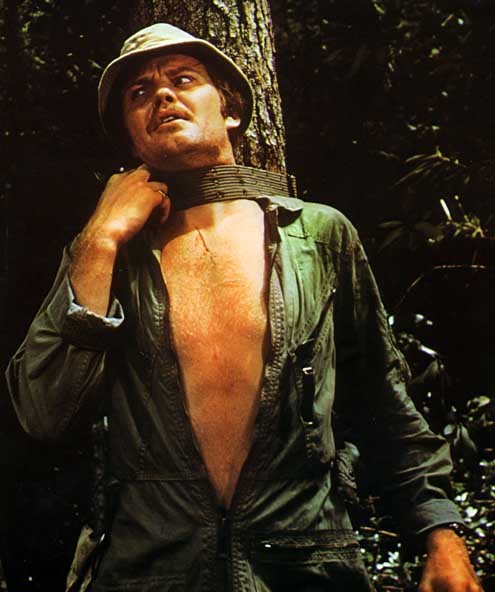
They find two hunters (Bill McKinney, Herbert Coward) who might be poaching but it doesn't matter. They have the drop on Ed and Bobby, and they take advantage of it, threatening with shotguns and attitude. Bobby tries to buy them off, but it just makes them more contemptuous. They take off Ed's belt and neck-tie him to a tree, rendering him immobile, and then they go after Bobby, ordering him to strip and man-handling him before assaulting him. Ed can only watch in horror, knowing that he's next, when he sees something in the trees.
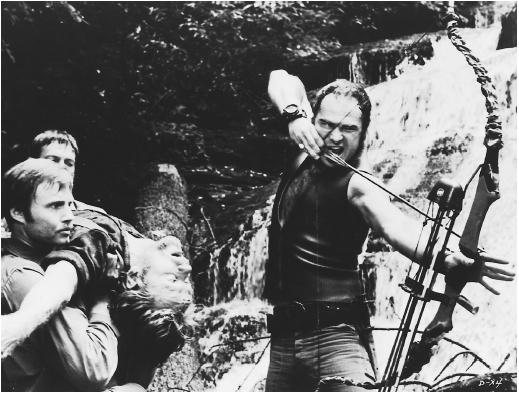
It's Lewis, bow drawn, taking aim. One of the men is shot full through the chest and can only look at the bloody blade of the arrow in disbelief, as he slowly staggers and dies, his accomplice running off into the woods. Lewis starts to think about the next step, as the other three try to pull themselves together. Drew is for reporting what happened to the authorities, but Lewis is against it, thinking they should bury the body instead, and let the reservoir complete the work hiding the body under tons of water. Drew is aghast, but Lewis argues that local justice and clan-vengeance will work against them. And he likes his freedom. Bobby is all for the burial, and Lewis leaves it up to Ed—if he sides with Drew, he'll abide by it, but if it's the burial, it's three votes to one. 
Ed chooses to bury the body. The four take the body of the hunter and bury near the edge of the river, where they're sure the reservoir will hide the body. Lewis fires the killing arrow deep into the river, and the four beat a hasty retreat for Aintrey through the roughest, loudest parts of the river. At one point, Ed looks back at Lewis and he's shouting something desperately, trying to be heard over the river, urging them to move fast through the rapids, and just when they approach the roughest part, drew suddenly lurches forward and is lost in the river.
Bobby and Lewis' canoe crashes into rocks and is split in two and Lewis is thrown into the river, breaking his leg in the process. Bobby and Ed drag him to the edge of the river and through his screams of pain, Lewis tells Ed that he saw something in the cliffs above him when they were going through the rapids, and he's convinced that Drew was shot. Perhaps it was the other poacher, but maybe not. Whichever way it turns, Lewis is sure they were targeted. If that's true, they're trapped there. Somebody has to climb the cliffs and confront the shooter. Given the circumstances, it can only be Ed.
Under cover of darkness, Ed makes his way up the cliff with the bow and arrows—if he falls, he could be killed. If he makes it to the top, he could be killed. But, the situation is desperate and there is no other choice. His friends depend on him, or everybody dies. 
At dawn, exhausted, Ed wakes up to see a distant man with a shotgun, looking down towards the river. Trying to escape notice (which he doesn't), he draws a bead on his target, but his hands shake and wobble under the strain of the bow and the act he must perform; he is not expert with the bow as Lewis is, and an earlier attempt to shoot a deer ended in failure, both because of his lack of strength and an unwillingness to kill. But that was then. This is now...more than ever.
It can't be Lewis, although Lewis would have carried it off. But, Lewis' skills are useless now. It has to be Ed, and there can be no weakness, no doubt, and no hesitation. The word "deliverance" has the meaning "the action of being rescued or set free." "Liberation." "Emancipation." And it comes down to one character to achieve it...for others and in himself.
The situation is simple, primal—man vs. Nature and man vs. man, but ambiguous, both morally and circumstantially, played out under extreme conditions with extreme consequences, and under duress, where hap-hazard thinking or action could doom them all. It must be carried out by one individual only marginally capable of it, and on whose shoulders, the solutions must weigh. 
Boorman accentuates the danger of the surroundings by avoiding clearings and staging so many scenes in the middle of the forest, with a restless camera that shifts perspective around trees, through brush, moving the formations of them around, to the point where you think you can see things in the patterns of the woods. at times you can't see the horrors for the trees, and it's as much a participant as the characters, so enveloping is its dark presence. 
And Boorman presents tangible, visceral horrors not present in the book-- a mountain man newly killed falling forward into the crotch of a small tree and remaining upright; macho Lewis pulling an arrow, slowly, excruciatingly, out of the breast-bone of a backwoods attacker ("Where'd the fletches go..." I thought when the act was done); the exaggerated horror of the men's injuries--the broken thigh-bone that pierces Lewis' leg (Reynolds does an incredible job undercutting his character's uber-stage-manliness with some of the most blood-curdling whimpering I've ever heard), the dislocated shoulder of Drew that has the man cradling his own head, sitting, weirdly on a rock out-crop, and Ed pulling an arrow out of his side to prepare for his final show-down below a sky that simmers in a yellow exposure-pushed sky. We won't even talk about how good and how brave Ned Beatty is. And it was his first film (as Reynolds generously points in interviews these days about what he considers the best work in the film).
If there is a weak performance at all in Deliverance it's by author Dickey as the seething Sheriff who's just a little too-unsubtle in his suggestions. Voight, Beatty, and Cox do great work, and, forgoing insurance, did their own rafting stunts. But Reynolds is terrific in his role, totally dominating the first half of the film, and, though out of action for the rest of the movie, still makes an impression. Hollywood may have a problem with him (doesn't take them...or himself...too seriously, perhaps?) but it would be nice to acknowledge that he can give gifted performances when gifted with good scripts.
In 2008, The Library of Congress chose Deliverance as one of the significant films to be added to the Film Registry.


Tuesday, August 30, 2016

Pete's Dragon (2016)

"The Bravest Boy I've Ever Met"
or
Ain't Them Dragons Saints?

The latest live-action remake of a past Disney film, Pete's Dragon, does not draw inspiration from the original (made during that period after Walt's death when the studio lost its way and produced "product" rather than innovation), but basically ignores it and starts from scratch, tossing out the songs, the period setting, and hammy performances from stalwart movie veterans to deliver something that hues closer to the main focus of the story, which is "a boy and his dragon."

The result is a far more satisfying film, not so much concerned with eccentrics, than with some core-values, which, although it may not have the slapstick elements of the original or all the schmaltz, still seems much more fitting the bill of "family-friendly" no matter how much mugging Jim Dale and Red Buttons could provide to amuse five year old's.

The film starts with young Pete contentedly sitting in the back seat of a station wagon driving a back-country road, while his mother and father talk about how they're "going on an adventure." They don't know the half of it. To avoid hitting a deer, Dad swerves the car off the road, flipping it and leaving Pete an orphan and alone in some pretty spooky woods that have their fair share of very carnivorous wolves. This is such a "Bambi" moment (and the director stages it with something like that film's strategy) that some kids might be traumatized by it. They won't be traumatized for long, though. No sooner do the wolves start baring their canines, do the trees begin to move and sway like nature's out of joint.
There emerges a very large, furry, winged creature who sniffs out the little kid and, having satisfied itself there is no threat, extends one paw, into which the child climbs. The creature then heaves into the air, flying undetected through the misty sky. Pete calls the creature "Elliott" (after the puppy in the book he carried with him from the wreckage of the car accident) and the two begin their "adventure" together.
Time, like a dragon, flies by. It is six years later, and Pete and Elliott seemingly have the forest (called "Millhaven") to themselves. Pete (now played by the rather stoic little Oakes Fegley) has become quite the little Mowgli, running through the trees, scampering over fallen limbs, fashioning a makeshift tree-house for himself (when he's not hanging out in the dragon's cave) with the snaggle-toothed "Elliott" keeping pace like a protective, obedient pet. Not only can "Elliott" fly, but it also has the ability to camouflage itself, blending in with its surroundings, making it virtually invisible. This becomes handy when eluding detection or for startling any bears that might see Pete as a potential meal...or a threat. No one disturbs them and no one encroaches. They're "Calvin and Hobbes" with no parental controls or supervision. What kid wouldn't love that?
But, that's a fairy tale. The town of Millhaven has stories and songs about the Millhaven dragon and one of its citizens, a retired woodcarver named Meacham (Robert Redford) claims to have actually seen the dragon back in his younger days, which he is only too pleased to regale to young kids who hang on his every word, to the amusement of his ranger daughter Grace (Bryce Dallas Howard) who treats the story like the too-often-told tales on Thanksgiving, with a resigned smile and the faintest of eye-rolls. For Meacham the experience was an example of "magic" made real. For Grace, it's an old man telling stories. As she says she "knows the woods like the back of my hand" and has seen no evidence. She's too busy monitoring the encroaching of man to be noticing 50 foot myths.
Grace may have commitment issues. She's engaged to Jack (Wes Bentley) who, with his brother Gavin (Karl Urban), runs the local saw-mill. While Jack does the books, Gavin does the "harvest," which is going deeper and deeper into protected areas of Millhaven and for which Grace does a certain amount of what is often termed "environmental terrorism" (she grabs the keys from a CAT and tosses them and paints over spray-painted "tagging" marks) to impede his progress (Really? She's going to marry into this family?). She is noticed by Pete and "Elliott" and the boy manages to grab a compass she drops during her walk. 
The boy is curious about the fellow humans, especially when he sees Jack's daughter Natalie (Oona Laurence). It sets up a series of encounters between the disparate parties that will expose "Elliott" to the "outside" world and separate the two and their bond. Plus, once Gavin gets wind of the dragon, he is determined to capture it for his own gain. What was once idyllic will be destroyed, never to be regained, and it will take sacrifice—a lot of it—if any semblance of "right" can be brought back to the world.  
What's great about Pete's Dragon is that it was conceived and directed by David Lowery, the independent film-maker who, a few years earlier, made the very good Ain't Them Bodies Saints, which took the simple story of crime and sacrifice and turned it into an elegaic film where images are most important and where the dialogue is circumspect and actually avoiding spelling things out, lest the hopes and secrets of the characters might be exposed and their lives...and dreams...destroyed. At the time, I wondered what other glories Lowery could be capable of. I never expected it to be a Disney film, Or a damned good one.
Pete's Dragon is not so guarded, whether in story or dialogue, and the characters are much more direct—none of them are doing anything illegal or dangerous, and at the most are just bending some rules to get by. They wear their hearts on their sleeves and their actions follow their desires, whether they're good, bad, selfish, or caring, and even the worst of them is not so shallow that they can't change their heart. It is a film of heart...and soul. And Lowery is enough of a dramatist...and a realist...that he isn't afraid to make things very bad for the characters (after all, he killed the kid's parents in the first five minutes). A good dramatist risks much, even the loyalty and comfort of the audience, in order to engage them, rather than placating. The rewards for such a strategy are great. And Pete's Dragon earns those.
The dragon's amazing, created by New Zealand's WETA with an air towards creating something oddly ungainly while plush, with the playfulness of a puppy but the eyes of an old soul. It is quite the imaginary friend, and one feels as much for the dragon as for the kid, as the two are separated from what is essentially a good thing in order to integrate them into what society considers normal. Just as the loggers are making little encroachments into the woods, reality makes its own in-roads into fantasy and the way Lowery plays it, it feels like a horrible incursion, like something precious is about to be forever lost, never to be regained, and, like the path to Hell, always asphalted over with good intentions.
But, don't tell the kids that. This is one that will keep them from being fidgety or wondering why they had to go someplace to see it, rather than just watch it on TV, and it isn't so insufferable to cause adults to check their I-watches and looking longingly for the "Exit" signs. It's a good, solid surprising "family" film that extols the virtues of family, even while it's questioning that it always has to be the best thing. Like dragons, this movie is something odd and rare and unexpected, especially given the source of Disney, who can do cinematic things that take you aback with how good they can be.

They can even spin gold from the threads of their less-accomplished films, answering the question of "why don't they remake the bad films, rather than merely try to recreate the glories of the good ones (and failing)?" Here, "they" do exactly that and make something wonderful out of it. Something that actually brought well-earned tears to my eyes.
The "original" Pete's Dragon—don't even go there.

Thursday, July 27, 2017

War for the Planet of the Apes

Ape-ocalypse Now (The Beginning and The End)
or
"What Would Caesar Do?" ("Jesus Christ, You're Impressive...")

The more steps you take away from War for the Planet of the Apes, the more interesting a film it is. Maybe it's the way the FX now make you "buy" the apes as credible characters and not motion-capture constructs (They always looked good, aided immeasurably by the at-the-core ape-performances of Andy Serkis and crew). Maybe because Matt Reeves doesn't do anything "fancy," just directs with an eye toward verisimilitude and not for the cutesy-kitsch (ala the first movie from 1968). Maybe because the movie touches so many cultural reference points (and not just the first "Planet of the Apes" tetrology) that you get the feeling you've seen it all before—you have, just never like this, and never from this perspective. It is a film of so much incident (although quite compact), that the Big Picture the film is aiming at doesn't become apparent until you're out of it. Like the apes in their California forest, you can't see them for the trees. It's because evolution has been upended, and Man has made his successor in the form of his ancestor. The apes become humanity...and that's not a good thing. We have met the enemy and "he is us." The humans have played God with evolution...and God's really pissed.
Those expecting a big apocalyptic nuclear set-piece will be disappointed (although I was rather expecting it when I saw a reference to Beneath the Planet of the Apes in one of the sets). The world doesn't end with a bang, or a whimper, for that matter. As George Carlin once groused about Earth Day: "The earth will be just F-I-I-NE. But WE'RE fucked!" The world doesn't end at all. It just hits "reset" as it occasionally does ("Okay, everybody outta the gene-pool!") and begins again. Cosmically speaking, The Earth bases its fiscal year on dominant species. And the new King in town is the one Evolution left behind, and that Evolution's beneficiary unknowingly gave a kick-start to in its attempt to improve itself. The next species would do well if it never invents irony.
It's been two years since Dawn of the Planet of the Apes, which saw the sentient Ape-Tribe created by the green-eyed laboratory-experiment Caesar (Serkis) going through its own Civil War, ending with the death of Caesar's Iago and rival for power, Koba. But Civil Wars never really end, and those divisions haven't quite healed, and for the human survivors of a population-consuming flu (which grew out of the same experiments that created the intelligent apes—ya  know, irony), there hasn't been any sign of Caesar and his followers, as they have dug even farther into the Muir woods outside of San Francisco.
But, just because you don't see anything doesn't mean you can't hunt for it...just ask "Bigfoot." After a brief summation of what has gone before ("Reading" is what they'll say on CinemaSins), over a darkened forest shot, we see a well-armed Special Forces team stealthily track forward. On their helmets are slogans like "Monkey-Killer" and "Bedtime for Bonzo!" Humorous cultural references aside, they're on a mission: they've come from the north of the country under the command of one Colonel McCullough (it will turn out to be Woody Harrelson) to eradicate Caesar's ape-tribe for specific reasons that will be explained later, beyond merely fear and loathing. 
The attack initially goes well, decimating forward ape-guards standing at the ape-colony's outer defenses. But, a lone ape escapes on horse-back to bring reinforcements and the superior weapons of the unit are soon overcome by sheer force of numbers in an attack consisting mostly of a coordinated arrow attack. The Special Forces are overrun, save for four prisoners, including a gorilla, recognized as one of Koba's followers.
The prisoners are defiant. "How long do you think the woods will protect you? The Colonel has more power." They have every expectation to be killed, even inviting it, but after questioning them, Caesar sets them free. "Tell your Colonel you have seen me now. Tell him leave us the woods." And he sends them packing, tied back to back, astride horseback, and the tribe attends to their dead, putting their bodies in the river to send them to the sea.
Caesar's son, Blue-Eyes (Max Lloyd-Jones) comes back to the encampment after a long sortee to report that he's found a potential permanent home for the apes across a wide desert that might provide them safety. Caesar makes plans to evacuate the current refuge in the Muir woods and head for his promised land with the surviving apes and his family.
But, that night, other plans come to fruition. In his cave with his family asleep, Caesar sees green lights through the cover of their water-fall camouflage—an attack is coming and he runs after his commanders to seek out the soldiers and defend the encampment. He tells Blue-Eyes to stay behind and guard his family as he bounds into the interconnecting tunnels to coordinate the attack.
But, coming back to his quarters, he finds his family dead, riddled with bullets...and...just about to escape the scene of the assassination, the Colonel, who fires on Caesar as he prepares to be helicoptered away. Enraged, Caesar leaps after him, grabbing onto his rappelling line and starts to climb. But McCullough cuts through the chord and Caesar falls into the lake below, his family's murderer, escaped.
The next morning, it's a different Caesar making the plans. He instructs the tribe to head to the area found by Blue-Eyes and start again. But, he won't be going with them. Instead, he's going to go to the Army compound and kill McCullough, to later re-meet with the tribe should he survive. But, at this point, that's the least of his ambitions. His face is now an almost permanent scowl not—as one reviewer has said—dissimilar from the face of one of Clint Eastwood's revengers. 
It's apt. Because there's a lot of The Outlaw Josey Wales in War for the Planet of the Apes, as well as The Searchers, The Great Escape, shades of Apocalypse Now (but not much) and more than a salute to "Monkey Planet" author Pierre Boulle's "other" famous work "The Bridge on the River Kwai" and before the movie's through, you'll see hints (actually, more than hints) of Spartacus, Moses, and Jesus Christ, as well as Othello and MacBeth. That's a lot of iconography to be shouldered by one ape, but, at this point, short of martyrdom, there's not much more this risen ape can do to become a mythic figure to his followers. Myth is precisely what War for the Planet of the Apes is going for. And History repeating itself, as sure as the turning of the Earth, or its era.
But, Caesar has unwelcome company on his way to McCullough's compound; he's followed by orangutan Maurice (Karin Konoval), the gorilla Luca (Michael Adamthwaite), and chimpanzee Rocket (Terry Notary), who refuse to leave his side on his journey. Before long, they come across another chimp, Bad Ape (Steve Zahn), a zoo escapee who has also learned to talk, and a mute girl (Amiah Miller), who will soon be called Nova. They soon discover others, of McCullough's troop, who have been shot, abandoned and left for dead, who also exhibit signs of mutism, apparently a mutation of the original simian flu, carried by the survivors, that affects their speech centers.
So, let's see...

Apes Talk √
Humans Fewer in Number √
Humans Become Mute √

All we need is a doll that goes "Mama" and a couple ruined national monuments and we're back to the beginning.
But, we've got a ways to go still. At one of the bases of the Alpha-Omega troop (the name of McCullough's forces), the small primary band of primates learn something else. While on their exodus, the Muir apes have been outmaneuvered, captured by McCullough's forces and taken as prisoners back to his main base. Now, Caesar has another mission besides his personal revenge—free the apes so they can continue on their exodus. What he sees at the camp enrages him. The apes are back in cages and during the day, they are brought out to (without food and water) work a quarry and construct a large defensive wall for a coming attack—not from apes, but from other humans, who think, quite rightly, that McCullough has gone off his rocker and plan to (and here's the Apocalypse Now part) "terminate the colonel's command with extreme prejudice."

I guess Caesar and the humans have more in common than thought.
"Apes strong...together."
While Caesar goes after McCullough, Maurice, Nova and the others do some planning behind the scenes on trying to break the Muir apes out, and this is where the center-piece of the action starts. Now, I'm starting to read comments on IMDB* that fuss about War being being mis-titled, that it's not so much a war as a skirmish. Numbers aside, this is a whiny comment, born of a diet of super-hero movies pumped with more adrenaline than craft. There's a lot going on here, besides orange-flamed flowering explosions and gymnastics (although there's plenty of that to satisfy anyone not eating their Wheaties with RedBull). Revolutions are made with more than bullets. And, given the cultural references brought to bear in War..., the film is hardly revolutionary, even if it's depicting one. This is good, old-fashioned film-making with a lot of thought and a lot of care. I think the IMDBullshitters are reacting to the rather glowing interviews of the mainstream critics, who are probably just relieved about seeing a good story well-told. Maybe they're pissed about the military being depicted this way. But, one should be reminded that McCullough is an outlier, an extremist, opposed by even the traditional military who have been satisfied to leave the apes in peace and have no interest in what he calls his "Holy War." If you're going to defend something you have to be able to recognize extremism...even if it's in the mirror.
If there's a failing, it's one of scope. What's the rest of the world doing? (The credits of Rise... indicated that the "simian flu" became a pandemic). The experiments that created Caesar and his kin was all based in the United States, so one can forgive this; the "action" of The Planet of the Apes should be focused on where the mutated apes are and that will be where Caesar is. So, one can forgive the U.S. base (I would rather like to see what the French are doing—it's their story, after all).
So, there's action aplenty and food for thought, as well. That's in keeping with the entire series, which has always been satirical, often heavy-handedly so. This prequel series of Rise..., Dawn..., and War... has been more cunning, and far more subtle, often defiantly so. One of my favorite shots of the three films is in War... where a captured Caesar stands up for his troop in their captivity and resists, taking the whipping that one of his followers started to endure. The weakened ape is dragged to McCullough who stares at him, mutters "Jesus Christ, you are impressive" and orders him to order the apes back to work. When Caesar refuses, he takes his gun and points it Caesar's forehead...and he defiantly leans into it, staring his oppressor down. That is powerful stuff, more than explosions, more than fire-power, more than mega-tonnage.
So...how does it all end? Aptly, actually. With an ending and a beginning. 
But the POTA prequels leave one thread dangling...suspended, as it were. Back in Rise... there was the hint of a mystery that was buried in background television newscasts and newspaper headlines...of the Mars Mission Icarus that was poised to enter the Martian atmosphere but became (as the headline read) "Lost in Space." Nothing of that seemingly doomed mission is mentioned in either Dawn... or War..., but it's still out there, somewhere. War for the Planet of the Apes ends (not with a bang, not with a whimper) with a shot of the former Muir-Ape-troop in their Promised Land, as the camera tilts up to the sky and lingers there for more than a moment before the final fade-out. This may not be to connotate the freeing of a spirit, but more probably to await the promise of...something...falling to the Earth. The circle in this trilogy is now complete, but with that completion of the turning, another one has begun, in the grooves of what has come before. Is it the end of The Planet of the Apes...or just the beginning?
* I've also seen comments that it's "communist propaganda" (I'm mystified as to how, but any thought I put into it would be more than was put into the original comment) and objecting because "humans are the bad guys." Well...duh. In the POTA series, they always were. The humans were the ones in charge of the nuclear weapons that decimated the human population and created the power vacuum that the apes filled. One only has to remember the last lines of the original: "So, we finally, really did it. YOU MANIACS! YOU BLEW IT UP! AH, DAMN YOU! GOD DAMN YOU ALL TO HELL!!!" (I'm surprised I didn't see THAT reply in IMDB).