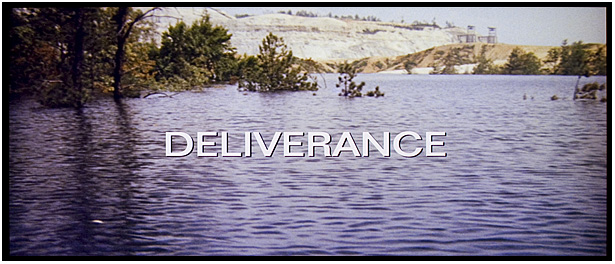
Deliverance (John Boorman, 1972) Let me start with an anecdote: I had a dog who was as feisty as all get-out. There's not too much he was afraid of, other than missing a meal, and, a Blue Heeler, he could be quite aggressive in protecting his perceived territory.
I would take him camping, which he enjoyed immensely. That is, until it came time to sleep in the tent. At that point, the dog would become quite agitated, especially because he could see through the tent's mesh to the outside world. He could hear what was scrabbling about outside. He could smell anything like it was in the tent with us. Of course, he kept acting as if the whole idea was absolutely insane: "Sleep? Out here? There's nothing but some fabric to protect us! Are you crazy?" He wouldn't sleep all night—and subsequently, neither did I—as he would dutifully pace around to make sure everything was safe, especially his idiot-master who thought a tent—in the wilderness—was the same thing as a well-constructed house in the suburbs. "Are you human beings mad??!"
And the answer was—and is—"Yes. Yes, we are."
I tell that story only because the dog realized something only a non-biped would realize--that Nature is raw and rife with a thousand natural disasters and is entirely cruel in our scheme of things. Cruel in tooth and claw, as they say. But, even so, "human" Nature's got it beat ten ways from Sunday in finding new demonstrations of cruelty. For every natural disaster we see in the headlines, the disasters imposed by man can fill out the rest of any edition of the Sunday paper.
And so Deliverance, from the novel written by the poet James Dickey that I was quite fond of back in the day...when I was a kid. I was a skinny, un-athletic little nerd with anger issues limited impulse control—what I knew about life, I learned from the movies, so I knew more about melodrama than I did about what living was like. When I read the book, it seemed an indictment of macho posturing and of the inner strength that can be brought to bear when necessity forces it upon you. For me, it seemed a hopeful book—I, too, could find my strength, when confronted by the challenges of life, despite my lack of stature and the emotional immaturity I used to supplant it. What can I say—I was a kid.
At the time Deliverance appeared in theaters I was worried about its adaptation because the simple story, of four city-boys who take on the adventure of canoeing a river about to be dammed out of existence, could have been made into a very crude film. And it skirts that by being so direct and just a shade surrealistic. The actors did their own stunts, the make-up team did some bizarrely realistic injuries that, rather than repulse, seemed almost fascinating—it looked like it hurt like hell, but fascinating nonetheless. And, under the austere direction of John Boorman, it's themes of ecology and fool-hardiness, vain-glory and finding strength where none was expected are enhanced and made into an almost mystical experience by the film-maker.
Four rather complacent suburbanites—Ed Gentry (played by Jon Voight), Lewis Medlock (Burt Reynolds), Drew Ballinger (Ronny Cox) and Bobby Trippe (Ned Beatty), spurred on by Lewis, take a weekend canoeing trip on the soon-to-be dammed Cahulawassee River. For Lewis, there is some urgency because dam construction has already started and soon, the river will cease to exist, to be replaced by a reservoir. All four want to have a weekend with some thrills and a little bit of danger to it.
The mix will be different, and with lasting effects they never counted on.
They car-pool deep into the northern Georgia woods to the river's head-waters and pay some locals to drive their trucks down to the town of Aintrey at the river's mouth where they can find them at the end of their run. It's at this section of the film that the memorable "Dueling Banjos" musical segment occurs. It's fairly apparent that the visitors and the locals don't quite see too much of value in the other.

The animosity between the locals and the "city-boys" (Lewis takes umbrage at that) gets reflected among the four once they get on the river. Lewis and Ed have had outdoors experience, but pals Drew and Bobby are newbies. Drew and Ed are in one canoe, and Lewis and Bobby are in the other. Bobby's a "good ol' boy" but not much of a man, doughy, a bit too loud, a little too easy with talking but not too much with thinking. Lewis, who is posturing and on the macho side of vain, takes a dim view of the overweight and overbearing Bobby, who is also the first to panic and the first to not take anything too seriously. Anything can be bought with a couple bucks, and in a canoe, he's more freight than power.
This causes a change of partners in mid-stream, and in a competition about getting through some rapids, Bobby and Ed make it through first and beach their canoe to wait for the others. They wander into the shade of the forest, not knowing when they'll show up.
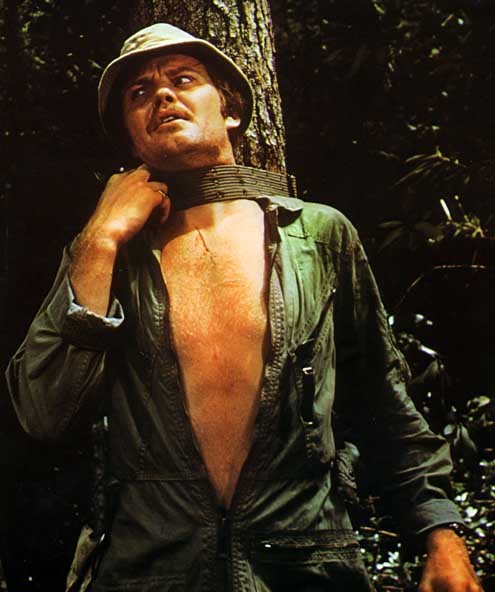
They find two hunters (Bill McKinney, Herbert Coward) who might be poaching but it doesn't matter. They have the drop on Ed and Bobby, and they take advantage of it, threatening with shotguns and attitude. Bobby tries to buy them off, but it just makes them more contemptuous. They take off Ed's belt and neck-tie him to a tree, rendering him immobile, and then they go after Bobby, ordering him to strip and man-handling him before assaulting him. Ed can only watch in horror, knowing that he's next, when he sees something in the trees.

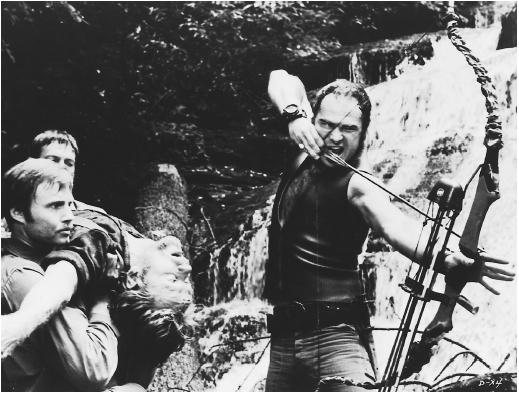
It's Lewis, bow drawn, taking aim. One of the men is shot full through the chest and can only look at the bloody blade of the arrow in disbelief, as he slowly staggers and dies, his accomplice running off into the woods. Lewis starts to think about the next step, as the other three try to pull themselves together. Drew is for reporting what happened to the authorities, but Lewis is against it, thinking they should bury the body instead, and let the reservoir complete the work hiding the body under tons of water. Drew is aghast, but Lewis argues that local justice and clan-vengeance will work against them. And he likes his freedom. Bobby is all for the burial, and Lewis leaves it up to Ed—if he sides with Drew, he'll abide by it, but if it's the burial, it's three votes to one.

Ed chooses to bury the body. The four take the body of the hunter and bury near the edge of the river, where they're sure the reservoir will hide the body. Lewis fires the killing arrow deep into the river, and the four beat a hasty retreat for Aintrey through the roughest, loudest parts of the river. At one point, Ed looks back at Lewis and he's shouting something desperately, trying to be heard over the river, urging them to move fast through the rapids, and just when they approach the roughest part, drew suddenly lurches forward and is lost in the river.

Bobby and Lewis' canoe crashes into rocks and is split in two and Lewis is thrown into the river, breaking his leg in the process. Bobby and Ed drag him to the edge of the river and through his screams of pain, Lewis tells Ed that he saw something in the cliffs above him when they were going through the rapids, and he's convinced that Drew was shot. Perhaps it was the other poacher, but maybe not. Whichever way it turns, Lewis is sure they were targeted. If that's true, they're trapped there. Somebody has to climb the cliffs and confront the shooter. Given the circumstances, it can only be Ed.
Under cover of darkness, Ed makes his way up the cliff with the bow and arrows—if he falls, he could be killed. If he makes it to the top, he could be killed. But, the situation is desperate and there is no other choice. His friends depend on him, or everybody dies.
At dawn, exhausted, Ed wakes up to see a distant man with a shotgun, looking down towards the river. Trying to escape notice (which he doesn't), he draws a bead on his target, but his hands shake and wobble under the strain of the bow and the act he must perform; he is not expert with the bow as Lewis is, and an earlier attempt to shoot a deer ended in failure, both because of his lack of strength and an unwillingness to kill. But that was then. This is now...more than ever.
It can't be Lewis, although Lewis would have carried it off. But, Lewis' skills are useless now. It has to be Ed, and there can be no weakness, no doubt, and no hesitation. The word "deliverance" has the meaning "the action of being rescued or set free." "Liberation." "Emancipation." And it comes down to one character to achieve it...for others and in himself.
The situation is simple, primal—man vs. Nature and man vs. man, but ambiguous, both morally and circumstantially, played out under extreme conditions with extreme consequences, and under duress, where hap-hazard thinking or action could doom them all. It must be carried out by one individual only marginally capable of it, and on whose shoulders, the solutions must weigh.
Boorman accentuates the danger of the surroundings by avoiding clearings and staging so many scenes in the middle of the forest, with a restless camera that shifts perspective around trees, through brush, moving the formations of them around, to the point where you think you can see things in the patterns of the woods. at times you can't see the horrors for the trees, and it's as much a participant as the characters, so enveloping is its dark presence.

And Boorman presents tangible, visceral horrors not present in the book-- a mountain man newly killed falling forward into the crotch of a small tree and remaining upright; macho Lewis pulling an arrow, slowly, excruciatingly, out of the breast-bone of a backwoods attacker ("Where'd the fletches go..." I thought when the act was done); the exaggerated horror of the men's injuries--the broken thigh-bone that pierces Lewis' leg (Reynolds does an incredible job undercutting his character's uber-stage-manliness with some of the most blood-curdling whimpering I've ever heard), the dislocated shoulder of Drew that has the man cradling his own head, sitting, weirdly on a rock out-crop, and Ed pulling an arrow out of his side to prepare for his final show-down below a sky that simmers in a yellow exposure-pushed sky. We won't even talk about how good and how brave Ned Beatty is. And it was his first film (as Reynolds generously points in interviews these days about what he considers the best work in the film).

If there is a weak performance at all in Deliverance it's by author Dickey as the seething Sheriff who's just a little too-unsubtle in his suggestions. Voight, Beatty, and Cox do great work, and, forgoing insurance, did their own rafting stunts. But Reynolds is terrific in his role, totally dominating the first half of the film, and, though out of action for the rest of the movie, still makes an impression. Hollywood may have a problem with him (doesn't take them...or himself...too seriously, perhaps?) but it would be nice to acknowledge that he can give gifted performances when gifted with good scripts.
In 2008, The Library of Congress chose Deliverance as one of the significant films to be added to the Film Registry.

 Unlike in The Beatles films, The DC5 don't play themselves—indeed, they don't even "perform" any of their songs, but a couple of tunes are used as background for edited hi-jinks—they're stuntmen/extras who are being used in an ad campaign for a British meat-packing plant, the most prominent of the commercials and billboards featuring Dinah (Barbara Ferris) "The Butcher Girl" extolling the virtues of meat to the British public. That an ad agency would use a swinging Blond "bird" as their symbol for meat is an absurd concept (but one that isn't inconceivable in the advertising world) and Boorman has a fine time larking about London showing more and more of the incongruous campaign, which, evidently, is doing the job as the city seems festooned with billboards.
 The plot starts when, on a commercial-shoot with Dinah and the boys, Steve (Dave Clark) strikes up a conversation with her and discovers that 1) she's bought her own private island in Devon and 2) she's bored and tired with her life. He could tell her that she is fundamentally well-off that she can afford to be bored and actually does have some agency and maybe she should sleep on it and give it 24 hours. Then, there wouldn't be a movie. But, no. He steals the ad agency's Jaguar and the two go off to find her island. Because that's what young, energetic, swinging 60's kids do, dad! And ad agency exec's—who are paying for studio-time—then send the police and whatever goon-squad they can find to bring them back.
 Which is just what Dinah's ad-agency pygmalion, Zissell (David de Keyser) does. Hi-jinks and low social comedy ensue, cutting a swath through a limited number of 60's outliers like vagabond-Brit-hippies and upper-class eccentrics, where if a point was being made it's a bit hard to discern. The trip to the island doesn't prove pointless, but it does have a bit of a let-down in store ("It smells of dead holidays, doesn't it?"). Not the kind of "gas" they were expecting.