Showing posts with label Sascha Baron Cohen. Show all posts

Wednesday, May 24, 2023

Les Misérables (Musical; 2012)

The Song of Angry Men
or
"To the Barricades!"

I realize I am not the man to do a critical analysis of Les Misérables, the filmed version of the long-running staged presentation of the concept album produced by Claud Michel Schönberg, Alain Boublil and Jean Marc Natel, (from the novel by Victor Hugo) for many reasons: 1) I'm not terribly fond of musicals, finding the form unnatural and artificial—the inclination to burst into song having the requirement of being necessitated by the surge of emotion, which, if you do it too much, is a bit unsufferable—but, if the words and music are clever, born out of character and need, my prejudices can be batted away in the sweep of sheer admiration; 2) I’ve never seen “Les Miz” on stage, so this is my first exposure to the material, which I found musically strong, with nice linking strains between songs, but the lyrics, for the majority of it, trite and of the “Moon-June” variety, and the propensity to insert (with a guillotine) moments of light-heartedness in the midst of the most dramatic moments; 3) I have never liked the direction of Tom Hooper (who directed the mini-series “John Adams” with a heavy emphasis on unnecessary dutch angles, tortured compositions, and camera movement “baggage” for its own sake, and then directed The King’s Speech with a somewhat less gaudy eye, but a penchant for “gilding the lily” of competent performances with camera and lens tricks.
So, Les Misérables is almost a “perfect storm” of things I don’t like in movies, making me feel a bit uncomfortable about even attempting to discuss it without the need to eviscerate it like an after-meal chicken. Oh, there are things I thought were marvelous—the grittiness of it, the general down-troddeness of the whole thing, the brio of the effort in dragging it, naturalistically, to the screen, when everything cries out to leave it on the stage where it seems the presentation would be at its optimum.
So, kids, let’s get started. I’ll leave out the show itself, which has more than silenced its original critical drubbing by becoming the wildly popular “people’s choice” at the box office, entirely appropriate given its liberté/fraternité themes. Vive “Les Miz” and all that.But the stage presentation was already an odd ying-yang of performers belting out their inner emotions to the cheap seats, confessing their shame at the top of their lungs. To then bring it back down to intimacy, forcing powerful song material to be played out with naturalistic emotions—crying, snuffling, doubt—then compounds the confusion by compromising the musical material from its original intentions.
Then, director Hooper further piles on the emotional dissonance by shooting everything in very tight close-up, so we have intimate emotions couched in thundering expressiveness delivered at a timid range right in our faces. Hooper did no service to his actors here, threatening to expose every mis-step of their performances (which, by the way, was sung and recorded on set in real time) so close that the audience can’t miss it.
How’d they do? Admirably well, considering. Anne Hathaway will surely win an Oscar for the “I Dreamed a Dream” sequence alone, finding the right balance of giving the song its due, while also expressing the grief, humiliation and moments of rage in her character.
*
Towards the end of the film, Eddie Redmayne pulls off a similar gift with “Empty Chairs at Empty Tables” and, surprisingly, Amanda Seyfried makes the most of her moments with a high, feathery voice that doesn’t betray fragility. Hugh Jackman and Russell Crowe are other matters. Both great performers with musical pasts (the former on Broadway, the latter with his vanity band), both are very capable, but the material, production and presentation get the better of both of them, exposing Jackman’s reedy voice (somewhere between Anthony Newley and David Bowie) and Crowe’s pop sensibility to pitch to the note he’s seeking.
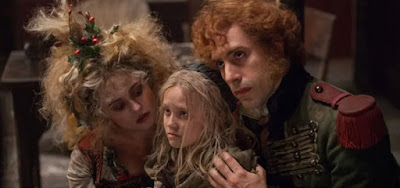
The unlikeliest successes are Sacha Baron Cohen and Helena Bonham Carter, as the unscrupulous Thénadier couple, because their song is a knockabout one with lots of stage business letting them loose from the trap of Hooper’s tight framing, and because Cohen is allowed to throw in a couple of ad-libs (in beat, mind you) between lyrics, allowing a little bit of fresh air into the proceedings.
For me, it was a train-wreck that seemed to go on forever, with only a couple of bright spots to give me hope. But, given the production’s history, I’m sure the people will rise above it all, despite the tyranny of the direction on display.

* One of the best lines at the Golden Globes was Amy Poehler’s about Hathaway’s performance: “I have not seen someone so totally alone and abandoned like that since you were on stage with James Franco at the Oscars."  And, yes, she did win the Best Supporting Actress Oscar.
  **  The creators of the stage version must have realized this, too, as they keep turning up and their capering has a tendency to undercut the heavy drama. Entertaining, yes, but at the expense of the rest of the play.

Thursday, January 21, 2021

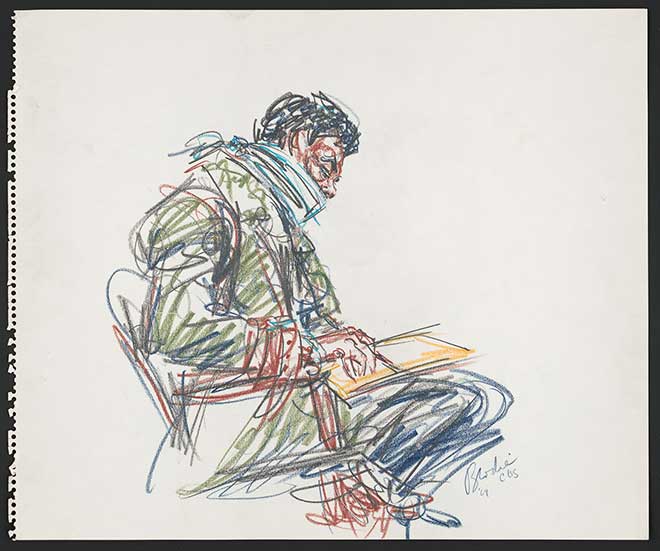
The Trial of the Chicago 7

"'Fictionalizing History and Sorkin It Out"
 or
"Give Me a Moment, Would You, My Friend? I've Never Been On Trial For My Thoughts Before" ("It's a Revolution. We May Have to Hurt Some Feelings")

The Trial of the Chicago 7 has been in the works since somewhere around 2006 when Aaron Sorkin was introduced to the idea of writing it by Steven Spielberg, who wanted to make it as a directing project. Seemed like a good fit; Sorkin is the "dean" of writing compelling court-room dramas and has a knack for putting emotional juice into "wonk" arguments. That work results in some rapturous writing, even if one feels like opposing arguments are given short shrift for the "slam-dunk" moment. With him, it's a—you know—"a thing"

One wonders what Spielberg would have done with it. One knows it would have been a much more precise directing exercise. One hopes that Spielberg might have taken the script and roughed if up a little, textured it with a bit more grit, and thus friction, and thrown in some ambivalence to make the thing more of a courtroom "shit-show" (as it was) than anything too neat and tidy. Maybe an "anti-polish" of the script by the Coen Brothers could do that.

Because the way Sorkin tells it, it's all very neat and tidy with a wildly "boo-yah" finish, where the defendants are convicted on one of the charges—to incite a riot (rather ironic post-01/06/2021)—but their post-conviction statement is such a rousingly heart-felt protest that the crowd in the court-room (and even the prosecution!) gets up to applaud in solidarity.

In a word..."Nah!"

To be fair, trying to organize the ramshackle case number 69 Cr 180 The United States v. David Dellinger et al. into a coherent timeline of pertinent facts that has "a wow finish" is an almost impossible task. Yes, the case was a slap-dash collecting of "usual suspects" at the behest of the Nixon Administration, so that a consistent charge was specious at best. Yes, the trial went on despite one of the defendants not having the benefit of counsel. And, yes, that defendant ended up being bound and gagged for a good section of the trial. Yes, Judge Julius Hoffman was out of his depth trying to juggle the cats involved, ending up charging 175 combined contempt charges among the defendants and their lawyers, indicating not so much that there were violations, but rather that the judge had no control over his court.
What actually happened, you can find here and here. There are so many feints, fibs, and sleights of hand in Sorkin's "portrait" (rather than "a picture" he's said about the script, something he also said about his script for Steve Jobs) that I could write the rest of the review going over them. But, they're well-documented (the least of which is that there were eight defendants counting Bobby Seale, not seven—the man was only in Chicago to give a speech, but he was lumped in with the others because putting a Black Panther on trial was "good optics" for a cynical Department of Justice, until the optics turned horrifying).
It is a "given" that, unless someone is making a documentary, film-makers will swerve away from the facts (and even documentary film-makers will cherry-pick from their sources). No one was there in the room taking down notes for dialog (although, in this case, Sorkin did have the trial transcripts), so we don't know what was said behind closed doors. There's a writer's term/cop-out for making things up: "Writing to Silence," because there is no one around to object.
Except, of course, the audience.

What is the creator's responsibility—to the audience or to truth? Tough question. It should be kept in mind by any discerning audience member that when the line "Based on a True Story" appears that it is a hedge against accuracy: the actual Perdicaris taken hostage in The Wind and the Lion was a man, not a plucky widow, and we don't know what Neil Armstrong was doing by that moon crater, even though First Man has him completing an emotional story point in the film. It might be some dramatic license to make a better story, to tie up a dramatic loose end. Or, changing the facts might be some cathartic wish-fulfilment as Quentin Tarantino provided in Inglourious Basterds or Once Upon a Time in Hollywood.
John Ford famously used the sentiment "when the legend becomes fact, print the legend" even as, in his later films, he sought to negate it.

Sorkin is not above re-writing history for the perfect dramatic punch-line...he did it quite a bit in "The Newsroom," blending real-life events with a parallel universe news organization. And one can't forget the point in A Few Good Men when he ginned up false drama by making Tom Cruise's defense attorney appear unsure and faltering before delivering his final gavel blow. It makes no sense, other than to show his protagonist at his lowest point before his turn-around to triumph. He "had" to get one more dramatic beat in to make the ending suitably triumphant. Audience manipulation. Nothing more.

But, now—after this particular Inauguration Day—perhaps we should reflect on the responsibilities to Truth. Even if it makes the side you favor look bad...or less righteous. False narratives and wishful, even magical, thinking does not make it so. Rhetoric is the art of persuasion, but that art has to stand on the fundamentals of truth. Not just how we want the truth to be. No matter who's side you're on.
Well! "Other than that, how was the play, Mrs. Lincoln?"

Sorkin does a good job mixing in contextural news footage (and some of Haskell Wexler's footage from Medium Cool) from the times, with his DP Phedon Papamichael. Given the amount of material he has to cull from, Sorkin, as both writer and director manages to keep the personalities he's interested in—that is anybody except John Froines and Lee Weiner, who are given short shrift—engaged and sparring. Acting stand-outs negotiating the dialogue are Eddie Redmayne's Tom Hayden and Mark Rylance's William Kuntsler (Jeremy Strong's Jerry Rubin is a bit of a buffoon, unfortunately). But, the stand-out is Sacha Baron Cohen's Abbie Hoffman, not so much in how good he is portraying the trial's Merry Prankster, but in how good he is in the dramatic scenes, when the veneer drops and the words become measured and sharp as a knife.

Tuesday, June 26, 2018

Hugo

Written at the time of the film's release.

"One for the Kid"
or
"The Secret in the Clockworks"

Okay, okay.  Let me get this straight...a Martin Scorsese "Kid's Picture?"  In 3-D?

Honestly, I laughed when I saw the preview.  What could be more incongruous than the director of Mean Streets, Taxi Driver, Raging Bull, and Goodfellas making a film for the kiddies.*  I mean, face it, if Scorsese made a baseball film half the players would be killed by line drives. What's next? Spielberg making a snuff film? Kevin Smith making a good one?

Well, will wonders never cease?
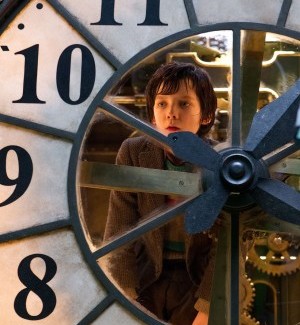
Hugo, the film that Scorsese made for the youngsters runs about 2 hours 8 minutes but feels longer, probably because it has so much on its plate.  A period piece—set post-WWI—about a young orphan, Hugo Cabret (Asa Butterfieldpossessing the most angelic urchin face since Elijah Wood) who caretakes the extended clockworks inside Paris' Montparnasse station, it also contains a brief history of the birth of the film era, an extended history of the career of French film pioneer Georges Méliès (Ben Kingsley) as well as being a feature-length advocacy piece for one of Scorsese's pet projects, film restoration.  But, lest one imagine a long lecture on the subject, it is so embedded in the film's story as to seem nearly invisible—a message hidden in a film of glass-sugar, so as to make the medicine go down.
Hugo ekes out a mouse-like existence, away from the orphanages, maintaining, unseen, the intricate, but elaborate clockworks that the trains run and the people depend onFrom the crystal clock-faces he can see life passing by and through, the scraps of left-over food that can provide a meal, and across the way the toy-maker's shop (with the very cranky proprietor) from whom he steals the tools and odd-parts to try and repair the last link to his late father (Jude Law, briefly), an amateur watch-maker, who took it upon himself to repair a mechanical automaton, discovered at the museum where he worked—the mechanical man's purpose no one knows

From his vantage-point, Hugo is at the hub of the station's bustling activity and many side-stories, but when the need or the hunger arises, he'll make time to enter that world through any number of vents, passageways and access-doors, usually one step ahead of the persistent Station Inspector, who is trying to maintain his own kind of order in the depot.
It may be a PG rated kids movie, but it is still Scorsese, so there are dark elements running all the way through, like Dickens. And Scorsese is never one for a light touch, no matter what the rating is or to whom the demographic is targeted. Still, it is Scorsese's breeziest project in years, recalling the set-bound, intricate work he did on New York, New York all those years ago. But, with the tools of CGI, the scope is huge and the director swoops and swings through corridors and tunnels and crawlspaces with a verve he's never displayed before. It's Scorsese unleashed, not unlike the doberman pinscher partner of the station garde (Sacha Baron Cohen, who displays a fine depth for physical comedy, as well as a Sellers-like ability to plumb perverseness from the lightest subjects), who scampers like a hell-hound through the station's ornately vast spaces (the most elaborate set-piece is a nearly wordless pre-title sequence that is its own CGI 3-D hurdle-fest, that is also a tribute to the silent film era.** 
Yeah, it's a kid movie, but it's also a relentless love letter to cinema, with craning shots the old masters would have busted Union rules for, emulations of the arty interpretive shots from the silent era—things the neo-realist Scorsese has never attempted before—while at the same time taking a toymaker/magician/film-makers' fascination with capturing what James Stewart (in an interview with Peter Bogdanovich) called "little pieces of time."  It is all a bit of magic, a bit of technology, a bit of art, presented with a stylists' eye for the dramatic.  
And Scorsese, with an army of the best at their cinematic craft—Robert Richardson, Thelma Schoonmaker, Dante Ferretti, Sandy Powell and Howard Shore (Shore's score is wonderfully soaring and French-laced)—including such fine actors as Kingsley, Law, Richard Griffiths, Emily Mortimer, Ray Winstone, Christopher Lee, Kick-Ass' "Hit-Girl" Chloë Grace Moretz and A Serious Man's Michael Stuhlbarg, have taken John Logan's intricately geared script-work and constructed a well-oiled entertainment machine taking today's technology to recreate an ephemeral past.

Wonders will never cease. Not with directors like Scorsese. Thank God!
Méliès accompanying himself on banjo in one of his films.


* This brings up one of those stories—the ones you repeat over and over again at Family Gatherings—of my Mother's side of the family, when she and her fellow Bannick sisters went to see Scorsese's Casino...because they thought it might be a musical? (!!!!) Casino. The one that begins with De Niro being blown up in a car, and later, a man's head in put in a vise until his eyes pop out, and Joe Pesci is bludgeoned to a pulpy death with a baseball bat—this, after an even more grisly scene where he has sex with Sharon Stone?

I've often wondered at what point in the film did they figure out there wouldn't be any dancing?

** It reminded me of the kids toy-box of Paris opening of Moulin Rouge!, Baz Luhrmann's zest-fest mash-up of period piece and slash and dash modern culture.