Sunday, July 19, 2020

Don't Make a Scene (Redux): Who's on First

The Story: This week marks the start of Baseball Season. Lots of baseball movies out there that we could review for Opening Day 2020. But heck, there's a tradition around these parks...er, parts that the BEST way to celebrate Opening Day and the Return of the Boys of Summer—a refresher course on who's on the team

!!!

...ehhhh, don't get me started....

The Set-Up:  Here's the wind-up...and the pitch...

Play Ball!


Abbott: Well Costello, I'm going to New York with you. You know Bucky Harris, the Yankee's manager, gave me a job as coach for as long as you're on the team. 
Costello: Look Abbott, if you're the coach, you must know all the players. 
Abbott: I certainly do. 
Costello: Well you know I've never met the guys. So you'll have to tell me their names, and then I'll know who's playing on the team.
Abbott: Oh, I'll tell you their names, but you know it seems to me they give these ball players now-a-days very peculiar names. 
Costello: You mean funny names? 
Abbott: Strange names, pet names...like Dizzy Dean... 
Costello: His brother Daffy. 
Abbott: Daffy Dean... 
Costello: And their French cousin. 
Abbott: French? 
Costello: Goofè. 
Abbott: Goofè Dean. Well, let's see, we have on the bags, Who's on first, What's on second, I Don't Know is on third... 
Costello: That's what I want to find out. 
Abbott: I say Who's on first, What's on second, I Don't Know's on third. 
Costello: Are you the manager? 
Abbott: Yes. 
Costello: You gonna be the coach too? 
Abbott: Yes. 
Costello: And you don't know the fellows' names?
Abbott: Well I should. 
Costello: Well then who's on first? 
Abbott: Yes. 
Costello: I mean the fellow's name. 
Abbott: Who. 
Costello: The guy on first. 
Abbott: Who. 
Costello: The first baseman. 
Abbott: Who. 
Costello: The guy playing... 
Abbott: Who is on first! 
Costello: I'm asking YOU who's on first. 
Abbott: That's the man's name. 
Costello: That's who's name? 
Abbott: Yes. 
Costello: Well go ahead and tell me. 
Abbott: That's it. 
Costello: That's who? 
Abbott: Yes.

PAUSE 
Costello: Look, you gotta first baseman? 
Abbott: Certainly. 
Costello: Who's playing first? 
Abbott: That's right. 
Costello: When you pay off the first baseman every month, who gets the money? 
Abbott: Every dollar of it. 
Costello: All I'm trying to find out is the fellow's name on first base. 
Abbott: Who. 
Costello: The guy that gets... 
Abbott: That's it. 
Costello: Who gets the money... 
Abbott: He does, every dollar. Sometimes his wife comes down and collects it. 
Costello: Who's wife? 
Abbott: Yes.

PAUSE 
Abbott: What's wrong with that? 
Costello: Look, all I wanna know is when you sign up the first baseman, how does he sign his name? 
Abbott: Who. 
Costello: The guy. 
Abbott: Who. 
Costello: How does he sign... 
Abbott: That's how he signs it. 
Costello: Who? 
Abbott: Yes. 

PAUSE 


Costello: All I'm trying to find out is what's the guy's name on first base. 
Abbott: No. What is on second base. 
Costello: I'm not asking you who's on second. 
Abbott: Who's on first. 
Costello: One base at a time! 
Abbott: Well, don't change the players around. 
Costello: I'm not changing nobody! 
Abbott: Take it easy, buddy. 
Costello: I'm only asking you, who's the guy on first base? 
Abbott: That's right. 
Costello: Ok. 
Abbott: All right. 

PAUSE 
Costello: What's the guy's name on first base? 
Abbott: No. What is on second. 
Costello: I'm not asking you who's on second. 
Abbott: Who's on first. 
Costello: I don't know. 
Abbott: He's on third, we're not talking about him. 
Costello: Now how did I get on third base? 
Abbott: Why you mentioned his name. 
Costello: If I mentioned the third baseman's name, who did I say is playing third? 
Abbott: No. Who's playing first. 
Costello: What's on first? 
Abbott: What's on second. 
Costello: I don't know. 
Abbott: He's on third. 
Costello: There I go, back on third again! 

PAUSE 
Costello: Would you just stay on third base and don't go off it.
Abbott: All right, what do you want to know? 
Costello: Now who's playing third base? 
Abbott: Why do you insist on putting Who on third base? 
Costello: What am I putting on third. 
Abbott: No. What is on second. 
Costello: You don't want who on second? 
Abbott: Who is on first. 
Costello: I don't know. 
Abbott & Costello Together: Third base! 

PAUSE  
Costello: Look, you gotta outfield? 
Abbott: Sure.  
Costello: The left fielder's name? 
Abbott: Why. 
Costello: I just thought I'd ask you. 
Abbott: Well, I just thought I'd tell ya. 
Costello: Then tell me who's playing left field. 
Abbott: Who's playing first. 
Costello: I'm not... stay out of the infield! 
Costello: I want to know what's the guy's name in left field?
Abbott: No, What is on second.
Costello: I'm not asking you who's on second.
Abbott: Who's on first!
Costello: I don't know. 
Abbott & Costello Together: Third base!

PAUSE

Costello: The left fielder's name? 
Abbott: Why.
Costello: Because!
Abbott: Oh, he's centerfield.

PAUSE
Costello: Look, You gotta pitcher on this team? 
Abbott: Sure.
Costello: The pitcher's name?
Abbott: Tomorrow.
Costello: You don't want to tell me today?
Abbott: I'm telling you now.
Costello: Then go ahead.
Abbott: Tomorrow!
Costello: What time?
Abbott: What time what?
Costello: What time tomorrow are you gonna tell me who's pitching?
Abbott: Now listen. Who is not pitching.
Costello: I'll break your arm if you say who's on first! 

Costello: I want to know what's the pitcher's name?
Abbott: What's on second.
Costello: I don't know. 
Abbott & Costello Together: Third base!

PAUSE
Costello: Gotta a catcher?
Abbott: Certainly.
Costello: The catcher's name?
Abbott: Today.
Costello: Today, and tomorrow's pitching.
Abbott: Now you've got it.
Costello: All we got is a couple of days on the team. 

PAUSE
Costello: You know I'm a catcher too. 
Abbott: So they tell me.
Costello: I get behind the plate to do some fancy catching, Tomorrow's pitching on my team and a heavy hitter gets up. Now the heavy hitter bunts the ball. When he bunts the ball, me, being a good catcher, I'm gonna throw the guy out at first base. So I pick up the ball and throw it to who?
Abbott: Now that's the first thing you've said right.
Costello: I don't even know what I'm talking about!

PAUSE

Abbott: That's all you have to do.
Costello: Is to throw the ball to first base.
Abbott: Yes!
Costello: Now who's got it?
Abbott: Naturally.

PAUSE
Costello: Look, if I throw the ball to first base, somebody's gotta get it. Now who has it?
Abbott: Naturally.
Costello: Who?
Abbott: Naturally.
Costello: Naturally?
Abbott: Naturally.
Costello: So I pick up the ball and I throw it to Naturally.
Abbott: No you don't, you throw the ball to Who.
Costello: Naturally. 
Abbott: That's different.
Costello: That's what I said. 
Abbott: You're not saying it...
Costello: I throw the ball to Naturally.
Abbott: You throw it to Who.
Costello: Naturally.
Abbott: That's it.
Costello: That's what I said!
Abbott: You ask me.
Costello: I throw the ball to who?
Abbott: Naturally.
Costello: Now you ask me. 
Abbott: You throw the ball to Who?
Costello: Naturally.
Abbott: That's it.
Costello: Same as you! Same as YOU! 
Costello: I throw the ball to who. Whoever it is drops the ball and the guy runs to second. Who picks up the ball and throws it to What. What throws it to I Don't Know. I Don't Know throws it back to Tomorrow, Triple play. Another guy gets up and hits a long fly ball to Because. Why? I don't know! He's on third and I don't give a darn!
Abbott: What?
Costello: I said I don't give a darn!
Abbott: Oh, that's our shortstop!


Friday, July 17, 2020

Park Row

Park Row (Samuel Fuller, 1952) One of those movies that I really wanted to see—it was writer director Sam Fuller's personal favorite, but finding it has been a challenge. Thanks to TCM, it finally showed up on a night of Sam Fuller movies and it more than satisfies the anticipation for its story about a fledgling New York newspaper going up against "the bigs" in the "lusty days of the golden 80's." Made with Fuller's own money—he went broke—it's also, more than any of his other films, of his blood, soul and passion. Big, broad, and loud, it saves subtlety for other stories. This one's about the field where Fuller grew up—he started as a copy-boy at 13 and was a crime reporter by the age of 17 ("a byline was the thrill of my life" he'd later say)—and obviously the one he was most nostalgic for, and the film, as a result, is wildly theatrical, almost operatic and wears its heart on its ink-stained sleeve.

Fuller could always be counted on to start his movies with a bang (sometimes literally) and he begins his tribute to newspaper publishing with a screen filled with the names of newspapers—each in their distinctive fonts—with a preamble linking them to his movie—"These are the names of 1,772 daily newspapers in the United States/One of them is the paper you read/All of them are the stars of this story"—and crescendoed with a "Dedicated to American Journalism" in the cinematic equivalent of 120 point type.

"Go jump off the Brooklyn Bridge!"

It's a thesis big and bold and approaching camp with a zeal that flavors the entire movie, starting with the first image when "Samuel Fuller Productions" is revealed to be a type-block held by a statue of Johannes Gutenberg, the first statue of the many lining "the most famous newspaper street in the world," New York's Park Row, "where giants of journalism mix blood and ink to make history across the front page of America."
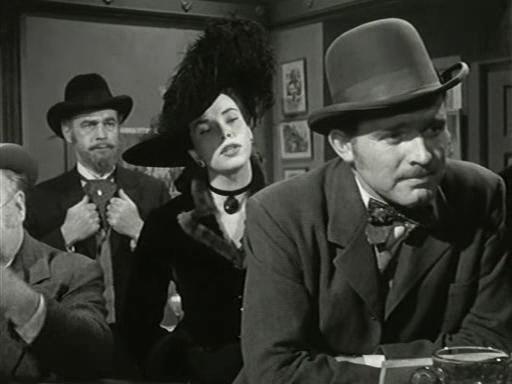
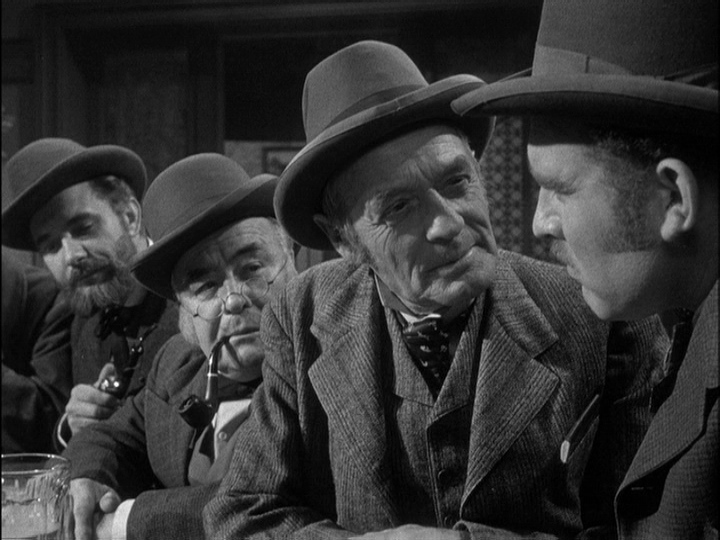
On this street—a stage-filling street set that we will be going up and down quite a bit—on this night, one door will shut and another open for Phineas Mitchell (Gene Evans in a gale-force performance) of the editorial department of The Star, as he stomps into O'Rourke's pub, intercepts the beer sudsily slid in his direction, and glowers, upset at something he's seen in the publication of his employ. A glory hound, Steve Brodie (George O'Hanlon), walks in and asks him what a guy has to do to get his name in the newspaper around here. Mitchell snarls "go jump off the Brooklyn Bridge," and then announces he doesn't work for The Star anymore. He's about to get himself fired.
He goes to the potter's field grave of recently hanged Charles Mott and nails up a makeshift head-stone "Here lies..." with a birth-year and death-date with the epithet "Murdered by The Star." That little act of defiance gets the attention of the publisher of The Star, Charity Hackett (Mary Welch), who isn't even aware Mitchell's on her payroll, but makes it to O'Rourke's to find the responsible party and, finding her prodigal son, fires him. She is unrepentant for the role her paper paid in the execution and Mitchell excoriates her for her "trial by publication."
Mitchell: He was tried by your paper.
Hackett: He was tried by a jury.
Mitchell: You sprung the trap.
Hackett: I simply broke the story.
Mitchell: The story broke his neck!
Whatever rhetoric he might employ, he's still fired. Hackett leaves; she's got a newspaper to put out. But, two more incidents happen at O'Rourke's that evening: Brodie comes back to tell everybody he jumped off the Brooklyn Bridge and a local printer who's been listening to Mitchell mutter about the paper he'd publish—"The Globe"—finally decides to put his money where Mitchell's mouth is and stake his dream-paper. With a key to the front door, a couple of the O'Rourke-habituating news-hounds in his employ, a compositor who can't read English, and a bail of butcher paper, he puts out Vol.1; No.1 of The Globe, four pages of "a newspaperman's newspaper." The lead story is how Steve Brodie got sprung from the clutches of the local authorities (the story doesn't mention that Mitchell turned him in so he could get him out and get the story).

"The press is good or evil according to the character of those who direct it."

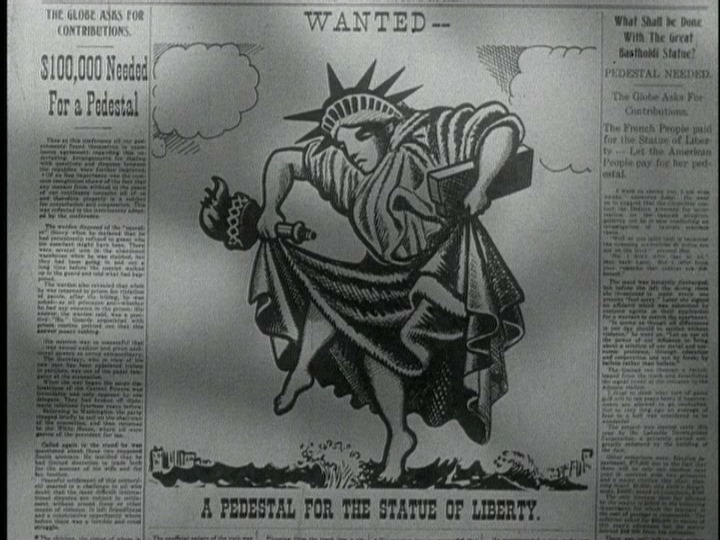
There will be other headline-grabbers—The Globe will start a fund for getting a pedestal for the Statue of Liberty (currently sitting around in pieces in New York) and that will start a small crime-ring of grifters selling false certificates, and, internally, that illiterate compositor will be inventing the linotype machine. But the Big Story will be the rivalry between The Star and The Globe, a love-hate relationship that will reflect the regard held between Mitchell and Hackett, but turn ugly in the ruthless competition to stay in business. She'll try to hire Globe reporters and compositors, he'll rail against her business practices, she'll try to buy up all the newsprint, he'll get in a brawl with a Star thug who started that grifting ring (in a long travelling shot that covers the length of Fuller's Park Row set and ends up with Mitchell using the statue of Ben Franklin as a weapon).
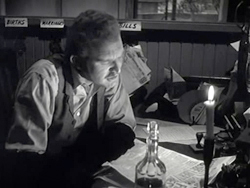
Fuller makes full use of his all-inclusive set, which includes both interiors and exteriors—thresholds are crossed in one unbroken camera move—and even when inside, there's bustle out on the street as seen through the windows and doors, filled with details of the day-to-day for all to see (one nice little bit of business is the pike-board at Mitchell's editorial desk with the obligatory spaces for Births, Deaths, Marriages and Bills—the "Bills" pike is never empty). Fuller was a director of the image and would far prefer to show you what's going on than tell you. And despite the speed with which he made the film—it was shot in 14 days—the compositions are careful with an eye towards crafting a painterly image, especially given the way he would crowd characters into the frame to direct the eye to its focal point. Fuller was never afraid of close-up's or two-shots, but here his film fairly busts with characters jammed to fill the frame, making use of every available use of space.
When a director makes his dream project there is often a let-down in quality—the opportunities come at their greatest success and the budgets expand and there's less of a critical eye and the burden of constraints. Dream projects suffer because of the indulgence and the ego of its creator. 

But, this is one dream project where the love is on the screen and the director's infatuation informs every shot, every beat and every edit. This is the movie that Fuller had his heart and soul set on—and he put his money on it to back them up (and set the constraints). The result is a love that isn't embarrassing in the least, but forthright, honest, and as bigger-than-life as the guy what made it.

There are lots of good Fuller movies—ones so brazen they'll make ya squirm—but, this one might make you proud. Just as it did its creator (even though it didn't make a dime). 

-30-

Wednesday, July 15, 2020

Woman of Straw

Woman of Straw (Basil Dearden, 1964) It wasn't much of a stretch for Sean Connery, in a filming break between From Russia With Love and Goldfinger, to play the cad Anthony Richmond in Woman of Straw (he also filmed Alfred Hitchcock's Marnie in the same period). His speaking voice is still "posh," the toupee is slightly fluffy (using the "drama" one, not the "action" one) and even the suits he wears would be reused in the third Ian Fleming adaptation. One who had seen Goldfinger first—a good bet as Woman of Straw did not do well at the box-office—could be forgiven for have a sense of deja vu watching him in this film and thinking he'd be drawing a Walther PPK and making a quip at any moment.

There is the added atmosphere provided by the sets of Ken Adam, which give the film added size and sheen—they even reuse the ridiculously long dining table for an intimate dinner joke.
So, there's a distracting shadow of Bond throughout the film, even though it's a different boiling pot of intrigue throughout. Richmond is the nephew and prince-in-impatient-waiting to kingpin Charles Richmond (Ralph Richardson), an irritable man of means, bitter due to the death of his wife and his confinement to a wheelchair. Charles is in constant need of care, but keeping a nurse around, given his cantankerousness is a problem. His home staff (Johnny Sekka, Danny Daniels) are only consistent because they are minorities and lower class—they have no other option than to put up with his obstinance and impotent sadism.
So "Tony"—acting as his uncle's solicitor—brings in a new nurse, Maria Marcello (Gina Lollobrigida), and she's a bit different. She's "foreign"—Italian, to be blunt about it—attractive, and a bit more assertive than the home-grown "angels of mercy" who have been dispatched, no doubt under emotional duress, from the old tycoon's employ. And this angel has a bit of a devil to her. She won't put up with Charles' guff and is just about to walk out of the situation when Anthony makes a proposal. 
What he proposes is this: stay in their employ, as "the old man" is less of an ogre with her, and maybe they both can profit by it. Tony's father was cut out of the family business by Charles and Tony knows that when the old man dies, he'll only inherit £20,000. But, if Maria marries the old man...and he dies...she'll inherit his fortune. The only thing Tony asks is £1M for providing the opportunity. Maria is attracted to Tony and her mother lives a poor existence in Italy and the money would certainly benefit her. So, she agrees to the plot.
Being a nurse is tough duty, even if one is a nurse in a gilded cage, but Maria sticks it out, doing battle with Uncle Charles about diet, exercise and medicine, while Tony purrs in her ear about the end-game. But, at one point, Maria decides that she's had enough and returns to Italy...only to be surprised that Uncle Charles travels there to ask her to come back. The old man evidently has a soft spot for her and so Tony's plan might actually work, so she relents, and Uncle Charles soon finds her to be indispensable. An extended yacht holiday cements their relationship, and Tony is pleased when Charles asks him to change his will—Tony will get £40,000 now—but Maria will become the new beneficiary, as he intends to marry her.

But, she'll only become the beneficiary...if he dies.
That's when the complications ensue and the film becomes one of small details and intricacies as opposed to personalities. The film falls off somewhat, despite adding a couple more characters—police investigators and such—and a murder plot that needs a bit too much suspension of belief to pull off.

And—spoiler alert (but is it really?)—the victim is actually the most interesting character—and player—in the movie. Richardson's thorny old coot is such an irascible sort that once he warms up, you miss him when he goes, leaving you with two conspirators, neither of whom you know too well and neither of whom are entirely trustworthy. 
What's an audience to do?

The filmmakers clearly intend sympathies to go with Lollobrigida's Maria, who is set up to "take the fall" for Charles' demise, but the collapse of the previously strong woman we witnessed—and Lollobrigida's playing of it—leave one a bit suspended (with very little suspense) and leaves her a woman in peril with only the actions of people we don't know to get her out of it. That third act weakness is an issue with other Dearden films I've seen, which can have terrific set-up's but unsatisfying (no, that's too strong a word—let's say "troubling") resolutions.
Now, back to Connery. Turns out his Tony Richmond is the dark side of Hamlet—taking revenge against his Uncle who ruined and cuckolded his father—but is in no way a hero. In fact, although Connery, once "established" in his career, played killers, cads, and cons throughout, he very rarely played the traditional villain role—the only other I can recall post-50's is the movie version of The Avengers. That his "bad guy" is only a shade more serious than his portrayal of his James Bond says a lot about the actor...and that particular character.*
On the whole, Woman of Straw, is a slightly better film than a "for completist's only" watch. It may interest those who like their Hitchcock-type films with a froth of soap opera.
* This is so "inside" that it only rates an asterisk: Connery's villain meets his well-deserved demise by a stunt contrivance that would be echoed in a not-too-believable method of tripping up Bond's fight-partner in the opening of Thunderball.  Deliberate? Like his mentioning of another of his films—Another Time, Another Place—later in that film? 

Tuesday, July 14, 2020

Serenity

Written at the time of the film's release...

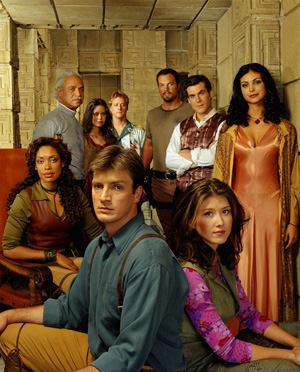
Serenity (Joss Whedon, 2005) Enjoyable, if violent, genre-bendin' space-farin' Western spinning off from the one season wonder "Firefly." But Serenity (that's the name of the ship) passes the crucial test of movies that make the leap from small to big screen—you don't need to have seen the series to "get" the concept and enjoy the film (probably because the concepts are so familiar). Sharply written and directed by series creator Whedon, and played by the regular cast, it boasts an intensely underplaying Chiwetel Ejiofor as a government operative who ritualistically silences outliers.

And outliers are exactly what the crew of the "Firefly"-class "Serenity" is comprised of; pirates, soldiers of fortune, outlaws, the scrappy veterans of the Galaxy's last civil war, who bounce from system to system dodging government entanglements and making a living by lying, cheating and stealing. Plus, they do good while doing bad.

The conceit of staging a Western in the infinitely wide-open spaces isn't new. "Star Trek" was sold to NBC as being "Wagon Train to the Stars"--not exactly true, but the suits got the point, "Star Wars" used Han Solo as a space cowboy ala Hondo (which Chewbacca as his faithful dog...or horse), and the "Wars" rip-off Battle Beyond the Stars was "The Magnificent 7 in Space." There isn't that much of a light-speed leap from horse-opera to space-opera. After all, the umbrella-genres of westerns and sci-fi can encompass all sorts of story-themes from Shakespeare to cleverly disguised issues of the day.
The plot for Serenity back-tracks a bit* to catch movie-goers up with the story of fugitives River Tam (Summer Glau) and her doctor-brother Simon (Sean Maher) and then resolves the conflicts their paid passage aboard Captain Mal Reynolds' (Nathan Fillion) ship of fools has created, and turns River from loose cannon on deck to a reliable asset. Along the way the crew stumbles on a gone-wrong planet-wide government experiment being kept under wraps. And since they're being pursued by "the op," anyway, they "aim to misbehave."
The characters are broadly drawn, easily discerned, and everyone is given significant plot-time (with the exception of Morena Baccarin's space-zen-hooker Inara, whose role was edited for time). Though not a success at the box office, it did spur interest in the series and kicked its box-set collection into hyper-drive. Though Whedon constantly discounts it, the crew of "Serenity" may fly again.

2020 aside: I'd still like to see it, as the film inspired a deep-dive into the TV series for me, although getting Fillion back would be a task—not to mention writer-director Whedon. And, given how everybody's aged a bit, it's going to have to surmount the "Star Trek movie-issue" of providing a sufficient reason for everybody getting back together, assuming that characters have gone separate ways and forged bonds elsewhere. Still, it was Whedon working on something he WANTED to work on and that usually entails his best work. I think a lot of it has to do with that I became a fan after it died...All that there was had already been done. And it was finite.

Maybe it's best to move on. 


* In a film-starting series of illusions that nest together like Matryoshka dolls.


Sunday, July 12, 2020

Don't Make a Scene (Redux): Lincoln

The Story:  "Times like this, I'm best alone" he says on the fade from the White House corridor to the hat.

There's a lot of good writing in Steven Spielberg's version of Lincoln, thanks to a phenomenal script by Tony Kushner, only part of which Spielberg filmed (it still irks me that he lost the Best Original Screenplay Oscar to Quentin Tarantino's messy Django Unchained script, but that's movie politics). Words are important in it, more so than most other screenplays. You're dealing with period language.  You have to go back in time and lose a lot of history and industrial vocabulary. This one and and 2013's 12 Years a Slave had a good ear for arcane language and the expression of it. Good period writing is its own time machine, letting you listen in on the conversations of the past, knowing it is the past, by the carbon-14 of its language, that has not yet been drained of its color, its edge burnished, its vibrancy dimmed, by time and misuse.

Here, the screenplay finds Lincoln in the act of composing a telegram. He's written down what he wants to say, the particulars involving transportation of a delegation from the Southern states to negotiate a peace agreement to the Civil War. But, the details are messy. Lincoln is fighting two fronts, one on the battlefield and one in the legislature. He wants to pass a bill outlawing slavery before the end of the war, in order to have the status of former slaves in place before its end, and that is a slow process in the halls of Congress, where compromise and obstructionist idealism (or what passes for it) keep pushing the realization of it further off. Meanwhile, the war goes on, tirelessly chewing through the nation's populace, doing double damage, because both sides of the fight involve Americans. To delay the peace means more of "us" die. To end the war...now...means only persons of a certain pigment are free.   

What would Lincoln do?

He'll go back to the words. Our sacred texts. And focus on one hyphenate embedded there: "self-evident." As in "we hold these truths to be..." Thomas Jefferson's use of the word harkens back to Euclid's Elements, and the very basis for geometry and all the "given's" that we take for granted in all those proofs. If it works in math, it works for the world, and "equals" means the same: 1=1.  That's a "given." That's "self-evident." Just like "all men are created equal."*  

We're created equal. But that's where it stops. After that, fate, charity and happenstance determines what we are: free man, slave, or property. Governance and economy decides our worth, and unequally. But, if that's true, "a nation conceived in liberty" will be stillborn in the throes of slavery.

1=1. Self-evident.

And so the war goes on while men and women are slaves. He'll amend that telegram to delay the peace negotiators until men and women are not, and it is safe to end the war...for all Americans.

Or all of them that are left.

He touches the shoulders of his two adjutants...and leaves, after those dictated words...so paltry and so innocent, but with the deadliest of intent ...frees some and kills others. But that's the thing about war.

You don't win it. Never completely. Not if you do the math.

The Set-Up: Abraham Lincoln (Daniel Day-Lewis) is this close to passing the Thirteenth Amendment abolishing slavery in the House of Representatives. But petty squabbling in the House and his own Cabinet is keeping that from being accomplished. Most House Republicans, especially the fiery abolitionists led by Thaddeus Stevens (Tommy Lee Jones) will water down their positions in order for it to pass, but the Democratic minority will not budge, especially if it can bring a speedy end to the Civil War by negotiating a settlement, and abolishing slavery would make that negotiation dead before starting. A secret negotiating team is heading for Washington now, and Lincoln does not want that knowledge watering down the urgency for abolition. Before dawn, he goes to the war-room telegraph office to send an urgent message to his Union commander, Ulysses S. Grant. He has one more tactic that he can pull...as he ever does...from his hat.

Action!

INT. THE TELEGRAPH ROOM, WAR DEPARTMENT - PRE-DAWN
Lincoln is seated at Eckert's desk, shawl wrapped around his shoulders, glasses on; he stares down into his hat, held between his knees. Homer Bates and Sam Beckwith are waiting for him. Lincoln draws a handwritten note from his hat and carefully unfolds it. 
LINCOLN "Lieutenant General Ulysses S. Grant, City Point. I have read your words with interest."
Sam Beckwith transcribes Lincoln's words into code on a pad with a pencil. 
LINCOLN (CONT'D) "I ask that, regardless of any action I take in the matter of the visit of the Richmond commissioners, you maintain among your troops military preparedness for battle, as you have done until now." 
He stops for a moment. Beckwith waits, pencil poised. Lincoln looks at the note, folds it, tucks it in a band inside his hat.
LINCOLN (CONT'D) "Have Captain Saunders convey the commissioners to me here in Washington." 
(ANOTHER PAUSE) 

LINCOLN "A. Lincoln." 
LINCOLN And the date. 
SAMUEL BECKWITH (WHILE WRITING:) Yes sir. 
Lincoln places the hat on the floor. 
SAMUEL BECKWITH (CONT'D) Shall I transmit, sir? 
LINCOLN (a beat, then:) You think we choose to be born?
SAMUEL BECKWITH I don't suppose so. 
LINCOLN Are we fitted to the times we're... 
LINCOLN ...born into? 
SAMUEL BECKWITH I don't know about myself.
SAMUEL BECKWITH You may be, sir. Fitted. 
LINCOLN (TO HOMER:) What do you reckon? 
HOMER BATES I'm an engineer. 
HOMER BATES I reckon there's... 
HOMER BATES ... machinery but no one's done the fitting. 
LINCOLN You're an engineer, you must know Euclid's axioms and common notions. 
HOMER BATES I must've in school, but... 
LINCOLN I never had much of schooling, but I read Euclid, in an old book I borrowed. 
LINCOLN Little enough ever found its way in here - (touching his cranium) - but once learnt it stayed learnt. 

LINCOLN Euclid's first common notion is this: "Things which are equal to the same thing are equal to each other." 
Homer doesn't get it; neither does Sam. 
LINCOLN (CONT'D) That's a rule of mathematical reasoning. It's true because it works; has done and always will do. 
LINCOLN In his book, Euclid says this is "self-evident." 

(A BEAT) 
LINCOLN  D'you see? There it is, even in that two-thousand year old book of mechanical law:...
LINCOLN ...it is a self-evident truth that things which are equal to the same thing are equal to each other.
LINCOLN  We begin with equality. That's the origin, isn't it? That balance, that's fairness, 
LINCOLN  ...that's justice. 
He looks at his scribbled note, then at Sam and Homer.
LINCOLN (CONT'D) Read me the last sentence of my telegram. 
SAMUEL BECKWITH "Have Captain Saunders convey the commissioners to me here in Washington." 
LINCOLN A slight emendation, Sam, if you would. 
Beckwith writes as Lincoln dictates. 
LINCOLN (CONT'D) "Have Captain Saunders convey the gentlemen aboard the River Queen..."
LINCOLN "... as far as Hampton Roads, Virginia," 
LINCOLN "...and there wait until..." 

(BEAT) 
LINCOLN "...further advice from me." 
LINCOLN "Do not proceed to Washington."

Lincoln

Words by Tony Kushner

Pictures by Janusz Kaminski and Steven Spielberg

Lincoln is available on DVD and Blue Ray from Touchstone Home Video.

 
* I believe that when Jefferson wrote that line into the 1776 Declaration, he was making the rhetorical point that people have the right to choose their government and not have policy dictated merely because of family ties—whether your name was Tudor or Plantagenet or York or Lancaster or Stuart...or Windsor. Just because you're born into a "house" doesn't make you capable or deserving of leading a nation of individuals, as in the British system.  George III was the King of England at the time and ruler in absentia of the British colonies in North America. That was 1776 and the issue was a nation's self-determination.

But, the vibrancy of those words in that declaration and the Constitution it inspired have come to be accepted as "everybody starts out equal; their rights should be equal, too." It is the logical extension of those simple words. And so it should be.