Showing posts with label Christopher Lloyd. Show all posts

Friday, October 14, 2022

Clue

Clue (Jonathan Lynn, 1985) It was director John Landis who came up with the idea to make a movie of the famous murder mystery board game. "Clue" was a staple of those stacks of board games in homes (at least it was in my home when I was growing up) and it guaranteed a good hour or so of fun, even if you did lose a murder weapon or two in the set-up and take-down. 

And those murder weapons—a candlestick, a dagger, a lead pipe, a revolver, a rope (with noose!), and a wrench—were all nefariously blunt ways to dispose of people, whether in the library, the billiard room, the conservatory, the ballroom, the kitchen, the dining room, the lounge, the hall, or the study (not to mention the cellar!). What sort of sick mind would come up with this thing?

Well, apologies to Agatha Christie, but the man who came up with it was a Birmingham, Englander named Anthony E. Pratt (he died—I'm not sure by what means—in 1994), who put out a patent for a murder mystery game called "Murder!" He sold the idea to British game manufacturer Waddington's House of Games in the UK, who released the thing in 1949 under the name "Cluedo." Originally, there were other weapons including a bomb, a syringe, a shillelagh, a fireplace poker, and an axe and poison. In the U.S., Parker Brothers released the game under the name "Clue," where, on both sides of "the pond" it enjoyed decades of success, even inspiring a young boy by the name of John Landis.
Where were we?
 
It is 1954 and six Washington D.C. residents are invited to a New England mansion, Hill House, where they are escorted to dinner by Wadsworth the butler (Tim Curry) and the maid Yvette (Colleen Camp). But, why these six individuals and why are they given pseudonyms, rather than being referred to by their real names?
 
A seventh guest, Mr. Boddy (Lee Ving) arrives and it is revealed that he has been blackmailing all of them.
"Mrs. Peacock" (Eileen Brennan) is the wife of a prominent U.S. Senator who has been taking bribes. "Mrs. White" (Madeline Kahn) may have murdered her nuclear physicist husband. "Professor Plum" (Christopher Lloyd) has had an affair with a patient and lost his medical license. "Mr. Green" (Michael McKean) is gay, but must keep it secret lest he be fired from his State Department job. "Colonel Mustard" (Martin Mull) is a war profiteer selling military parts on the black market. Miss Scarlett (Lesley Ann Warren) runs a D.C. brothel. None of this looks good on a resume, which is why when they're informed by Wadsworth that they only 45 minutes before a contingent of police arrive, so they have been pulled together to turn him over to the police for his blackmailing schemes.
Well, to make a long story short,* Boddy reminds them, though, that if he arrested, he will gladly reveal all their secrets to the police, and suggests an alternative: he gives them each a weapon and suggests that as Wadsworth has the only key that will allow them to escape, one of them should kill the butler when Boddy turns out the lights. Boddy turns out the lights. When they're turned back on, it is Boddy himself who has had his lights turned out.
Oh, bother. Whodunnit?
 
Really, who cares? The strength of Clue—as opposed to Murder By Death
—is that, for a comedy, it has a fairly good laugh-to-stinker ratio. And Lynn has insisted that it proceed at a slightly faster pace than a Marx Brothers movie. Yes, it will pause for an audience laugh, but for the shortest amount of time possible, before setting up its next joke. Not only that, but it throws in a considerable amount of slapstick.
Slapstick that looks really painful.
Really painful. But, then what do you expect when you have six or seven live characters within a house with secret passages and a lot of marble flooring? There has been some careful study of early comedy films for this one and so the pace rarely flags, even, at times, it does exhaust. But, there is a measured quantity of vocal humor before something physical happens, which relieves some of that pace.
Plus, the cast is perfectly capable of tossing in a look, a reaction, a bit of business, or—in the cases of Kahn and Curry—line readings that are so exquisite that you want to hear them again...immediately. There is the little conceit of there being three endings—a fourth was scrapped—and that's a bit lame, especially as they all tend to have a momentum-crushing finality with no pay-off when you expect there should be.
The movie bombed at the box-office, but it has achieved an inexplicably ardent cult following (with some pathetic soul trying to gain hits for their podcast with the hyperbole that it's the best movie ever made). It's entertaining and even occasionally inspired, but as for it's breaking any new ground in comedy, no.
 
Talk about not having a "Clue!"

* Too late.

Tuesday, January 18, 2022

The Tender Bar

What Does J.R. Stand For?
or
One Swingin' Dick to Another...
 
A comedian stands on stage and says "So, a termite walks into a saloon and says "Is the bar tender here?" and he waits...
 
George Clooney's directing career has been hit-or-miss. It's never been very consistent, except for the love of details, decor, quality...in words and pictures. After a disastrous run of films soon after leaving his television career, there was a period where Clooney paused and re-considered (rather than merely considered) roles being offered to him, resisting the urge—as the late Betty White observed—to act like a feral cat, consuming whatever was available, in the concern that the supply would run out. Tent-pole films were out, as they could be compromised by locked-in release dates. Directors were important, and not just "flavor-of-the-moment" directors studios were pimping. Scripts had to have the spine to be improved, rather than good box-office "buzz." Clooney wanted less time in the trailer and more time learning the craft, and started directing only when he found a project with enough of a chance to work—a long-languishing Charlie Kaufman script, based on Chuck Barris' highly questionable memoir. Confessions of a Dangerous Mind put Clooney on the directing map, and his next film Good Night, and Good Luck. established his cred as a "serious" director. This was no stunt. Clooney wanted to make good films and good art. To that end, Clooney started swinging for the fences than easy lay-ups.
The results have been mixed. But, with The Tender Bar, he's established a new high-mark for his efforts. Based on J.R. Moehringer's memoir, with a script by (the first script of his I've liked!), it's a coming of age story of how a village takes care of their own. JR (played by Daniel Ranieri in the early years) and his Mom (Lily Rabe) make another return to the house of her father (Christopher Lloyd) after being kicked out of her place for being behind on the rent five months. This is not looked upon kindly by the residents who include three generations of family, none of whom have fled the nest. To Mom, it looks like failure. To JR, it looks like family.
JR's father is merely referred to as "The Voice"—a radio bum who got Mom pregnant and had no designs on anything post-ejaculation. This produces the first words of advice from JR's Uncle Charlie (
Ben Affleck, developing an Al Pacino growl) "He's just an asshole who happens to be on the radio. Don't look for your father to save you. And don't play sports (you're no any good at it). That's all I have to say. The game is five card stud." And as Uncle Charlie has assured JR "I'll always tell you the truth," JR has to believe him. Still, he listens to his father's voice on the radio as if it was His Master. It is only when the father starts breaking promises that JR takes Charlie's advice.
Charlie runs the Dickens Bar down the road, dive for a regular crowd of pack-rats of which Charlie is the Master of Ceremonies and Obedient Servant. "When you're eleven years old," says JR "You need an Uncle Charlie." Especially, when wisdom is so casually dispensed—you've got to know "how to change a tire...jump a car" and tangentially "never hit a woman even if she stabs you with scissors." He encourages him to read, opening up his closet full of books to him, inspiring JR to become a writer.
But, single Mom wants him to be a lawyer and go to Yale. It seems impossible, but JR stays on track and when he's a young man (played by
Tye Sheridan), he's off to New Haven to chart his own course, with several detours along the way, including a romance with a girl (Briana Middleton) that throws him right off the road.
The reviews have been mixed, but I owe that to post-Trump cynicism, where when someone tells you they'll tell you the truth, you can't believe they'd actually do it. Maybe it has something to do with professional jealousy as
Moehringer's won a Pulitzer. I don't know. All I know is, at this point in time when a lot of people are moving back home, it is a nostalgic look at when America had such a thing as a community, instead of dwellings standing in for bunkers. 
Clooney has always had a nostalgic streak—his contemporary work can be a little nasty and his one futuristic one had no hope at all. But, here, principles are still intact, his dialog crackles quickly (when it's not overlapping) and the pauses are deftly comic. And the director is less concerned with locked-down formalism as with an economy of footage, that still takes the time for the important interplay of looks between people—or more importantly, not looking. And despite the incessant cursing, it's concerned with civility...and learning about it and recognizing it, no matter what class it originates in.
There are no big issues underpinning the story, other than the origins of respect and grace, personal attributes that have shown up in the director's other movies that give them their air of being old-fashioned and principled. This one is less of a sermon, more of a demonstration. It makes its points softer and less obtrusively, and for some reason that reflects an attitude of more respect towards the audience, maybe because self-respect is so inherent a theme of it that it reflects back. 

It makes it less a coming of age story, than one of the coming of wisdom.

Saturday, March 2, 2019

The Postman Always Rings (Twice)

The Postman Always Rings Twice (Tay Garnett, 1946) Drifter Frank Chambers (John Garfield) blows in on the Santa Ana wind* and gets picked up along the road by a man called Kyle Sackett (Leon Ames), and gets himself dropped off at a local diner-slash-service station called "Twin Oaks" run by a genial old fellow named Nick Smith (Cecil Kellaway), who has a sign out front that indicates he could use a little help around the place. Frank can use the work, but he's not sure about it until he gets a look at the benefits, when he follows a fallen lipstick across the diner floor and sees Nick's much younger wife, Cora (Lana Turner), who shows up in a midriff-baring white two-piece number that one presumes she doesn't normally wear at job interviews for mechanics. With Nick, he's a bit of toady, but with Cora, it's a sparring match where he always ends up the loser. "The best way to get my husband to fire you is to not do what I tell you to do," she tells him once he's off work the first day. When he grabs her in a clinch later, she just fixes her lipstick and walks away...slowly. She's funny that way.
But Frank is confident. "I can sell anything to anybody," he brags. "That's what you think," she scoffs. But, a moonlight swim (with Nick's approval) starts to get Cora in a buying mood. And when Nick goes away to Los Angeles, Frank seizes his chance—there's a lovely moment when, he's tending the dining bar with one lone customer between him and trying to make his move on Cora and he stares the poor sap down until he's so uncomfortable he leaves...with a tip—closing the diner for business and giving his full attention to Cora. She finally answers the question that's nagged at him—why marry Nick? She tells him that since the time she was 14, she had to fight off a lot of guys—all of them—until she met Nick, with a ring and a proposal. "And you retired," he says. "The undefeated champ." "Not 100% undefeated," she says. And that is that.
Soon after they begin their affair—hours after, in fact, which makes you wonder if they had enough time to have an affair—they run off together. But, as Nash has the only available car, they end up bumming rides to get away, and that's just honest-to-goodness not good enough for Cora (even though it may be good enough for Frank. *CONFLICT ALERT* She doesn't want to start out their life together as bums...like Frank. Besides, if she just up and leaves, all the work she put into Twin Oaks will go waste, as Nick would surely keep it in a divorce. So, the two go to plan "B" by dialing "M" for murder: they decide that Cora will get to keep Twin Oaks if they kill Nick. Well, at least kill Nick and get away with it.
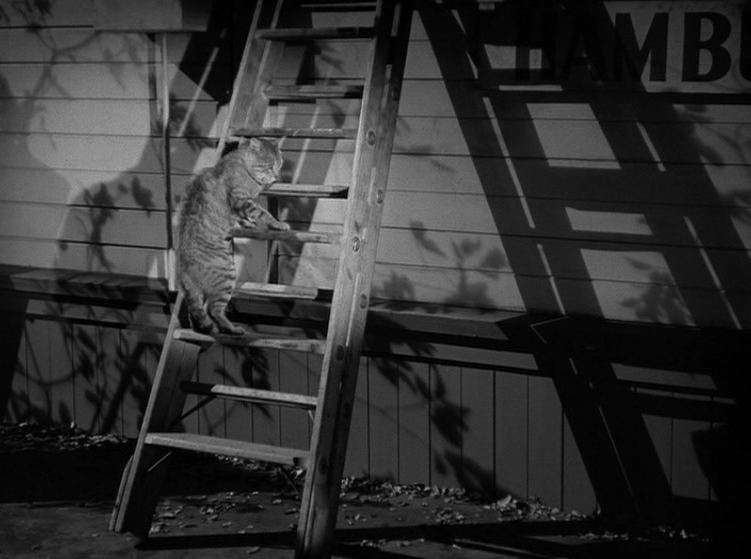
And so, they hoof it back to Twin Oaks, waiting for Nick to come back. He does, conveniently weaving from from too much drink in the city, but not conveniently enough that he's killed drunk-driving all the way from Los Angeles. The plan is for Cora to clobber him in the bath-tub, so he falls and drowns. But, Fate, in the form of passing cars, busy-body motorcycle cops, and a darn cat manage to escalate the dread and foil the plot. Nash only get conked on the head by Cora, but a black-out-by-cat keeps the plot from being completed, and he ends up in the hospital, undrowned, with no memory of it happening at all. The speculation is that it's from his "fall" in the bathtub, but I'd make a case for him being "so drunk last night."
When Nick comes back to Twin Oaks, he decides to sell the place and move him and Cora to Canada with his sister, and that's something that Cora just won't do—so to prevent it, Frank and Cora stage a car accident, hitting Nick over the head—again—and the crash to explain the injuries that killed him.
Nick does die, and Frank is injured, but the District Attorney trying the case is the same Kyle Sackett who drove Frank into town, and, thinking that it's all too coincidental, separates the two lovers and gets a statement from Frank when he only files charges against her. The two turn on each other, and it's only through the machinations of Cora's lawyer (Hume Cronyn) that she only gets a manslaughter charge for being the driver of the vehicle.
Cain's sordid little story is given a veneer of M-G-M glamour throughout, making the affair between Frank and Cora much more romantic than it should be—after all, chicanery and murder are what bring the two together and what will ultimately drive a wedge between them. Everything looks clean and tidy and Frank is one of those lucky mechanics for whom grease never seems to stick, not even under his fingernails. Turner is always photographed in the best possible light and a shimmering gauze in close-up's. One may almost get the impression they're innocent of murder or deception. But, Cain's story ultimately catches up to them and anything illusory becomes tragic reality, when Fate comes a-knocking again and disturbs any complacent slumber and the dreams it may contain. The postman will always ring twice, just to shatter any misconceptions.


The Postman Always Rings Twice (Bob Rafelson, 1981) Cain's story was remade in 1981 with no pretensions by playwright (and ultimately director) David Mamet (his first screenplay), who takes the romance out of it, and with the more low-key direction of Bob Rafelson, makes the circumstances a lot more tawdry. The major difference is that the 1946 M-G-M version is a "PG" version, slouching towards a "PG-13" (if such a thing existed at the time), whereas the 1981 Warner Bros. version is a tumescent "R," where the participants are desperate people, unattractive in body or spirit. The disparities between the people involved are seen in a much harsher light. The novel's depiction of Nick Papadakis ("The Greek") is brought out with more emphasis on his ethnicity and the casting of John Colicos makes one wonder why this version's Cora—in the depiction of Jessica Lange—would "settle" for this particular man for any reason other than being sold to him or by any others means beyond some kind of blackmail.
One even wonders why she would find Jack Nicholson's drifter a more attractive alternative. Not that the actors' ages make that much of a difference—Nicholson was only 43 at the time of filming; Lange was 31. But, Nicholson was only 10 years younger than Colicos, and although a great actor and (sure) a star, he was beginning to get doughy, his hair thinning, and progressing from his younger, angular good looks to a young middle-age. Would a beauty like Lange's Cora risk everything for him? One wonders.
The story proceeds the same, but back in Cain's original era of the Depression years: Drifter. Twin Oaks. Older husband. Male lust. Female need. Clinch. Affair. Murder. Ring-ring. But, there's nothing romantic about the Frank-Cora affair in this one. The two start out just as bitchy as the 1946 version, but when Nick leaves town, there's no embrace and kiss—it's a lunging, violent sex-scene that starts out as a rape, with the major indication that Cora wants it as badly as Frank does ("Come on!") is she clears the bread-table—loaves, dough, bread-knife, flour (one worries about yeast infections)—with a clumsy wave of her arms and it's a big dusty fumble with a lot of flailing and almost comical moans of exertion. 
Ya know...like sex turned out to be rather than what you imagined...

But, it's not enough that Rafelson and Mamet strip away the romantic veneer that played such a part of the M-G-M version, they've also added a sado-masochistic kink to the affair, with a lot of roughage and slapping—Cora spits in Frank's face at one point and there's a disgusted curl to her lip when she says "You're scum, Frank. I knew that when I met you. You'll never change." This is "trading up?"
One gets the impression that this is what she wants and it's what she thinks she deserves and is resigned to her fate. She's certainly not as ambitious as Turner's Cora. She just "settles" for slightly higher increments. And Nicholson's Frank isn't a go-getter drifter, he's just a snake, who'll turn any situation to his advantage. It does make his turning on Cora once Nick is killed a bit more understandable, psychologically. He thinks he's the master of his fate, and a white trash Master of the Universe, who, if he knew about Ayn Rand, would cling to objectivism as an excuse for what is basically selfish self-interest. Maybe he and Cora have more in common than originally thought.
It made me think less of a human drama than of zoology—we're dealing with much more primal instincts that crouch deep in our alligator brains. Cora calls Frank an animal when she sees him drinking milk out of a bottle instead of a glass and one can see their relationship as more bestial—the male lion lords it over everybody while the female is the more practical of the sexes. But, it's a completely different power dynamic than from the '46 version, which has more to do with entymology. In that one, Cora is the queen bee, giving the illusion that the men are more than mere drones...and potential victims. 
"Aren't we ambitious?" Garfield's Frank cracks at Turner's Cora when she talks about her plans for Twin Oaks. Of course she is, and at a level far higher than the men she encounters. And higher than Lange's Cora in the Mamet-Rafelson version.
But, Nature is red in tooth and claw. And, far more powerful than the machinations that preoccupy the creatures that plan and scheme and rut in The Postman Always Rings Twice. It can unravel any scheme that chooses to beat Fate.

* Raymond Chandler wrote about the desert winds that blew into Los Angeles: "On nights like that every booze party ends in a fight. Meek little wives feel the edge of the carving knife and study their husbands' necks. Anything can happen."

Tuesday, October 4, 2016

Growing Up Addams

First, came the macabre series of Charles Addams\one-panel cartoons in The New Yorker (where the ghoulish family were only periodic characters).
Then came the TV series—the characters' names provided by Addams himself.
 
 
A quarter century later, given the trend to recycle old television into new movies, The Addams Family came to the big screen.

The Addams Family (Barry Sonnenfeld, 1991) The first directing job by cinematographer Barry Sonnenfeld, who came out of a short, boisterous career that started in the Coen Brothers/Sam Raimi early years of hyper-activity, something that he has maintained throughout his own films.

Sonnenfeld's movies careen between dead-pan humor and break-neck agitation—you could see it in some of his camera moves for the Coen's and you can certainly see it in the pell-mell caroming of the first big-screen version of The Addams Family. The casting is truly inspired and may, in fact, be perfect, with Anjelica Huston as Morticia, Raul Julia as Gomez, Chris Lloyd as Fester, and Carel Struyken as Lurch.*  

But the breakout performance is by 11 year old Christina Ricci as daughter Wednesday, who manages to make her lines all laughers with a bland expression and a direct unironic reading of her lines.  She found the secret to making the script work, because it isn't very good, (a collaboration between Beetlejuice author Larry Wilson and Edward Scissorhands scripter Caroline Thompson) not doing anything really unique with the characters, basically amping up the character traits of the TV versions while creating a plot in which Uncle Fester has been missing for 25 years (presumably lost in the Bermuda Triangle). Gomez's crooked accountant (played by Dan Hedaya) attempts to bring an impostor in to take over the Addams fortune.  For awhile, it looks like the plan succeeds, but it doesn't, and it's soon revealed that the impostor really IS Fester, and blah, blah, blah. 
One of the jokes that works—Pugsley's collection of "Stop" signs
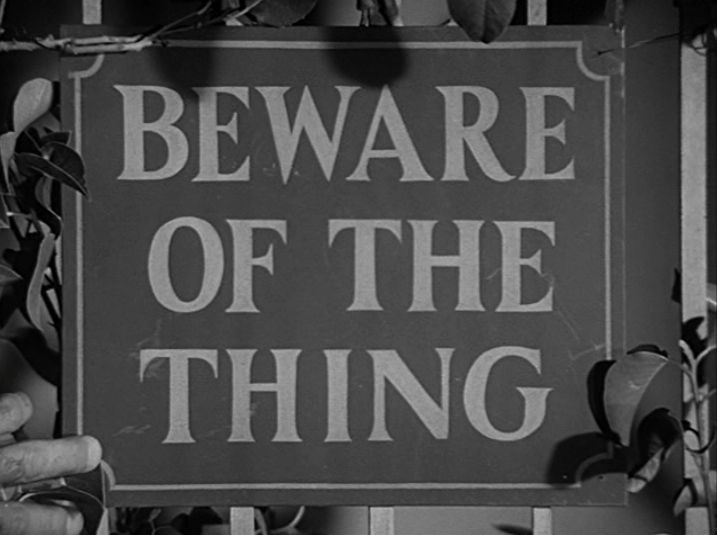
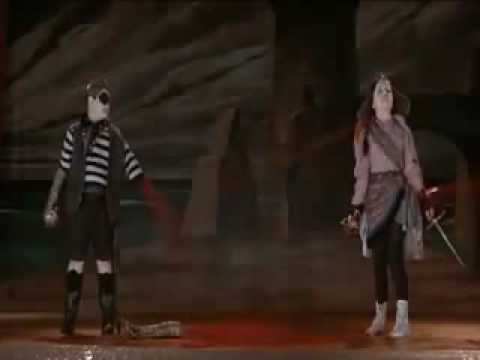
Sonnenfeld ramps up the film for all it's worth, making a lot—in fact, too much—of the character of "Thing," the disembodied hand-servant to the Addams, but the only time the film gets lively is when children Pugsley and Wednesday are forced to participate in a school version of "Hamlet" which involves a sword-fight that they make look decidedly real. Sonnenfeld had the help of two legendary craftspeople Owen Roizman (who shot The French Connection and The Exorcist**) and master editor Dede Allen (who edited Bonnie and Clyde, Slaughterhouse-Five and Reds), but even played well, the material is stale, and was a major disappointment.  When it was announced that a sequel was being prepared, one could only think "...why?"

One of the Addams cartoons used in the film—this one
before the credits! \Frankly the film could have used
more of this and less of what they did use, which was
watered down sit-com material.


Addams Family Values (Barry Sonnenfeld, 1993) As much of a fan as I was of the "Addams" television show—I liked them, far more than the bland television families usually presented—I didn't even go see Addams Family Values in the theater (I was working—a lot).  

Big mistake. Sonnenfeld was back, having completed a slightly tamer Michael J. Fox comedy in the interim. Dede Allen was gone. Owen Roizman was replaced by Don Peterman (who'd DP'd Star Trek IV, Splash, and Flashdance) and Ken Adam, legendary Art Director, came on-board.


But the most important element was the script...written by Paul Rudnick*** with what must have been a poison pen from an inkwell filled with snark and maliciousness. It is an extraordinarily funny movie, despite an unpromising premise: the Addams welcome a new child to the family, a boy, Pubert (the original name Charles Addams gave to Pugsley, which was rejected by the network censors). 
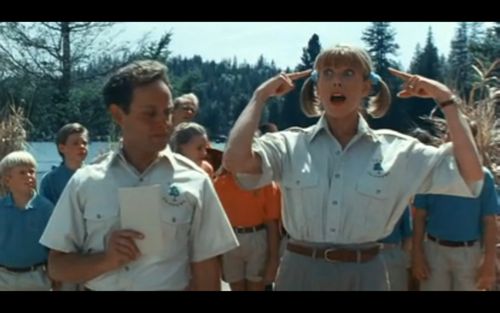
This creates enormous tension in the family, as Pugsley and Wednesday exhibit jealously and make many plans to kill the child, who manages to thwart their every efforts. Concerned, Morticia and Gomez hire a series of nannies for the kids, all of whom are frightened away by the children, except for Debbie Jilinsky (Joan Cusack, never funnier), who attracts the attentions of Uncle Fester. When the children become suspicious of her behavior, she convinces Gomez and Morticia to send them to Camp Chippewa, run by the extraordinarily wasp-y and perky Gary and Becky Granger (Peter McNichol and Christine Baranski), who make no secret of their disgust with these "weird" children who don't fit in.
Indoctrination in Addams Family Values
Now, that is truly creepy.  And funny.  The "Camp Chippewa" segments are the best of the film's sub-plots, indicating that if someone wants to do another film with the Addamses they need to 1) get them out of the house and 2) hire Rudnick (This iteration's Gomez, Raul Julia, sadly, passed away a year after Addams Family Values was released). But, the entire film has more zest, more life (or what passes for it, given the subjects) and genuinely twisted humor than the original exhumation.****  
 
It's always a pleasure to run into on the tube, no matter at which point one comes in.  
* I love doing this if only to share finds: like Carel Struyken's 360 photography site, which you can find here.

** Roizman left the production after a month. Sonnenfeld, who started as a cinematographer with the Coen Brothers, ended up finishing the film himself.

*** Rudnick did some dialogue touch-up on the first film.

**** I've spared a lot of the quotable lines (they're peppered all over the Inter-spider-web anyway), but one little joke I love is the lighting of Morticia in Values-taking the "Kirk-lighting effect" used a little in the first film, and in the second, bending lightwaves backwards in order to achieve the same effect in every. single. shot.

Finally, this is my favorite Charles Addams cartoon....