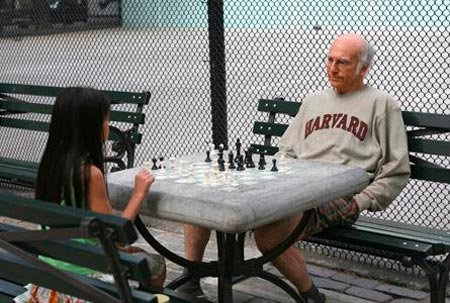
"And Sometimes, Finally, a Cliche is the Best Way to Make a Point" or "Mommy, That Man is Talking to Himself" ("Come Along, Justin")
Boris Yellnikov (Larry David) is a genius. A misanthropic genius, to be sure, but a genius; he's only too happy to tell you that he almost won a Nobel Prize for his work in quantum mechanics, specializing in string theory. He's also only too happy to tell you that you're sub-normal, a microbe!, an inchworm!, a potzer!, a troglodyte!, a mouth-breather!—and in fact, at a couple points during the film he turns to the audience and turns on them...us...to tell us what he thinks of us. A lot of movies choose to insult its audience these days (sometimes directly, sometimes by what the makers think they can get away with), but Yellnikov has the courtesy of treating anyone who chooses to listen to him the same disparaging way. >He has a lot of views about quantum theory, the Heisenberg Principle, but never mentions the Konigsbergian Bubble Theory, in which the world is essentially a sub-set of forty individuals restricted to a single geographical point, 15 of whom have speaking parts.
Whatever Worksis a return to Woody Allen's World, and its story of a young girl turning the heart of a beast is familiar ground, coming across as a "Woody's Greatest Hits" film—you'll find bits of Annie Hall, Manhattan, and particularly Hannah and Her Sisters—with its scenes of turmoil in the marriage between intellectual Frederick (Max von Sydow) and sensitive former-student Lee (Barbara Hershey). And Whatever...'s Melodie St. Ann Celestine (Evan Rachel Wood) is the latest in a long string of naive young waifs portrayed by Diane Keaton, Mariel Hemingway, Mia Farrow, Mira Sorvino, Samantha Morton, Juliette Lewis, and Scarlett Johansson. One could make some excuse about Allen returning to themes he explored earlier in order to form a more perfect coalescence of his ethos and it would be as pretentious as it sounds. Allen says that Whatever Works is an early screenplay he wrote in the 70's with the intention of it starring Zero Mostel. When Mostel died, Allen shelved it. So, the truth is Allen has been cherry-picking from this script for years to make some of his earlier, better pictures.
Although this is one stretch of New York City pavement worn a bit thin, there is something unique about it. One thing you can count on in Allen's movies is his autobiographical characters, the passive aggressive smart-asses played by Allen or a surrogate (past stand-in Woody's have been Mia Farrow, Mary Beth Hurt, Kenneth Branagh, John Cusack and Edward Norton). But Yelnikoff isn't passive at all, and David plays him as he does much of his work...at 110%. This should get tiring, but it doesn't, and that's a very tricky thing to pull off. Mostel could do it, with his razor's edge timing and comic flailing, but David doesn't have his gifts as an actor. David merely sends off "vibes" that he could actually be this self-absorbed (he did co-create "Seinfeld," after all), and as with George Costanza, the entertainment value is in watching the train wreck. He's the reason to see Whatever Works (and his character is of the opinion that's the main motivation of the audience).
So, if you're going to go, go already, but understand that you'll see a lot of the same themes that have come before: of the chameleon nature of personality due to environment, of universal impermanence and the embracing of it, that it's a long, long way from May to December, and that it's not such a stretch for a physicist to move on from string theory, and pursue post-doctorate work on the ties that bind.
Clue(Jonathan Lynn, 1985) It was director John Landis who came up with the idea to make a movie of the famous murder mystery board game. "Clue" was a staple of those stacks of board games in homes (at least it was in my home when I was growing up) and it guaranteed a good hour or so of fun, even if you did lose a murder weapon or two in the set-up and take-down.
And those murder weapons—a candlestick, a dagger, a lead pipe, a revolver, a rope (with noose!), and a wrench—were all nefariously blunt ways to dispose of people, whether in the library, the billiard room, the conservatory, the ballroom, the kitchen, the dining room, the lounge, the hall, or the study (not to mention the cellar!). What sort of sick mind would come up with this thing?
Well, apologies to Agatha Christie, but the man who came up with it was a Birmingham, Englander named Anthony E. Pratt (he died—I'm not sure by what means—in 1994), who put out a patent for a murder mystery game called "Murder!" He sold the idea to British game manufacturer Waddington's House of Games in the UK, who released the thing in 1949 under the name "Cluedo." Originally, there were other weapons including a bomb, a syringe, a shillelagh, a fireplace poker, and an axe and poison. In the U.S., Parker Brothers released the game under the name "Clue," where, on both sides of "the pond" it enjoyed decades of success, even inspiring a young boy by the name of John Landis.
Where were we?
It is 1954 and six Washington D.C. residents are invited to a New England mansion, Hill House, where they are escorted to dinner by Wadsworth the butler (Tim Curry) and the maid Yvette (Colleen Camp). But, why these six individuals and why are they given pseudonyms, rather than being referred to by their real names?
A seventh guest, Mr. Boddy (Lee Ving) arrives and it is revealed that he has been blackmailing all of them.
"Mrs. Peacock" (Eileen Brennan) is the wife of a prominent U.S. Senator who has been taking bribes. "Mrs. White" (Madeline Kahn) may have murdered her nuclear physicist husband. "Professor Plum" (Christopher Lloyd) has had an affair with a patient and lost his medical license. "Mr. Green" (Michael McKean) is gay, but must keep it secret lest he be fired from his State Department job. "Colonel Mustard" (Martin Mull) is a war profiteer selling military parts on the black market. Miss Scarlett (Lesley Ann Warren) runs a D.C. brothel. None of this looks good on a resume, which is why when they're informed by Wadsworth that they only 45 minutes before a contingent of police arrive, so they have been pulled together to turn him over to the police for his blackmailing schemes.
Well, to make a long story short,* Boddy reminds them, though, that if he arrested, he will gladly reveal all their secrets to the police, and suggests an alternative: he gives them each a weapon and suggests that as Wadsworth has the only key that will allow them to escape, one of them should kill the butler when Boddy turns out the lights. Boddy turns out the lights. When they're turned back on, it is Boddy himself who has had his lights turned out.
Oh, bother. Whodunnit?
Really, who cares? The strength of Clue—as opposed to Murder By Death
—is that, for a comedy, it has a fairly good laugh-to-stinker ratio. And Lynn has insisted that it proceed at a slightly faster pace than a Marx Brothers movie. Yes, it will pause for an audience laugh, but for the shortest amount of time possible, before setting up its next joke. Not only that, but it throws in a considerable amount of slapstick.
Slapstick that looks really painful.
Really painful. But, then what do you expect when you have six or seven live characters within a house with secret passages and a lot of marble flooring? There has been some careful study of early comedy films for this one and so the pace rarely flags, even, at times, it does exhaust. But, there is a measured quantity of vocal humor before something physical happens, which relieves some of that pace.
Plus, the cast is perfectly capable of tossing in a look, a reaction, a bit of business, or—in the cases of Kahn and Curry—line readings that are so exquisite that you want to hear them again...immediately. There is the little conceit of there being three endings—a fourth was scrapped—and that's a bit lame, especially as they all tend to have a momentum-crushing finality with no pay-off when you expect there should be.
The Big Picture(Christopher Guest, 1989) Every film-maker who has ever made a film in Hollywood has had a sneaking desire to make a film about the absurdities of making a film in Hollywood. There's just a considerable smaller amount who have the balls to risk reprisals in the company-town. One doesn't shit where one eats. There's an even smaller amount who have the talent, wit, and lack of invective to point out the absurdities without making it a hatchet job...or a crashing bore.
Chris Guest's 1989 film falls somewhere in-between, retaining the wonder-lust of film-making with the soul-crushing corporate low-balling of vision. Having the creative impulse doused by a flood of compromises and bidding agendas.
Budding film-maker Nick Chapman (Kevin Bacon) is "hot", having just won a film-making competition and given the opportunity to pitch ideas for "projects." Taking a meeting with studio producer Alan Habel (J.T. Walsh) gives him flashing hope until Habel wants to make changes to his ideas more in line with Habel's peccadilloes. Then, there's the "Catch-22" of not having an agent—he can't be taken seriously without one but can't get one until he's taken seriously. So, he takes a lunch with a prospective agent (Martin Short), more interested in being seen than seeing what he can do.
Then, he gets invited to a Hollywood party given by Habel and his wife (Fran Drescher), but it's less about working than distraction—touring the house, socializing, networking. One of the biggest distractions is Gretchen (Teri Hatcher, her first film), aspiring actress, who further pushes Nick from his artistic visions by suggesting that he write his movie with her in mind. Her efforts further complicate Nick's life by making his girlfriend Susan (Emily Longstreth) jealous, driving a wedge in their relationship. Gretchen becomes the embodiment of every Hollywood enticement, moving him further from making HIS movie and compromising his aspirations. Pretty soon, his potential movie is so far afield from his intentions that his enthusiasm starts to wane, and ultimately, his film is canceled, forcing him to take entry-level jobs in Hollywood just to make ends meet.
Oh, how far the lofty intentions fall. It's hard to drum up much sympathy for Nick—sure, the Hollywood system is corrupt and capricious, but Guest at least makes his downfall as much about the weakness of Nick's character as the environment he's stepped into.
That story, thus, is not that involving, and it has a hard time competing with the opening of the showing of student films vying for Best of Show, which is a hilarious look at the pit-falls of student film competitions; they involve a film by an agent's son—loaded with recognizable stars, but clearly shot at a time when those actors are available, with mismatched shots showing that nobody was on the same set at the same time—or a full-of-itself vanity project by a young filmmaker with an outsized ego featuring himself in a starring role. The satire of the sequence is sharp and cruel and the rest of the film never lives up to the potential of the opening sequence—an inadvertent portent for what is to come for its hero.