The Postman Always Rings Twice (Tay Garnett, 1946) Drifter Frank Chambers (John Garfield) blows in on the Santa Ana wind* and gets picked up along the road by a man called Kyle Sackett (Leon Ames), and gets himself dropped off at a local diner-slash-service station called "Twin Oaks" run by a genial old fellow named Nick Smith (Cecil Kellaway), who has a sign out front that indicates he could use a little help around the place. Frank can use the work, but he's not sure about it until he gets a look at the benefits, when he follows a fallen lipstick across the diner floor and sees Nick's much younger wife, Cora (Lana Turner), who shows up in a midriff-baring white two-piece number that one presumes she doesn't normally wear at job interviews for mechanics. With Nick, he's a bit of toady, but with Cora, it's a sparring match where he always ends up the loser. "The best way to get my husband to fire you is to not do what I tell you to do," she tells him once he's off work the first day. When he grabs her in a clinch later, she just fixes her lipstick and walks away...slowly. She's funny that way.

But Frank is confident. "I can sell anything to anybody," he brags. "That's what you think," she scoffs. But, a moonlight swim (with Nick's approval) starts to get Cora in a buying mood. And when Nick goes away to Los Angeles, Frank seizes his chance—there's a lovely moment when, he's tending the dining bar with one lone customer between him and trying to make his move on Cora and he stares the poor sap down until he's so uncomfortable he leaves...with a tip—closing the diner for business and giving his full attention to Cora. She finally answers the question that's nagged at him—why marry Nick? She tells him that since the time she was 14, she had to fight off a lot of guys—all of them—until she met Nick, with a ring and a proposal. "And you retired," he says. "The undefeated champ." "Not 100% undefeated," she says. And that is that.

Soon after they begin their affair—hours after, in fact, which makes you wonder if they had enough time to have an affair—they run off together. But, as Nash has the only available car, they end up bumming rides to get away, and that's just honest-to-goodness not good enough for Cora (even though it may be good enough for Frank. *CONFLICT ALERT* She doesn't want to start out their life together as bums...like Frank. Besides, if she just up and leaves, all the work she put into Twin Oaks will go waste, as Nick would surely keep it in a divorce. So, the two go to plan "B" by dialing "M" for murder: they decide that Cora will get to keep Twin Oaks if they kill Nick. Well, at least kill Nick and get away with it.

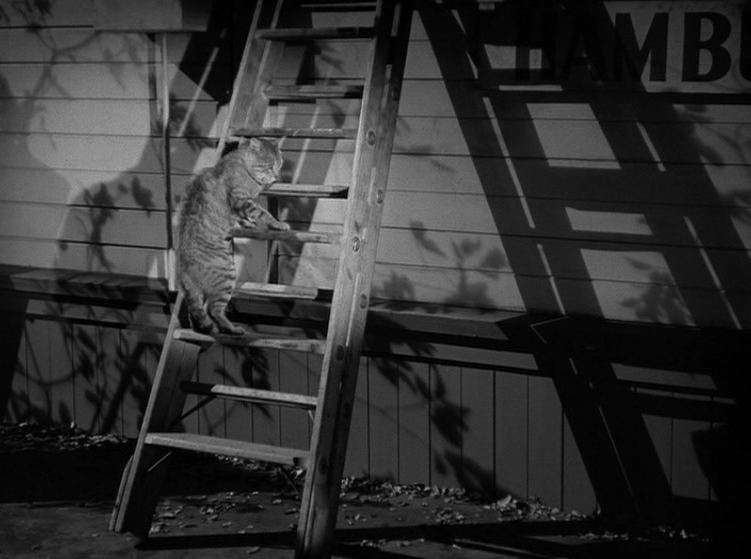
And so, they hoof it back to Twin Oaks, waiting for Nick to come back. He does, conveniently weaving from from too much drink in the city, but not conveniently enough that he's killed drunk-driving all the way from Los Angeles. The plan is for Cora to clobber him in the bath-tub, so he falls and drowns. But, Fate, in the form of passing cars, busy-body motorcycle cops, and a darn cat manage to escalate the dread and foil the plot. Nash only get conked on the head by Cora, but a black-out-by-cat keeps the plot from being completed, and he ends up in the hospital, undrowned, with no memory of it happening at all. The speculation is that it's from his "fall" in the bathtub, but I'd make a case for him being "so drunk last night."

When Nick comes back to Twin Oaks, he decides to sell the place and move him and Cora to Canada with his sister, and that's something that Cora just won't do—so to prevent it, Frank and Cora stage a car accident, hitting Nick over the head—again—and the crash to explain the injuries that killed him.
Nick does die, and Frank is injured, but the District Attorney trying the case is the same Kyle Sackett who drove Frank into town, and, thinking that it's all too coincidental, separates the two lovers and gets a statement from Frank when he only files charges against her. The two turn on each other, and it's only through the machinations of Cora's lawyer (Hume Cronyn) that she only gets a manslaughter charge for being the driver of the vehicle.

Cain's sordid little story is given a veneer of M-G-M glamour throughout, making the affair between Frank and Cora much more romantic than it should be—after all, chicanery and murder are what bring the two together and what will ultimately drive a wedge between them. Everything looks clean and tidy and Frank is one of those lucky mechanics for whom grease never seems to stick, not even under his fingernails. Turner is always photographed in the best possible light and a shimmering gauze in close-up's. One may almost get the impression they're innocent of murder or deception. But, Cain's story ultimately catches up to them and anything illusory becomes tragic reality, when Fate comes a-knocking again and disturbs any complacent slumber and the dreams it may contain. The postman will always ring twice, just to shatter any misconceptions.

 The Postman Always Rings Twice (Bob Rafelson, 1981) Cain's story was remade in 1981 with no pretensions by playwright (and ultimately director) David Mamet (his first screenplay), who takes the romance out of it, and with the more low-key direction of Bob Rafelson, makes the circumstances a lot more tawdry. The major difference is that the 1946 M-G-M version is a "PG" version, slouching towards a "PG-13" (if such a thing existed at the time), whereas the 1981 Warner Bros. version is a tumescent "R," where the participants are desperate people, unattractive in body or spirit. The disparities between the people involved are seen in a much harsher light. The novel's depiction of Nick Papadakis ("The Greek") is brought out with more emphasis on his ethnicity and the casting of John Colicos makes one wonder why this version's Cora—in the depiction of Jessica Lange—would "settle" for this particular man for any reason other than being sold to him or by any others means beyond some kind of blackmail.

One even wonders why she would find Jack Nicholson's drifter a more attractive alternative. Not that the actors' ages make that much of a difference—Nicholson was only 43 at the time of filming; Lange was 31. But, Nicholson was only 10 years younger than Colicos, and although a great actor and (sure) a star, he was beginning to get doughy, his hair thinning, and progressing from his younger, angular good looks to a young middle-age. Would a beauty like Lange's Cora risk everything for him? One wonders.

The story proceeds the same, but back in Cain's original era of the Depression years: Drifter. Twin Oaks. Older husband. Male lust. Female need. Clinch. Affair. Murder. Ring-ring. But, there's nothing romantic about the Frank-Cora affair in this one. The two start out just as bitchy as the 1946 version, but when Nick leaves town, there's no embrace and kiss—it's a lunging, violent sex-scene that starts out as a rape, with the major indication that Cora wants it as badly as Frank does ("Come on!") is she clears the bread-table—loaves, dough, bread-knife, flour (one worries about yeast infections)—with a clumsy wave of her arms and it's a big dusty fumble with a lot of flailing and almost comical moans of exertion.
Ya know...like sex turned out to be rather than what you imagined...
But, it's not enough that Rafelson and Mamet strip away the romantic veneer that played such a part of the M-G-M version, they've also added a sado-masochistic kink to the affair, with a lot of roughage and slapping—Cora spits in Frank's face at one point and there's a disgusted curl to her lip when she says "You're scum, Frank. I knew that when I met you. You'll never change." This is "trading up?"

One gets the impression that this is what she wants and it's what she thinks she deserves and is resigned to her fate. She's certainly not as ambitious as Turner's Cora. She just "settles" for slightly higher increments. And Nicholson's Frank isn't a go-getter drifter, he's just a snake, who'll turn any situation to his advantage. It does make his turning on Cora once Nick is killed a bit more understandable, psychologically. He thinks he's the master of his fate, and a white trash Master of the Universe, who, if he knew about Ayn Rand, would cling to objectivism as an excuse for what is basically selfish self-interest. Maybe he and Cora have more in common than originally thought.

It made me think less of a human drama than of zoology—we're dealing with much more primal instincts that crouch deep in our alligator brains. Cora calls Frank an animal when she sees him drinking milk out of a bottle instead of a glass and one can see their relationship as more bestial—the male lion lords it over everybody while the female is the more practical of the sexes. But, it's a completely different power dynamic than from the '46 version, which has more to do with entymology. In that one, Cora is the queen bee, giving the illusion that the men are more than mere drones...and potential victims.
"Aren't we ambitious?" Garfield's Frank cracks at Turner's Cora when she talks about her plans for Twin Oaks. Of course she is, and at a level far higher than the men she encounters. And higher than Lange's Cora in the Mamet-Rafelson version.
But, Nature is red in tooth and claw. And, far more powerful than the machinations that preoccupy the creatures that plan and scheme and rut in The Postman Always Rings Twice. It can unravel any scheme that chooses to beat Fate.
* Raymond Chandler wrote about the desert winds that blew into Los Angeles: "On nights like that every booze party ends in a fight. Meek little wives feel the edge of the carving knife and study their husbands' necks. Anything can happen."