Showing posts sorted by date for query Raymond Chandler. Sort by relevance Show all posts

Saturday, February 1, 2025

Presence (2024)

Teen Angel, Can You Hear Me?
Teen Angel, Can You See Me?Why Do You Still Give a Damn
Why Do You Glide on Steadi-cam?
or
"Ghosts Are Ass-Holes, Man!" 

I have a friend who (so he says) became a psychic, though not of his own volition. One day, he walked into work and discovered that he could read people's thoughts and know what they were thinking (I should have asked him what number I was thinking of at the moment, but the story was too interesting to hear for some quick-thinking debunking). Anyway, he was a professional psychic for awhile and gave it up, settled down, raised a family. The toughest trick for a psychic is to STOP being a psychic...if you REALLY ARE a psychic.
 
Anyway, I went to a lecture he was giving and was driving him home and we were talking psychic stuff—its arcana and down-sides and my weird forays into TM—when I asked him "What about ghosts?" And he blurted, frustrated, "Aw, ghosts are ASS-HOLES, man!" He'd never met a ghost he'd liked, as they were always hanging around with some left-over agenda from their previous existence that they just...couldn't...let GO of! "One ghost was hanging around her daughter because she never returned a BOOK she borrowed from her! Can you believe that?" I actually could (and if he was really psychic he would have known that). But, he could never understand why ghosts just never let go and move on, especially as the way (I've heard) is perfectly well-illuminated.
 
So...Presence, director Steve Soderbergh's new film with a script by David Koepp that only cost $2 million bucks and (supposedly) has only 33 editorial cuts in it. That is as lean and mean as a movie can get, and I've always liked Soderbergh for his daring and his playing with the movie-form and his many invented ways to get movies made and/or distributed. He's the guy I'd want running DOGE over anybody else. Smart and experimental, but efficient as any director making movies—he even shoots and edits them under pseudonyms. And, in this one, he literally plays a larger part.
We open on a house. More actually, we open IN a house, looking through the window down at some pavement below and then the camera looks up and we see the window, turn around and we're looking at the empty bedroom of a vacant house. The camera glides through rooms, up and down stairs, down to the main floor into the kitchen, around the living room and out the window. Nothing to see here. Fade to black.
When we come back we're looking out the upstairs front window and a woman getting out of a car. "We" run down to the first floor as she enters and it's a real estate agent (Julia Fox) who's going to show the house to a family who soon arrive. They are, as we soon learn, the Payne's: Rebekah (Lucy Liu), Chris (Chris Sullivan) and the kids Tyler (
Eddy Maday) and Chloe (Callina Liang), both teens. Rebekah loves the place, but Chris has questions—are the schools okay? it's by a fire-station and are the sirens going to be annoying—and the kids are... preoccupied. Tyler's a jock and submersed in his phone—it's not even sure if he notices the house ("whatever...") and Chloe wanders around, not saying a word...except...at a couple points she looks directly at the camera, which then swiftly retreats away from her gaze. Nobody else notices or looks our way, only Chloe and only a couple times. In fact, the camera will move very close to people in intense discussions and there is no reaction. It's like we're invisible.
It's like we're a GHOST. Which is exactly what's going on here. There is a spirit in the house (something the real estate agent doesn't mention and probably doesn't know as she's focused on making a sale). Everybody is busy with other issues and so they don't notice, they're not attuned to it. Only Chloe who is sunk deep in depression over the death of a friend—accidental overdose it was ruled—is aware that there's an unseen house-mate, who's useful at putting her books away or causing a fortuitous distraction. One night, on the edge of sleep, she senses something in the closet (the spirit's go-to refuge), gets up, wanders to the center of the room and tentatively asks "Nadia?" It was the name of her passed friend.
There have been plenty of "point-of-view" movies. They were quite prevalent in the day of slasher horror (but only sparingly—but enough that it became a trope—and usually to disguise the perpetrator or increase suspense ala The Silence of the Lambs), and Orson Welles was going to use it for his aborted first RKO film Heart of Darkness, and director Robert Montgomery employed it (partially successfully) in his adaptation of Raymond Chandler's The Lady in the Lake—quite naturally as Chandler wrote his mysteries in the first person. But, it's a gimmick, like those movies employing found media (I'm thinking The Blair Witch Project and Cloverfield) where the point-of-view technique is meant to be claustrophobic and limit what is shown. It's a distraction, as well.
Interesting that there are a couple of extra chairs at the dinner table.
Expecting guests, are we?
But, not here. "Our" role—as we, the audience, don't have a choice in the matter—is not as a stand-in for the narrator or the director's presence (although director Steve Soderbergh DID shoot the whole thing himself, so one could say that he is portraying the ghost). We are the observer (as per usual), like the presence, unseen and unheard—but, even if we don't, it is still quite capable of making an impact.
The film is of our time, and what is going on in the lives of the Paynes is distrust, an uneven power dynamic between the four, and involves teens and bullying and social media, plus an unsolved murder or two, all seen through the eyes of a spirit who knows a few more things than we do and acts accordingly when it feels the urge to. One may have a qualm or two with its selective abilities ("Well, if it can do that, why can't it do this?") and it all may come down to cherry-picking for the sake of dramatic effect and suspense. Given the amount of detail that Koepp and Soderbergh put into the scenario, one suspects that they were just interested in telling an engaging story and didn't want resolutions to be too easy. Poltergeists can't do everything. If they could, they'd be guardian angels...which is another pay-grade.
Are ghosts ass-holes? I don't know. Presence would make the argument against—that they serve some purpose other than flickering lights and poltergeisting to their sacred hearts' content. And "Ass-holes" is a little judgy. Plus, it's never a good idea to look down on things that can look down on you (especially things known for knocking things off ledges). Maybe ghosts are just like those career-people who absolutely refuse to retire and can't imagine themselves relaxing with a harp. That's a little relatable. It certainly would be to Steve Soderbergh who's said at several junctures of his career that he's going to retire and he...just keeps...making...movies.
 
I certainly hope he does...if the spirit is willing.

Friday, November 8, 2024

I Know Where I'm Going!

I Know Where I'm Going!
(Michael Powell
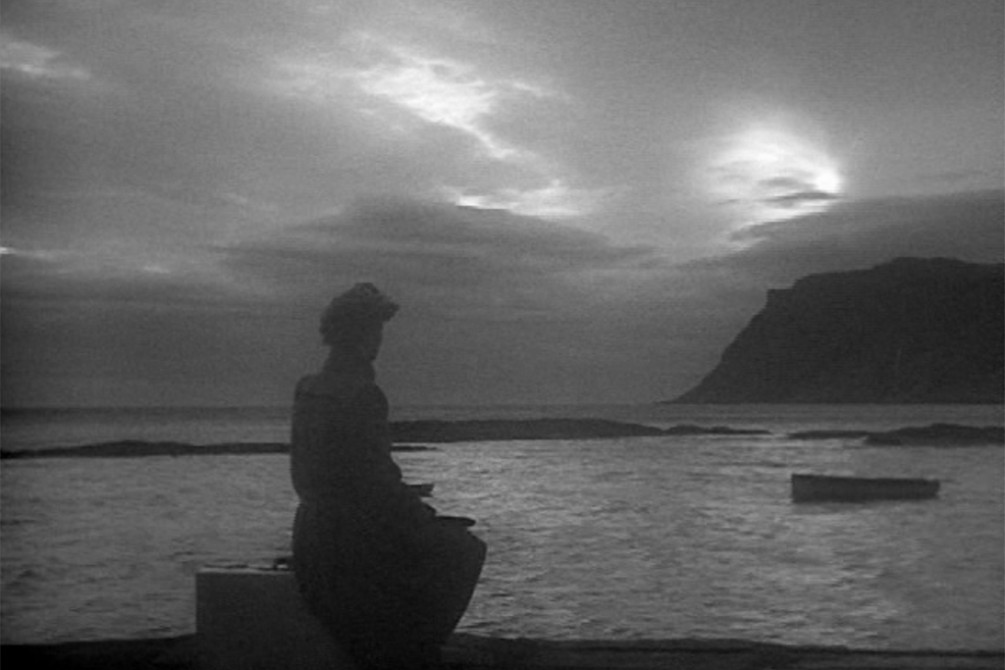
/Emeric Pressburger, 1945) Wendy Hiller stars as Joan Webster, a determined woman whose whole life has been planned out and played out according to her own well thought-out scenario. Now, she's traveling to the Scottish Highlands to marry her industrialist fianceĆ© (head of Consolidated Chemical Industries) on the Island of Kiloran. But to get there—and become "Mrs. Consolidated Chemical Industries"—she must book boat passage from the Island of Mull. But Nature and Fate conspire to keep her Mulling and scuttle her schedule, while the cutely eccentric citizens cast a spell all their own.
 
By all accounts, it should never have been made. Powell and Pressburger were going to make A Matter of Live and Death for the Rank Organization after a request that they make a film that might help cement relationships between the British and Americans. But, the plan was to make A Matter of Life and Death partially in Technicolor (why "partially" is best explained by seeing the movie). But with all the Technicolor cameras being used by the American military for training films, The Archers (the company name of Powell and Pressburger) had to delay filming until they became available.
 
What to do in the meantime?
Pressburger knew that Powell loved spending his initial down-time after a movie by going to the Scottish islands and proposed a story about a woman who wanted to make a transit to an island but couldn't and by the time one's available she's made the decision that she no longer wants to go.
Pressburger wrote the story in a whirlwind four days, and Powell and he fine-tuned over a matter of a couple weeks. Initially to star Deborah Kerr and James Mason, The Archers had to navigate their own troubled waters as Kerr had a contract at M-G-M and couldn't get out of her commitment (either that or Powell and Pressburger didn't have the money—they certainly didn't!—to pay M-G-M to loan her out) and Mason didn't want to spend his days "camping out" with the crew in an out-of-the-way location. Wendy Hiller, whom Powell and Pressburger had wanted for The Life and Death of Colonel Blimp—her parts had been played instead by Kerr!—was signed and Roger Livesey was ultimately cast as one of the island's residents (ironically Livesey was doing a play in London and never went to the Hebrides locations, but did his part in the studio filming—Mason needn't have worried about the rough conditions).
For Powell and Pressburger, it was something of a lark, and allowed them to continue an anti-materialist theme that they'd started with their previous film, A Canterbury Tale, of the aesthetics of rural life, while also breaking their four-film streak of making war films. A whimsical love story was just what was needed. A whimsical love-story with a third-act action sequence where our heroes nearly drown in the
 Corryvreckan whirlpool, but a delightful one, nonetheless.
 
Powell and Pressburger create a film concoction with fantasy elements, surreal dream sequences and musical interludes, taking a straightforward story and applying an extremely creative approach to it. The story may seem overly familiar, but not the approach to it which keeps one watching intently to see not so much what will happen, but how. No less an expert as writer Raymond Chandler wrote of it: "I've never seen a picture which smelled of the wind and rain in quite this way nor one which so beautifully exploited the kind of scenery people actually live with, rather than the kind which is commercialised as a show place."
 
It's a lost little gem that shows what a creative force "The Archers", the team that made The Red Shoes, could be. Also, look for a short appearance by a child-actress named Petula Clark. Yup, that one.

Thursday, May 23, 2024

Shane

Shane
(
George Stevens, 1953) George Stevens came back from World War II a changed man...and a changed director. As documented in Mark Harris' book "Five Came Back" and its subsequent documentary, Stevens had started his career a director of comedies, but, after the war, he became a different film-maker. His service in the Second World War was in the combat motion picture unit from 1944 to 1946, where he documented the landing at Normandy, the Battle of the Bulge, the liberation of Paris and the uncovering of the horrors at the Dachau concentration camp, where he stated that he realized his function deepened from simple documentarian to collecting evidence of the greatest atrocities of the century. His footage was crucial in the post-war Nazi trials, but, he found no solace in the role he played. As he wrote to his first wife in 1945 "if it hadn't been for your letters . . . there would have been nothing to think cheerfully about, because you know that I find much [of] this difficult to believe in fundamentally."
 
Coming back from the war, he co-founded Liberty Films with fellow Army Signal Corpsmen Frank Capra and William Wyler, but made no films for the fledgling production house and the company folded. He would not make another film until I Remember Mama (1948), a film that bore some resemblance to his own upbringing in America. Then, 1951's A Place in the Sun, a dark tale of a man's duplicity and fall from grace, won him an Academy Award for Best Director. 
 
His follow-up film was far-afield from the subject matter that was associated with Stevens both pre-war and post-war—a Western that sharply demarcated right and wrong, almost naively making a world where good wins out over bad, without the complications and hollow justifications of an adult sensibility, Shane. 
In the Jackson Hole Valley of the Grand Tetons, the family Starrett are homesteading in a wild area still trod by deer and elk. In fact, in one miraculous shot an elk frames an approaching stranger between its antlers. When Joe jr. (
Brandon De Wilde), out stalking deer with his bullet-less rifle, spots the stranger coming onto their land, he alerts his Pa (Van Heflin), who is still trying to get rid of a stump he's been hacking away at for months. He and wife Marian (Jean Arthur) have been homesteading in Jackson Hole for some time, but he is frequently being sabotaged by cattle baron Rufus Ryker (Emile Meyer), who claims the land as his for grazing rights and has made it a campaign to rid the valley of "squatters," by having his men (including Ben Johnson and John Dierkes) run roughshod over Starrett's and the other homesteaders' properties).
So, Joe Sr. isn't altogether welcoming, seeing a stranger enter his property. He tells the buckskin wearing newcomer (Alan Ladd)
, who is suspiciously vague about what he's dong there, to vamoose.
As bad luck would have it, before Shane can reach the fence, Ryker and his goons show up with news. It seems Ryker is going to be providing beef for the nearby reservation and he needs Starrett's land for them to graze. Joe refuses and things start to get testy, until, finally, Ryker starts making threats.
At which point, the stranger re-enters the scene and introduces himself as "a friend of Starrett's" and seeing how he's armed, too, Ryker backs off with a final warning to clear out or the Rykers will clear them out themselves. The stranger's intervention casts him in a different light to Starrett, and introductions are made.
The stranger's name is "Shane." Just "Shane." No indication if that's christian or surname. And, for his stance on behalf of Starrett's family he's invited to stay the night and have a meal, which he compliments as "an elegant dinner." Then, without any prompting, he goes out and works on cutting out that stump as a thanks. Starrett goes out to help and between the two of them, they're able to clear the stump at night-fall, a task that the homesteader had been working on weeks. Starrett asks if Shane wants to work there, as he most certainly seems to want to help.
So, who is Shane? He doesn't say where he came from, and as to where he's going? "Heading North—one place or 'nother. Some place I haven't been." Some place he isn't known is what he means. That would seem to be a contradiction as he's quiet. Polite. Keeps his counsel. Knows his place even if he doesn't have a place. He's rootless...in a community trying to establish them. He feels comfortable there, despite that, but never so comfortable that he can't be snapped out of it at the first sign of trouble. He doesn't make trouble, but he's seen enough to know trouble will almost certainly come to him as it seems to have come to him in the past.
He's twitchy. When little Joey pumps his unloaded rifle, Shane whips around, ready to draw down on him. He's haunted, probably because of his skill with a gun and having had to use it. And he's ridden into a situation where trouble could come from across the fence, ready to tear that fence down if it's in the way. Ryker is one of those breed of men who fought hard to establish his stake and will fight just as hard to keep things the way they were when there was no one else but him. He's not interested in community—he's all the community he needs—and he resents seeing what he thinks is his from being parceled out to newcomers. To "others."
It's why the homesteaders are being harassed. Some have suffered enough intimidation that they're threatening to leave and it's only the entreaties of Starrett that keep them from leaving. Shane, himself, is on the receiving end of those taunts from one of Ryker's men, Calloway (Johnson), which ultimately leads to an old-fashioned bar-fight that wrecks the Grafton bar. Given the intervention of Shane into the struggle, Ryker brings in reinforcements, a sadistic gunfighter named Jack Wilson (
Jack Palance), who takes a satisfied glee in gunning down anyone he can provoke into a fight.
For a Western of that era, Stevens ramped up the level of violence than what audiences were used to. His fights were messy affairs that were tightly edited to maximize the cuts and scrapes one associated with the usual dust-ups. And anyone seeing Shane remembers the shoot-outs where a bullet could propel a person backwards like they were yanked off their feet (which they were, due to some discrete cabling).
In such a world it's no wonder that Marian Starrett tells her young son "Joey, don't get to liking Shane too much." There's always the possibility that a man such as Shane won't be sticking around for too long, whether riding out of town or being buried in the cemetery that overlooks the slip of a town. But, the kid can't really help himself. Shane is something of a mystery, not saying much, but giving the child the same level of attention as he does the father and the mother. That makes an impression on a kid. And his proficiency with his fists and his guns—all fascinating to little Joey—endears the man to the boy.*
Stevens is playing with Myth in Shane, and nowhere so boldly as in little Joey's hero-worship of the competent stranger, his version of a White Knight, who gives him a lesson in strength in restraint (something Joey doesn't quite comprehend) as well as the cold competency in "doing what has to be done." To standing up in the face of wickedness, not backing down, no matter the consequences, and fighting the good fight. At times, it's almost too much, with Stevens cutting back and forth between fights and Joey's wide-eyed reactions to the fireworks.
And it all comes to a head when, once the killing is done, Shane takes his leave, having brought resolution—but hardly peace—to Jackson Hole. The dirty work is done, and just as there was no place for a killer like Wilson, there isn't for Shane, either. And despite the child's entreaties, there is no going back...not from what you've done. And not from what you've seen. It's a weird scene, simultaneously a bit over the top, but also punches the gut on an emotional level. Even more so when you take in George Stevens' history in the war.
That ending resonates...and haunts. Not so much as a small child's plaintive pleas, but of the echoes embedded in them of a director who had seen the worst atrocities perpetrated by man, and, through that boy, implores 
the darkening wilderness for a world of forbearance and a return of the merely and simply decent. 

In context, Shane is so much more than "a Western", and is heart-breaking. Fundamentally.
 
* And to the point, author Raymond Chandler (who'd written a couple of Ladd's noirish movies) had said this about Ladd some years earlier: "Ladd is hard, bitter and occasionally charming, but he is after all a small boy's idea of a tough guy."

Wednesday, May 8, 2024

Dead Reckoning

Dead Reckoning (John Cromwell, 1948) Notice the title in the poster—John Cromwell's Dead Reckoning, (as it is in the film's credits) indicating a special prominence. Producers don't allow the possessive credit (relinquishing some of their ownership, which they only do kicking and kvetching) unless the director is so powerful they can't refuse.

So, who's this John Cromwell?

We'll get to that; how's the movie? Well, it's
Bogart—not looking too healthy and struggling with the material, although it's tailor-made for him...if measured a bit too tightly. But it's warmed-over Bogart, stale and picked from elements of Bogart movies past, with all the presentation of a Chef's Mess. And you know how it is when you get the last leavings of anything Bogarted: not only is there a feeling of disappointment, but also a feeling of resentment.
Things start off well enough: Bogie's a coming-home paratrooper with his buddy to receive medals for valor, but before they can exit the train, the buddy disappears, prompting Bogart's character to start a search to see what's at the bottom of it. The film is introduced by Bogart's character eluding the police, and ducking into a church where, in complete shadow, he makes a confession of sorts to a priest serving as a first-person narration. So far, so good. However, the narration, like the dialog, is as purple as can be, with tortured metaphors and a desperation to remind of Bogart's detective roles (the best of which were done—of course—without narration).* We're introduced to the buddy's wife, Carol "Dusty" Chandler (Lizabeth Scott, meant to evoke Lauren Bacall, no doubt, but more of a bleached, washed out version of her), a low-throated chanteuse at a club run by the mob—and although it's surely unintentional, you get the impression that she must be sleeping with the owner, as Scott can't sing well, even by Bacall's (or the young Andy Williams')** standards.
The movie lurches along with some fine shadow-play, photographically, but that's about it, and it ends with one big howler of a leaden line, meant to have deep meaning and import, but is merely typical of the dumb lines Bogie has to chew through. There are a lot of immortal lines associated with Humphrey Bogart: "Geronimo, baby" is not one of them. ***
So, who's John Cromwell and why was he given possession of this stinker of a movie?

John Cromwell was a well-respected actor, who was also put of the directing fast-track at Paramount Studios when he signed with them in 1928. He continued in his capacity as an actor throughout his career, winning a Tony Award in 1952 for "Point of No Return" and appearing in Robert Altman's 3 Women, and A Wedding late in life.
But forget Dead Reckoning for a moment. Look at some of the other films he directed: the 1930 version of
Tom Sawyer, the Bette Davis-Leslie Howard version of Of Human Bondage, the Freddie Bartholomew version of Little Lord Fauntleroy, the Ronald Colman version of The Prisoner of Zenda, Algiers with Charles Boyer and Hedy Lamarr, Abe Lincoln in Illinois with Raymond Massey, Son of Fury with Tyrone Power, the "they also serve" war movie Since You Went Away, Anna and the King of Siam with Rex Harrison and Irene Dunne, the lurid Caged with Eleanor Parker. These are really good, and sometimes spectacular films made with a fine craftsman's hand.

So, why is John Cromwell not mentioned in the same breath as Hawks and Ford and the other film-makers of their generation?

The answer is simple. Cromwell was black-listed during the McCarthy era and his career seemingly thrown into a black-hole. Born in 1887, he was in his 60's when he filmed
Paddy Chayefsky's The Goddess in 1958. He was still pushing the envelope of what could be brought to the screen at the tail-end of his career.
You might also know him as the father of actor James Cromwell.
Dead Reckoning
aside, a re-evaluation and appreciation of his career as a pioneering film-maker is very much overdue.
 
* You'll also recognize lines and sentiments from The Maltese Falcon, To Have and Have Not, and The Big Sleep. More than once, the film evokes a "Deja Vu" feeling: "Now, where have I heard a better version of that?"

** The story goes that Andy Williams, when he was a kid, dubbed in Bacall's singing voice for one of her movies, but I've yet to see any concrete evidence (and a lot denying it) that that was the case, and not some malicious gossip (Bacall got a lot of that).
 
*** I think you have to chalk this one up to that period of time between the acknowledgement of Bogart as a big box-office star, and studios trying to figure out what to do with him. The roles and writing became better once Bogart took charge of his career and formed his own production company.

Saturday, March 30, 2024

Frank Miller's Sin City: A Dame To Kill For

It's "Just Another Saturday Night" and Saturday's are usually "Take Out the Trash" Day...
 
Frank Miller's Sin City: A Dame To Kill For (Robert Rodriguez, Frank Miller, 2014) Frank Miller became the darling of comic-book fans by bringing a mature, gritty, often brutal, sometimes mystical approach to iconic comic-book heroes—specifically Marvel's Daredevil and DC's Batman—when he got the chance to write them and mark them with a stamp of more than just india ink. He could be radically forthright in his interpretations, and for young men—and women—enamored of four-color literature (people who read comic books and take them seriously), he became one of the top-tier of comic-creators.

But, writing for "Daredevil" and "Batman", owned by corporate interests who were also interested in the longevity of the character and its marketability for selling T-shirts and toys—sorry, action figures—there was only so much creative lee-way he was allowed. Creating his own works—like the Samurai series "Ronin" or his spartan graphic novel about the Spartans, "300," let his talents bloom full-flower. His "Sin City" series let him tackle the noirish aspects of pulp novels, filled with roughneck men and soft women who were hard as nails, while employing a radical design sense of dark pages (rather than the usual white) blasted by white highlights of louvered light with just a dash of color. Miller allowed his drawing to become blocky and stark, emphasizing the filmic frame, rather than graphic details. And he bleached the traditional four colors of comics—just as the industry was benefiting from more sophisticated color printing—to a monochromatic night-scape (something artist Jim Steranko had used to great effect in his graphic novel "Chandler: Red Tide").

Miller's influence could be seen when the Batman character returned to the screen under Tim Burton's direction (but, more especially when Zack Snyder was allowed to tinker with the character later), and he was approached to do script-work, turning out the screenplays for Robocop 2 and Robocop 3. His graphic novels started to make their way to film and he was approached by Robert Rodriguez to script a film version of his "Sin City" series, to which he was added as co-director as the resulting film took so many cues from the original work—Rodriguez was even using the graphic novels as story-boards.
That movie, Sin City, was a success, making a lot of money and revived the careers of a lot of people, including Mickey Rourke, who was encased in so much prosthetics to play the character of "Marv", but it didn't distract from his acting (he even did press interviews in the make-up which was...weird). Sin City looked different. It felt different. Plus, there was the eerie feeling that you were watching a comic-book literally come to life—the same impression evoked by Zack Snyder's adaptation of Miller's 300—that the film was merely filling in the missing parts of the "money shots" displayed in the comics. But, it wasn't a movie you could take seriously—you needed a jaded humor to appreciate that it was over-the-top satire and not really reflective of the noir genre Miller wanted to ape. The dialogue was bad, clipped less from the gritted-teeth jargon of B-movie writing and more like Spillane spillage. What movie was it that said "the cheaper the hood, the gaudier the patter?"*  
Sin City (both the books and film) should be so lucky. It's a distillation of Hemingway minimalism and thug-mumbling, with punch-lines of nihilism that are supposed to be funny, but ultimately are just for an audience so low on Gustav Hasford's "phony tough and crazy brave" index that they think it's sophisticated. A.O. Scott had it right when he said that Sin City "offers sensation without feeling, death without grief, sin without guilt, and, ultimately, novelty without surprise." That's what they would call in these things "a head shot"—couldn't've been put better.

The financial success of the first Sin City led to a sequel of sorts—released nine years after the first one—featuring two original Miller tales as well as adapting his short story "Just Another Saturday Night", as well as the tale the film is titled for, "A Dame To Kill For".
The first film was a true anthology, with one of the stories being split up for a final resolution at the end. A Dame To Kill For jumps around, allowing time to pass for the healing of wounds and grudges to fester. The film also brings back characters from the first film—forget the fact that they might have died!—to continue stories or serve as prequels to the previous film.
The first story is one of Miller's shorter stories (from "Dark Horse Comics Presents") called
"Just Another Saturday Night" in which his character "Marv" (
Mickey Rourke) wakes up from an auto accident on the edge of town with no idea how he got there. This has to be an early tale—a prequel, if you will—because if you've seen the first Sin City movie, Marv was executed in it...by the electric chair.
The second story,
"A Long Bad Night" stars 
Joseph Gordon-Levitt as Johnny, a cocky gambler who comes into town for a big score with under-pinned reasons. He goes to what seems to be the only bar in town—Kadie's Place, where all the Sin City regulars hang out, like Marv, and where Nancy Callahan (Jessica Alba) dances. But, like everything in Sin City, it has a hidden side (given everybody's instincts one would think nothing would be hidden in that burg).
Senator Roark (Powers Boothe) arrives at Kadie's for the poker game in the back room—just missing being plugged by a vengeful-but-chicken Nancy for the death of her guardian angel, Hartigan (Bruce Willis—his character died in the last movie, but this is based on a comic book and nobody really dies in comics, even ones written by Frank Miller). Johnny, who's had a string of wins on the slots, uses one of the waitresses, Marcie (Julia Garner) to buy in on the game. 
 
He cleans out the Senator—who, of course, has a reputation and everybody named Roark in Sin City is not only a psychopath but a corrupt psychopath. With Roark seething, Johnny is advised by the police lieutenant in the game to blow Sin City and pronto, but, as nobody in town seems to have any sense whatsoever, Johnny takes Marcie and they decide to have a night on the town. It should be noted that, as this is an original Miller story for the movie, Rodriguez isn't depending on Miller's comics for story-boarding and shot-lists, but delves into something Miller doesn't do in his graphic work, which is to resort to surrealism.** It causes a bit of a disconnect when it happens, like suddenly a musical sequence pops into a kitchen-sink drama. Yes, it's a transition device, but it's something that Miller never resorted to, short of impossible acrobatics and virtiginous angles.
As soon as you can say the words "predictably obvious" Johnny is attacked in town by Roark's goons, which he manages to dispatch and tells Marcie he'll hook up with her later at a hotel. But, before he can high-tail it to safety, he's manhandled into Roark's limousine where his winnings are stolen, his fingers broken and he's left in the street with an added bullet in his leg and Roark telling him he's his bastard-son ringing in his ears. Johnny swears revenge because that's the chief economic product in Sin City. Fade to monochromatic black.
Cut to "A Dame To Kill For" featuring 
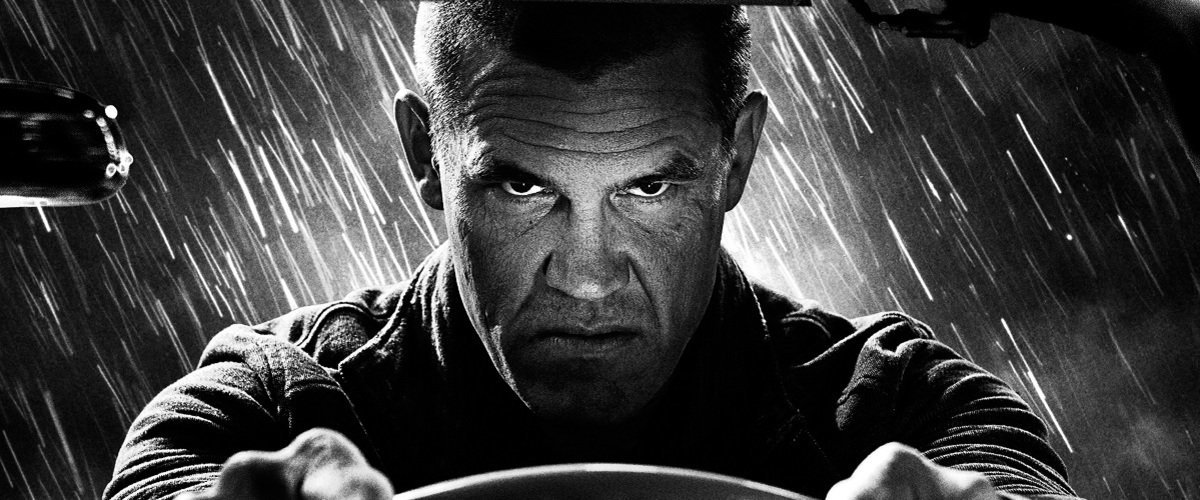
Josh Brolin as Dwight McCarthy (played by Clive Owen in the "The Big Fat Kill" in the first Sin City movie and Dame is a prequel to that story). Dwight is sober now, a private detective, and after a late-night rescue of a hooker (Juno Temple) from her corporate lover (Ray Liotta), he is contacted by an old flame Ava Lord (Eva Green) asking to meet him at Kadie's Place (natch!) to tell him that the fat-cat (quite literally) she left him for years a go is a violent abuser and that she now fears for her life. Dwight is non-committal, but he's an addict (isn't he?), so he can't help but go back to the Lord compound to see what he can do about her situation. What he spies doesn't tell him anything about abuse—Ava is swimming nude, obviously not showing any bruises and contusions—but, investigating further, he's beat up and tossed off the Lord property.


He goes home only to find a naked Ava in his bed. And, as Sin City people, apparently can't feel pain, he succumbs and the two frantically make love, despite his not trusting her and being beat up within an inch of his life. 
 
Another thing: With "A Dame To Kill For" Miller began experimenting with how much nudity he could get away with in his comics, usually with his by-now draping shadows, which, when Rodriguez replicates it for the screen, merely comes off as slightly ridiculous, along the lines of an Austin Powers "hide-the-wiener" sequence. Things are exposed, alright, but exposed as juvenile and puerile.
Yeah, yeah...I kvetch about the nudity, but I put these up...(for illustrative purposes, of course!)
And I might get a couple of extra puerile "clicks" for it.
Any after-glow he might have is interrupted by the Lord chauffeur-bodyguard Manute (Dennis Haysbert, replacing Michael Clarke Duncan, who had died in the 7-year lag between producing Sin City and Sin City: A Dame To Kill For) who beats Dwight up and tosses him out the window. So, Dwight has been beaten up twice over this woman—anybody detecting a flat learning curve?
Dwight's determined to save Ava, so he teams up with Marv (hey, it's a small town...) to strike the Lord compound and get her out, and although a fair amount of wet-work is done, the results are not optimum—Dwight ends up falling out another window after a few bullets to the body—and one to the face. Marv scoops up what's left and takes him back the detectives Old Town haunts, where he is tended to by a gang of assassin-hookers led by another old flame (Rosario Dawson) and the very dangerous ninja-assassin Miho (Jamie Chung), who heel his wounds and do some reconstructive surgery, presumably to help him look more like Clive Owen. The instruments probably won't need to be sharp as Dwight isn't that sharp himself, planning on making one more excursion to Lord Manor after his recuperation. The girls evidently don't do brain transplants...or extensive therapy.
 Here's another "film noir quote" for you: "So many guns. So few brains."***
Okay, enough about "A Dame To Kill For". Once enough people are pushing black-and-white daisies in that one, Rodriguez and Miller pick up the "Long, Bad Night" story...
Johnny, probably reading a Yelp! review of the reconstructive surgery-hookers, goes to see another saw-bones (Christopher Lloyd), a heroin addict, who resets Johnny's fingers (not sure why, as he presumably can look at his cards one-handed—it's not like he's a pool-hustler or anything) and sets out to get his revenge on his legitimately illegitimate Dad, the Senator. Absolutely busted, Johnny borrows a single dollar from a waitress (Lady Gaga...LADY GA-GA!?) and repeats the strategy that got him into the poker game at Kadie's...and cleans the Senator out...again. So...dear old Daddy shoots him in the head. End of story. We waited through the peek-a-boo idiocy of "A Dame To Kill For" to get this?
Yeah. But, it ain't over. There's still "Nancy's Last Dance"—remember the stripper at Kadie's...Jessica Alba/Bruce Willis...didn't shoot the Senator? Sounds like there's a revenge story going wasting. Can't have that.
Nancy decides to go after the Senator after spiraling into depression and drink and giving herself a bad hair-cut, all the time being watched over by the ghost of Hartigan...

Wait. Wait, wait, wait, wait, wait. Isn't "Sin City"—the concept—derived from the hard-scrabble reality of B-movies and pulp-books? Aren't they supposed to be rooted in the American Promise Unfulfilled, where the well-intentioned are driven to desperation due to the economic inequities that reward the retention of wealth by any means necessary, while the principled person "doing the right thing" can't even catch a break? Isn't the basis of these things the "Reality-Is-A-Bitch" principle (if you can call it that)?

And we got a ghost? What the Hell?
I'll go out on the shakiest limb—Stanley Kubrick once said that his version of "The Shining" couldn't be depressing because it implied the existence of an after-life. Right? It doesn't all end with death. We go on. There is no such thing as extinction. Even a BAD after-life is better than no after-life at all. You get a do-over. Another chance. You don't get "second chances" in film-noir unless "the other guy" is a sucker. And you don't wake up from "The Big Sleep" that's what makes it so bad. Death eliminates Hope...and the near-occasion of fooling yourself.

And yet, here's Frank Miller going all-Shirley Jackson on us. What a bunch a' hooey.
Or...maybe they just wanted Willis back, however implausibly, to boost audience recognition and as a box office draw. Talk about "hope". Didn't work, though; Sin City: A Dame to Kill For was an aesthetic failure, a critical failure, and a box office failure, the full negative-Hat Trick.
There's only so many times you can go to the well, when it's basically a dry hole. It's a parody. It's like telling the same joke twice in a row. Don't expect the same results both times. Resurrect all the characters you want; all you're showing is that you've run out of ideas.
One thing you can say, for sure, about Sin City: They've got a hell of a recycling center.

* Dashiell Hammett wrote it for "The Maltese Falcon." I've read everything Hammett ever wrote. He knew he was writing trash, but, by god, he made sure it was the BEST trash, and elevated the genre.

** Although he would when he was directing his film of The Spirit.
 
*** Yeah, that's Raymond Chandler from "The Big Sleep"