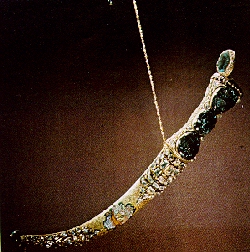
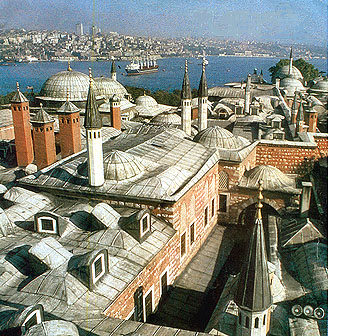
Topkapi(Jules Dassin, 1964)Dassin spoofs his earlier crime dramas with this comedy-caper (based on an Eric Ambler novel) set in Istanbul. There an odd assortment of crooks (Melina Mercouri, Maximillian Schell, Robert Morley) recruit an English prat (Peter Ustinov, who replaced a planned Peter Sellers and went on to win the Academy Award for Best Supporting Actor for the role) to take the fall for an elaborate heist—the stealing of a priceless ornamental dagger from the well-alarmed Topkapi museum. Shot in rapturous color—with an opening sequence that seems a precursor to psychedelic films—Dassin uses the local color to spice up the activities of the wily criminals and their elaborate scheme, which involves clambering over the pointed roof-tops, impeding the progress of a beam from a nearby lighthouse, suspending an aerialist over the display, while also precisely elevating its heavy glass case. It's one of those "Mission: Impossble" capers, where what could go wrong probably will, and the precisely planned plot goes out the window and they have to punt, lateral, and do whatever can come to mind to get over the goal line. The escapade is fraught with perils of all sorts, not the least of which is getting caught.
It's a jolly good time, and Dassin has as much fun seriously pulling off the robbery as he does spoofing the characters who fully fulfill the old adage of the best-laid plans of mice and men...and women. Twists and turns abound as much as a silhouette of an Istanbul skyline. Schell and Mercouri have never looked more glamorous—Dassin lovingly channels his Hollywood studio days with M-G-M with a directorial smile—and Ustinov has never looked more sweaty or been more peripatetic; Elizabeth Taylor won a sympathy-Oscar that year, and maybe the Academy did the same for Ustinov, seeing him scramble white-knuckled over high, slippery Istanbul rooftops.
For years, there was talk of a remake under the direction of Paul Verhoeven, with Pierce Brosnan repeating his debonair thief role from The Thomas Crown Affair to be called The Topkapi Affair. As it's been 18 years since that remake hit theaters, interest seems to have waned... at least until some studio head sees a heist film having a good opening weekend and asks if they have anything in the pile.
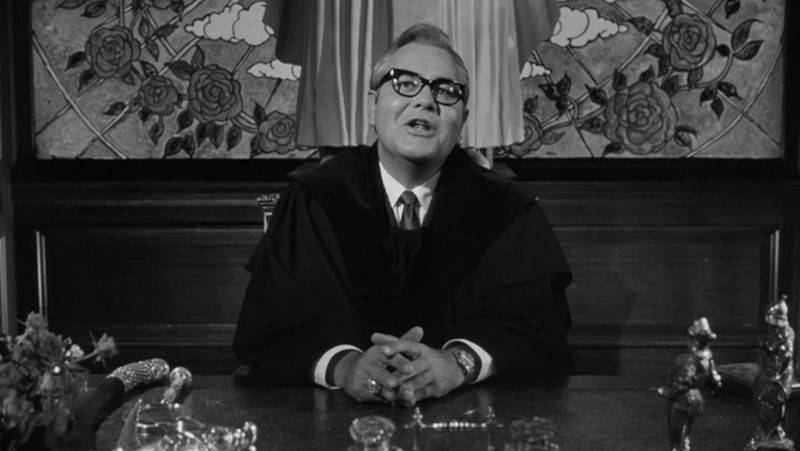
The Loved One(Tony Richardson, 1965) Director Tony Richardson "does" Hollywood, and it ain't pretty. There are lots of Tinsel Town screeds out there, mostly about personal mania (Sunset Boulevard, What Makes Sammy Run?), but few—like Day of the Locust—where the craziness seems endemic to the region and its excesses. The Loved One has an air of pretense with sanctimonious chortling while it shoots its fish in a barrel, casting the film with "types"—Liberace as a coffin salesman, Milton Berle as a crass businessman—that might be a little too leaden in its intent. Flush from his success with the multi-Oscar-winning Tom Jones, after toiling away over in the British "kitchen-sink" industry, Richardson returned to black and white cinematography (by Haskell Wexler) in an adaptation of Evelyn Waugh's novel adapted by Terry Southern and Christopher Isherwood. Waugh's book was inspired by a disappointing trip to Hollywood on the pretense of making a film of "Brideshead Revisited," and his twining of the film industry with the funeral business has a natural feel to it, as both have a lot to do with presentation, and the construction of artifice, all in the name of comfort (while robbing money blind).
But that was in the 40's. The film was made in the early 60's on the cusp of "mod" and in the nuclear shadow of Dr. Strangelove. Both films have that Southern exposure in common, but where Kubrick made his film with a gargoylishly straight face, Richardson can't help gilding the mourning lily.
Poet Dennis Barlow (Robert Morse, post-dubbed with a wavering British accent) wins a literary competition, the first prize being a trip to Hollywood, where he stays with his uncle, Sir Francis Hinsley (John Gielgud) who works at a film studio. Hinsley is soon fired by the studio's boss DJ, jr. (Roddy McDowell) and commits suicide. The British community (led by Robert Morley) insists that Hinsley's funeral be as grand as possible, bankrupting the old man's estate, and forcing Barlow to stay in Hollywood and taking a job at a pet cemetery run by Henry Glenworthy (Jonathan Winters), whose brother, the Reverend Wilbur Glenworthy (also Jonathan Winters) runs the Whispering Glades cemetery and mortuary, the establishment handling Hinsley's solemnities. There, Barlow meets Aimee Thanatogenous (Anjanette Comer), a corpse beautician and Mr. Joyboy (Rod Steiger), the Whispering Glades embalmer, who competes with Barlow for her affections.
There is a lot of brilliant stuff here: a sequence at another chapel has a wedding (ministered by Ed—the original "You're in good hands with Allstate" announcer—Reimers) that is run like a television production, so that everyone can be ushered out, and the next scheduled funeral ushered in; the "keeping up appearances" haranguing of the British enclave in Hollywood; Jonathan Winters, not really given free rein to his inner demons in the roles, but showing how he might have been our Peter Sellers; and (okay) Liberace as a coffin salesman, there's something utterly apropos about that; a visit to Ms. Thanatagenous' under-construction cliff-house that is constantly rumbling with the threat of sliding to the highway below (a nice visual representation of her fragile doe-eyed innocence); Lionel Stander as newspaper advice columnist Guru Brahmin—a study in contrasts; the creepily loving reverence of the Whispering Glades workers for "the loved ones," as opposed to how the stiff pets at the pet cemetery are tossed into a freezer.
It's all very ghoulish and naughty (even flirting with pornography towards the end, discretely edited by Hal Ashby) but something of a misfire in its presentation. Morse is energetic and fun (and he has the teeth to play British), but in the same way The Wrong Box has the timing wrong to evoke humor, The Loved One never quite convinces you that you're supposed to be laughing, even guiltily. Instead, it has the air of stuffy indignation even as it's trying to regale. One can sympathize with the sentiments, but one wishes it was done better, less fire and more mockery. What's the quote? "There's nothing I like less than bad arguments for a view I hold dear."
The African Queen (John Huston, 1951) "I now pronounce you man and wife. Now, proceed with the execution." An anomaly among John Huston's movies—an unambiguously happy ending (and with the same camaraderie and laughter of his less heroic finishes). Originally set up as a vehicle for Charles Laughton and Elsa Lanchester, then for Bette Davis and David Niven, by the time it crossed Huston's path it became an excuse for Huston to visit Africa (which had just made a cinematic splash in King Solomon's Mines) and get in some hunting, in a Hemingway-esque quest to conquer new territory.*
Along for the ride were Huston's favorite actor, Humphrey Bogart (with his new bride Lauren Bacall), and the spunky, patrician Katherine Hepburn, who had never worked with Huston before, but was always up for an adventure. **
That always came working with the much-storied Huston.
But, The African Queen is a love story, one of those about the transforming nature of love, and the trip down the treacherous rapids on a craft not suited for the purpose is a metaphor for the new experience of love among the ruins—two mature people set in their ways, and for whom love has never been a part of the path. Love is an adventure, exciting but dangerous, making one vulnerable—but whatever doesn't kill you makes you stronger, and at the end of the coasting, carousing, exploding journey, the couple are adrift but floating, no boat underneath them, but operating on their own power, swimming to an unseen shore, laughing, without a care. What might have seemed peril before is just one more momentary inconvenience, for the most important thing is the life, the love, and reveling in it. They start out, bound in dogma and disposition, but in the course of the movie the stick-up-their-butts bend like the high reeds that they must plow through to reach their destination. Change and accommodating change is all. At the end, the stodgy individuals are a very zen couple.
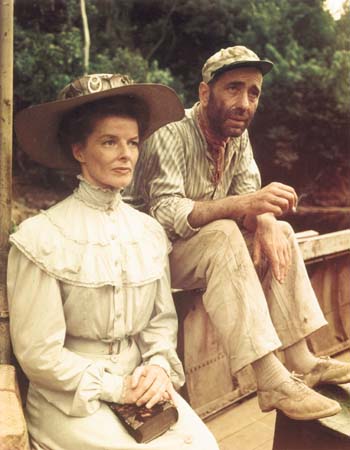
Rose Sayer (Katherine Hepburn) is an African missionary when World War I breaks out, and the mission maintained by her and her brother (Robert Morley) comes under attack by German troops. The mission burned, her brother dead, Rose is taken transit by Canadian riverboat captain Charlie Allnut (Humphrey Bogart), who soon finds himself at odds with his passenger. She is disgusted by his boorish behavior and his drinking, and he is horrified at her stubborn suggestion of using his "African Queen" as a weapon in the war effort. It's a small skirmish in the world-wide conflict, but the battle of wills softens once the gin is gone and the thrill of the journey kicks in. The drama comes in the conflict and the crisis, the comedy comes in the duo's new-found dependency on each other and courtliness. They're an "odd couple," (even the Germans think so!), and the movie veers on a course from drama to high adventure to comedy to horror and even despair, before veering back to its satisfying conclusion. It's not "The Love Boat," but you'll feel like you've been through the rapids, as well.
I have never seen a version of this movie that wasn't scratched, patched, discolored or broken up. I've sat through many screenings, horrified, that such a classic (containing Bogart's only Oscar-winning performance) would be allowed to fall into such a state of disrepair. So, I am pleased to say that, finally, new generations can now see The African Queen, newly digitized and cleaned up, on DVD and Blu-Ray.
* In her book about the filming of his movie of The Red Badge of Courage, ("Picture") Lillian Ross talks about the distraction of The African Queen leading Huston to abandoning his Civil War film before it was finished editing, leading to M-G-M (and Louis B. Mayer) cutting the film down from two hours to 69 minutes.
.jpg) Dassin spoofs his earlier crime dramas with this comedy-caper (based on an Eric Ambler novel) set in Istanbul. There an odd assortment of crooks (Melina Mercouri, Maximillian Schell, Robert Morley) recruit an English prat (Peter Ustinov, who replaced a planned Peter Sellers and went on to win the Academy Award for Best Supporting Actor for the role) to take the fall for an elaborate heist—the stealing of a priceless ornamental dagger from the well-alarmed Topkapi museum. Shot in rapturous color—with an opening sequence that seems a precursor to psychedelic films—Dassin uses the local color to spice up the activities of the wily criminals and their elaborate scheme, which involves clambering over the pointed roof-tops, impeding the progress of a beam from a nearby lighthouse, suspending an aerialist over the display, while also precisely elevating its heavy glass case. It's one of those "Mission: Impossble" capers, where what could go wrong probably will, and the precisely planned plot goes out the window and they have to punt, lateral, and do whatever can come to mind to get over the goal line. The escapade is fraught with perils of all sorts, not the least of which is getting caught.
Dassin spoofs his earlier crime dramas with this comedy-caper (based on an Eric Ambler novel) set in Istanbul. There an odd assortment of crooks (Melina Mercouri, Maximillian Schell, Robert Morley) recruit an English prat (Peter Ustinov, who replaced a planned Peter Sellers and went on to win the Academy Award for Best Supporting Actor for the role) to take the fall for an elaborate heist—the stealing of a priceless ornamental dagger from the well-alarmed Topkapi museum. Shot in rapturous color—with an opening sequence that seems a precursor to psychedelic films—Dassin uses the local color to spice up the activities of the wily criminals and their elaborate scheme, which involves clambering over the pointed roof-tops, impeding the progress of a beam from a nearby lighthouse, suspending an aerialist over the display, while also precisely elevating its heavy glass case. It's one of those "Mission: Impossble" capers, where what could go wrong probably will, and the precisely planned plot goes out the window and they have to punt, lateral, and do whatever can come to mind to get over the goal line. The escapade is fraught with perils of all sorts, not the least of which is getting caught.


-large-picture.jpg)



_04.jpg)

_01.jpg)
