Showing posts with label Roddy McDowell. Show all posts

Friday, April 7, 2017

The Loved One

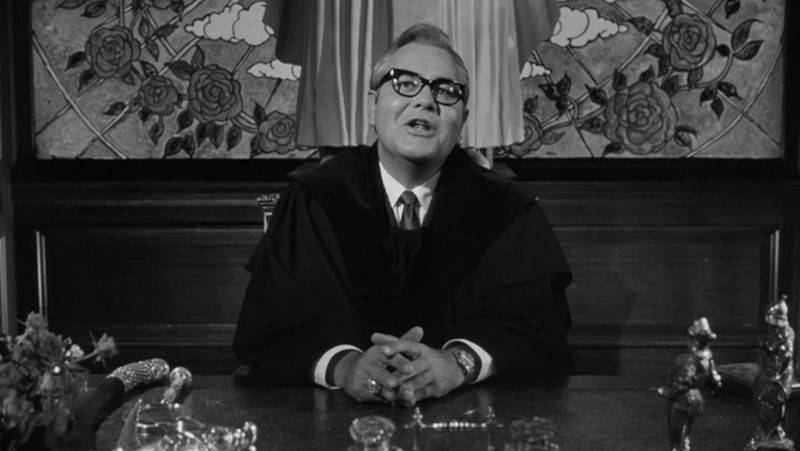
The Loved One (Tony Richardson, 1965)  Director Tony Richardson "does" Hollywood, and it ain't pretty.  There are lots of Tinsel Town screeds out there, mostly about personal mania (Sunset Boulevard, What Makes Sammy Run?), but few—like Day of the Locust—where the craziness seems endemic to the region and its excesses. The Loved One has an air of pretense with sanctimonious chortling while it shoots its fish in a barrel, casting the film with "types"—Liberace as a coffin salesman, Milton Berle as a crass businessman—that might be a little too leaden in its intent.

Flush from his success with the multi-Oscar-winning Tom Jones, after toiling away over in the British "kitchen-sink" industry, Richardson returned to black and white cinematography (by Haskell Wexler) in an adaptation of Evelyn Waugh's novel adapted by Terry Southern and Christopher Isherwood. Waugh's book was inspired by a disappointing trip to Hollywood on the pretense of making a film of "Brideshead Revisited," and his twining of the film industry with the funeral business has a natural feel to it, as both have a lot to do with presentation, and the construction of artifice, all in the name of comfort (while robbing money blind).  

But that was in the 40's.  The film was made in the early 60's on the cusp of "mod" and in the nuclear shadow of Dr. Strangelove. Both films have that Southern exposure in common, but where Kubrick made his film with a gargoylishly straight face, Richardson can't help gilding the mourning lily.
Poet Dennis Barlow (Robert Morse, post-dubbed with a wavering British accent) wins a literary competition, the first prize being a trip to Hollywood, where he stays with his uncle, Sir Francis Hinsley (John Gielgud) who works at a film studio. Hinsley is soon fired by the studio's boss DJ, jr. (Roddy McDowell) and commits suicide. The British community (led by Robert Morley) insists that Hinsley's funeral be as grand as possible, bankrupting the old man's estate, and forcing Barlow to stay in Hollywood and taking a job at a pet cemetery run by Henry Glenworthy (Jonathan Winters), whose brother, the Reverend Wilbur Glenworthy (also Jonathan Winters) runs the Whispering Glades cemetery and mortuary, the establishment handling Hinsley's solemnities. There, Barlow meets Aimee Thanatogenous (Anjanette Comer), a corpse beautician and Mr. Joyboy (Rod Steiger), the Whispering Glades embalmer, who competes with Barlow for her affections.  
There is a lot of brilliant stuff here: a sequence at another chapel has a wedding (ministered by Ed—the original "You're in good hands with Allstate" announcer—Reimers) that is run like a television production, so that everyone can be ushered out, and the next scheduled funeral ushered in; the "keeping up appearances" haranguing of the British enclave in Hollywood; Jonathan Winters, not really given free rein to his inner demons in the roles, but showing how he might have been our Peter Sellers; and (okay) Liberace as a coffin salesman, there's something utterly apropos about that; a visit to Ms. Thanatagenous' under-construction cliff-house that is constantly rumbling with the threat of sliding to the highway below (a nice visual representation of her fragile doe-eyed innocence); Lionel Stander as newspaper advice columnist Guru Brahmin—a study in contrasts; the creepily loving reverence of the Whispering Glades workers for "the loved ones," as opposed to how the stiff pets at the pet cemetery are tossed into a freezer.
It's all very ghoulish and naughty (even flirting with pornography towards the end, discretely edited by Hal Ashby) but something of a misfire in its presentation. Morse is energetic and fun (and he has the teeth to play British), but in the same way The Wrong Box has the timing wrong to evoke humor, The Loved One never quite convinces you that you're supposed to be laughing, even guiltily. Instead, it has the air of stuffy indignation even as it's trying to regale. One can sympathize with the sentiments, but one wishes it was done better, less fire and more mockery. What's the quote? "There's nothing I like less than bad arguments for a view I hold dear."

Sunday, August 7, 2016

The Defector

The Defector (Raoul Levy, 1966) The Defector is mostly known for being the last film starring Montgomery Clift. That casts a pall over a minimalist spy film that already has a dark melancholy tone in stark relief to the high-contrast spate of spy films bring released at the time that had more to do with Fu Manchu and Dr. Mabuse than with anything to do with the real-life geo-politik of the Cold War. The Defector is a few Hitchcock steps below even his rather sedate Cold War thrillers Torn Curtain and Topaz, resembling the former in outline, but not in form.

The film is based on a 1963 Paul Thomas novel "L'Espion" which took advantage of the recent construction of the Berlin Wall (ground-breaking and barbed wire installed August 13, 1961) to expose the porousness of the wall (or its lack) in the early days of the physically divided city (as did the similar "The Spy Who Came in From the Cold," published the same year). Crossing over—by any means—became an act of heroism and defiance. It was the very stuff of drama in real life. But, what sort of person would make the attempt?

American physicist James Bower (Clift) is approached by a CIA operative (Roddy McDowell) who proposes Bower take a detour on his vacation to West Germany by making contact with an East German associate named Grushenko, who is willing to smuggle microfilm containing results of Russian missile tests to the West...but only if Bower will be the one who couriers it. The two are distant colleagues—one's in the U.S. and the other behind the Iron Curtain, so Bower is a little reluctant. But, when the CIA threatens to interfere with his grant processes, Bower agrees.
When Bower gets to the East, he is met—"welcomed" is too strong a word— by "Public Relations Counselor" Heinzmann (Hardy Kruger, the movies' second favorite Aryan after Oscar Werner), who has been tasked by party operative Orlovsky (David Opatashu) to take Bower's visa with the assurance that it will be returned once Bower gives him the location of Groshenko—which, at this point, Bower doesn't know. The American protests, but is powerless to do anything about it and so is released, but under surveillance. When he gets to his hotel, he finds that he's been moved, without his authorization, to another room. He calls the management, but they insist he stay in that room.
There's a reason for that,  Bower begins to hear voices, the phone rings with no one on the other end of the line, the room begins to spin and pretty soon Bower is completely disoriented as the East tries to brainwash Bower into revealing Grushenko's whereabouts. While Orlovsky pushes for more invasive means of persuasion, Heinzmann tells him that Bower will be his responsibility solely.
After the surreal brain-washing sequence, the movie turns into a true cat-and-mouse game as Bower attempts to make contact with Grushenko and must come up with a plan to cross the border into West Germany without the benefit of papers. Clift, despite being in poor health, does his own stunts, in a long semi-tense sequence where he must negotiate a waterway that is routinely guarded by soldiers who are alerted to looking for an American physicist.

The Defector is a perfunctory spy movie—one cannot use the word "thriller" ("confuser" might be a better term)—that is not without irony (can you make a spy film that doesn't have that?) and at least accomplishes its goal of having a beginning, middle and end...and a final bitter denouement, in which anything pure must be expunged. Nothing, really, can be done without sacrifice.
 
Clift died three months after making this movie.

Raoul Levy committed suicide six moths after the film hit theaters.