Showing posts with label Peter Bull. Show all posts

Tuesday, July 17, 2018

Olde Review: Dr. Strangelove, or: How I Learned to Stop Worrying and Love the Bomb

This was part of a series of reviews of the ASUW Film series back in the '70's. Except for some punctuation, I haven't changed anything from the way it was presented, giving the kid I was back in the '70's a break. Any stray thoughts and updates I've included with the inevitable asterisked post-scripts.

Dr. Strangelove: Or, How I Learned To Stop Worrying and Love the Bomb (Stanley Kubrick, 1964) 
"I can no longer allow...Communist infiltration, Communist indoctrination, Communist subversion...and the international Communist conspiracy...to sap and impurify...
all of our precious bodily fluids!"

Stanley Kubrick
was sitting, working out the first draft of a screen-play based on the nuclear thriller "Red Alert" by Peter George, when he came to a scene in which the President of the United States gives out secret information to the Russians in order that they may stop a squad of U.S. B-52's before they can drop their nuclear payload on the USSR and instigate world-wide destruction. Kubrick decided to throw it out because audiences would laugh at such an implausible occurrence. But, as he went along, Kubrick found himself throwing away more and more important plot developments, and slowly peeling away his story.

A fine story it was, too. A lower echelon general goes mad and mis-uses a government-approved contingency plan that would allow him to make nuclear war decisions in the event that Washington D.C. were destroyed. It is up to the President and the Joint Chiefs of Staff to stop the General and obtain the code that will stop the B-52 attack on Russia.

Kubrick solved his dilemma with an almost suicidally daring decision—to treat this thriller as a comedy, a nightmare-comedy where the grins are the same as produced by rigor mortis. So, have the mad general attack Russia because of their plot to fluoridate our waters and turn the men impotent. Turn the B-52 commander into a Stetson-sporting "Hot Damn!" baboon. Make the head of the Joint Chiefs a gravel-voiced reactionary and a sex maniac. And turn almost every communication device in the film against them. Then turn the title into Dr. Strangelove: Or How I Learned to Stop Worrying and Love the Bomb.
This decision let Kubrick have his cake and eat it, too, for not only is Strangelove funny, but it is, at the same time, the skillfully realized edge-of-your-seat thriller it originally was. And the comedy aspects cast a realization of what an insane situation the nuclear "stand-off" is. Despite the characterizations, Kubrick managed to pull to present a completely factual account of a possible nuclear accident, right down to the equipment in the B-52's. It is all plausible no matter how broadly drawn the characters (and the Air Force disclaimer at the beginning of the film only adds fuel to this argument). As is Kubrick's style, the most horrendous occurrences will happen and Kubrick will sit back and watch, for his films, by this time in his career, had become cold observations taken, as some have commented, from the view of some extra-terrestrial life, not human, and unmoved by what he sees...with a definite slant, but without a heart.*
And so the comedy bill in 130 Kane is a full one--a perverse comedy of warmth and sweetness and a perverse comedy of cold and destruction--and both excellent in each other's way.
Broadcast on KCMU on Januray 7th, 1977
* That's a pretty tortured last 'graph, and I think I put it there just to have that final statement contrasting Young Frankenstein and Dr. Strangelove—the films were paired together on that night's double-bill.

I no longer think Dr. Strangelove is cold. I think it presents the case and lets the viewer decide. But that stratagem is ham-strung by Kubrick's decision to make it a comedy (he felt that it was going to be laughable no matter what he did, so making it a romp would make it, at the least, entertaining, all the hewing to fact is for naught if you have an audience resenting the lecture). But the best part of Dr. Strangelove is the coda, where plans are made to maintain the status quo, despite that policy already having lead mankind down the path of total annihilation. The scenarists in power take the situation and find out how to make the best of it (usually for them), completely devoid of accountability and conscience or any sense of responsibility for its part in the disaster. It's all about self-justification. 

And all it takes is one mad man to set the intricate death-trap in motion.

Dr. Strangelove: Or, How I Learned to Stop Worrying and Love the Bomb is timeless.


And should be required viewing every election year.

Nixon's "War-Room" from Zack Snyder's Watchmen (2009)


Friday, May 8, 2015

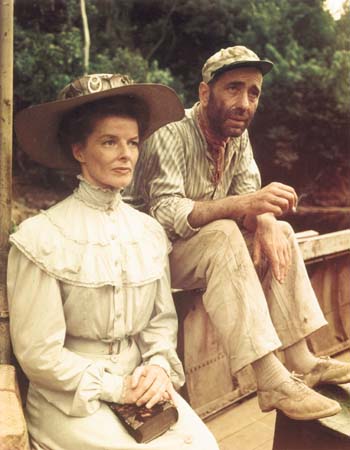
The African Queen

The African Queen (John Huston, 1951) "I now pronounce you man and wife.  Now, proceed with the execution."

An anomaly among John Huston's movies—an unambiguously happy ending (and with the same camaraderie and laughter of his less heroic finishes). Originally set up as a vehicle for Charles Laughton and Elsa Lanchester, then for Bette Davis and David Niven, by the time it crossed Huston's path it became an excuse for Huston to visit Africa (which had just made a cinematic splash in King Solomon's Mines) and get in some hunting, in a Hemingway-esque quest to conquer new territory.*

Along for the ride were Huston's favorite actor, Humphrey Bogart (with his new bride Lauren Bacall), and the spunky, patrician Katherine Hepburn, who had never worked with Huston before, but was always up for an adventure. **

That always came working with the much-storied Huston.
But, The African Queen is a love story, one of those about the transforming nature of love, and the trip down the treacherous rapids on a craft not suited for the purpose is a metaphor for the new experience of love among the ruins—two mature people set in their ways, and for whom love has never been a part of the path. Love is an adventure, exciting but dangerous, making one vulnerable—but whatever doesn't kill you makes you stronger, and at the end of the coasting, carousing, exploding journey, the couple are adrift but floating, no boat underneath them, but operating on their own power, swimming to an unseen shore, laughing, without a care. What might have seemed peril before is just one more momentary inconvenience, for the most important thing is the life, the love, and reveling in it. They start out, bound in dogma and disposition, but in the course of the movie the stick-up-their-butts bend like the high reeds that they must plow through to reach their destination. Change and accommodating change is all.  At the end, the stodgy individuals are a very zen couple.
Rose Sayer (Katherine Hepburn) is an African missionary when World War I breaks out, and the mission maintained by her and her brother (Robert Morley) comes under attack by German troops. The mission burned, her brother dead, Rose is taken transit by Canadian riverboat captain Charlie Allnut (Humphrey Bogart), who soon finds himself at odds with his passenger. She is disgusted by his boorish behavior and his drinking, and he is horrified at her stubborn suggestion of using his "African Queen" as a weapon in the war effort. It's a small skirmish in the world-wide conflict, but the battle of wills softens once the gin is gone and the thrill of the journey kicks in. The drama comes in the conflict and the crisis, the comedy comes in the duo's new-found dependency on each other and courtliness. They're an "odd couple," (even the Germans think so!), and the movie veers on a course from drama to high adventure to comedy to horror and even despair, before veering back to its satisfying conclusion. It's not "The Love Boat," but you'll feel like you've been through the rapids, as well.
I have never seen a version of this movie that wasn't scratched, patched, discolored or broken up. I've sat through many screenings, horrified, that such a classic (containing Bogart's only Oscar-winning performance) would be allowed to fall into such a state of disrepair. So, I am pleased to say that, finally, new generations can now see The African Queen, newly digitized and cleaned up, on DVD and Blu-Ray.

* In her book about the filming of his movie of The Red Badge of Courage, ("Picture") Lillian Ross talks about the distraction of The African Queen leading Huston to abandoning his Civil War film before it was finished editing, leading to M-G-M (and Louis B. Mayer) cutting the film down from two hours to 69 minutes.

** Two books on the subject of the movie's filming are out there: Hepburn's remembrance of the episode "The Making of 'The African Queen,' or How I Went to Africa with Bogie, Bacall and Huston and Almost Lost My Mind," and "White Hunter, Black Heart" by "Queen's" script doctor Peter Viertel, a roman à clef about the circumstances, much fictionalized—the names have been changed to protect the elephants.