Showing posts with label George Reeves. Show all posts

Saturday, December 7, 2019

From Here to Eternity

From Here to Eternity (Fred Zinnemann, 1953) One shouldn't study war, but my family has a personal connection with Pearl Harbor. My Dad was there and survived it...barely. And, as a result, never wanted to go to Hawaii again. My mother told me that when he returned from the war—he was in it for the duration—for the first year, he would wake up every night screaming.

That says more to me about the events of Pearl Harbor than any movie, documentary, or chronicling...and there have been many, many of them, starting with Remember Pearl Harbor (in 1942), John Ford and Gregg Toland's documentary—December 7th—from 1943 and Howard HawksAir Force (also 1943), which were rushed into production soon after the event, when most of what was known about the incident was heavily censored by the government—relatives got post-cards from attack survivors that allowed them to check boxes about their condition but that was it. And that was all.
There have been quite a few movies since and it seems most of the films coming out of the 40's paid lip-service to Pearl, producer Darryl Zanuck made a by-the-book film about it in 1970, utilizing both American and Japanese directors (at one point Akira Kurosawa was attached) and Michael Bay saw good explosion material when he saw it, so he made his in 2001, which I resented a bit as he paid more attention to the bombs than he did the people.
But, the one that most people (of a certain age) remember is From Here to Eternity because of its rather mature story, its all-star cast at the top of their respective games, and as it's settled into its own folklore—George Reeves' part in it, "that" kiss in the surf (Criminy, it's the scene on the cover of all the video releases), the "Sinatra story"—a timelessness that, even though it couldn't go as far as the book in its themes, keeps it in its status as a classic even today as the people who have claimed to watch it dwindle. It's still fresh, it's still surprising, despite the restrictions put on it "in the day."
The basic idea behind it is a variation of the Casablanca line: "The problems of two little people don't amount to a hill of beans in this crazy world." Pearl Harbor in the days before the attack is a little too concerned about matters other than defense that—along with the strategic issues explored in Tora! Tora! Tora!—sets it up to be a very complacent sitting duck for any well-planned and coordinated attack...for those willing to take advantage of it. If, as the apocrypha says, that Admiral Yamamoto compared America to a sleeping giant, most of the sleeping around, according to From Here to Eternity, was going on at Pearl.
What the novel—and the movie (at least as much as the Armed Forces allowed it)—implied was that there was a lethargy where the company commander, Captain Holmes (Philip Ober) is more concerned about a boxing competition than the defense of the base, so much so that he allows the systemic abuse of Robert E. Lee Prewitt (Montgomery Clift) for his refusal to participate in that competition. Prewitt is enough of an obstinate outlier that he takes the abuse—the beatings, the extra duty, the demeaning—rather than give in. It's not that Prewett is a bad soldier, he's just different. He plays trumpet, but not for the service. He's more a jazz man, playing outside the lines—disciplined, sure, and will do a by-the-book rendition of taps for his pal, Maggio (Frank Sinatra) because it's right—but Prewitt is not a lock-step marcher. He will take the abuse for his principles, but will not tolerate it being applied to others.
The situation is noted by Sgt. Milton Warden (Burt Lancaster), who cannot go against his company commander, but can encourage Prewett, even defend him in specific circumstances. That this view is complicated by Warden's affair with his commander's wife (Deborah Kerr) only makes him more conflicted, maybe slightly hesitant, to not buck the system, even in the face of seeing things he knows is wrong. Warden chooses his battles. And when one comes to him on December 7th, it is he who leads the defensive efforts.
If you haven't seen it, it's another one to put on the Bucket of Popcorn List. It's intelligent melodrama—although it is melodrama (most movies are, kids)—that dares to not end on a happy or even hopeful note, but ends with shattered men and shattered lives—with a war going on in the background. It also puts a lit to the trope that "All's Fair in Love and War."

No. Nothing's fair. In either. And the only victory is to survive it.

Like my Dad did.


Tuesday, January 31, 2017

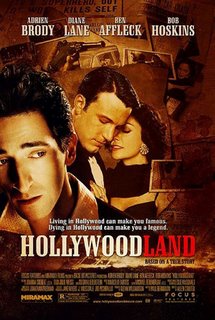
Hollywoodland

This was written at the time of the film's release, when Ben Affleck once played "Superman" of a type. I've only walked out of two movies—the Eddie Murphy/Dudley Moore so-called comedy Best Defense...and this one. I can tolerate a lot, evidently. But I have my limits. As I recall, I labeled this movie "a waste of time."

All reviews are personal; they are opinion, after all, shaped by life and experience. This one seems more personal than most. I should avoid doing that.

Fearful Symmetry

It's been a long time since I'd seen a new movie--the last was
Superman Returns--and I'd compiled a short list in my mind of films I wanted to see, and should, as the Holiday Movie Season was galumphing closer. Hollywoodland—another "Superman" movie of sorts—was the first released on the list, and by coincidence it was playing at the Uptown Theater on lower Queen Anne just a couple of blocks from where my business' post office box is.

I'd been following the movie's production process for years.
Kyle McLachlan was attached, then not. It was greenlit, then not. "Snake-bit" was more like it. It was based, supposedly, on the investigation into the George Reeves' (TV's winking "Superman" in the 50's) suicide, which had more than enough "urban legends" attached to it to make an interesting idea for a movie. Besides, I liked Reeves. And his co-workers 'descriptions of him belied the depressed suicide scenario that was the accepted explanation.
But if you're looking for answers, Hollywoodland gives you none. What it gives you is a shabby L.A. P.I. (Adrian Brody) late of studio security (nice angle, that), asked by Reeve's mother (Lois Smith) to investigate her son's death. She doesn't know who did it, but it can't be her shining baby boy. Also, true, supposedly.
At that point, the movie goes awry. As investigator Louis Simo (who never really convinces you of "competence") goes over the details of Reeve's life, we are given the usual trope—the big break in Gone with the Wind that never pans out, "B" movie existence, the dalliances, the affair with the wife of Eddie Mannix, "Superman" and its career-killing effects, the From Here to Eternity disappointment (cut from the final print because the presence of TV's "Superman" was considered a distraction—which is fiction, evidently) and the ultimate feeling that his career had dead-ended on a kid's show. Fortunately (and yes, its a surprise to say this), Reeves is embodied terrifically by Ben Affleck, who manages to convey Reeves' "nice guy" casualness with a "bad-boy" swagger that never trashes Reeves, but emphasizes the charm. Affleck becomes Reeves, to the complement of both. If only the rest of the movie did as much research....
Reeves' "Superman" is shown flying with ropes. Uh...no. Didn't happen. Yes, he had accidents, but not like depicted (stage hands hauling a suspended Reeve around a dilapidated studio for flying scenes makes a funny, sad scene but it's just not true). Also, they hedge their bets on the suicide angle by having the "Superman" series cancelled (celebrated by Reeves with a bonfire of the vanities, burning his "Super-suit" on the barbecue--really, they'd let him have that?) when, in fact, "Superman" was about to go back into production with several episodes to be directed by Reeves. Suicide is a bit harder to swallow when a guy's got career possibilities ahead of him. That aside, the movie also starts hedging its bets with the investigator's story--the deeper he digs, the more resistance he gets, the more determined he becomes to find "the answer" (Detective Movie 101), his personal life starts to disintegrate, he starts to drink, and act stupidly--and I began to hear faint echoes that indicated the screenwriter'd been dipping into Robert Towne's "Chinatown" script. Hmmm.
I could see where this was going--in the course of the detective's backslide, two possible scenarios of Reeves' death are played out as murder, but as the ersatz detective starts to spiral down into depression and drink it's only a matter of screen-time before he inevitably reaches that place where he would see it as natural for Reeves to commit suicide. The only surprise left in the movie being whether he follows Reeves in the death-wish.
Now, earlier in the day, I had gone to a luncheon held by the temp agency I was working for and they gave me a little certificate for exemplary work—I'd been reviewed well and recommended for recognition. It was all very nice, but I couldn't help but dismiss it. This isn't the work I do. It's not work I love. I do it well, but I do it to make money. That's all. And in this sort-of telling of the Reeves story, that's exactly where he was, too. Stuck playing Superman, unable to do anything else because of it—hopelessly typecast and no prospects (in this telling of the story) for the future. I could relate. Too well. And as if to put a sick little bow on the paralleling, I had received at this luncheon a tee-shirt from the agency for my service...with a quasi-Superman logo on the chest of it--I was a "VOLT Superstar." Huh. It all felt a little too close. And watching the characters on-screen spiral to oblivion wasn't helping much.
I checked my phone. Three calls. I should return them. I got up from my chair in the dark and headed for the lobby. I obviously had better things to do with my life and it was best that I get on with it. I walked out of the theater and outside into the sunshine.

Wednesday, March 16, 2016

Rancho Notorious

Rancho Notorious (Fritz Lang, 1952) The old-old story of Hate!  Murder!  and Revenge!

After hearing about this one for oh-so-many years, I finally got a chance to sit down and luxuriate a while with Rancho Notorious, a film that offers so many surprises—subtleties and Big Statements—that work-outs were had by both my jaw (dropping) and the remote, which afforded me the essential ability to go back and "look at that again."

Rancho Notorious offers opportunities a-plenty for both. You don't see very many movies where people are actively snarling at each other, but then there aren't many movies like this wildly expressionistic main-stream Western directed by the master of German Expressionism Fritz Lang. Preceding High Noon by a matter of months, it also has a song-based score, but an odd one, not so "on the nose" as "Do Not Forsake Me...", but one's that's haunting and echoes through your head like a warning (as it did mine) for days.

The song is "The Ballad of Chuck-a-Luck," (that was supposed to be the movie's title and there's a story for ya*) written by Ken Darby and plays over the titles and interstitially during the murder investigation that lasts the entire movie, each stanza ending with those words "Hate. Murder. And revenge."

So, what's the story, pilgrim?


Vern Haskell (Arthur Kennedy) is a ranch-hand in a small town in Wyoming and he only has eyes for Beth Forbes (Gloria Henry**), the girl who runs the counter at the dry-goods store. But, right after he comes a-courtin' two strangers come into town, with an eye to robbing the store, and when the one sees Beth, things go too far. She's raped and murdered by the outlaw when she screams and the two cowards escape.
Vern Haskell (Arthur Kennedy) doesn't like you

All Haskell wants is revenge, so he quits the ranch and, with a posse, heads in the direction the bastards left town. After hours of riding, the posse gives up, but Haskell refuses to stop, and soon comes across one of the men, Whitey, shot in the back by the other desperado, who only says the words "Chuck-a-Luck" to Haskell with his dying breath. Haskell travels on, gathering clues about the mysterious word that refers to a spinning "wheel of fortune" in gambling houses and a former dance hall girl named Altar Keane (Marlene Dietrich), who made a fortune on her departing spin of the wheel, and left town on the arm of the outlaw "Frenchy" Fairmont (Mel Ferrer), never to be heard of again.

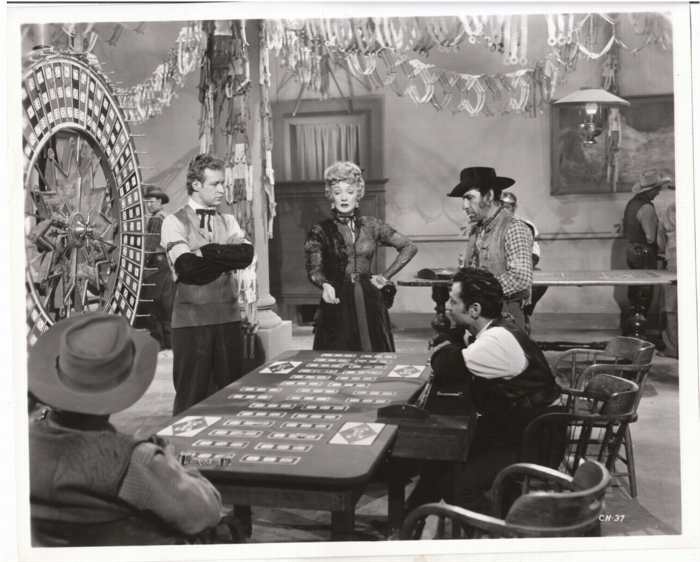
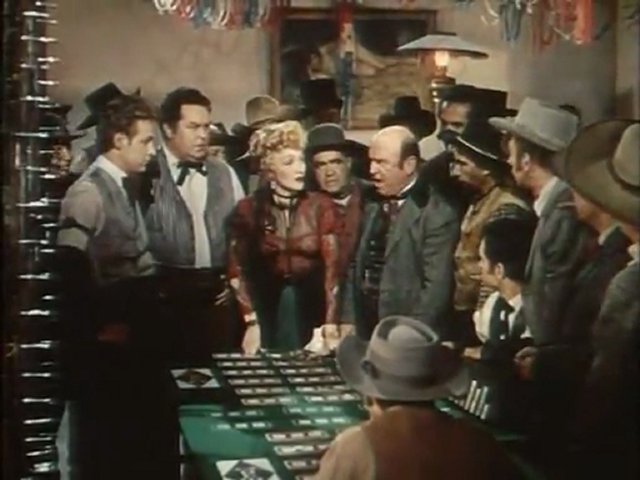
But, "Frenchy's" in jail, so Haskell gets himself arrested, and once behind bars, ingratiates himself with Fairmont, and gets sprung on his coat-tails. The two make their way to the Flying C Ranch, also known...as "Chuck-a-Luck," a working ranch legitimate to the world, but in secret is actually a hideout-for-hire for any outlaw willing to offer up a 10% share of their loot to Altar Keane. Quite the little operation the lady has there, and at the moment, she's full up.


But she makes room for Haskell, whom she describes as "a man who stands in doorways." All the better to survey the room, looking for clues. Is it the guy who's fast with the ladies (George Reeves) with those tell-tale scars on his face? Is it the guy who keeps looking at him funny (Lloyd Gough, not credited due to The Black List), or the guy who's just funny-looking (wall-eyed Jack Elam in an early role, looking lean and mean). He decides to hang out at Chuck-a-Luck, picking up clues, laying low, making himself handy while not necessarily doing anything...illegal, until he can determine who's the right (by saying the wrong) man. It's a little bit like Poirot in spurs with a nasty disposition. Of course, today, Haskell would be expected to lay waste to the room and let God deal with the details. Here, revenge is tempered by justice and not hormones.

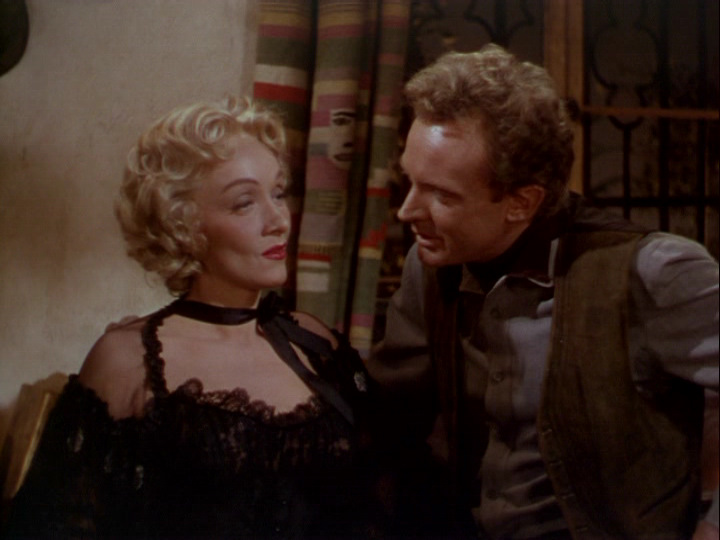
Russell Johnson and Marlene Dietrich in Rancho Notorious

Before we get onto the subject of Marlene Dietrich, we should probably discuss the wealth of character actors on the verge of hitting their defining roles: William Frawley, right before "I Love Lucy," George Reeves before "The Adventures of Superman," Mel Ferrer, only his fifth film and right before Scaramouche, Russell Johnson (Happy Birthday, sir), only his second movie, Jack Elam, Dan Seymour, John Doucette, the movie is top-heavy with great veteran character actors with recognizable faces.


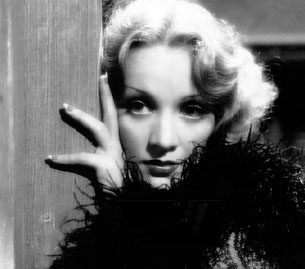
Then there's Dietrich.  For those of a certain age (anyone born post-Blazing Saddles), one may not recognize what a force she was and continued to be throughout her career.  She was the preternatural "other" woman, capable of seducing men and (pre-Code) women, one is always hesitant to call her the first feminist, but she might have been in movies, and she certainly was before it became "cool," (and she always was in the role). Put it this way, you'd never see Dietrich in a western riding side-saddle. Rancho Notorious is her slightly softened (although barely—when was the last time you saw a dance-hall girl riding the town sheriff like a horse?), in partnership with a man, and acting out of love or loyalty (always hard to say which with her), but it's her ranch and her operation, and that's something you rarely see in even the most hard-core of Westerns.   And it's weird, but, in Westerns, Dietrich (sorry but it's a spoiler) always seems to take a bullet, as if the genre won't accept her (or any woman) as ruling the ranch. That would change, as film-makers got more bold.**

Rancho Notorious is one of those odd Westerns of the Mainstream that took a decided bend in the river to do something else with the form. There's no pretense at naturalism (Lang wouldn't toy with that until Clash By Night), but used the familiarity of westerns to work out some interesting conflicts about gender roles (Others on that list are Nicholas Ray's Johnny Guitar, Samuel Fuller's Forty Guns, and, to a lesser extent, Hawks' Red River).


It's not your usual oater.  It's something different and it's recognizable from the first watch.

* The story goes that Howard Hughes wanted to change the title from "Chuck-a-Luck" and Lang wanted to know why. "Nobody'll understand it" was the reply, even though it was a familiar gambling game in the Southwest. "Okay, so what's your alternative?" Lang asked. "Rancho Notorious." came the reply. "Rancho Notorious?!  Nothing's called 'Rancho Notorious' in this movie! You think anybody'll understand THAT?!"

** There was a shock for me: I remember Gloria Henry as the mother of "Dennis the Menace" on TV.  Her presence was only the first of a long line of TV stalwarts who were paraded throughout Rancho Notorious—"Hey! there's...fill in the blank..."

*** Ford's frontier women usually ran the ranch, but let the men think they did.