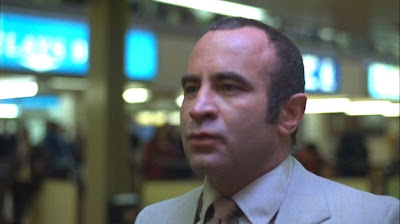
The Long Good Friday (John Mackenzie, 1980) Dense, gritty film about the London underworld that could just as well be about the British government being undermined by terrorists.
Easter weekend as planned is a good one for Harold Shand (Bob Hoskins). He's set up an elaborate yacht-party for his investors, a few politico's in his influence and a guest appearance by a U.S. mob-boss (Eddie Constantine), to toast Harold's new developments planned along the Thames dockyards. Everything seems to be in place—the pay-offs to the pols, the cheap Irish workers are kept in line, and the Americans want to help finance the new construction.
Then things start to go North. An old pal of Harold's (Paul Freeman), acting as a courier to the IRA, has siphoned off some funds, and been murdered in revenge. Harold's mum went off to Good Friday services and, while in the church, somebody blew up the Shand Rolls. A bomb has been discovered in one of Shand's casinos, and he's been getting some stick from Jeff (Derek Thompson), his college-educated lieutenant. Shand and his better half (Helen Mirren) are having trouble keeping the partyers occupied and unaware of the difficulties, especially when one of Shand's restaurants they've set as a meeting place is blown up moments before they step inside.

This gets on Harold's bad side. Harold's a bloke from Stepney, who's risen in the ranks and wants to do his part to make England great again, with international relations enhanced by their entry into the Common Market. He's polishing his image to make further entries into legitimate business.
But all those explosions are getting in the way.
It's a delicate balancing act he must portray in 36 hours: on the one hand, pulling whatever strings (and tendons) he can to find out who's sabotaging him, and on the other, keeping a respectable front for his business partners, current and future.
It's a crackling tale full of malice, the occasional conflagration, some well-placed bullets, and the occasional sharp edge. For the holidays, there's even a crucifixion (off-screen). Hoskins is brilliant in this, barely keeping a veneer of civility over his tough roots, capable of his own explosions at any time, and Mirren is the one trying to keep him from shattering. Look for the first feature-appearance of Pierce Brosnan as a gum-chewing hit-man, and stay on top of the dialogue—it's pretty complex.
This was written at the time of the film's release, when Ben Affleck once played "Superman" of a type. I've only walked out of two movies—the Eddie Murphy/Dudley Moore so-called comedy Best Defense...and this one. I can tolerate a lot, evidently. But I have my limits. As I recall, I labeled this movie "a waste of time."
All reviews are personal; they are opinion, after all, shaped by life and experience. This one seems more personal than most. I should avoid doing that.
Fearful Symmetry
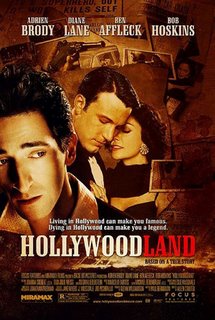
It's been a long time since I'd seen a new movie--the last was Superman Returns--and I'd compiled a short list in my mind of films I wanted to see, and should, as the Holiday Movie Season was galumphing closer. Hollywoodland—another "Superman" movie of sorts—was the first released on the list, and by coincidence it was playing at the Uptown Theater on lower Queen Anne just a couple of blocks from where my business' post office box is.
I'd been following the movie's production process for years. Kyle McLachlan was attached, then not. It was greenlit, then not. "Snake-bit" was more like it. It was based, supposedly, on the investigation into the George Reeves' (TV's winking "Superman" in the 50's) suicide, which had more than enough "urban legends" attached to it to make an interesting idea for a movie. Besides, I liked Reeves. And his co-workers 'descriptions of him belied the depressed suicide scenario that was the accepted explanation.
But if you're looking for answers, Hollywoodland gives you none. What it gives you is a shabby L.A. P.I. (Adrian Brody) late of studio security (nice angle, that), asked by Reeve's mother (Lois Smith) to investigate her son's death. She doesn't know who did it, but it can't be her shining baby boy. Also, true, supposedly.
At that point, the movie goes awry. As investigator Louis Simo (who never really convinces you of "competence") goes over the details of Reeve's life, we are given the usual trope—the big break in Gone with the Wind that never pans out, "B" movie existence, the dalliances, the affair with the wife of Eddie Mannix, "Superman" and its career-killing effects, the From Here to Eternity disappointment (cut from the final print because the presence of TV's "Superman" was considered a distraction—which is fiction, evidently) and the ultimate feeling that his career had dead-ended on a kid's show. Fortunately (and yes, its a surprise to say this), Reeves is embodied terrifically by Ben Affleck, who manages to convey Reeves' "nice guy" casualness with a "bad-boy" swagger that never trashes Reeves, but emphasizes the charm. Affleck becomes Reeves, to the complement of both. If only the rest of the movie did as much research....

Reeves' "Superman" is shown flying with ropes. Uh...no. Didn't happen. Yes, he had accidents, but not like depicted (stage hands hauling a suspended Reeve around a dilapidated studio for flying scenes makes a funny, sad scene but it's just not true). Also, they hedge their bets on the suicide angle by having the "Superman" series cancelled (celebrated by Reeves with a bonfire of the vanities, burning his "Super-suit" on the barbecue--really, they'd let him have that?) when, in fact, "Superman" was about to go back into production with several episodes to be directed by Reeves. Suicide is a bit harder to swallow when a guy's got career possibilities ahead of him. That aside, the movie also starts hedging its bets with the investigator's story--the deeper he digs, the more resistance he gets, the more determined he becomes to find "the answer" (Detective Movie 101), his personal life starts to disintegrate, he starts to drink, and act stupidly--and I began to hear faint echoes that indicated the screenwriter'd been dipping into Robert Towne's "Chinatown" script. Hmmm.
I could see where this was going--in the course of the detective's backslide, two possible scenarios of Reeves' death are played out as murder, but as the ersatz detective starts to spiral down into depression and drink it's only a matter of screen-time before he inevitably reaches that place where he would see it as natural for Reeves to commit suicide. The only surprise left in the movie being whether he follows Reeves in the death-wish.

Now, earlier in the day, I had gone to a luncheon held by the temp agency I was working for and they gave me a little certificate for exemplary work—I'd been reviewed well and recommended for recognition. It was all very nice, but I couldn't help but dismiss it. This isn't the work I do. It's not work I love. I do it well, but I do it to make money. That's all. And in this sort-of telling of the Reeves story, that's exactly where he was, too. Stuck playing Superman, unable to do anything else because of it—hopelessly typecast and no prospects (in this telling of the story) for the future. I could relate. Too well. And as if to put a sick little bow on the paralleling, I had received at this luncheon a tee-shirt from the agency for my service...with a quasi-Superman logo on the chest of it--I was a "VOLT Superstar." Huh. It all felt a little too close. And watching the characters on-screen spiral to oblivion wasn't helping much.

I checked my phone. Three calls. I should return them. I got up from my chair in the dark and headed for the lobby. I obviously had better things to do with my life and it was best that I get on with it. I walked out of the theater and outside into the sunshine.
 The Long Good Friday (John Mackenzie, 1980) Dense, gritty film about the London underworld that could just as well be about the British government being undermined by terrorists.