Showing posts with label Thomas Kretschmann. Show all posts

Friday, March 15, 2024

The Pianist

Believe it or not, despite my last paragraph, this was written ages ago, soon after The Pianist was released on DVD. It seems like when one mentions "current events" as bad news, there is always an example one can point to. It is sadly inevitable. Wish it wasn't.

The Pianist (Roman Polanski, 2002): I've been avoiding watching this like the plague, because when you get home from a long day at work the last thing you want to see is a "holocaust" movie. (In fact, now, I'm thinking "when WOULD be the best time to watch a holocaust movie?" and the answer I come up with is "BEFORE the next holocaust!" seeing as a little education about precedent might prevent the next one...) But since our current Netflix choices are The Pianist or The Constant Gardener, its a bit easier to choose which of the two depressing movies you want to take on. We went with Pianist, and now I regret putting it off.

Yes, it's about the Warsaw Ghetto. But it's also a terrific adventure/survival movie about a man used to the rarefied world of the arts—a luxury, truth be told—being forced to make life and death choices just in order to survive. 
It begins with
Władysław Szpilman (Adrien Brody) performing a concert piece over the radio only to have the program interrupted by Nazi Germany bombing the city. The reaction among the populace is a typical one--great fear leavened by a hope for the best (with a cautious "it can't happen here" disbelief). France and England declare war on Germany, and, with help like that, the crisis can't last long. 
But, it does. It gets continually worse with the Polish government cooperating with the Nazis, the Russians presenting an opposing front within the nation, the Jewish population denied jobs and businesses, forced to wear identifying arm-bands, then segregated into the poorest sections of Warsaw.
When the Jews are rounded up to be sent to the Treblinka concentration camp, Wladyslaw is separated from his family by a sympathetic member of the Jewish Ghetto Police and forced into slave labor, while secretly working to smuggle weapons into the ghetto for a rumored uprising.
Wladyslaw manages to escape and for the next three years, with the help of sympathetic friends—and, unbelievably, even one German officer—he manages to eke out an existence during the occupation and war-time bombardments.
*
That its a true story
makes it even more remarkable and a testament to one's will to live. But its also one of Roman Polanski's best films--a straight ahead artful telling of the tale without blandishments or Polanski's usual tendency to throw in some frivolous garbage that devalues the piece. Brody is simply amazing in it (but "Man Alone" movies tend to bring out the best in actors—anyone remember Dr. Hang S. Noor in The Killing Fields? Both actors won Oscars for their respective roles), slowly losing the detached look in his eyes as his situation worsens and worsens. 
One can't help but flash on current events and how a populace can be fooled into thinking "But they wouldn't dare...." Give someone enough power, and they'll dare anything. With enough power, who's going to stop them? 

Well worth seeing if only as a cautionary tale.

* Polanski was undoubtedly drawn to the story as he did basically the same thing growing up in war-time Krakow. He tells of how his family was rounded up for the concentration camps and only surviving because his father shoved him out of line, saying "I don't know you! Get out of here!" He lived under a false identity in a series of foster homes and on his own throughout the rest of the war.

Tuesday, September 5, 2023

The Young Victoria

Written at the time of the film's release...

 "Her Serene Highness"
 
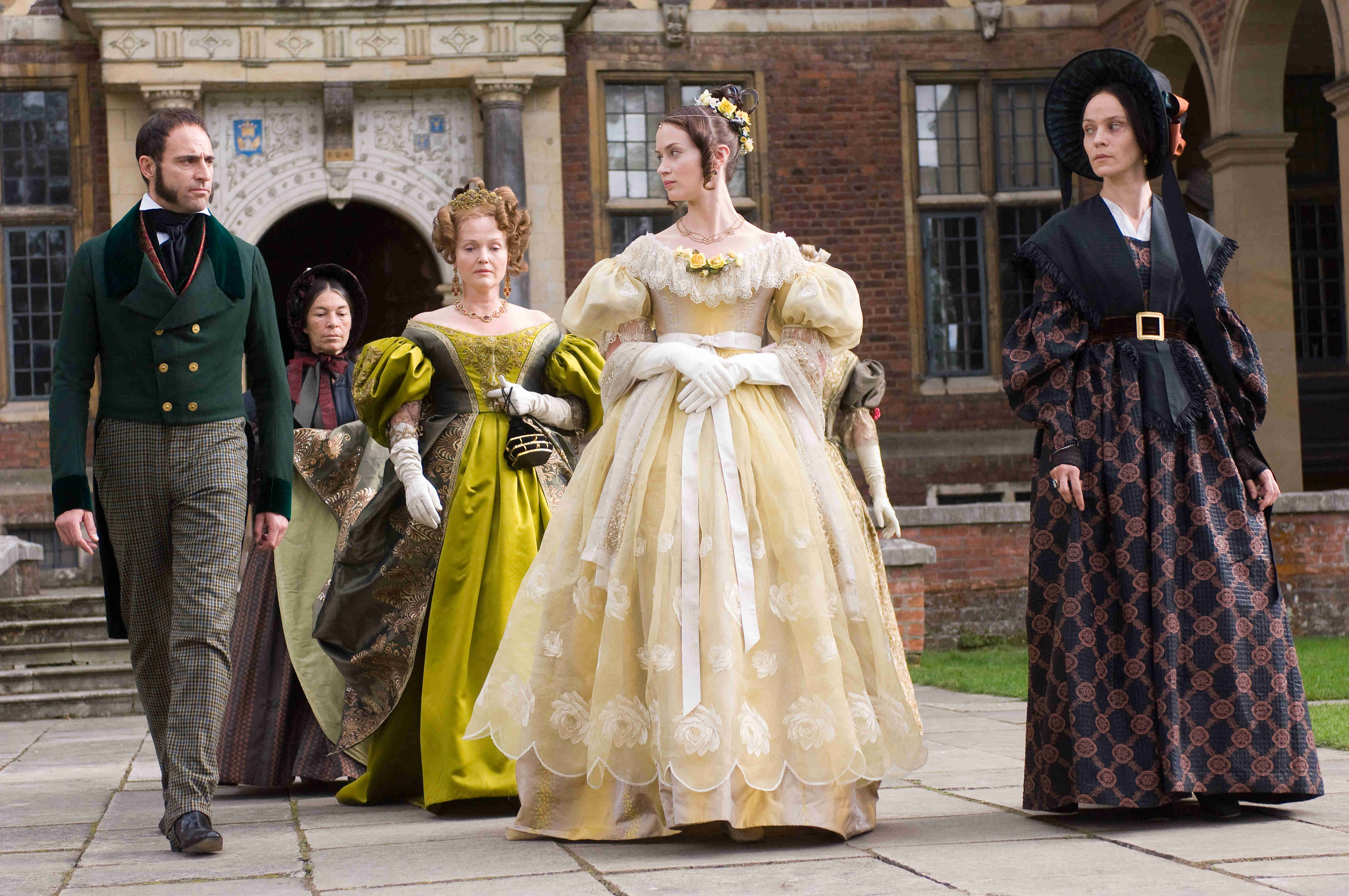
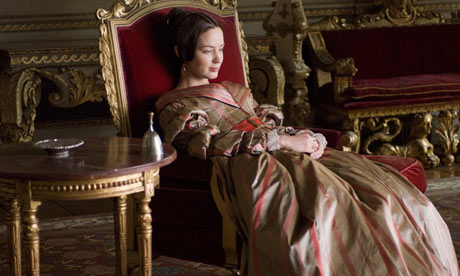
William Jefferson Clinton famously called The White House the crown jewel of the U.S. prison system. Young Queen Victoria (Emily Blunt) says early on in The Young Victoria, "Even a palace can be a prison." As the only heir to England's throne in the Royal House of Hanover, the young princess is managed and controlled, ostensibly for her safety, but also for the power that an unprepared and naive queen can offer her advisers. The last image we see before the title of the film is a gate swinging towards us and slamming shut with a bang.

Go to black. Title up.

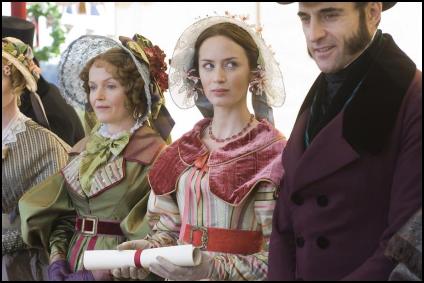
There are a lot of shuddering doors in The Young Victoria, as the upstart princess, well aware of the red carpet ahead, defies her manipulaters and her mother (Miranda Richardson), who is cowed by their presence, especially that of Lord John Conroy (Mark Strong—his second villain role this year after Sherlock Holmes—risking typecasting, he'll be playing Sir Godfrey in the upcoming Robin Hood) who viciously seeks to be made regent in case of the death of King William (Jim Broadbent). Ambition is on everyone's mind, except the one who will be getting the power. And ambition is what the young queen must learn, if only to be used as a weapon.
Director Jean-Marc Vallée (and his script-author Julian Fellowes, who wrote Gosford Park and a little something called "Downton Abbey") spend a lot of time concentrating on Victoria's noggin. It is focussed on, framed and discussed. "Look at that demure little head," says Lord Melbourne (Paul Bettany) at her coronation. "And all of us wondering what's inside it." He, like the rest of the court, really couldn't care less. If her mind can be changed, then it doesn't matter. But there is enough rebellion, and enough fighting the gold shackles binding her, that can be used to sway her.
It should be noted at this point that one of the producers of The Young Victoria is none other than Sarah Ferguson, the Duchess of York, who endured her own time of constraints while married to Prince Andrew. "Fergie" was known to be quite feisty, herself, and one looks at the movie and wonders how much of its editorial stance originated with her, as it is pretty sly in its view of the monarchy as being both a blessing and a curse. Whatever animosities Ferguson has incurred with the current Royal family, there seems to be an understanding of just what is asked of a monarch, and with The Queen, it shares a similar visual touch—the Royal de-focussing of the eyes that appear to see nothing, but are merely providing a non-commital mask for the public to see, the eyes looking, instead, inward.*
Given that,
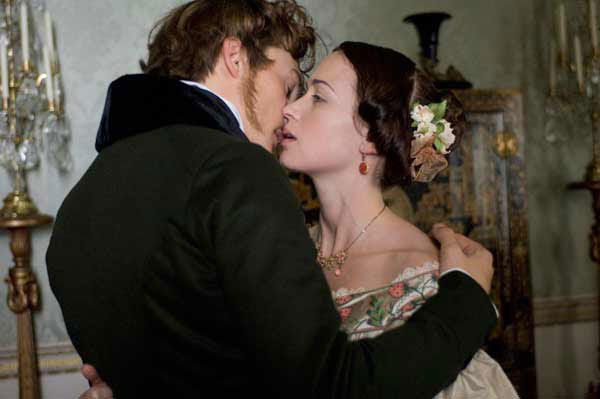
enter Prince Albert (Rupert Friend) of the Belgians. Groomed as a suitor by his father King Leopold (Thomas Kretschmann), the young Prince also resents being kept in a can, and upon meeting Victoria goes off-script, showing himself to be of equal mind. During a supervised chess game, they compare notes on their similar circumstances. "I know what it means to live inside your own head," he offers. "You must learn the rules of the game, so you can play it better than they can," and as if we don't get the point, he takes her Queen and sweeps it off the board, captured.
Vallée keeps things properly ornate and unfussy in his direction, save for some odd little rack-focuses interrupting the continual focus on Emily Blunt's head of restrained expression. At one point, though, he does indulge. At the Queen's entrance to a Royal Ball, upon seeing Albert, he keeps Blunt locked in position and then yanks her away from her party, as if pulled, floating to her paramour. A neat little trick that, and very dependent on Blunt keeping her muted expression while having her transport taken completely away. It's indicative of Vallée knowing that his best weapon in the movie is Blunt's subtle whisps of expression; one is drawn to her face to see how she'll react, even if, until the last frame, it is reluctant to reveal.

* At the end, there is a title stating that Victoria was the longest reigning British monarch (that would be be 63 years and 216 days). And as if to tweak the ex-mother-in-law a bit, with a wink, a new title emerges below it—"To date." 

Elizabeth II surpassed her great-great-grandmother's reign on September 09, 2015.  She went on to serve 70 years and 250 days. Only the reign of Louis XIV of France was longer.

Friday, June 30, 2023

Indiana Jones and The Dial of Destiny

Once More Without Spielberg
or
The Adventures of Old Indiana Jones
 
Released right before "Indy-pendence Day," Indiana Jones and the Dial of Destiny comes with a lot of promise and a few new wrinkles—and not just the ones on star Harrison Ford's face (although the opening sequence takes pains to "de-age" him as it takes place during World War II). This is the first of the adventures (with the exception of 28 episodes of "The Young Indiana Jones Chronicles") not to be directed by Steven Spielberg—instead it's overseen by James Mangold, who's no slouch having directed Logan and Ford vs. Ferrari. It also promises—with all the credibility that goes with the words "Farewell Tour"—to be the last of the Indiana Jones series.
 
Ford is getting "up there"—he'll be 82 on July 13th—and he's been joking since The Last Crusade that he'd prefer any next "Indy" film to be called "Indiana Jones and the Really Comfortable Bed."* Dial of Destiny doesn't prove to be that (although, he does spend some melancholic time sprawled out in a barcalounger). But age is catching up to the old whipper-snapper, and we find him in the year 1969—just after the Apollo 11 moon landing—doing more than the requisite small steps and giant leaps, certainly more than a man his age should be attempting.
Indiana—or as the world knows him Dr. Henry Walton Jones, Jr.—is spending "Moon-Day" in New York—the date of the Apollo 11 astronauts' ticker-tape parade—dreading it. He is retiring from his teaching post at Hunter College where his students are now bored by antiquities (including him!) and his teacher-prep consists of hitting the bottle rather than the books. He's alone; among the clutter of his dreary apartment are the unsigned divorce papers from Marion, one more separation in a life (and film-series) full of them. But, his class has one new auditor, Helena Shaw (
Phoebe Waller-Bridge), god-daughter to Dr. Jones and daughter of another of his allies during the second world war, Basil Shaw (Toby Jones). 
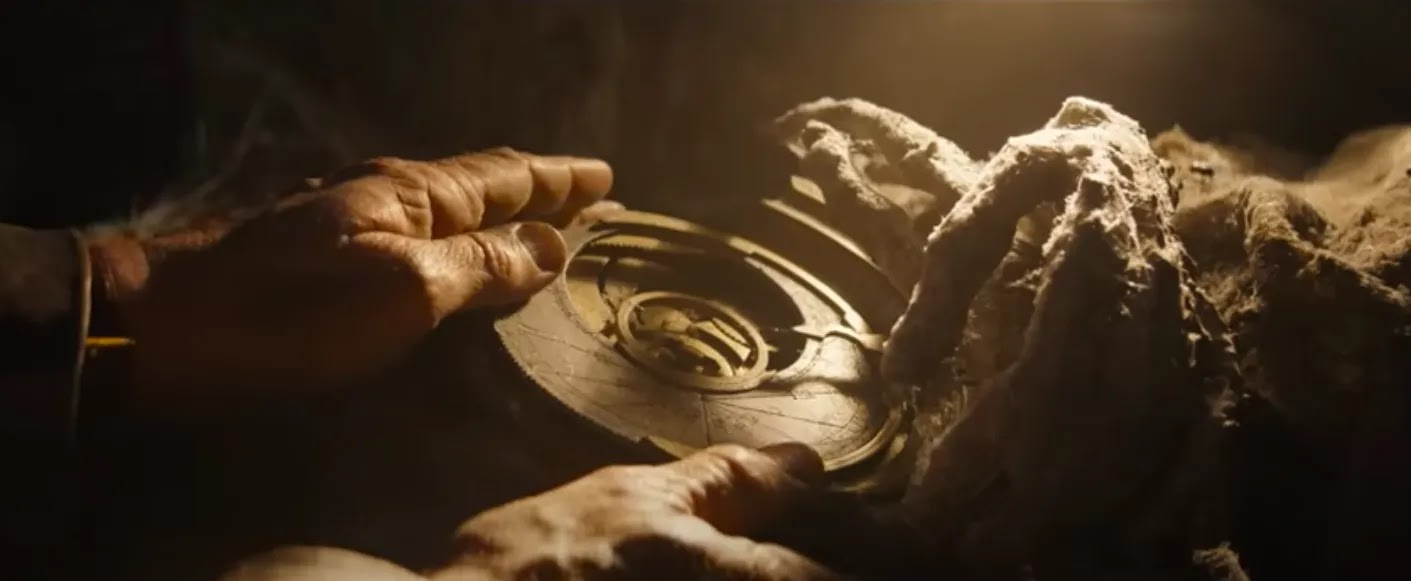
We've met Basil in the film's first sequence—a protracted chase of planes, trains, automobiles, and motorcycles to try and claim back treasures from a Nazi plunder-train to satisfy Hitler's fascination with the Occult. First, they're after the "Lance of Longinus" (which turns out to be fake), then attention is shifted to Archimedes' Dial—the Antikythera—which is of particular interest to a young Nazi physicist named Jürgen Voller (Mads Mikkelsen). The Dial was considered the first computer, constructed around 87 B.C. and was designed to calculate astronomical positions, eclipses, and the movie would have you believe it can predict geological upheavals and...time-fissures.** The trick of it is, though, that the Nazis only have half of it. They need the other half to make it work.
Anyway, Voller wants it, and Indy and "Bas'" want to keep it from him. Indy has been captured by the Nazis (of course) and they want information and he thinks all those antiquities should be in museums. While he's being threatened by the Nasties, Basil gets captured, as well, and is carted onto a train for any information about the Lance. After Indy survives an execution (several times), it becomes his mission to 1) get on that train 2) rescue Basil and 3) get all those baubles while surviving machine guns and bombing runs by the allies. All done at night, the better to hide the extensive special effects it takes to pull the sequence off, somewhat credibly.
One becomes aware, almost immediately, that Mangold is directing this entry and not Steven Spielberg (although George Lucas—who thought up the series—and Spielberg are listed as Executive Producers, they're not involved in the picture-making). It is in the DNA of Spielberg-as-director to make any sequence a playful series of complications that his shot-choices link one to the other. There's a flow that he intentionally puts into his action scenes that instantly telegraphs information to his audience. Mangold tries to do that, here, but there's a disconnect between elements that is often confusing and, at times, seems jarring to the point of obfuscation. The initial action set-piece immediately lowered my bar for expecting a superior Indiana Jones movie—as good as the other four, certainly—and those who have criticized the previous films may find themselves re-appraising their gripes (although I doubt it).
That's the set-up and the 1969-situated remainder of the movie involves the efforts to retrieve the other half of the Antikythera, which necessitates globe-trotting looking for clues to where that might be. I've always loved that element of the Indiana Jones—the tricks, the clues, the puzzles and translations unearthed from the vagaries of time and Nature. There's mounds and mounds of that, with the concomitant parallel of villains riding the research coat-tails that get in the way and delay the satisfaction of the reveals. 
In this case, its the older
Jürgen Voller, who has spent his time helping NASA with their rocket program and has gotten the co-operation of the U.S. government (specifically the C.I.A., in the form here, of Shaunette Renée Wilson doing a great "Foxy Brown" impression), and a couple of thugs (Boyd Holbrook, Olivier Richters) who have their own agenda, which is a bit more contemporary, even if they are less dramatically interesting. Throw in a kid-sidekick (Ethann Isidore) who starts out annoying and becomes gradually more entertaining.
Toss in helpers like Antonio Banderas (in too short a role) and old pal Sallah (John Rhys-Davies), and you have a nicely well-rounded cast.
Most valuable player, though, is Waller-Bridge, whose character, frankly, brings most of the energy to the whole enterprise, completing a series that seems to depend on complicated females of divided loyalties to play off Ford's adventurer-archaeologist. Sure, she probably employed just as many stunt-doubles as Ford, but her quick-witted delivery and expressions has the advantage of youth and energy. Ultimately, where Ford was previously the lynch-pin for audience identification, here, she's the character that may (eventually) engender trust to make things right, while Indy becomes something of a liability in terms of age and attitude.
The end-sequences usually are where things get a bit dicey in these things (especially where "the Wisdom of the Fan-Tribe" weigh in), where the adventurers reach the end of the road and cross over into mysticism, myth and science-fiction. And although, credulity will be snapped to the breaking-point for many, I found that sequence to be the best part of the film, worth even enough to sit through the tedious bits (although I tend to be an apologist for this series, thinking quite highly of Kingdom of the Crystal Skull).
No spoilers here, but given the rather depressed nature of the older Dr. Jones Jr. throughout the film, the fourth act makes perfect sense, story-wise and emotionally, and presents an opportunity—although one hyper-fantastically reached—to complete a series-long character arc of learning and yearning. Okay, maybe I don't "buy" how they got there, but, dramatically, the ends justify the means and presents something unique to say,
with some real resonance, about this character we've followed from youthful arrogance to wistful dotage.
And the end-sequence before the credits? (there is no post-credit scene, thank you). I'm not ashamed to say I teared up, and it made me glad I saw the two hour-twenty-minute-movie even if two hours of it I found wanting. There was no reason for a fifth Indiana Jones movie—other than the thought that maybe they shouldn't go out on the fourth one—and the whole thing is an exercise in nostalgia. The coda only emphasizes that point. But, sometimes nostalgia is pretty important. Memories of the past warm the heart, enrich the soul, and make one step into an uncertain future with the hope of finding more treasures for the memory. Nostalgia isn't "what it used to be". It can also be a beacon to face the future.
But, I can't end this without acknowledging 81 year-old Harrison Ford for making another one of these when most of us hovering around decades of his age are worried about walking the stairs of the multi-plex without using a hand-rail. That's some stamina, man, I don't call how many stunt-doubles and digital-face-replacements were used to pull it off. That should be celebrated, along with the score by 91 year old John Williams, that still manages to raise goose-bumps and make the heart soar. 
 
If this is their mutual last movie, bravo. And thank you...for the memories.

* Me, skewing towards the time-chronology of the Indiana Jones series, wanted the 1960's adventure to be titled "Indiana Jones and the Electric Kool-Aid Acid Test". Oh, well.
 
** Sure, you'll call bullshit. But, you loved the Ark of the Covenant melting Nazis, cheered when rafts were used to bail out of airplanes and sled on the Himalayas...not to mention pulling beating hearts out of chests, and were awed by the Last Surviving Knight Templar. But, you couldn't get past "nuking the fridge." The suspensions of disbelief among fans are more rickety than the bridges Indy repeatedly has to cross. How can one love the one and hate the other? I think it has to do with being a fan as a child and a jerk as an adult—you grow up but never mature. Anyway, I'm long since done trying to understand fans of the "fantasy" genre. They seem determined to destroy what distinguishes the genre from the rest—imagination and wonder. End of lecture. No, I don't have office hours and I won't meet you for a fight in the parking lot. (And...I stole your lunch).