Believe it or not, despite my last paragraph, this was written ages ago, soon after The Pianist was released on DVD. It seems like when one mentions "current events" as bad news, there is always an example one can point to. It is sadly inevitable. Wish it wasn't.
The Pianist (Roman Polanski, 2002): I've been avoiding watching this like the plague, because when you get home from a long day at work the last thing you want to see is a "holocaust" movie. (In fact, now, I'm thinking "when WOULD be the best time to watch a holocaust movie?" and the answer I come up with is "BEFORE the next holocaust!" seeing as a little education about precedent might prevent the next one...) But since our current Netflix choices are The Pianist or The Constant Gardener, its a bit easier to choose which of the two depressing movies you want to take on. We went with Pianist, and now I regret putting it off.
Yes, it's about the Warsaw Ghetto. But it's also a terrific adventure/survival movie about a man used to the rarefied world of the arts—a luxury, truth be told—being forced to make life and death choices just in order to survive.
It begins withWładysław Szpilman (Adrien Brody) performing a concert piece over the radio only to have the program interrupted by Nazi Germany bombing the city. The reaction among the populace is a typical one--great fear leavened by a hope for the best (with a cautious "it can't happen here" disbelief). France and England declare war on Germany, and, with help like that, the crisis can't last long.
But, it does. It gets continually worse with the Polish government cooperating with the Nazis, the Russians presenting an opposing front within the nation, the Jewish population denied jobs and businesses, forced to wear identifying arm-bands, then segregated into the poorest sections of Warsaw.
When the Jews are rounded up to be sent to the Treblinka concentration camp, Wladyslaw is separated from his family by a sympathetic member of the Jewish Ghetto Police and forced into slave labor, while secretly working to smuggle weapons into the ghetto for a rumored uprising.
Wladyslaw manages to escape and for the next three years, with the help of sympathetic friends—and, unbelievably, even one German officer—he manages to eke out an existence during the occupation and war-time bombardments. *
That its a true story makes it even more remarkable and a testament to one's will to live. But its also one of Roman Polanski's best films--a straight ahead artful telling of the tale without blandishments or Polanski's usual tendency to throw in some frivolous garbage that devalues the piece. Brody is simply amazing in it (but "Man Alone" movies tend to bring out the best in actors—anyone remember Dr. Hang S. Noor in The Killing Fields? Both actors won Oscars for their respective roles), slowly losing the detached look in his eyes as his situation worsens and worsens.
One can't help but flash on current events and how a populace can be fooled into thinking "But they wouldn't dare...." Give someone enough power, and they'll dare anything. With enough power, who's going to stop them?
Well worth seeing if only as a cautionary tale.
* Polanski was undoubtedly drawn to the story as he did basically the same thing growing up in war-time Krakow. He tells of how his family was rounded up for the concentration camps and only surviving because his father shoved him out of line, saying "I don't know you! Get out of here!" He lived under a false identity in a series of foster homes and on his own throughout the rest of the war.
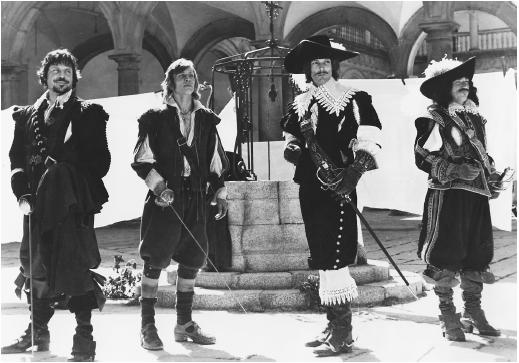
The Three Musketeers: The Queen's Diamonds/ The Four Musketeers: Milady's Revenge(Richard Lester, 1974/1975)These rollicking films were originally planned as a two and a half hour epic (no matter what the Producers now say!) may just be one of the best adventure films (and adaptations of a classic novel) ever adapted, balancing the demands of the story, the tenor of the times in which it was made and the idiosyncrasies of its director.
When approached, Richard Lester (who hadn't made a film since The Bed Sitting Room in 1969) wasn't enthused. Then he read the story, and did some research...and heartily agreed. One can see why. For The Three Musketeers, as Lester and his screen-writer George MacDonald Fraser envisioned it, is a story of intrigue done in high places, but carried out by the lackeys and foot-soldiers who live only to serve. Forget that the palace-dwellers are either snakes or dullards—they provide an opportunity for income and adventure--two qualities lacking amongst the citizens of France and England, who, at the time, are at war. The opportunities for thrills, humor and rapier-pointed satire are rich and mined well by the film-makers.
And Lester's direction is masterful—simple set-ups and multiple cameras are used during the swash-buckling to make sure there's a glimpse of every buckled swash. And those scenes are choreographed as a group participation so that every Musketeer has "business." Lester also worked to make sure that the fights were inelegant affairs--not balletic, as had been the tradition, but more like street-fights, with few rules and the use of landscape and surroundings as equal strategies to the sword technique (and every part of the sword is used, as opponents are sometimes conked with the ornate handles). And, as Lester was renowned as a "one-take" director, opportunities for mis-haps, mess-ups and stumbles only added to the verisimilitude. Sure, the action was rehearsed, but any imperfections made things seem more real.
Reed, Finlay, Chamberlain, York and Kinnear enjoying the fruits of their labors.
Lester surrounds the royalty with games and idle amusements that have a slight tint of mindless cruelty to them, and that extends to the villains, whose elaborate machinations involving the Royals are merely extensions of those same games, with regime-toppling consequences.
A royal chess-game with dogs and capuchins
And the cast! As the musketeers, Oliver Reed as the surly Athos, Richard Chamberlain as the effete Aramis, Frank Finlay as the clownish Porthos, and Michael York as the young and naive D'Artagnan. As the Royals, Jean-Pierre Cassel as the foppish King Louis XIII, Geraldine Chaplin as the frail Queen Anna of Austria, and Simon Ward as the rakish Duke of Buckingham. As the villains, Faye Dunaway as Lady De Winter, Christopher Lee as the villainous Rochefort, and Charlton Heston in one of his best performances as the Machiavellian Cardinal Richelieu. Rounding out the cast are Raquel Welch as the Queen's seamstress, the accident-prone Constance de Bonacieux,*Spike Milligan as her randy husband, and Lester regular, the great Roy Kinnear as D'Artagnan's man-servant, Planchet. A superb cast, rarely equalled.
Welch and Dunaway as good girl/bad girl
It's long been contended that the film was supposed to be one movie, but that the Salkind's split it into two to maximize profits. That's the rumor—there is a natural split of the film at the half-way point that features almost all the actors for a sort-of bow, but it could have easily been used as the starting place for an intermission. It's born out by the fact that there is less movie in The Four Musketeers, it being padded with an "up-to-that-point" narrated prologue.
Charlton Heston in one of his best performances as Cardinal Richelieu
The two-film scheme is helped by the fact that there are two very distinct stories of different tones, both of which are resolved, the first being the intrigue-filled, but relatively light-hearted The Queen's Diamondsstory (in which Athos, Aramis and Porthos are wounded, but not killed), and the second, Milady's Revenge where the Palace forces seek to disrupt whatever kept them from succeeding in the first one. That story, with its be-headings, extended back-story and several prominent deaths, is less fun (although certainly as clever) and considerably darker. Where Part 1 is rollicking fun with minimal consequences, the stakes in Part 2 are very high, passions flare, and the sword-play becomes deadly and fraught. The humor is darker than the first, too. Despite the same cast and crew,**the two are very different films. The combination of the two of them would have left audiences winded and less ebullient (and more anticipatory of a continuance).
Two other highlights: David Watkins' exquisite cinematography and the hysterically ornate costumes.
Taken together, they have a moralist's sensibility of the costs of frivolity and duplicity; adventure can be fun, but in a poisonous political atmosphere, one adventures at one's own risk. You can have a good time watching The Three Musketeers, but the story is incomplete without the paid dues in The Four Musketeers. Together, they make one of the finest adaptations of a classic novel ever put to film.
* Welch, not the most versatile of actresses, won the Golden Globe for her hilarious performance in The Three Musketeers and tearfully told the crowd "I've been waiting for this since One Million Years B.C.!"
** ...except for the score composers--Michel Legrand for The Three Musketeers and Lalo Schifrin for The Four Musketeers.
 , 2002): I've been avoiding watching this like the plague, because when you get home from a long day at work the last thing you want to see is a "holocaust" movie. (In fact, now, I'm thinking "when WOULD be the best time to watch a holocaust movie?" and the answer I come up with is "BEFORE the next holocaust!" seeing as a little education about precedent might prevent the next one...) But since our current Netflix choices are The Pianist or The Constant Gardener, its a bit easier to choose which of the two depressing movies you want to take on. We went with Pianist, and now I regret putting it off.