Showing posts with label Drama. Show all posts

Wednesday, August 27, 2025

East of Wall

South Dakota Will Make You Humble
or
"Life's a Metaphor, Isn't It?" "(F... Off!)"
 
East of Wall is a difficult film to classify. It defies pigeon-holing and slotting. Classification. It's not a documentary, because it's scripted. It has real people playing themselves (with two actorly exceptions), so it's not exactly fiction, even though it fits the bill of being "based on a true story." Even if it isn't. But, it could happen. That it doesn't goes a long way in explaining the nature of the real people involved. So, that's fiction "becoming" fact. In an interview with NPR, director , describes her film as "docufiction" filmed on location, sometimes documentary style "on the fly" with the actual people who live the daily lives depicted in the film. To paraphrase "Dragnet": "The names you are about to see are true. The story has been changed to project the innocent."
 
Tabatha Zimiga has lived on her husband's family horse farm for years after his death. She's raising three kids, a lot of horses—training them in a style similar to "Buck" Brannaman—and taking in strays...animals and kids, teens who through issues with their parents (addiction, incarceration, incompetence or indifference or just plain delinquency) live on the Zimiga farm working the land and the animals, and working on themselves.
I first heard of Zimiga and her South Dakota ranch on the news...probably PBS Newshour because I've lost interest in network news...and her unconventional approach to caring for all her charges. Tatted and head-shaved, she defies the conventions of ranch-owner, her property a collection of paddocks and mobile homes--horses and people house similarly--and she scrapes by a living training horses and selling them at auction, while also keeping her revolving door of kids fed, clothed and sheltered...and schooled. She's had sufficient life lived to understand...but not necessarily sanction...teen drama, keeping a wary eye on behavior, both human and equestrian. She has enough drama of her own.
Unlike most cowboys, she has an internet presence, posting on TikTok, showing off the kids' riding skills as well as the dexterity of her horses, all good marketing tools for showing off the animals before the weekend auction day. 
Director Beecroft uses those videos to show the day-to-day, connecting and interlacing bits of story-fabric, providing background on the various interactions, all revolving around the hub of Tabatha, going to court seeking conservancy for new members of her makeshift brood, keeping truancy to a minimum, dealing with the slights and jolts of everyday ranch life...and not talking about the death of her husband, who committed suicide years before. This is one of the threads running through East of Wall because it affects her daughter Porshia (a really impressive performance) who aches to remember him as he was her mentor and taught her how to ride.
One keeps looking for artifice and the film is remarkably free of it—there are only two actors, 
Scoot McNairy (he played Woodie Guthrie in A Complete Unknown) and Jennifer Ehle who plays Tabatha's mother Tracey (her resume is so impressive and I've seen her in so many things that the way she insinuates into the role is, frankly, startling) but you can "sense" the actors from everybody else—even the makeshift stuff feels completely natural in this day and age of corporate takeover. But, when the real people playing their real selves (though fictionalized a bit) are on-screen, it's a truly eerie feeling. You feel like you're watching a documentary, despite the occasional beautiful landscape shot. Movies do a really good job of faking real. East of Wall isn't faking.
That becomes readily apparent during Tabatha's drunk monologue about finding her dead husband, which is one of the most riveting one shots I've ever seen. Raw, profane, and bitter, all expressed through a haze of repressed regret, it's a jaw-dropping sequence, repeatedly challenging the sense of reality and drama in an audience's mind. Sort of like real life.   
Some have gone so far as to say the film is a modern "take" on the Western (if we're still pining for categorization). I'm not so sure one could call this a traditional Western per se, but if John Ford's entries are, in the end, about the struggles of making a community in a wasteland, then East of Wall certainly fills that bill.
 
It's one of the best films of the year. 

Friday, April 25, 2025

Having a Wild Weekend

Having a Wild Weekend (aka Catch Us if You Can)(John Boorman, 1965) If you're old enough to remember "The British Invasion" back in the 1960's, you might remember the name of "The Dave Clark Five", one of the British pop bands that was dominating American air-waves and record charts after the barrier had been broken by The Beatles. The Beatles caused a sensation, making their American TV debut on The Ed Sullivan Show for three weeks in a row, but my memory remembers The DC5 being the group that appeared on Ed's variety show in the weeks following The Beatles' American tour...before The Animals and before The Rolling Stones.
 
They were a great group, with a tougher, fuller sound than their contemporaries, with great "hooks" that had an ability to become ear-worms instantly, even though their lyrics had little depth. But, you didn't care—they were free-wheeling, rocking musicians with throat-bleeding lead vocals by the inimitable Mike Smith.
 
And if you weren't a "rebel" group (like the Animals or the Stones), but pop, there was the standard foray into other entertainment forms, following the shimmying footsteps of Elvis—Herman's Hermits made films and Gerry and the Pacemakers and Freddie and the Dreamers and Cliff Richard* and on and on. The Dave Clark Five made one, too, but it wasn't a hit, barely featured the DC5, but can boast it was the first feature directed by British director John Boorman (Point Blank, Deliverance, Excalibur, Hope and Glory).
Unlike in The Beatles films, The DC5 don't play themselves—indeed, they don't even "perform" any of their songs, but a couple of tunes are used as background for edited hi-jinks—they're stuntmen/extras who are being used in an ad campaign for a British meat-packing plant, the most prominent of the commercials and billboards featuring Dinah (
Barbara Ferris) "The Butcher Girl" extolling the virtues of meat to the British public. That an ad agency would use a swinging Blond "bird" as their symbol for meat is an absurd concept (but one that isn't inconceivable in the advertising world) and Boorman has a fine time larking about London showing more and more of the incongruous campaign, which, evidently, is doing the job as the city seems festooned with billboards.
The plot starts when, on a commercial-shoot with Dinah and the boys, Steve (
Dave Clark) strikes up a conversation with her and discovers that 1) she's bought her own private island in Devon and 2) she's bored and tired with her life. He could tell her that she is fundamentally well-off that she can afford to be bored and actually does have some agency and maybe she should sleep on it and give it 24 hours. Then, there wouldn't be a movie. But, no. He steals the ad agency's Jaguar and the two go off to find her island. Because that's what young, energetic, swinging 60's kids do, dad! And ad agency exec's—who are paying for studio-time—then send the police and whatever goon-squad they can find to bring them back.
Which is just what Dinah's ad-agency pygmalion, Zissell
(David de Keyser) does. Hi-jinks and low social comedy ensue, cutting a swath through a limited number of 60's outliers like vagabond-Brit-hippies and upper-class eccentrics, where if a point was being made it's a bit hard to discern. The trip to the island doesn't prove pointless, but it does have a bit of a let-down in store ("It smells of dead holidays, doesn't it?"). Not the kind of "gas" they were expecting.
But, another way that Having a Wild Weekend separates itself from the usual pop-film fluff (aside from only leaving the band-mates as cyphers and concentrating on Clark's character—he was, after all, the group's manager and impresario) is decidedly down-beat ending, where all the gadabouting and free-thinking comes to naught when confronted by economic reality, power dynamics and the superficial benefits of fame. Hardly the message of peace, love, and understanding associated with the 1960's or rock n' roll. That could be why the film didn't do so well. But it did give Boorman enough attention to get his next gig directing Point Blank, a genre-piece with its own subversive take on noir, business, and corruptibility.
"Tried it once. Didn't fancy it."


* I remember, as a kid, having to suffer through Richard's film Summer Holiday, the first film of the double bill, at the Seattle premier of A Hard Day's Night. I have a vague memory of it as being insufferable and more amused at the Beatles-starved audience being impatient with it. Summer Holiday was directed by another up-and-coming director, Peter Yates. It was a hit in Britain, though, earning the position of the 2nd most popular film of 1963, right behind From Russia With Love.

Thursday, April 24, 2025

Millions

Written, initially, when it was released on video. And recently expanded because it's so darned good and everybody needs a good movie every once in awhile...

Millions (Danny Boyle, 2004) "The French have said au revoir to the franc, the Germans have said auf wiedersehen to the mark, and the Portuguese have said...whatever to their thing."
 
"Now, it's our turn to say good-bye to sterling. This Christmas, we are going to get the euro. Good-bye, old pounds. Everyone says we're going to miss you."
 
It's 2002, and with the establishment of the European Union, the country-specific currency in the days of conflicting exchange rates was being replaced by the euro in 12 of the member states (although it's now in 20 of the 27 EU countries) as of the first of that year, all in the name of solidarity and globalization. Such a radical shift is the sort of thing to make great stories of, and this little parable (of a sorts) is a remarkable example of making a great story out of cultural change (and not just the monetary kind).
Director Danny Boyle begins Millions with a sun-dappled intro to a child's world, and a visit to the site of a new housing development, where our hero Damian (
Alex Etel) and his brother Anthony (Lewis McGibbon) imagine the building of their soon-to-be new home in fantastical stop-motion animation set to John Murphy's cooing Elfmanesque score.* One is instantly charmed, not only by the fairy-tale way in which the story is introduced, but also by the promise of what is to come. Anything is possible.
But, the sequence is interspersed with shots of impossibly propulsive trains, indicating—along with the house-building sequence that, in this child's world, things can move pretty fast.
Once, they've moved into their new home named appropriately "Serendipity" ("Surprisingly spacious with attractive views!" enthuses Anthony), it's off to school with them, where Anthony is better able to adapt than Damian who when he's asked if he has any heroes rattles off the names of saints (with whom he's obsessed) enthusiastically detailing their grisly fates to the horror of his fellow students (whose heroes are footballers).
But, their lives change when Damian imagines an audience with Clare of Assisi (1194 to 1253 and the patron saint of television...no, really) in his hermitage made of moving boxes taped together to form an ornate structure and its interrupted by the construction being crushed by a flying Nike bag filled with pound notes—£229,520 to be precise—which Damian assumes (naturally) that it came from God. His brother, Anthony, is far less deistic and thinks—maybe—it came from a passing train, but doesn't question it enough to see the opportunities implied. The kids stash the loot, vow to not tell their Dad, and Anthony begins to use it to gain friends at their new school to form a "posse."
But, Damian has other ideas (of course). Since the funds came from God, he starts to distribute it the way his idols, the saints, would. His first act is to buy a bunch of pigeons and release them, as per St. Francis (who dutifully shows up to give his approval and suggest that Damian use the money to help the poor). With aid from St. Nicholas, he leaves stuffs a lot of pound notes into the mail-slot of some neighboring Mormon missionaries (they needed a dish-washer and a microwave), the Ugandan Martyrs persuade Damian to give to a Christian charity that will provide wells to African villages (that one is so obvious and un-anonymous it gets him in trouble with his whole family and exposes the fact that he has the loot), then St. Peter comes by for a visit and tells him maybe he should slow down a little as miracles aren't always what they seem.
Damian with St. Francis (note the halo)
 
Meanwhile, there's all this money with a certifiable expiration date and two boys have to figure out how to use it while it's still valuable. Anthony starts to tour real estate "for investment opportunity." Damian comes to realize that even though giving to the poor is a really good idea "it's really hard" to do. Plus things get...complicated once Da knows there's all this money and then, there's the business of some guy nosing around the neighborhood looking like he's lost something really valuable. And Doyle maintains his penchant for keeping things visually fascinating and telling a story in unconventional ways, but still conveying what he absolutely means.
Millions is one of those ones I missed in the theater, and one I deeply regret for having missed it. It's a little gem of a movie Boyle made between his zombie-film 28 Days Later (which will be getting a sequel this year) and his sci-fi film Sunshine but sweeter than his usual fare, although—Doyle being Doyle—it does flirt with some dark material involving child jeopardy, but it ultimately has its sacred heart in the right place.
At one point St. Peter tells Damian: "Something that looks like a miracle turns out to be dead simple." Millions isn't dead simple, but it is something of a miracle.
 
It's a highly charming movie, while avoiding the usual cute kid cliches, and maintaining a quite sophisticated tone of drama and off-the-wall comedy. That was a trick even Disney found hard to pull off.** It gets a very high recommendation from me. 

* I was delighted to see that the score was performed by the Seattle Symphony Orchestra and The Northwest Boychoir and recorded at Studio X of my old stomping ground Bad Animals and recorded by old comrade Reed Ruddy. Nifty!
 
** This being what they are, and the film being originally produced by Fox Searchlight, it is now the property of The House of Mouse. 
Everybody watches "Who Wants to be a Millionaire" which is some sort of career-foreshadowing.

Tuesday, April 15, 2025

The Friend (2024)

White Ghost/Sad Pony
or
"What's Going To Happen To The Dog?"

As soon as it's over, you want to watch The Friend again. It's that good, with a literate script, masterful performances (from everybody, not just Naomi Watts and Bill Murray...or the dog, Bing), New York as a background, an intricately selected soundtrack, and the least anthropomorphic animal performance I've seen in a long time.

And, it's a "dog" movie.

I hate "dog" movies, usually. You know why. The dog always seems to die at the end, usually in the dramatic interest of teaching the film's protagonist a life-lesson of great import. Like "life is a gift" or "appreciate what you've got when you've got it." Blah-de-blah-de-blah. I'm cynical of the form because I hate to cry in theaters and beating me with a dead dog turns me into a blubbering wreck and I hate to throw away all the soggy popcorn. The one time I didn't was when John Wick's dog was murdered and that it inspired him to come out of assassination retirement (which I giggled at, finding it perversely ludicrous).
But, this one I rushed to see because, well, 
Naomi Watts and Bill Murray are in it and their taste in parts alone should sell it, some laudatory words online were mentioned, and it's based on a Booker prize-winning novel by Sigrid Nunez. All indications were for some good breeding of a project that was low-key and mildly amusing. I wasn't prepared for a great movie, but I got it in spades.
It starts with a moment of inspiration, which we're not privy to: successful author-teacher Walter Mitchell (Murray) is out on his morning "Two Bridges" jog when he sees something that delights him, but we cut away before we see what has animated him so. We see him at a dinner party where he is holding court, volubly telling the story of his discovery. By the next scene, he is dead—by his own hand, they say*—and the survivors are left wondering how such a thing could happen. What would the world be without Walter? There were so many projects in the air, so many things left undone, and he'd just met his grown daughter whom he—or any of his wives, past or present—never knew existed.

But, hardest hit seems to be Iris (Watts), ostensibly his best friend. Walter was her mentor (currently she's working on a book of his correspondence) and she, in turn, is mentoring his new/old daughter, collaborating on the book. Progress on it has been slow but, now, work on it—like Walter—has come to a screeching halt.
Walter's widow (Noma Dumezweni) has asked Iris to come see her and she has a request. Well, more of a bequest—Walter had asked that if anything happened to him that Iris should take care of his dog, Apollo, the creature that he encountered on that morning run.
"Apollo" is a 150 lb. Great Dane and Iris weighs quite a bit less and is only half-again taller. Plus, Iris' apartment is, what they call in New York, a "studio" but it could be a "prewar", but anywhere else it would be called "cramped" and if you were selling it you'd mention "simplicity" and "ease of maintenance". In no way would it be considered a kennel, and—besides—it's in a "No Pets Allowed" building. Iris is not keen on the idea and her "go-to" is to avoid the Super as long as she can and find a place to "re-home" Apollo. But, in the meantime, she picks up the dog at its temporary kennel to take to what she hopes is its temporary home in her apartment only to find that the brute jumps on her bed and spreads out, despite her protests. His forlorn look prompts Iris' neighbor to remark "There's a PONY on your bed! A SAD pony!"
A sad pony to be sure, but also the elephant in the room. Apollo is just too big to fit into her apartment without obstructing Iris' every movement. She capitulated by pulling an air mattress out of her closet and sleeping on the floor, Apollo's sad eyes never leaving her through the night. But, the two are bonded, despite the separate bed-places in that they're both grieving—she for her mentor, he for his master. One's a human, one's a dog; she's a loner, he's a pack animal, so they're both approaching each other from separate corners. And with all the inconvenience this big white ghost causes in her life, some accommodation needs to be reached, some compromise between these two living beings who've been left behind.
And, ultimately, value.
The Friend, unlike so many "dog movies", is what the AARP magazine likes to call 
"Movies for Grownups". The emotions are complicated and recognizable, and maybe over some folks' heads. But, a New Yorker will recognize the panic of possibly losing a rent-controlled apartment; an older person will recognize the paralysis of grief; a real dog-owner will understand the inconvenience of pet-ownership** ...beyond the dog-movie-cliché antics of four-legged tornado-damage to the feng shui. There are no easy-laugh slobber jokes. This one is about loss, responsibility, and mutual need. And a bit about survivor's guilt. And the usual "taking care of others is more fulfilling than taking care of yourself." And Watts and Murray are brilliant in this.
It's so good and funny and wise that you immediately want to see it again. Or, better yet, read the book to get all the good stuff they couldn't make room for. Sometimes, that's the best part.

* I suppose with the mention of it, I should give the number of the Suicide and Crisis Hotline—If you or a loved one are having emotional distress or thoughts of suicide, call 988 to connect with a lifeline specialist for support.but DOGE only knows if it still exists. From what I've been able to access online, it does. 
 
** The other day something popped up in my news-feed that still makes me laugh: "Nobody has ever said 'What this house needs is a box-full of shit. Let's get a cat!'"

Wednesday, March 5, 2025

The Way Back (2010)

Written at the time of the film's release. 
 
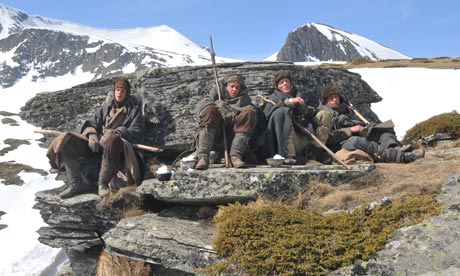
This is the last film directed by Australian director Peter Weir. On March 17, 2024 saying that he had "no more energy," Weir announced he was retiring from directing and that "for film directors, like volcanoes, there are three major stages: active, dormant and extinct. I think I've reached the latter! Another generation is out there calling "action" and "cut" and good luck to them."
 
"Strangers in a Strange Land"
or
"Every Journey Begins with the First Steppe"

A new Peter Weir film is something of an event. The Aussie director of Picnic at Hanging Rock, The Year of Living Dangerously, Gallipoli, The Truman Show, Witness, and Master and Commander makes meticulous, thoughtful films of ambiguity and great beauty, throwing civilized men and women into clashes of culture (frequently more primitive) exploring the impact, with an eye towards the rough, otherworldly beauty of this world. Along the way, you learn a lot even if the movie does not draw to a dramatic or philosophical conclusion.
So, with little fanfare, here is The Way Back, Weir's latest film, one that has been optioned many times since its source book, Slavomir Rawicz's "The Long Walk: The True Story of a Trek to Freedom," was published in 1956. The veracity of the tale has been questioned a lot in that time, but the evidence is clear: four emaciated men walked into an Indian village, saying that they had walked from a Communist gulag in Siberia across the Gobi Desert and the Himalayas to freedom, a journey on-foot of 4,000 miles.
One could speculate—for the length of such a journey—why it had never come to the screen before: too depressing—but think what it would do for soda and popcorn sales! Elvis wasn't interested, indeed, what star would take on such a rugged movie, Burt Lancaster's brief interest notwithstanding; the movie has a lot of explaining to do about socio-political situations; the Russian market might not be too pleased with the film, and on and on. Weir made it (reportedly for less than $30 million, which seems incredible), but so few studios were interested in it that it almost went straight to video...which would have been a shame, as this is one of those movies demanding to be seen on a big screen.
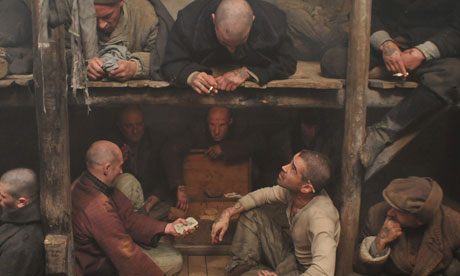
Janusz (Jim Sturgess) begins the film under interrogation in occupied Poland. The year is 1940.  He has been turned in (reluctantly) by his wife under torture, and he is sent to a Soviet gulag in the mountainous regions of Siberia. After a period of learning the ropes (and the whips of the guards and the barbed wire of the camp), he becomes a part of a loose group of prisoners of differing skills and supplies to make a fast surgical escape from the gulag and make their way to Mongolia. Based on a loose plan of prisoner Khabarov (Mark Strong), they plan to make it to Lake Baikalfollowing it to the Sino-Russian railway. Their supplies will run out in mere days, but Janusz is convinced they can live off the land, walking the entire way. Among the group of escaping stragglers are "Mr. Smith" (Ed Harris)—"First name: Mister"—a particularly mysterious American (he tells Janusz, "you have a weakness I can use: kindness"), and, as it seems all movie escape attempts must have, a plays-by-his-own-rules maybe-criminal named Valka (Colin Farrell). The group begins suspicious of each other, but soon forms a close-knit, surprisingly democratic structure, sharing ideas and resources, voting when they're at a crossroadsdespite the occasional individual insurrection.
Watching the movie is a slog. At 2 hours, 20 minutes, with the principal characters pushed to their endurance, the film feels longer than its running time, but one is never tempted to do a watch-check. The Way Back is one of those films that keeps you guessing, intrigued and involved every minute, like you were involved in the long walk, craning to see what is around every corner. Weir keeps the pace moving quickly, cutting scenes briskly from one episode to the next, so the film develops a natural rhythm.
But, it's the director's eye for detail—as always—that is striking, with scenes of stark, natural beauty that astonish: taking refuge in ancient caves, the camera pans up, following a bedraggled Mr. Smith's gaze, to two large holes in the ceiling, like the angry eyes of God; walking up a scrabble hill, Weir directs our view up and over the weary travelers to a screen-stretching shot of the expansive Gobi desert; at one point, they find a single solitary structure—a gate with no walls—absurdly marking their goal, while announcing another set-back.
It is a grueling adventure story with fine performances all around, interpreted through Weir's talent for keeping things real, even when they turn startlingly surreal. Go prepared for a tough movie, but a satisfying one, that, like all escapes, becomes a journey of the individual will and spirit, covering all manner of obstacles in physical space, mental discipline, and the longest journey...of time.

Sunday, March 2, 2025

Nickel Boys

Walk a Mile in My Shoes
or
"Not My Elwood. Not My Elwood."

Impressionistic and impressive, Nickel Boys tells its story of Elwood Curtis, from Tallahassee, Florida ("Frenchtown" he'll add), who hitchhiking to attend a technical college in New York, is picked up by a car-thief and arrested as an accessory and sent to "Nickel Academy" a segregated reform school with a checkered history.
 
Raised by his grandmother (Aunjanue Ellis-Taylor
), Elwood (played by Ethan Herisse) had received exemplary marks at school, got a scholarship to that college, and had been active in civil rights actions, but being sent to "juvie" merely by association has derailed his life and his prospects, and somewhat his spirit. 

But not his conscience. Sticking up for a weaker kid being picked on, he is punched in the face by the bullies, knocked out, and sent to the hospital. 

And he has one friend. A good friend, Turner (Brandon Wilson), who is as cynical as Elwood is principled, and the two kids bond, help each other out and talk out their problems, confiding in each other. One seems to complete the other.
Our first glimpse of Elwood, reflected in his grandmother's iron.
Which is interesting, considering how the movie's filmed. It's all shot from a first-person singular point-of-view, initially Elwood's, but then once the two boys meet, the movie will switch off from one to the other.*  Sounds like it could be confusing, but director RaMell Ross manages to clue you in even if it isn't obvious which of the kids' eyes you're seeing the world through.
Elwood watches Dr. King in a store-front window.
Now, I haven't read Colson Whitehead's Pulitzer Prize winning novel (entitled "THE Nickel Boys") from which the film is based, but I'm getting the impression its not from a first person narrative.So, this re-imagining of the film is a pretty radical shift, boiling the novel down to just dialog and leaving the descriptive to be handled by the director and cinematographer (which you'd think would be natural—it's a movie, made of visual storytelling *duh*), but Ross does it with such discipline, one is never confused and only disoriented when the subject is disoriented.
Turner, from Elwood's perspective.
And Ross presents these unique perspectives in an almost-stream-of-consciousness way. He presents impressions of scenes. Glimpses of details that the characters' perspectives latch onto, whether it be their own reflection or in how you can tell someone's nervous by how their knees shake. In that way, it reminded of no other movie so much as The Tree of Life, but with a much-more controlled narrative structure and ...an actual story, rather than fleeting memories played at seeming random (as Tree does).
Elwood, from Turner's perspective.
And POV perspectives rarely work in movies, except for brief sequences where the sight of the actor on screen talking right at the audience is arresting. Here, the entire movie puts us in Elwood's—or Turner's—skin and we see what they see. We see their world and what attracts their attention. This is the sort of cinema I love...where the visuals tell the story more than the circumspect dialogue does. And Ross respects the audience enough to not resort to narrative hand-holding to explain what's on the screen (so many movies over-explain). It's all right there to see, if you're paying attention. It's a rich narrative dance that Ross creates, and it's one of the best films of the year.

* Director Ross does this in an interesting way. He first shoots Elwood meeting Turner sitting across a cafeteria table from him. THEN, Ross repeats the sequence all from Turner's point of view. There is really no differentiation between how the two perspectives look, but if you see Elwood, you know you're seeing things from Turner's point of view and vice versa. And if you're not looking at one or the other, you're given enough clues to figure out which character we're seeing the world through.

Thursday, February 27, 2025

Emilia Pérez

The Exhumation of the Dead
or
Careful, There's No Railing
 
Jacques Audiard's Emilia Pérez (streaming forever on Netflix) seems purposely designed to make half of America's head explode. A musical with a trans protagonist who decides to quit their life as a drug kingpin and to become a woman. It's both a practical decision—he wants out of the drug trade, which guarantees a short life expectancy and he has a wife and kids that he adores—and a personal one—he wants a clean soul and to be true to himself, and his life in the macho world of the drug-trade just doesn't lend itself to his aspirations. He wants out, both of the way of the cartels and the way he must live his life as a merciless no-nonsense drug lord. 

Easier said than done.
 
Top-lining the film is Zoe Saldaña as attorney Rita Mora Castro, who we first see writing the closing argument for a case she does not believe in, but that ultimately is won, which leaves her conflicted about her profession. She receives an anonymous phone-call that puts it bluntly "Do you want to become rich? I have a proposition for you."
She's directed to a location 10 minutes away, where a car comes to pick her up, a hood is placed over her head, and she is taken to the stronghold of the Los Cabalos drug cartel, run by Juan "Manitas" Del Monte (
Karla Sofía Gascón), the man who made the phone-call. His proposition is this: he wants to "disappear", fake his own death, and to have gender-affirming surgery so that he can live the rest of his life as a woman, with his family transported to Switzerland for their safety. Rita's job is to investigate, advocate, and see to the details to accomplish these goals.
She manages to make all the arrangements and walks away a very rich woman. Four years later at a swank dinner party she meets a woman named Emilia Pérez (Karla Sofía Gascónagain) and suddenly realizes...it's her client.
Audiard dramatizes the moment by shutting off every decorative light in the room, isolating the two women, who are the only people on Earth (well, besides the operating team) who know Emilia's past. For Rita, it's a moment of horror, because why would they suddenly cross paths just four years later—she fears for her life. But Emilia has other plans for Rita; as she accomplished things so well previously, she hires her to arrange to bring his wife (played by Selena Gomez) and his two children back to Mexico, to live with Emilia, who will masquerade as Manitas' sister. What could possibly go wrong?
Well, a lot, apparently. If half the heads of America have exploded, almost all of them have in the story's setting of Mexico. Director Audiard is French and he filmed the movie in Paris. Only one of the principal actors is Mexican, and the script has been criticized for its confusion of Spanish and Mexican idioms as well as incorrect uses of pronouns, and for those "in the know" the accents are all over the place, needing to have them explained away in some expositional dialogue and for all this the movie is considered something of a pariah in Mexico. There are various controversies at the core of Emilia P
érez, but they've tended to eclipse some of the more problematic aspects to the film.
Before we get into that, the performances, however untechnical in terms of accents, are game.
Gascón, a trans actor, is great in both roles she plays, and manages to garner empathy, while retaining an element that makes you suspect she could snap at any minute. Selena Gomez does well with her role as Manitas' wife, who realizes her place as a pawn in the relationship, but has just enough brio to make her own choices when given a long enough leash. But, the stand-out is Saldaña, who has done well for herself in well-established roles even if they're CGI enhanced, but here she gets to show her abilities as singer and dancer and she electrifies at it, while also going through some pretty complex emotions in transition scenes when the professional veneer she maintains drops.
Now, the downside...for a musical, the music isn't that great, for the most part taking the "Hamilton" approach of scatting between beats with lyrics that are better than the ones in, say, Annette, but far from memorable. The piece was first designed as an operetta, so the songs are just syncopated dialog revealing inner thoughts that transactional dialog is too plain to convey and the way they're presented is director-heavy music-video mode, where the camera does most of the dancing.
But, the part of the movie that irritates me is it's very old-fashioned in its way of dealing with the trans issues. To tell you why would reveal too much of the plot, but let's just say there's no such thing as redemption in
Emilia Pérez. No second chances. It says, you may live a new life, but you will pay for the sins of the previous one...which, given the fact that the character tries to redeem herself with a charitable organization to provide answers to the families of victims of drug-cartels, is very Old Testament. You could argue that Manitas was a drug-lord, that he's destroyed so many lives she doesn't deserve to atone or to achieve atonement. Point taken. The crimes one then does are a forever-trap, despite secular ideas of reformation or religious ones of penance absolving them.
But, if that's so, it's akin (to the nth degree) to the faux-pas of "dead-naming" a trans person. Does blame transcend sexual identity? Does guilt? And if a person changes their life to atone for the sins of their past, to try to make it right for the survivors, is it atonement, or is it "too little too late." But, somebody just didn't have the chops to "go there." Emilia Pérez completely by-passes any deep-thought for melodrama and a conclusion for complex moral arguments right out of the Hays Code. It's annoying.
There's just enough clutziness to the whole enterprise, that you kind of wish there was a trans director (a Mexican trans director) behind it who might have been a bit more savvy, not only to the possibilities, but also the problems. Audiard has done some great work in the past (
Une Prophete and Rust and Bone), but this one, he overreached and stylistic story-telling or satirical elements cannot camouflage the inherent issue of being a bit behind the curve when dealing with gender-politics. 
 
Emilia Perez is content to merely be outrageous. Well, they got the outrage. Just not the kind they were expecting.