Showing posts with label Based on a True Story. Show all posts

Wednesday, April 23, 2025

Warfare

Route Spartan
or
"Look for the Blood and the Smoke! That's Where We Are!"

Warfare just drops you into it. The film, written and directed by Alex Garland (Ex Machina, Civil War) and Ray Mendoza (who lived it) tells the story of an insignificant little troop deployment of Navy SEALS in Ramadi, Iraq in 2006 to lend support to a Marine operation nearby (in fact only 300 meters away!). Standard stuff. In and out. No mess no fuss.
 
They come in under cover of darkness, enter a strategically placed household, subdue the inhabitants, isolate them, put them out of operations' way, then monitor for any suspicious activity among the locals, any amassing, any weapons sightings, any what we call in the U.S. "assembly." Just basically "watch the backs" of the Marines. The radio contact is "5 by," they are well-armed and well-ammo'd, and they have a bird's eye view of the area from aerial surveillance that can track any warm body that comes into view. And they're frequently being updated on the mission status. Everything is nominal. From that point on, the movie runs in "real time."
Alpha One pumping up before the mission.

On top of that, they've punched a hole in the outer wall of an upstairs bedroom for Elliott Miller (Cosmo Jarvis), their lead sniper, to lay prone on a mattress for hours on end, peering through the telescopic sight of his M110 SASS rifle to take out anyone or anything that seems suspicious or out of place at a market across the street. It's maximum concentration for minimum movement, but you can't be too careful. Anything suspicious could be prelude to an attack on them, and if you have to pull a trigger to prevent yourself or your troop from dying, that's the job.

Of course, when the clock is ticking and you're just waiting for the sortie to be over, everything looks a little suspicious. But no shots are fired.  Sure, they're being watched...by people who duck so they're not being watched...and the aerial view shows there might be some amassing on the roofs, but things are merely heightened anticipation and they can be Bradley'd out of there within minutes. It's going to be fine.
Until a grenade is dropped through that sniper's nest hole into the bedroom where Miller and another SEAL are positioned. They're able to move quickly and out of the blast-radius, but the resulting explosion instantly turns the monitoring mission into an evac mission. Miller's left hand is bleeding, but treatable if they can get him back to the base quickly and so Bradley tanks are called while the crew sweats the minutes it will take to get them out of there. They are under attack, after all. And the sooner they can get Miller out the better. But, even with the best equipment American tax-dollars can buy, they are still trapped in a house (along with the civilians) and targets. They're surrounded. 
 
And things will only get worse.
The legal disclaimer ("This is a work of fiction", etc. etc) at the end of the movie is unlike any I've seen. I didn't have time to write it down and I haven't found anything that quotes it on the internet, but basically it says it's based on a true incident that was parsed from several interviews (and Mendoza was part of the SEAL team) and any inaccuracies are entirely due "to memory." And, indeed, Miller—who's a real guy—has no recollection of the incident, even though he lost a limb, received severe burns and lost the ability to speak. In part, Mendoza wanted to make the film for him and dedicated it to him.
And from what I've been reading online, a lot of Iraq vets are saying that it's brutally accurate. If true, it is harrowing what we put our fighting men through, even if the the mission depicted was only in a support capacity. There is no safe place in a war-zone (for anybody) and no action taken does not attract a reaction. And with the sophistication of the weaponry, the destruction is catastrophic. It makes you wonder why anybody does it? Why do governments launch wars knowing that the end-result is winning rubble and destroyed infrastructure? What is "gained" by that? But, over the last couple years, that's all we've seen on a day-to-day basis, escalating destruction and death over cratered territory. For what?
I've also read some online critiques that the film is "pointless." Hardly. Not if the portrait it paints is as accurate as has been said and the filmmakers have accomplished their goal, ignoring the jingoism, the cliches, the false melodrama and cheap theatrics in the name of creating drama. It's dramatic enough without inserting fudged ironies into it. The conflict is real without back-story and motivation. The real motivation is living through it, plain and simple. You can say that "war is hell", but Warfare makes it look like insanity. And as director Sam Fuller used to say the only glory in war is surviving it. Giving it to us straight, while we're sitting in our comfortable theater seats, is hardly pointless...especially if it makes us think twice.
The most telling part of Warfare is when the echoes die and the dust settles and the SEAL team gone, and the family of the occupied house come out of hiding and see the slippery blood-trails and multitudes of cartridges on the floor, the holes in the wall, and devastation left behind. Then, there's a shot of the street that moments before was a killing field as villagers come out of their doorways, some armed, some not, walking past body-parts through the smoke that has been left behind. Mendoza has enough wherewithal to include them in the aftermath of the destruction, and one can't help but think that somewhere they're thinking the same thought as you.
 
One hopes there won't be a sequel.
But hopes...and prayers...are ultimately...useless. And...finally...comes the realization that that is the one word that accurately describes the unholy act of war.

Wednesday, April 16, 2025

The Alto Knights

De Niro 17 (And Just Beside Himself)
or
Keep Your Friends Close and Your Enemies Closer (Tough to Do When They're One and the Same)
 
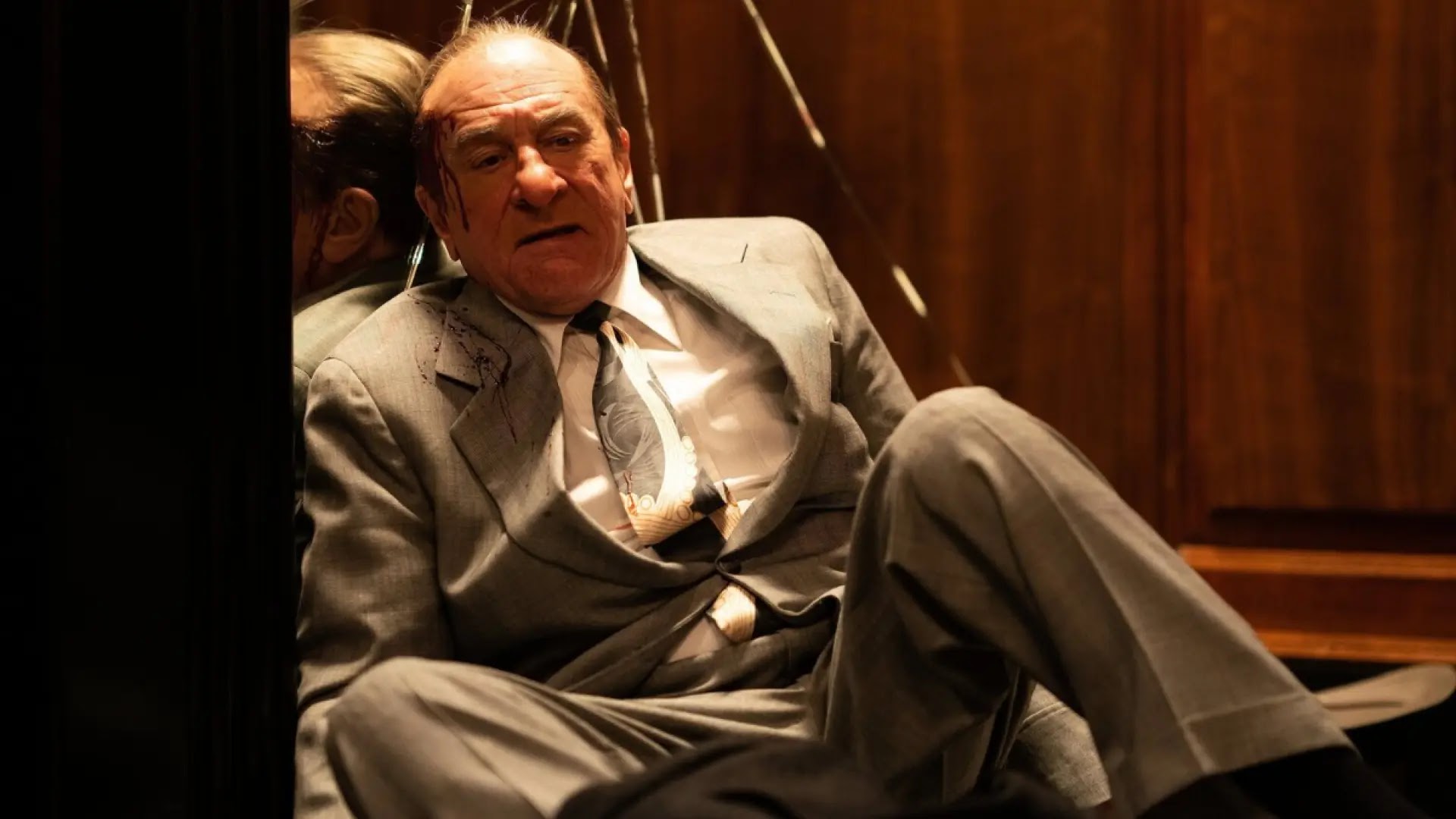
It wasn't the stunt-casting of Robert De Niro in the two lead roles that made me want to see The Alto Knights. It was that this property had been "in the works" since the 1970's (when it was known as "Wise Guys"), being produced by legendary producer Irwin Winkler (who is now 93), with a script by Nicholas Pileggi (he wrote the screenplays and source-books for Goodfellas, Casino, as well as writing City Hall and executive producing American Gangster) and directed by Barry Levinson—who started out writing for Tim Conway, "The Carol Burnett Show", Mel Brooks, and directed such films as Diner, The Natural, Rain Man, Good Morning, Vietnam and his previous gangster movie, Bugsy. Levinson was the draw for me and considering the amazing work he's done in the past—he also executive-produced "Homicide: Life on the Street", a personal favorite—that was more than enough reason.

The Alto Knights tells the story of the Luciano mob family that went from bootlegging during Prohibition to gambling, and controlling criminal activities in Manhattan's Lower East Side. It concentrates on the relationship between Frank Costello, Luciano's consigliere and Vito Genovese, the gang's underboss, who grew up as friends but became bitter rivals once they achieved higher status in the Mafia. And it covers the time from when Costello ran the mob to the helter-skelter Apalachin meeting, the "mob convention" so flagrant that even the FBI's J. Edgar Hoover finally had to admit that organized crime actually existed (why he never had before has been an unexplained mystery).
If you've seen The Godfather, the story will have echoes of the same gun-fire—author Mario Puzo used details and scrambled them for his novel—but, at one point, Genovese (who'd been put in charge of Luciano's mob after its head was sent to prison for running a prostitution operation) fled to Sicily to avoid a murder charge, and was replaced with Costello. Costello and Luciano had deep contacts with New York politicians, and, with Costello in charge, it was easier to get away with murder. 
But when Genovese returned to America in 1945—witnesses to the murder had been very conveniently murdered before any trial could take place—the re-patriated mobster assumed that Luciano would put him back in charge, but, instead, Costello kept himself as the mob's boss, making him an enemy in the mercurial, less steady Genovese's eyes and for the rest of their lives the two stayed bitter rivals. 
The film chronicles that rivalry—from Costello's point of view, so it's more than a bit prejudiced—picking through pages of Mob history back and forth in time in flashback, beginning with the most obvious example of their rivalry, the botched assassination of Costello by Genovese's son on his Dad's orders (Genovese was never said to be subtle). It's that act that convinces the more strategic Costello to retire from the mob, but not without some manipulation of the volatile Genovese. Of course, it's all from Costello's self-sympathetic view of things. But, the film also has Genovese's wild divorce trial, the killing of Costello's hand-picked successor Alberto Anastasia, the Senate hearings of Estes Kefauver, and that ill-fated Mob convention.
Pileggi and Levinson keep it moving and some of the set-pieces are nicely conceived, with the director sometimes evoking Edward Hopper paintings (as he has done in the pas) this time with the aid of 81 year old cinematographer Dante Spinotti. 
So, since he's all over the movie, is De Niro any good? I mean, at playing two different characters in the same movie? Yeah, it's quite the show. Early on in the movie De Niro takes pains to separate the two personas—his Costello is more soft-spoken and cagey-eyed, while his Vito Genovese spits out his dialog and has a nervous energy (it's almost like De Niro is doing an impression of Joe Pesci). And the few scenes where the two characters are together and De Niro is literally beside himself, it's something of a wonder as the dialog flows naturally but the two characters interrupt each other, react to the others' accusations and gives the impression that, hey, this is two different guys here having a rather diffident conversation with each other (but it's the same actor doing both parts!). I have no idea why they did this (I've read that it was Warner CEO David Zaslav's), but it's an amazing to see. 
And, really, who is De Niro going to play against? Who has the caliber to go toe to toe with him? Pacino, maybe (but they've made a pact that they're not going to do anything together unless it's really good). Alec Baldwin would have been an interesting choice and quite capable. But, watching De Niro play two different characters...with two different energies...is a fascinating exercise. That he pulls it off (despite never fully convincing us that it isn't a "twins" act) impresses. "Molto rispotto."
But, any gangster movie is going to have that weird quality of upside-down absurdism (Costello wants to retire and lead a "normal" life...really?), which Levinson, with his comedy background, leans into heavily. The thing that's missing is any sense of moral outrage. These were gangsters, after all. Their day-to-day illegal activities are mentioned ("just business") and prominent assassinations are portrayed (because "if it bleeds, it leads"), but like Levinson's Bugsy, there isn't the sensibilities of penance being paid that you'd find in Catholic filmmakers like Scorsese or Coppola. For the criminal record, Genovese died in prison, while Costello died in his retirement penthouse at the Waldorf Astoria. A lot of their victims, we'll never know.
Frank Costello and Vito Genovese mug shots
 

Wednesday, March 5, 2025

The Way Back (2010)

Written at the time of the film's release. 
 
This is the last film directed by Australian director Peter Weir. On March 17, 2024 saying that he had "no more energy," Weir announced he was retiring from directing and that "for film directors, like volcanoes, there are three major stages: active, dormant and extinct. I think I've reached the latter! Another generation is out there calling "action" and "cut" and good luck to them."
 
"Strangers in a Strange Land"
or
"Every Journey Begins with the First Steppe"

A new Peter Weir film is something of an event. The Aussie director of Picnic at Hanging Rock, The Year of Living Dangerously, Gallipoli, The Truman Show, Witness, and Master and Commander makes meticulous, thoughtful films of ambiguity and great beauty, throwing civilized men and women into clashes of culture (frequently more primitive) exploring the impact, with an eye towards the rough, otherworldly beauty of this world. Along the way, you learn a lot even if the movie does not draw to a dramatic or philosophical conclusion.
So, with little fanfare, here is The Way Back, Weir's latest film, one that has been optioned many times since its source book, Slavomir Rawicz's "The Long Walk: The True Story of a Trek to Freedom," was published in 1956. The veracity of the tale has been questioned a lot in that time, but the evidence is clear: four emaciated men walked into an Indian village, saying that they had walked from a Communist gulag in Siberia across the Gobi Desert and the Himalayas to freedom, a journey on-foot of 4,000 miles.
One could speculate—for the length of such a journey—why it had never come to the screen before: too depressing—but think what it would do for soda and popcorn sales! Elvis wasn't interested, indeed, what star would take on such a rugged movie, Burt Lancaster's brief interest notwithstanding; the movie has a lot of explaining to do about socio-political situations; the Russian market might not be too pleased with the film, and on and on. Weir made it (reportedly for less than $30 million, which seems incredible), but so few studios were interested in it that it almost went straight to video...which would have been a shame, as this is one of those movies demanding to be seen on a big screen.
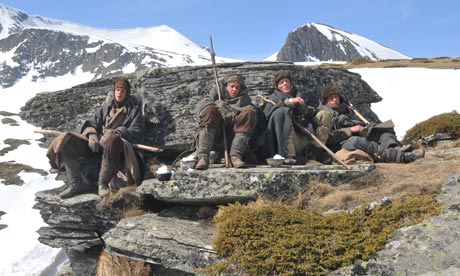
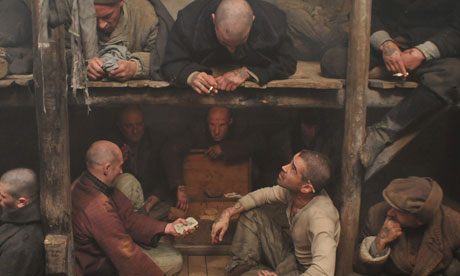
Janusz (Jim Sturgess) begins the film under interrogation in occupied Poland. The year is 1940.  He has been turned in (reluctantly) by his wife under torture, and he is sent to a Soviet gulag in the mountainous regions of Siberia. After a period of learning the ropes (and the whips of the guards and the barbed wire of the camp), he becomes a part of a loose group of prisoners of differing skills and supplies to make a fast surgical escape from the gulag and make their way to Mongolia. Based on a loose plan of prisoner Khabarov (Mark Strong), they plan to make it to Lake Baikal, following it to the Sino-Russian railway. Their supplies will run out in mere days, but Janusz is convinced they can live off the land, walking the entire way. Among the group of escaping stragglers are "Mr. Smith" (Ed Harris)—"First name: Mister"—a particularly mysterious American (he tells Janusz, "you have a weakness I can use: kindness"), and, as it seems all movie escape attempts must have, a plays-by-his-own-rules maybe-criminal named Valka (Colin Farrell). The group begins suspicious of each other, but soon forms a close-knit, surprisingly democratic structure, sharing ideas and resources, voting when they're at a crossroads—despite the occasional individual insurrection.
Watching the movie is a slog. At 2 hours, 20 minutes, with the principal characters pushed to their endurance, the film feels longer than its running time, but one is never tempted to do a watch-check. The Way Back is one of those films that keeps you guessing, intrigued and involved every minute, like you were involved in the long walk, craning to see what is around every corner. Weir keeps the pace moving quickly, cutting scenes briskly from one episode to the next, so the film develops a natural rhythm.
But, it's the director's eye for detail—as always—that is striking, with scenes of stark, natural beauty that astonish: taking refuge in ancient caves, the camera pans up, following a bedraggled Mr. Smith's gaze, to two large holes in the ceiling, like the angry eyes of God; walking up a scrabble hill, Weir directs our view up and over the weary travelers to a screen-stretching shot of the expansive Gobi desert; at one point, they find a single solitary structure—a gate with no walls—absurdly marking their goal, while announcing another set-back.
It is a grueling adventure story with fine performances all around, interpreted through Weir's talent for keeping things real, even when they turn startlingly surreal. Go prepared for a tough movie, but a satisfying one, that, like all escapes, becomes a journey of the individual will and spirit, covering all manner of obstacles in physical space, mental discipline, and the longest journey...of time.

Saturday, March 1, 2025

I'm Still Here (2024)

All I Have is a Photograph (And I Realize...)

or
"Hey, Hey, Dee Dee, Take Me Back to Piaui"
 
Rubens Paiva was taken from his home in Rio de Janeiro, Brazil by armed men on January 20, 1971 for questioning about seditionists to the military dictatorship in power at the time and about a recent spate of kidnap cases involving foreign ambassadors to Brazil, including the representatives from the U.S., West Germany and Switzerland.
 
He never came home.
 
In fact, despite his car being found at a prison facility run by the military, there was no sign that he had ever been taken there, and officials denied he was in custody. It was like he never existed. Except that he left behind a wife and five children, one of whom, Marcelo, grew up to write about the incident in his 2015 book "Ainda Estou Aqui". 

That translates to I'm Still Here, and Brazilian filmmaker Walter Salles—he made On the Road—has made a film of it, to put a face on one of the people "disappeared" due to governmental malfeasance throughout the world. The Paiva story is just one of thousands; there were 434 such "disappearances" during Brazil's military dictatorship alone.
Salles doesn't sensationalize things. He starts with family activities, the kids interacting on the beach
not far from their back door, playing volleyball, finding a stray puppy, while mother Eunice—her full name is Maria Lucrécia Eunice Facciolla Paiva—(Fernanda Torres) floats in the ocean, peaceful and calm, when a military helicopter passes not far overhead interrupting the tranquility. Salles cuts between his footage and recreated 16mm "home movies" that the kids make to document their lives, serving as the movie's "B"-roll. They'll become important later. 
It's every day life. Parties, new dog, music, dancing. But, there's an under-current of politics. The party is for daughter Vera who's going off to London for school, partly because she has friends with leftist leanings who are being tracked by the government. Dad Ruben has returned from his own self-imposed exile after some months as a liberal councilman put him on the military's radar. But the ambassadorial kidnappings have intensified the military's presence in the streets and the father is keeping close contact with his friends in the Brazilian Labor Party. It's only a matter of time before that presence arrives at their door-step.
When it does, it comes quietly but assertively. Men in plain clothes and suspicious looks show up one day, armed, while the family is going on about their normal lives. But, the normalcy ends immediately. Ruben drives off in his car with a couple of the guys to be taken in for questioning. The family, particularly Eunice, take a "wait and see" attitude. But, then Eunice and her next eldest daughter Eliana are driven to one of the military prisons for their own questioning. Eunice will stay there for twelve days; Eliana just one. No mention is made of the whereabouts of her husband, and eventually all information about him dries up, and the military denies they have them. Then why is his car still in their lot?
I'm Still Here tracks the family's progress and the stoic Eunice's change from victim to activist and her quest for answers about what happened to her husband. It will take decades of effort as she also raises her children, but always keeping an eye on that empty chair at the dinner table. With her stores of pictures and films she has the evidence that her husband existed, while the government continues to deny his existence or their part in his disappearance. She will fight until she gets the one piece of paper that will expose the whole thing—his death certificate.
It's an amazing movie, much more so for the fact that it seems so ordinary, so focused as it is with the mere act of surviving a trauma, and building a family out of tragedy. Despite the hopelessness of the circumstances, the movie comes out filled with hope.

Tuesday, February 4, 2025

September 5

Schrödinger's News
or
Up-Close and Personal (Duct-Tape and Spit)
 
We are inundated by news. Saturated with it. Awash with it. Some is fact-checked, some have two sources, a lot of it—most of it—is just blather, speculation, filling time and selling soap...or pharmaceuticals. "I heard a guy who said..." followed by professional blowhards, who used to have a job, saying what they think, and their "act" is that they know. So much of what poses as "news" is "opinion"—newspapers traditionally limit that to just two pages. That's on the national level. On the local level, it's all sports and weather with the top story being somebody died...and the last story something about puppies. All smiles. "Have a good night."
 
It didn't used to be that way, back in the "old" days, before "24 hour news" channels (which never have 24 hours of news), and back when there were only three networks and each one had their own news department that encapsulated the news in 30 minutes (minus commercials). They didn't have time for opinion (we shouldn't have time for it at all). That's the way it was...and somehow you were assured that was right.
The only time you saw a lot of news was in the Dickensian "best of times, worst of times". Coronations. Moon missions. Assassinations. And the 1972 Munich Massacre. If you don't know about it, Spielberg made a movie of it...and its vengeful aftermath. But, to boil it down, during the 1972 Olympic Games in Munich, a terrorist group called "Black September" broke into the Israeli compound in the Olympic Village, killed some, took hostages, made demands to be flown with the hostages to Egypt, and then everyone was killed, hostages and terrorists before the plane could get off the ground. And it was covered "live" on television.
 
By ABC Sports.
September 5, the film by Swiss director Tim Fehlbaum, tells the story of what was going on inside the ABC Sports facility and the herculean task of trying to report a terrorist attack with the same resources they used to show swimming, boxing, and track-and-field. In charge of their broadcast unit was Roone Arledge, head of the ABC Sports division and whose promotional mantra was "up-close and personal" in that he would have pre-produced background stories for athletes to engage viewers with the drama inherent in the matches rather then merely showing anonymous individuals competing. It was a brilliant model for sports-broadcasting, adding the back-story to the competition, raising the dramatic stakes and adding the element of "inspiration" to what was merely gamesmanship—which would, in turn, serve as inspiration to future generations of viewers who might, then, want to take on the challenges of sport—that's why "talent competition" shows these days fill up their time-slots with back-stories of simply everybody who participates. "Up-close and personal."
But, nobody was prepared for this. A world-stage of athletes from all over the world competing in peace, and that year in a country whose previous hosting was under the leadership of Adolph Hitler, who saw the Olympics as a political tool, advancing Germany's status, and trying to make a point of Aryan superiority in the process. That was the year of Jesse Owens and "The Boys in the Boat" so things didn't go according to the Master-Race plan. The 1972 Munich Olympics were envisioned by the country to bury past ghosts and be seen as a meeting place for peace after having plunged the world into war and committing genocide on an inhuman scale. And, again, things didn't go according to plan.
A Palestinian-militarist group breached the lack of security in the Olympic Village—armed guards and security would have provided a bad "image" for this post-Nazi German Olympics—and started killing Israeli athletes. They made demands that, if they weren't met, would mean the death of another Israeli on the hour. It was political warfare as theater, or—in the word that would become despicably familiar then from—"terrorism." To cover it would be to give the bastards what they wanted. But, cover it, ABC News did.
What else were they to do? Ignore it? Lives were at stake. Early on, Arledge made the decision that ABC News would not take over the coverage—they were half-a-world away and would have consisted of talking heads filling time. ABC Sports was on-site and closest to the story. In their zeal to do as complete a job as possible, they probably went too far—planting cameras across from the Israeli living quarters to get "good shots," deceiving security guards that their runners were athletes in order to smuggle film back and forth between their photographers and the ABC facilities. They punted. No one at the base could speak German, so an assistant editor (played in the film by
Leonie Benesch) became the eyes and ears of official announcements and police scanners. The audio guy started soldering make-shift connections between walkie-talkies, telephones, and the control board.* For replays of video-tape, hands manually moved the reels. It was all duct-tape and spit and flying-by-instinct, but without the journalistic rigor associated with news coverage (except for the on-site presence of Peter Jennings (played by Benjamin Walker, whose voice-imitation of Jennings is eerily good).
They got the story. But, in one critical juncture, they got the story wrong—okay, they reported mis-information from the German spokespeople, but it was still wrong. And it was still put out in the world, and spread by other sources monitoring the ABC coverage, and it was just as wrong. That information was that the hostages were rescued in a daring raid by German police. It wasn't true. They were all killed and (although the truth didn't start coming out until 2012) that the raid was an unmitigated disaster. Those "rescued hostages" were all dead. There was a rush to judgment to get out the story. And rather than get the story right, they just wanted the pictures.
Eight years later, CNN started business and the business of getting the pictures, rather than the story right became a news business model. And we've seen examples of "news specialists" getting it wrong ever since. September 5 shows us where it all began...we in our bubbles and they in theirs...and how we haven't learned anything since. So much for keeping us "informed."

Gabrielle Giffords still lives...

The WNYC program "On the Media" which is something of a "news-watchdog" has put out a series of handy "Breaking News Consumer Handbooks" with helpful advice on how to listen to "Broken News." There are quite a few of them, but I'll post a few salient ones.


* One thing they got right (but for all the wrong reasons): the invention of the "network bug"—those irritating graphics burned into the corner of network feeds to identify the source-station. ABC started burning their logo into their coverage because so many news sources were copying it and ABC wanted it known where the pirated sources came from. It also tells us who we can blame.