Showing posts with label Peter Sarsgaard. Show all posts

Tuesday, February 4, 2025

September 5

Schrödinger's News
or
Up-Close and Personal (Duct-Tape and Spit)
 
We are inundated by news. Saturated with it. Awash with it. Some is fact-checked, some have two sources, a lot of it—most of it—is just blather, speculation, filling time and selling soap...or pharmaceuticals. "I heard a guy who said..." followed by professional blowhards, who used to have a job, saying what they think, and their "act" is that they know. So much of what poses as "news" is "opinion"—newspapers traditionally limit that to just two pages. That's on the national level. On the local level, it's all sports and weather with the top story being somebody died...and the last story something about puppies. All smiles. "Have a good night."
 
It didn't used to be that way, back in the "old" days, before "24 hour news" channels (which never have 24 hours of news), and back when there were only three networks and each one had their own news department that encapsulated the news in 30 minutes (minus commercials). They didn't have time for opinion (we shouldn't have time for it at all). That's the way it was...and somehow you were assured that was right.
The only time you saw a lot of news was in the Dickensian "best of times, worst of times". Coronations. Moon missions. Assassinations. And the 1972 Munich Massacre. If you don't know about it, Spielberg made a movie of it...and its vengeful aftermath. But, to boil it down, during the 1972 Olympic Games in Munich, a terrorist group called "Black September" broke into the Israeli compound in the Olympic Village, killed some, took hostages, made demands to be flown with the hostages to Egypt, and then everyone was killed, hostages and terrorists before the plane could get off the ground. And it was covered "live" on television.
 
By ABC Sports.
September 5, the film by Swiss director Tim Fehlbaum, tells the story of what was going on inside the ABC Sports facility and the herculean task of trying to report a terrorist attack with the same resources they used to show swimming, boxing, and track-and-field. In charge of their broadcast unit was Roone Arledge, head of the ABC Sports division and whose promotional mantra was "up-close and personal" in that he would have pre-produced background stories for athletes to engage viewers with the drama inherent in the matches rather then merely showing anonymous individuals competing. It was a brilliant model for sports-broadcasting, adding the back-story to the competition, raising the dramatic stakes and adding the element of "inspiration" to what was merely gamesmanship—which would, in turn, serve as inspiration to future generations of viewers who might, then, want to take on the challenges of sport—that's why "talent competition" shows these days fill up their time-slots with back-stories of simply everybody who participates. "Up-close and personal."
But, nobody was prepared for this. A world-stage of athletes from all over the world competing in peace, and that year in a country whose previous hosting was under the leadership of Adolph Hitler, who saw the Olympics as a political tool, advancing Germany's status, and trying to make a point of Aryan superiority in the process. That was the year of Jesse Owens and "The Boys in the Boat" so things didn't go according to the Master-Race plan. The 1972 Munich Olympics were envisioned by the country to bury past ghosts and be seen as a meeting place for peace after having plunged the world into war and committing genocide on an inhuman scale. And, again, things didn't go according to plan.
A Palestinian-militarist group breached the lack of security in the Olympic Village—armed guards and security would have provided a bad "image" for this post-Nazi German Olympics—and started killing Israeli athletes. They made demands that, if they weren't met, would mean the death of another Israeli on the hour. It was political warfare as theater, or—in the word that would become despicably familiar then from—"terrorism." To cover it would be to give the bastards what they wanted. But, cover it, ABC News did.
What else were they to do? Ignore it? Lives were at stake. Early on, Arledge made the decision that ABC News would not take over the coverage—they were half-a-world away and would have consisted of talking heads filling time. ABC Sports was on-site and closest to the story. In their zeal to do as complete a job as possible, they probably went too far—planting cameras across from the Israeli living quarters to get "good shots," deceiving security guards that their runners were athletes in order to smuggle film back and forth between their photographers and the ABC facilities. They punted. No one at the base could speak German, so an assistant editor (played in the film by
Leonie Benesch) became the eyes and ears of official announcements and police scanners. The audio guy started soldering make-shift connections between walkie-talkies, telephones, and the control board.* For replays of video-tape, hands manually moved the reels. It was all duct-tape and spit and flying-by-instinct, but without the journalistic rigor associated with news coverage (except for the on-site presence of Peter Jennings (played by Benjamin Walker, whose voice-imitation of Jennings is eerily good).
They got the story. But, in one critical juncture, they got the story wrong—okay, they reported mis-information from the German spokespeople, but it was still wrong. And it was still put out in the world, and spread by other sources monitoring the ABC coverage, and it was just as wrong. That information was that the hostages were rescued in a daring raid by German police. It wasn't true. They were all killed and (although the truth didn't start coming out until 2012) that the raid was an unmitigated disaster. Those "rescued hostages" were all dead. There was a rush to judgment to get out the story. And rather than get the story right, they just wanted the pictures.
Eight years later, CNN started business and the business of getting the pictures, rather than the story right became a news business model. And we've seen examples of "news specialists" getting it wrong ever since. September 5 shows us where it all began...we in our bubbles and they in theirs...and how we haven't learned anything since. So much for keeping us "informed."

Gabrielle Giffords still lives...

The WNYC program "On the Media" which is something of a "news-watchdog" has put out a series of handy "Breaking News Consumer Handbooks" with helpful advice on how to listen to "Broken News." There are quite a few of them, but I'll post a few salient ones.


* One thing they got right (but for all the wrong reasons): the invention of the "network bug"—those irritating graphics burned into the corner of network feeds to identify the source-station. ABC started burning their logo into their coverage because so many news sources were copying it and ABC wanted it known where the pirated sources came from. It also tells us who we can blame.

Thursday, May 2, 2024

Blue Jasmine

Depending on the Kindness (Enabling) of Strangers
or
Being Entitled to Your Opinion

Blue Moon/You saw me standing alone/
Without a dream in my heart/Without a love of my own/
Blue Moon/You know just what I was there for/
You heard me saying a prayer for/Someone I really could care for/
And then there suddenly appeared before me/

The only one my arms will hold/
I heard somebody whisper please adore me/
And when I looked to the Moon it turned to gold
Blue Moon/Now I'm no longer alone
Without a dream in my heart/Without a love of my own


Woody Allen's 21st century version of Tennessee Williams' "A Streetcar Named Desire," Blue Jasmine, is a contemporary version of the play's tragedy in an unsympathetic post-Bernie Madoff/Wall Street Bail-Out world, turning it into a moralistic comedy. It may seem a little misogynistic to be so mocking to someone as Williams' Blanche DuBois who has suffered a cataclysm, but when the someone is as cluelessly entitled and myopic as Allen's Jasmine (nee Jeanette) Francis (Cate Blanchett), there is a very real glee to see them get their, as the term is used in The Magnificent Ambersons, "comeuppance."
It's a brilliant conceit, combining Allen's love for classic literature and forms, tossing his own hang-dog spin onto it, while, for once, being refreshingly contemporary—something Allen hasn't really done of late, as he's had a depressive's obsession with the past for the past couple of decades (no matter how fresh the cast may be).

Allen starts his film (after the standard black background with white credits backed this time by '30's depression era rhythm and blues) with an (unusual for him) CGI shot of a jet approaching the camera, sailing by and moving away. Jasmine Francis ("I fell in love with the 'Jasmine.' 'Jeanette' has no panache") is on that jet flying from New York to San Francisco to move in with her sister Ginger (Sally Hawkins—her second film for Allen) for a fresh start after losing everything in her life. They're both adopted and couldn't be more different (As Sally says "She got the good genes."); Jeanette is all high cheek-bones and au couture, while Sally is low class and all teeth, surrounded by Guido's and roughnecks. Jasmine has suffered a reversal of fortune as her husband Hal (Alec Baldwin) has been caught wheeling and dealing in real estate schemes, ending up in prison, and committing suicide. Her extended visit delays Ginger's boyfriend Chili (Bobby Cannavale) moving in with her and her two kids by Augie (Andrew Dice Clay), her ex-husband. There's a bit of a sandpaper quality to Ginger and Jasmine's relationship; when Ginger and Augie were married, they lost a lottery nest-egg investing in one of Hal's "get-rich-quick" investment schemes, something Jasmine forgets when she drama-queens over her own plight, and dismisses entirely when confronted with it.

Jasmine (Blanchett) and Ginger (Hawkins)
So it rankles when Jasmine pulls a Mrs. Madoff and claims victim-hood about the money she's lost. Jasmine has no plans, no prospects, and there are hints of a nervous breakdown after she was found wandering the streets talking to herself. Now, she's popping Xanax with a vodka chaser and barely keeping ahead of anxiety attacks and comatose fugue states as she barrels through the lower echelons of San Francisco, trying to latch onto opportunities.
She decides to go back to school, learning computers so she can go "into" interior design, taking a job at a dentist's (Michael Stuhlbarg)—for which she is totally ill-suited (anything with the words "customer" and "service" in any combination would be)—to fund the courses. In the meantime, from her lowly status, she lords it over the family and friends she finds beneath her. That meaning everyone.

The flip-side to this is that people still find her attractive, as she puts up a great, if shallow, front, speaking of her glory days—which segue into flashbacks of her privileged happy life, only to find that once the flashback has ended, that she's still carrying on the conversation inside the flashback, and whoever she was talking through previously has left.
* It's a clever use of flashback as psychosis, a clever, nearly invisible off-shoot of the film-star (played by Jeff Daniels) stepping out of the film in The Purple Rose of Cairo. Where Allen has been living in the past the last few films, Jasmine is doing the same thing, to her detriment, as, whether in flashback or real life, it comes back to haunt her and take her away from the present and any future she might aspire to.

It's a return to near perfect form without the tricks and conceits that Allen used (during his "earlier, funny" films) and nicely merges the bi-polar extremes of comedy and tragedy that the more mature filmmaker in Allen has aspired to.  It also feels less fussy and musty than the after-taste some of the lesser Allen films have left of late. After a lifetime of making good films, some classic and some merely pedantic, and eschewing his earlier stylistic tricks, one wonders if, at the age of 78, Allen's best films might still be ahead of him and that's an exciting prospect.

Jasmine in her "fugue" state

* It's a bit like the Larry David monologues-to-the-camera in Whatever Works, only there's no child around to ask "Who's that man talking to, Mommy?"

Friday, March 4, 2022

The Batman

It was a Dark and Stormy Knight
or
How Many Batmen Does It Take to Change a Light-bulb?

You know how it went: in "Peanuts", Snoopy would sit on top of his dog-house type-writing—"It was a dark and stormy night. Suddenly a shot rang out. The maid screamed. A door slammed.
 
 
That's how Matt Reeves' The Batman felt to me after I'd survived it. Just as suddenly as something is resolved, you think there's some breathing room, and then you think "Geez! They haven't even figured out the serial killer yet!" And then that starts and you think THAT's finished, and you go "Wait a minute, that seemed kind of easy", and that's when the guano really hits the fan, and things get even more complicated, and you start looking for something to tell you what time it is, because you really think that the thing is never going to end, and then, they distract you and you think "Oh no, they're going to bring him in?"
It's at that point you realize that it's no fun being the Batman—because the job just never stops. You wonder if you even want to admire the Batman or pity him, but you sure don't want to be him. 
 
And maybe...you don't want to watch him.
"So, is it even worth going?" Hell, yeah. Because The Batman is more like the Batman from the comics (depending on the period of origin—in this case, the 1930's and 70's) than he's ever been. Stripped down and deconstructed, this version escapes the taint that has hung on the character ever since the TV-series from the 1960's. There's no "camp". There's no crazy costumes...well, except for the Bat-suit (which is armored to the point that it's bullet-proof and probably tough to maneuver in—he even thuds when he walks)...and there's no goofy archness or hysterical theatricality, which still remained even in the Christopher Nolan-directed trilogy. Not even an artfully-choreographed fight; they're all thumping and brutal.
It's perfectly serious. And does things the "Batman" series has never done before. For instance, this is the first Batman movie since the series started (with Tim Burton back in 1980), where Batman doesn't kill anybody—oh, he messes people up really bad, but they don't die unless it's due to their own actions—and that was a "code" that an orphan who lost his parents to gun-violence strictly adhered to. And the "Batman" in the movies has always stood for vengeance, and here, the character arc has him realize how limiting that is—when he sees the main villain of the piece committing heinous acts to avenge his own circumstances. His self-imposed mission changes during the course of the movie; the film pointedly ends with Batman looking forward and not back.
Now to say I "survived" it takes an explanation. The Batman is just shy of three hours long. And it feels like it*—Reeves can make fascinating movies, but he's not an editorial trickster (like Nolan) so things happen at a steady, remorseless pace (Reeves uses Nirvana's "Something in the Way" as background, and that's the beat that he uses for the film). It's a long run-time, and the story covers a lot of ground, dealing with corruption, organized crime, and striking out against sins of the past. It's less a "super-hero" film than a police procedural along the lines of contemporary British mysteries or "Law and Order"—this Batman even walks through crime-scenes with the police (despite "official" disapproval of vigilantes by the Gotham City Police Department), making observations, providing lines of investigation. It's an intricate maze of clues and evidence that increases the run-time. What would I take out? Not a jot. Certainly not with the Warner studio's recent insistence of cutting things down to near-incomprehensibility.
Because it's a good story that has the construction of the best of the (Batman co-creator) Bill Finger-penned Batman stories: murder victims of a prominent vintage, all seemingly unrelated but leading inexorably to a far greater threat (it's nice that the clues are multi-layered without the usual *snap* "I've got it! He's going to rob the Obvious Clue Savings and Loan!"). And we've become so used to comic-book threats—penguins with rocket launchers, "fear-gas," 'memory-sucking devices" and ice-guns—that it's a little disconcerting—even creep-inducing—that the various plots all nudge at real-world headlines: "Zodiac" messages, "collar-bomb" extortion, mailed death-packages, internet zombies, even Hurricane Katrina.
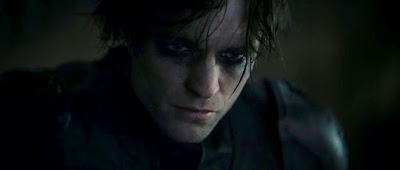
Ah, but you don't want to know all that. You want to know how the Patt-Bat is! He's darned good if you want to discard the whole "Zorro"/"Scarlet Pimpernel" vibe that inspired the character. Pattinson's Bruce Wayne is a brooding recluse holed up in Wayne Tower in the middle of Gotham City, and he'd probably be a prime suspect in the "Riddler" case if the police just looked at the power being used by the dingy bat-filled basement of the building (nah, they wouldn't—he has too much money). His Bruce is so emo, he almost wears a bat on his sleeve—so much for secret identities. But, his Batman is slow, hulking and fills a room, the eyes constantly moving and the perfect jaw-line not at all. It would almost be a mime act if he didn't have Jeffrey Wright doing heavy-lifting (and expositing) as Lieutenant James Gordon ("You could have pulled the punch..." "I did"). Wright makes a character important no matter how much he's pushed to the background, but here, he's the other half of a buddy act. By contrast, Andy Serkis' Alfred is the character who's given short shrift.
But, it's the villains that everybody pays attention to in Batman movies and there's a lot of them: It's a great cast and everybody does very good work.
Zoë Kravitz is a fine addition to the ever-growing litter of cat-women, with the appropriate fanged snark and a duplicitous sensuality that one expects of the character by this time. Her scenes with Pattinson fall a bit flat unless they're quarrelling, because he doesn't give out that much as far as any sort of response. That's on him; not her.
Paul Dano leans in to his cherubic looks to create an intensely creepy Riddler—he has several aliases—internalizing the schitzy nature of the character with the same intensity with which Heath Ledger externalized his Joker in The Dark Knight. Ledger is a tough act to follow, but Dano isn't as theatrical and does more with little expressions than anything playing to the loges.
Speaking of which, if Dano leans in,
Colin Farrell leads out with his take on "The Penguin" ("Call me 'Oz'") as a voluble Chicagoan gangster with none of the panache or freakishness in past portrayals, but bearing a family resemblance to Rod Steiger's Al Capone. He is wholly unrecognizable, physically or in performance, and it's not just the elaborate prosthetics he's forced to wear to pull off the job, the acting is larger than it can contain, making a huge impact in a role that's a supporting character to John Turturro's Carmine Falcone, the Gotham boss who's pulling all the strings only to find his organized crime operation being undone by a lone outlier. Also Peter Sarsgaard should be given a hand-clap for his portrayal of a weak Gotham D.A. caught up in the carnage.   
Is it the best Batman movie? I think it's too soon to tell. I didn't come away from it thrilled with it as a whole (as with others), but was delighted at its parts (and little touches like
the bust of Shakespeare in Wayne Tower, the very apt use of DOS graphics, the song that plays when Bruce Wayne visits Mob-boss Falcone)
There is no doubt that this is the best interpretation of the character if you want to do it as a straight-ahead portrayal, ignoring the many iterations that have made up its history, the bad and the good. Someone had to do it—to put the detective back in The Darknight Detective. And Reeves, who has proved time and again that he can make something special and unique out of retread material, has managed to make something original with Batman.

* It isn't helping that the theaters front-load this particular attraction with more than the usual number of commercials (even inserted between previews—which, let's be honest—are commercials, too). The whole presentation is like 4 hours long. One can see why the theater-chains are doing this—a 3 hour movie limits the number of times it can be screened, even though they've Bat-jammed as many  showings in as many plex's as they can manage. And those commercials pay the chains. But, it is testing the endurance of an audience not expecting an epic Lawrence of Arabia roadshow. 

Saturday, January 8, 2022

The Lost Daughter

O Mother, Where Art Thou?
or
"They Really Put Us Through it, Huh?"
 
Leda Caruso (Olivia Colman) is on a "working holiday" in Greece and for awhile, it's quite idyllic. She has the beach to herself and time is not an issue. She works on her studies—she's a professor—and when she tires of that, she sleeps in the sun or goes floating. There is no intrusion on her time, and, for awhile, there's no intrusion on her solitude. At first, there's only Will (Paul Mescal), the resort "boy" whose job it is to be solicitous. He's useful, when you don't know where to get a glass of water or when he offers an ice treat. Then, there's Lyle (Ed Harris), an ex-pat American who owns the resort, and is your typical ex-pat—he's helpful but a little stand-offish. He likes things the way he has them, carved out a life for himself by carving out everything else, and is basically living in the "now." His "now." He has a past, but he's not going back to it.

And, for awhile, it's good. The weather is temperate, the water is warm. Oh, there's that annoying light house that, when conditions are right, slashes light into the night of a room and "whooms" so incessantly that you have to sleep with a pillow over your head to try and drown out the sound. But, responsibilities are few. With very few invasions of privacy, it's perfect.
It can't last. It might with somebody else, but not with Leda. Soon, a family from New York shows up at the resort, and, to her, it feels like an invasion. She watches them suspiciously, as they talk loud and curse casually. Vasilli (
Panos Koronis) and his young wife Callie (Dagmara Dominczyk) are the ostensible heads of the family, but there's also Toni (Oliver Jackson-Cohen) and his wife Nina (Dakota Johnson) and their daughter Elena (Athena Martin Anderson). Things get off on the wrong foot when Callie asks Leda if she'll move to another lounge chair so the family can all be together and Leda haughtily refuses. There's a lot of stink-eyes and muttering just within ear-shot, but Leda has been eying the family before.
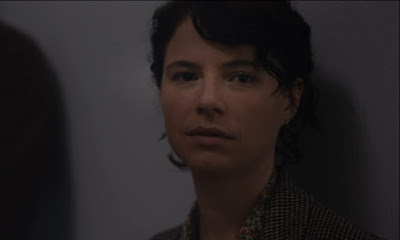
At the same time, Leda watches them—and director Maggie Gyllenhaal keeps us locked in on her point-of-view so that it almost becomes claustrophobic—she starts to think back to when she was a young mother (
Jessie Buckley takes over as Leda at this point) with two small girls. Two very needy little girls that tax Leda's time and her patience, taking her away from her translation work which takes a lot of concentration. There are little parallels between what she sees and what she remembers. And she catches every nuance of Nina's interaction with her child—the hesitations, the annoyances, the impatience, the reluctant giving-in—all to which she can relate.
Leda's "Kravitzing" does have a good result; when Nina is distracted by something, little Elena goes missing, and the family starts to panic, freaking out rather than trying to figure out where Elena could have wandered off. They're not organized at all. Leda, seeing Nina's distress and remembering a time when she experienced the same thing, assists in the search, and ultimately does find Elena to the relief and gratitude of the family. The earlier touchiness evaporates and Leda is empathetic enough that the family fairly embraces her. Nina, in particular, is drawn to Leda, seeing her as a kindred spirit who understands the pressures and toils of raising young kids. She does. But, Leda's approach is to internalize it as a burden, one that can come to a breaking point if allowed to fester.
Thank God for Olivia Colman. The Lost Daughter would be a very tough slog if it weren't for the excellent work done by her and the rest of the cast. Not that the movie is dull. It's that you have to spend so much time in Leda's head. It's a situation shared with the character. Leda is so internalized that there shouldn't be much of an exterior at all. All that studying, translating, her inner life is so much more fascinating to her than her external one. But, she indulges it to the detriment of those around her, be they friends, colleagues...family. And her obvious grasping for approval in the young Leda scenes contrasts with the less satisfying, messy, chaotic world of raising a child. Who gets acclaim for that?
It's a tough thing to raise children. It is not easy and there can't be a consistent plan or syllabus to cling to. So, Leda lives her life in her head, playing mind-games with herself and others, just her against the world. At times you see what the character is doing and wonder why on Earth do that? I have suspicions—which have to do with control and punishment and teaching lessons—but to delve deeper would be to take some of the shocks out of it, and deprive the viewer of questions that will inevitably arise.
And that would be a pity because Colman wears Leda's neurosis so much on her sleeve that it's fascinating to see her mercurial performance playing across her face. At times, you're aware that not even she understands why she does what she does and the film becomes less about the issues she has with the world than about her own, and how she imposes them on the world, with the inevitable consequences, intended or otherwise, that become self-fulfilled prophecies. It's a psychological adjunct to all those Kubrick movies where smart people make bad choices, intellect be damned, and gives truth to the old saw that people can be too smart for their own good.
 
It's like the thing I read on Twitter today that was attributed to Nicola Tesla: “One must be sane to think clearly, but one can think deeply and be quite insane.” The Lost Daughter walks that razor edge, fortunately, with Olivia Colman's nimbleness.

Thursday, July 15, 2021

Knight and Day

Written at the time of the film's release...

"Planes, Trains and Automobiles on Cruise-Control"
or
"Every Man His 007 (And Every Woman, Too)"

June Havens (Cameron Diaz) is going through a life-transition and doesn't even know it.  She's getting on a plane to Boston to be a brides-maid (never a bride) at her little sister's wedding, and letting go of the past by putting the finishing touches on her father's dream-project, restoring a pre-70's GTO, and giving it to her sister as a wedding present.

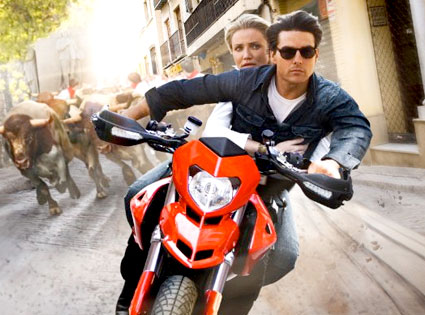
But, she's keeps running into this "guy," literally—the last time at the airport before she boards her plane, and finds that...sorry, the flight is full-up. The "guy," Roy Miller (Tom Cruise) enigmatically says, "Some times things happen for a reason" and boards the plane.
Truer words. Before you can say "Non-res" she's on the plane and chatting up Miller, who's personable, quiet, and (when she's not looking) scoping out the plane. It's the first instance of her not registering what's happening to her, but it won't be the last. Don't be too hard on herShe's a "newbie" at counter-espionage.
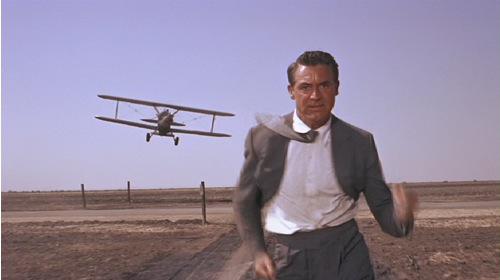
It starts tracking like a Hitchcock film—the "innocent" caught up in the intrigue—but it ends up morphing into Hitchcock's bastard love-child, the James Bond series. Cruise has always wanted to play Bond (incorrigibly American and too short, despite Daniel Craig's height issues—and some of the sets are low-ceilinged to disguise Cruise's short stature), hence the "Mission: Impossible" series that turned a team-effort into a one-man show. But, this is as close as he'll come, and he and the film do well by it, with the typical derring-do, a lot of homages to Bonds of the past, and doing one thing that the Bond's have never done:  this is a "Bond" film for women.
With all the variations on the theme the Bond producers have explored over the years, there's one thing they haven't done: looked at the adventure from the woman's perspective. As Kim Basinger said about Never Say Never Again, her part didn't amount to much because "it's all about Bond, anyway." Deft analysis.  It is always from Bond's perspective, and the women dragged into the scenarios, with or against their wills, are just chaff blown about in the fire-storm (or the Thunderball), accoutrements like his cuff-links and his wristwatch, though usually less functional.  Bond walks into their world, blows it up, and the best they can do is end up in the boat with him, ahead of the shock-wave. Even the most important and dynamic of the Bond-girls, Natalya Simonova from Goldeneye—she's the one who saves the world at the end—is along for the ride in all of the instantly disposable vehicles. Appropriate, as they're instantly disposable, too, the inevitable break-up happening between films never to be seen again in the series. Even the original books' author, Ian Fleming, tinkered with the idea, making "The Spy Who Loved Me," entirely from "the girl's" perspective.
And that's what this is, too. We're focused more on June and her "learning the ropes," frequently knocked out and dragged from one exotic location to another, by good guys and bad guys alike, a pawn in this battle of knights, Alice in "Thunderland."
The great thing about Knight and Day is that it doesn't have the "Bond cache" where he's always in charge, and stretches the formula to resolve a lot of the women's issues about control and taking charge in a satisfying, and complete, manner.
Of course, the "big" issue with a Tom Cruise movie is...how is Cruise? He's always been the eager-beaver, and sometimes, most times, in an effort to fill the void of the camera-frame, he'll take things so far as to be ludicrously over-the-top, practically mugging in an effort to create a character that registers.  He's learning. He's antic and funny in this, especially in the action scenes ("Alright, nobody move, or I shoot myself, and then the girl!"), sure, and sometimes frustratingly practical when the bullets are flying ("promiscuously" as they say in The Wind and The Lion) at him on the roof of car. But, in the quieter moments, he's relaxed and subtle, and emitting a mega-wattage star-power—somewhat less than Cary Grant, but certainly in the Christopher Reeve/Pierce Brosnan range, where he knows less is more. The camera loves him, and he accepts that love, without having to push it. He's GOOD in this, and Diaz, as ditzy as she can be, manages to make her "every-girl" sympathetic and identifiable.
This is the Bond movie that the wife/girl-friend won't sit in frustration during, as it's been nicely laser-etched with a "chick flick" by James Mangold, (and a bevy of screen-writers, starting with Patrick O'Neill and also passing though the PC of the great Scott Frank) with a cast rounded out by good actors like Paul Dano, Peter Saarsgaard, Gal Gadot, and Oscar nominee Viola Davis (Good to see HER again!).  Knight and Day, you are the one.