Showing posts with label Comedy. Show all posts

Friday, August 8, 2025

The Naked Gun (2025)

Serving 20 Years for Mans Laughter
or
"Usual is Unusual, Usually" 
 
I was worried about this one. The original "Naked Gun" series (the ones that starred Leslie Nielsen as Lt. Frank Drebin) came out of of the Z-A-Z team—the guys that made the original Airplane!—they would be David and Jerry Zucker and Jim Abrahams, who had a free-wheeling style of evergreen comedy and an impeccable sense of timing that made their movies work, despite production values that would have been suited for a Hallmark movie. That stuff's tough to duplicate—just ask anyone who saw the non-Z-A-Z sequel, Airplane 2, which was a desperate cash-grab and desperately unfunny despite writers credits by two of the geniuses behind "The Simpsons". 
 
"The Naked Gun" films came out of a Z-A-Z TV series that lasted all of six episodes (before being cancelled) called "Police Squad!" and I remember it as being fitfully funny and not quite up to par with the laugh-a-minute styles of Airplane! or their "Elvis-fights-the-Nazis" follow-up, Top Secret! The ideas were good, playing with the tropes of television and especially cop shows, but they were slightly hampered by 1980's TV censorship and the comedic pace never matched their movie work. That changed eight years later when they revived the concept for feature films and everything went up a few notches. Three "Naked Gun" films were produced between 1988 and 1994, the last only having David Zucker involved with the writing. The complete Z-A-Z team acted as producers. There'd been talk about doing a fourth "Naked Gun" movie with Nielsen, but nothing came of it. His death in 2010 put the stopper in it.
Now, thanks to producer Seth McFarlane's clout, there's a new one, the duplicate-titled The Naked Gun
, featuring Liam Neeson as Frank Drebin, Jr., the son of Leslie Nielsen's character, and he's a chip off the old blockhead. Not the most original of concepts, but Neeson does such an amazing job of playing it absolutely straight while still nailing the comic timing that it's a pleasure to see him make the Nielsen transition from drama to high comedy with nary a misstep. The review for the movie at RogerEbert.com stated that it is "legitimately" Neeson's best screen performance, and one comes out of The Naked Gun actually believing it, so deft is his way of fusing comedy with the deadly-serious "I have skills" intensity that he brought to his "action-star" phase.
What's the plot? Who cares? Surely, you don't think the efficacy of a "Naked Gun" entry lies in the carefully crafted screenplay. No, this is a matter of throwing all kinds of shit at a fan—which became a literal joke in Airplane!—and seeing what sticks. But, loosely, it's about a tech billionaire (
Danny Huston, who's sounding more and more like his Dad every movie), who's into breaking things and starting from scratch...including populations. Somehow, Junior Drebin gets involved in all this, as well as getting involved with the sister (Pamela Anderson, who's actually quite good) of an "accident" victim.
One is struck by how good the movie looks, with lots of mood-lighting and leaning into noir styles (as opposed to the Z-A-Z approach of key lighting everything, lest you miss a joke in the shadows, and also aping the style of its inspiration, "'M' Squad"). That's a bit of a shock, but seeing as this one is a couple generations removed from its source, it's a good shock.
Is it funny? Comedy is always subjective (he hedged)—one man's laugh-riot is another's snooze-fest—but, the first hour or so provided some genuine howlers and some inspired bits of business...then right about the time director Shaffer cuts to a shot of the house band of the villain's "Bengal Club" (and does nothing with it), the movie coasts to the end, wasting joke opportunities, occasionally perking up, but seemingly on comedy auto-pilot until the end. That wouldn't be so discouraging if the first two acts weren't so darned good.
Hopefully, there'll be more. It's refreshing to find a movie that's funnier and sillier than watching the nightly news. 
 
Oh. And don't call me "Shirley."

  Wilhelm Alert: @ 01:15.00

Tuesday, July 22, 2025

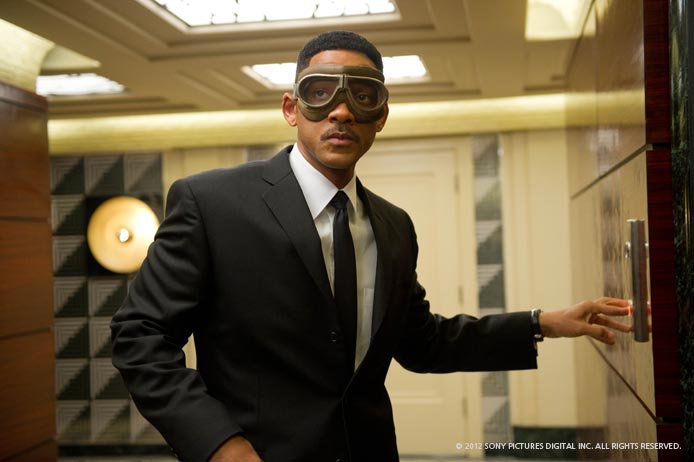
Men in Black III

Sunday was International Moon Day (yes, that's a "thing") commemorating the date that human beings first put boot-treads on the Moon. That historic mission figured fictionally in this movie.

Written at the time of the film's release. 

Time Wounds All Heels
or
"Don't Ask Questions You Don't Want to Know the Answer To..."

The third "Men in Black" film had to go somewhere else but up. The first two films were variations on the "illegal alien" theme about a government organization that monitored the activities of extraterrestrials in the world and specifically New York City, and revolved around alien invasions and the containment of said aliens. And when you've seen one alien invasion directed by Barry Sonenfeld, you've seen them all, and hyper-kinetically at thatAnd once it's been established that "aliens can be anywhere" the joke runs a bit dry pretty quickly, especially when the sub-species can contain pug-dogs and large cockroaches. The second film tried to expand on those concepts and felt a bit thin in the process, concentrating a bit too much on the secondary characters rather than the basic plot and the character interactions.

So, where does Men in Black III go from there?
One of the nice aspects of the series has been its ability to still think outside the box, while expanding the horizons of just what that box might contain, be it variations of scale and dimension, even if only in afterthought. With the infinite reaches of space seemingly exhausted, the group (based, supposedly on an idea by Will Smith) has the series going back in time. Naturally. It ostensibly revolves around an Earth-takeover plot by another alien (one must ask at some point "why always us?"), "Boris the Animal" (who seems based on the DC Comics "Hell's Angel in Space" Lobo and is played with growly gutteral responses by Jemaine Clement from "Flight of the Conchords") who escapes from his maximum (and we mean maximum) security prison to find the man who sent him there 40 years ago—Agent K (Tommy Lee Jones). When he's unable to kill him here, the Boglodite finds another means to do so, and Agent J (Smith) wakes up the next morning, the only one with any memories of K past July, 1969. Agent K has been killed by Boris in the past, and J must journey back to try and save him.*
Once back there, J negotiates his way through a 1960's era way of doing things. Everything's a little less high-tech (a little less), but the MIB Agency is still there, as is the much younger Agent K (Josh Brolin, doing a bang-on interpretation of Jones) and J must solve the puzzle of saving the Earth (of course), while keeping K safe. The past sequences are greatMen in Black has exploited the "fish-out-of-water" angle perpetually—and new corners are being thrown out the whole time (My favorite being a brief glimpse of a "Barbarella"-type being escorted around MIB, and although Smith is a bit too "Red Bull" throughout the entire movie, check out his understated reaction to some Black Panthers). 
Great cast, too. Rip Torn is gone, but David Rasche plays him in the past, Emma Thompson is on hand as the new MIB head, Will Arnett makes a brief appearance as does Bill Hader. Toss in the chameleon-like Michael Stuhlbarg as an alien able to read multiple time-lines and there's always someone to deflect the eye, or hand things off from Smith.
But, the best thing about this "Men-in-Black" installment is resonance. The other two were fine, the first better than the second just for its novelty, but had a shelf-life of three minutes. Part of it is Sonenfeld's way of comically undercutting any meaning to the thing, by changing perspective—"you think you got a handle on it yet? Well, let me throw THIS at you!" The whole "the Universe is so big and cosmic that there's no way you can understand it because there's so many mysteries, so nothing is real" concept, which is the backbone of the series (and the source for most of its humor) leaves one with a feeling of "meh"—nothing matters in a vast uncaring, unfathomable Universe. 
Not here. The cold of Space has nothing to do with the leavening of Time, and, in this case, the franchise plays it straight, without a wink, a nod, a reveal, or a goo-spraying splat. For once, something really means something in the "Men in Black" Universe, and that venturing into uncharted territory makes the third time the charm.

  * I'm not saying anything here that isn't revealed in the trailer.

Saturday, April 26, 2025

The Man with Bogart's Face

Saturday is traditionally "Take Out the Trash" Day...

The Man with Bogart's Face
(Robert Day
, 1980) With some television series ("The Rebel" and "Branded"), a couple movies (like Chisum) and a long association with director Irvin Kershner on his resume, writer-actor-producer Andrew J. Fenady began work on his first book, "The Man with Bogart's Face" which was first published in 1977. 

I read it not long after that--the title caught my attention-- but it didn't leave much of an impression on me, other than the guy had done his research and that he had an obvious love for the detective films of the 1940's and '50's. It tells the story of a man so obsessed with Humphrey Bogart, he has plastic surgery done on his face and changes his name to Sam Marlow, all the better to become what he's always dreamed of being—a private detective. 

Fenady had an eye to making a movie of the book, wrote a screenplay, got financing from Melvin Simon—Fenady wrote it to be low-budget—and started the process of getting the movie on the screen.
But, who would play Sam Marlow, the man with Bogart's face? Supposedly, an actor had been cast* when in walked a little known thesp' named Robert Sacchi. Saachi had his own one-man Bogart-tribute touring show which he took around the country and from most angles, he was a dead ringer for Bogart (who'd passed away in 1958), and did an impeccable mimicry of him, if slightly limited in range. Put him in a trench-coat and a fedora and he fit the bill like a slightly rumpled suit. 
George Raft (in his last role) confronts Sam Marlow
But for an entire feature film? Maybe that's going a bridge too far. The plot follows the outline of The Maltese Falcon: after unveiling his new plastically-surgeoned face (in a sequence that resembles a similar sequence in Dark Passage), a valuable "whatsit" is coveted by a variety of outlandish characters and newly-chiseled Sam Marlow (Sacchi), with a newly installed ditsy secretary he calls "Duchess" (Misty Rowe), is employed by almost all of them for the prized "McGuffin." That they all vaguely resemble characters from Dashiell Hammett's original only proves that the falcon doesn't fall far from the tree.
 
But, it's The Maltese Falcon-light.
Light, but not so nimble. His first case is with his sizable landlady whose husband is missing. Then he gets a call from Elsa Borscht (
Olivia Hussey), who tells him that her father, Horst, a former prop-man for the pictures, has been getting threatening phone-calls. She tells him this right before they get attacked by two masked gun-men at the Hollywood Bowl. It's enough action to almost make you forget that a character's name is Horst Borscht. It's going to be that kind of picture.
It seems everybody is looking for "The Eyes of Alexander" two perfect blue sapphires once a part of a statue of Alexander the Great. Among the many coveters is Commodore Anastas (
Victor Buono)—whose daughter Gena (Michelle Phillips) Marlow thinks looks just like Gene Tierney in Laura (he even has "the portrait" hanging in his office)—the fey-caricatured Mr. Zebra (Herbert Lom), the slimy club-owner Hakim (Franco Nero), and the former Nazi general (with a wooden arm) Wolf Zinderneuf (Jay Robinson, considerably toned down from his performance as Caligula in The Robe). All have eyes on the Eyes and are ready to resort to any sort of skullduggery to get them. And Marlow is forced to dodge bullets and search for the sapphires in some of the seedier, less photogenic sides of Los Angeles.
It starts to get formulaic very quickly: everybody who meets Marlow has to ask: "Has anyone ever told you you look like..." before he cuts them off with a pivot, Marlow's dialogue is always a little too clever by half and sometimes downright irritating at any quarter. Then, there's an omnipresent narration where he waxes philosophic and usually has to include an old movie reference ("Hollywood Boulevard isn't what it used to be, but then it never was" huh?).
 
After awhile, it gets to be a drag, the kind of movie Bogie would say "only phonies like it."
It gets so bad that Sacchi's performance starts to wear a little thin and you start to notice the differences instead of getting comfortable with them. For examples, the forehead is too high, the nose a little pudgy and the chin weak. Plus, every chance he gets, Sacchi runs a finger across his lip "just like Bogie did" but, he never did it this much and although imitation is the sincerest form of flattery, too much of it is the sincerest form of boredom.

Things get really ugly when things get deadly serious and the most sympathetic (although sadly also the most dull) character gets killed. And the movie begins to drag and Sacchi's impression starts going stale. The real Bogie would risk looking ugly or tortured or something at this stage of the mystery, but Sacchi doesn't dare lest the Bogie-illusion suffers for it. And one realizes then that the performance is relentlessly one-note and the whole enterprise starts to slide downhill.
The movie is of its time and you can't change that—the direction and cinematography looks like that of every run-of-the-mill detective television series of the 1970's—But one would think this thing might have played better during the "Bogie renaissance" when he started being a cult-figure on college campuses during the 1960's.

The Man with Bogart's Face just goes to show that unique can't be imitated and that Bogart was and remains inimitable.

* I'm guessing Jerry Lacy, the most obvious choice. Lacy did commercials as a Bogart look-alike and starred as the phantom-Bogart in Woody Allen's "Play it Again, Sam" both on-stage and film. If he was considered, the loss shouldn't have been too upsetting, as The Man with Bogart's Face died a quick death at the box-office. Sacchi died in 2021, outliving Bogart by over 30 years. Lacy is still quite alive at the age of 89.

Friday, April 25, 2025

Having a Wild Weekend

Having a Wild Weekend (aka Catch Us if You Can)(John Boorman, 1965) If you're old enough to remember "The British Invasion" back in the 1960's, you might remember the name of "The Dave Clark Five", one of the British pop bands that was dominating American air-waves and record charts after the barrier had been broken by The Beatles. The Beatles caused a sensation, making their American TV debut on The Ed Sullivan Show for three weeks in a row, but my memory remembers The DC5 being the group that appeared on Ed's variety show in the weeks following The Beatles' American tour...before The Animals and before The Rolling Stones.
 
They were a great group, with a tougher, fuller sound than their contemporaries, with great "hooks" that had an ability to become ear-worms instantly, even though their lyrics had little depth. But, you didn't care—they were free-wheeling, rocking musicians with throat-bleeding lead vocals by the inimitable Mike Smith.
 
And if you weren't a "rebel" group (like the Animals or the Stones), but pop, there was the standard foray into other entertainment forms, following the shimmying footsteps of Elvis—Herman's Hermits made films and Gerry and the Pacemakers and Freddie and the Dreamers and Cliff Richard* and on and on. The Dave Clark Five made one, too, but it wasn't a hit, barely featured the DC5, but can boast it was the first feature directed by British director John Boorman (Point Blank, Deliverance, Excalibur, Hope and Glory).
Unlike in The Beatles films, The DC5 don't play themselves—indeed, they don't even "perform" any of their songs, but a couple of tunes are used as background for edited hi-jinks—they're stuntmen/extras who are being used in an ad campaign for a British meat-packing plant, the most prominent of the commercials and billboards featuring Dinah (
Barbara Ferris) "The Butcher Girl" extolling the virtues of meat to the British public. That an ad agency would use a swinging Blond "bird" as their symbol for meat is an absurd concept (but one that isn't inconceivable in the advertising world) and Boorman has a fine time larking about London showing more and more of the incongruous campaign, which, evidently, is doing the job as the city seems festooned with billboards.
The plot starts when, on a commercial-shoot with Dinah and the boys, Steve (
Dave Clark) strikes up a conversation with her and discovers that 1) she's bought her own private island in Devon and 2) she's bored and tired with her life. He could tell her that she is fundamentally well-off that she can afford to be bored and actually does have some agency and maybe she should sleep on it and give it 24 hours. Then, there wouldn't be a movie. But, no. He steals the ad agency's Jaguar and the two go off to find her island. Because that's what young, energetic, swinging 60's kids do, dad! And ad agency exec's—who are paying for studio-time—then send the police and whatever goon-squad they can find to bring them back.
Which is just what Dinah's ad-agency pygmalion, Zissell
(David de Keyser) does. Hi-jinks and low social comedy ensue, cutting a swath through a limited number of 60's outliers like vagabond-Brit-hippies and upper-class eccentrics, where if a point was being made it's a bit hard to discern. The trip to the island doesn't prove pointless, but it does have a bit of a let-down in store ("It smells of dead holidays, doesn't it?"). Not the kind of "gas" they were expecting.
But, another way that Having a Wild Weekend separates itself from the usual pop-film fluff (aside from only leaving the band-mates as cyphers and concentrating on Clark's character—he was, after all, the group's manager and impresario) is decidedly down-beat ending, where all the gadabouting and free-thinking comes to naught when confronted by economic reality, power dynamics and the superficial benefits of fame. Hardly the message of peace, love, and understanding associated with the 1960's or rock n' roll. That could be why the film didn't do so well. But it did give Boorman enough attention to get his next gig directing Point Blank, a genre-piece with its own subversive take on noir, business, and corruptibility.
"Tried it once. Didn't fancy it."


* I remember, as a kid, having to suffer through Richard's film Summer Holiday, the first film of the double bill, at the Seattle premier of A Hard Day's Night. I have a vague memory of it as being insufferable and more amused at the Beatles-starved audience being impatient with it. Summer Holiday was directed by another up-and-coming director, Peter Yates. It was a hit in Britain, though, earning the position of the 2nd most popular film of 1963, right behind From Russia With Love.

Thursday, March 13, 2025

Local Hero

Local Hero (Bill Forsyth, 1983) The head of Knox Oil and Gas Company, Felix Happer (Burt Lancaster) decides that the site for the new Knox oil refinery must be in the Scottish town of Ferness, and so he sends "Mac" MacIntyre (Peter Riegert)—because his name sounds Scottish ("they're your people" even though his family is Hungarian)—to impress on the locals the need to sell the town to Knox Oil, which already has a team in Aberdeen doing research on what it'll take to get the facility up and running.

What it will take is the entire town of Ferness to approve of the venture. But, will they go for it? MacIntyre would rather do the whole operation at Knox Oil in Houston ("I'm more of a telex man"), but Happer insists "Mac" travel to Ferness and scout the location for himself and to "watch the sky" for anything interesting as (as he tells him) "The constellation of Virgo is very prominent in the sky right now, in Scotland. I want you to keep an eye on Virgo for me. Will you do that?" Happer happens to be an amateur, but very enthusiastic, astronomer.
So, Mac flies to Scotland, specifically Aberdeen where Knox has a research facility and hooks up with a rep, Danny Oldsen (Peter Capaldi in his first movie) and discuss the refinery plans before heading to Ferness, where he plans to woo the locals. Everything's a little bit primitive in that "living-off-the-land" kind of way and Mac makes the rounds of the residents, who, once they find out there's American money involved, are all-too-eager to hear what the pay-out will be. While negotiations are going on, Mac becomes less the "go-getter" and adjusts to "island-time" and the quirky life-styles of the locals. At night, he goes to the town's one phone-booth to keep Happer apprised of the situation. "Watch the skies," he keeps exhorting.
His one hitch of the locals is old-timer Ben Knox (Fulton Mackay) who lives in a shack on the beach, but he owns the land and has no intention of selling, no matter the price, a human sea-wall to the development. Although the Fernessians might be "quirky" it's a mercenary kind of quirky and Knox's recalcitrance takes a bit of "twee" out of their quaintness. And a row looks to be a-brewing in the small town.
In the meantime, people get known and Mac becomes more and more like an islander. His closest contact is Gordon Urquhart (Denis Lawson), the innkeeper and town accountant, whose way of doing business is singular, as well as one of his clients, the captain of a Russian fishing boat, who regularly stops in Ferness to check his stock portfolio. Danny becomes infatuated with a dedicated marine biologist, Marina (Jenny Seagrove), who is convinced that Happer's company is going to be building a marine research facility and who has the distinction of being so dedicated that she has webbed feet.
Meanwhile, Mac keeps watching the skies and starts to become fascinated with the meteor showers and the northern lights, phenomenon that he breathlessly relates to Happer on his phone calls, prompting the boss to come see things for himself.
The film has all the charm of a fish-out-of-water story—director Bill Forsyth both wrote and directed—while maintaining sympathy for its hapless lead character falling under the island's spell while also making the case that small-town life has its advantages, despite (and maybe even because of) its remoteness. Forsyth was adept at bringing out character details that charmed even if they could also risk an audience's sympathies, and Local Hero manages to walk the tightrope of dry humor and odd-duckness.
If it had been made three or four decades before, one would swear it was a product of The Archers, and, in fact, it bears a lot of tonal resemblance to I Know Where I'm Going! without leaning so much into Scottish culture. But, it has a way of making you yearn for community and towny closeness. And it's beautiful as all get-out.
In the next few weeks, I'm going to be doing more reviews of Forsyth's work, as in my obsessive movie days, he was always a particular favorite of mine to watch.

Wednesday, November 6, 2024

Galaxy Quest

This was written at the time of the film's release in theaters and a cursory glance at it a couple weeks ago (in between regularly scheduled programs) revealed just as much enjoyment and admiration as the first time I watched it. "Never give up. Never surrender."

Galaxy Quest (Dean Parisot, 1999) Up until J.J. Abrams' re-boot, this 1999 release was probably the best "Star Trek" film that Paramount Studios never made.
 
Unfortunately, it wasn't "Star Trek" but a spoof of the phenomenon that Paramount inherited from the originating production house Desilu (and apparently didn't know what to do with—at the the time of Galaxy Quest's release, they were in between producing the Next Generation movies Insurrection and Nemesis, which effectively killed the series). 
 
Still, this film is an affectionate send-up with a fine cast doing good comedic...and dramatic...work, and manages to pull off something of a miracle, making one one embrace the cliches of the original while at the same time making delicious fun of them. And given the ubiquity of "Star Trek", fans still recognized the show, backwards, forwards and behind-the-scenes, even when it was in the disguise of another Intellectual Property.
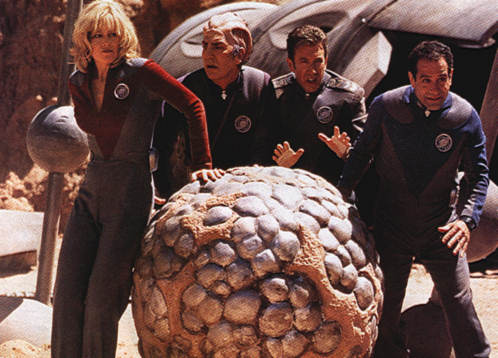
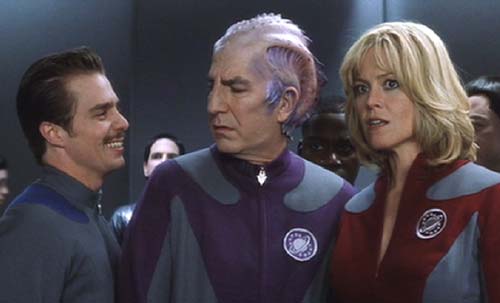
At a sci-fi convention, the cast of a long-cancelled television series "Galaxy Quest" is going through the motions of meeting their fans, even though the show has been off the air for years, and the actors are having a difficult time finding other work due to "type-casting." They squabble, each remembering personal quirks and on-set peccadilloes, either jostling for the limelight or just "doing the gig," and by happenstance, find themselves portraying their characters in a real outer-space adventure, persuaded by desperately seeking aliens who have caught transmissions of the show as it zipped through space at light-speed, and not only liked what they saw...they bought it hook, line, and beridium sphere.
It's a fun conceit, combining the background stories of actors with the characters they're playing put into a situation where their attributes as actors inform their actions in a real-life approximation of the roles they play. It stands to reason that the traits they embody to play the roles would come to the fore when reality sets in—it implies, of course, that they could do all this without "handlers," make-up assistants, or even (ya know...) decent writers and directors. It's fun to imagine.  
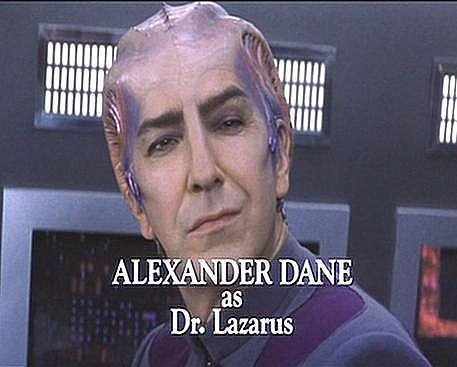
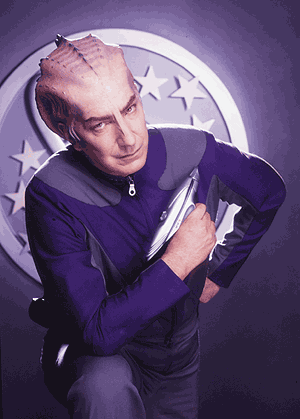
And the writers of the film have the "Star Trek" types down: the blow-hard lead actor (Tim Allen) who looks after himself until the chips are down; the second-in-command alien character—a fan-favorite—portrayed by an actor (Alan Rickman) who aspires to more prestigious roles and makes efforts to distance himself from his most popular one—until the role's inherent dignity and importance occurs to him; the actress (Sigourney Weaver, paralleling both Lt. Uhura and her "Ripley" character in Alien) trying to rise above the inherent sexism of her role, opening "hailing frequencies"; and the "also-ran's" (Tony Shalhoub and Sam Rockwell) who are stuck in their careers, forever typecast and unable to move on, bitterly watching their co-stars take better advantage.
There's also a tip of the hat to the faithful fans who start out as convention geeks, then play a pivotal role in the survival of the crew and their mission—and they don't even have to do it with a write-in campaign to the network.
Fiction becomes fact becomes fiction becomes fact; Galaxy Quest is an inter-dimensional trek on a Universe that's folded in on itself, through all the frontiers influenced by TOS and its progeny that explored new frontiers on a journey that seems on-going. It's also one of the best examples of a rare film genre that usually comes off as lame, childish, or patronizing—the science fiction comedy.

Friday, October 25, 2024

A Bucket of Blood

 
"I will talk to you of Art, for there is nothing else to talk about, for there is nothing else. Life is an obscure hobo bumming a ride on the omnibus of Art. Burn gas buggies, and whip your sour cream of circumstance and hope, and go ahead and sleep your bloody heads off. Creation is, all else is not. What is not creation, is graham crackers; let it all crumble to feed the creator. The Artist is, all others are not. A canvas is a canvas or a painting. A rock is a rock or a statue. A sound is a sound or is music. A preacher is a preacher, or an Artist. Where are John, Joe, Jake, Jim, jerk? Dead, dead, dead. They were not born before they were born, they were not born. Where are Leonardo, Rembrandt, Ludwig? Alive! Alive! Alive! They were born! Bring on the multitude, the multitude of fishes: feed them with the fishes for liver oil to nourish the Artist, stretch their skin upon an easel to give him canvas, crush their bones into a paste that he might mold them. Let them die, and by their miserable deaths become the clay within his hands that he might form an ashtray or an ark. For all that is comes through the eye of the Artist. The rest are blind fish, swimming in the cave of aloneness. Swim on you maudlin, muddling, maddened fools, and dream that one bright and sunny night, some Artist will bait a hook and let you bite upon it! Bite hard - and die! In his stomach you are very close to immortality."
Maxwell H. Brock
 
Feel free to snap your fingers at the crazy, words, man, and order another espresso. But, don't expect it anytime soon because the guy waiting tables, Walter, is a little bit distracted. Because he's surrounded by Art, baby, and internally roiling by his lack of it inside him. He aspires to be an artist...and to get a girlfriend...so don't harsh your mellow if the java's a little cold. You're in the Yellow Door cafe in Venice, California and the hipsters and beatniks are milling and mulling. Looking for the next "thing" to give life meaning and distract them. Because in this milieu if you aren't an artist, you're not anything. Dig?
Walter Paisley (
Dick Miller) isn't an artist; he's a busboy. But, the words of all the hep cats extolling art makes him want to be an artist, too. Except he's not good at anything. Not even waiting tables. As the Yellow Door's resident genius (Julian Burton) states (and he doesn't doing anything less than "stating"):"Walter has a clear mind. Some day a thought will enter it, get lonely and leave again."
He gets a block of modeling clay, but although he has a picture of the prettiest girl at the Yellow Door (
Barboura Morris), he can't make that clay into the form of what he loves. "Make a nose! Make a nose!" he pleads to the gunk in his hands, but it remains mere clay; something is needed to make the transition from raw material to completed artwork. Fortunately, Walter manages to find it when he accidentally kills the landlady's cat stuck in his stucco wall (unfortunately for the cat). The next day he presents a clay sculpture of a cat with a knife sticking through it (he's basically covered it in clay) and—what do ya know?—the hipsters think it's really good! They dig it (without having to dig anything)!
Oh, the owner of the club (
Antony Carbone) gets wind of it—the "sculpture" breaks when it's knocked to the floor after-hours...and the cat's hair pokes through the crack. But, when a potential buyer looking to make an investment in "very important art" makes an offer for the sculpture far exceeding expectations, he's willing to look the other way. But, he sweats Walter's rise in stature...and statuary ("Keep up the good work...but don't RUSH things!"). Especially when Walter starts to bring in life-size...or past-life-size...figurines.
See, one of Walter's admirers, in appreciation, gave Walter a little vial. And when one of the undercover vice-cops (Ed Nelson and...Bert Convy..!!) casing the Yellow Door comes over to Walter's flea-bag apartment and tells him the vial contains "H! Horse! Heroin!" and tells the clueless Walter that he's going to drag him down to the pokey, Walter resists arrest by cracking him over the head with a skillet. But, how is he going to get rid of the body? 
 
He has to get creative.
Shot over five days and with a budget of a mere $50,000, A Bucket of Blood was a cheap horror film made by Corman on demand from the bosses at American International Pictures. The budget was a curse and a strength: with so little money, Corman and his writer
Charles B. Griffith could not depend on monsters, effects, or even atmospherics; but with such a small budget, the film couldn't help but make money. So, they based their story on where they were holding their writer meetings—coffee-houses—and twisted the "Mystery of the Wax Museum"-based plot into a black comedy about the morose Beat culture, art pretensions and the skin-thin veneer of both, as well as the craving of status at any cost. That they all merge in as unironic a way as possible is a nice little "dig" at the values of hipsters, whichever coast they may find themselves on.
To maintain his admittedly minor status as an artist, Walter moves from obtaining raw material by accidental death to becoming a serial killer of whoever so much as gives him a stink-eye, and pretty soon, it becomes obvious where the schlubby sculptor gets his talent, and the film devolves into a noir-chase through the back-alleys of L.A. before the final shot of life imitating death.
It doesn't deserve to be as good as it is, but Griffith's script is clever with a lot of call-backs and ironic choices of words and some of the performances are actually better than they deserve to be. I've long been an admirer of Dick Miller,
who stars as Walter Paisley* and there are times when his portrayal here has a whiff of Jerry Lewis to it—he'd be a lot more disciplined and funnier, underplaying as a flower-eating customer of Mushnik's Flowers in The Little Shop of Horrors the next year—but his physical acting at times is extraordinary, almost rodent-like initially, and then, when fame comes, flailing in ways both subtle and wild.
Everybody else is good, too, but they have the advantage of playing pretentious "types", so that florid over-acting is par for the personality and under-acting means that that character is merely holding their cards to their vest, dramatically. Also, much of the darker shading of the film is inherent in the beat milieu—the morbidity of folk-music with their subjects of murders down-by-the-river and death-row histrionics is not so out of place in a horror movie and the cynical poetry (which foreshadows events in the film) make the moral ambiguity a bit more reachable. But, a lot of what makes A Bucket of Blood so great happened by accident—there wasn't time for prep!—so, if one of the actors affected a limp or decided to wear sandals with their tuxedo it was just more detail in a project that didn't have the budget to be overstuffed with it.
And Corman makes the budget stretch as credibly as the incredulity allows. Miller groused about how the film would have been better with more budget so that they didn't have to depend on mannequins for the statues and such. True enough (although a bigger-budgeted remake isn't as good...or clever). But, budget can't replace the innovation needed to overcome its lack and it put Corman in the mind-set to make more of making-do, which would stand him in good stead for the rest of his career at AIP, and the many mentors to whom he passed on that ethic.

* He...or his collaborators...would use that name for quite a few Dick Miller characters throughout his career.
...where the title comes from.